 Podit
Podit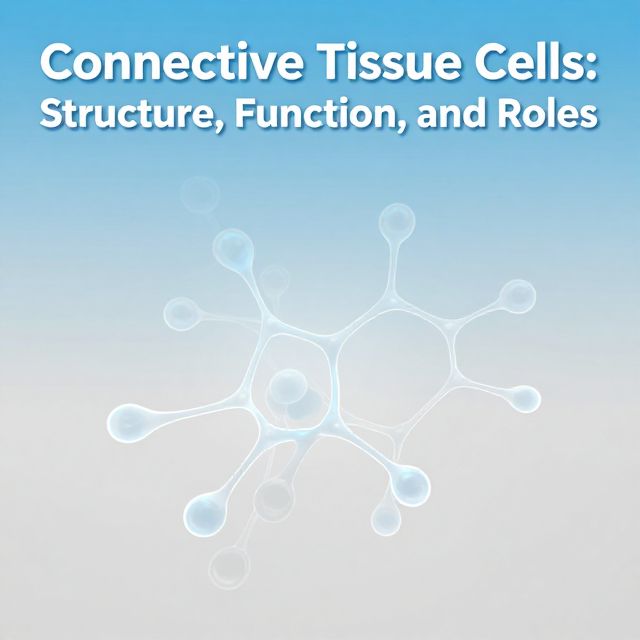
Connective Tissue Cells: Structure, Function, and Classification
Source Information: This study material is compiled from detailed lecture notes and an accompanying audio transcript, focusing on the classification, characteristics, and functions of various connective tissue cells.
📚 Introduction to Connective Tissue Cells
Connective tissues are fundamental to the body, providing structural support, connecting tissues, and playing crucial roles in defense, repair, and metabolism. These functions are largely carried out by a diverse population of cells embedded within the extracellular matrix (ECM). Connective tissue cells are broadly categorized into two main groups based on their mobility and permanence within the tissue: resident cells and wandering (or transient) cells.
✅ Classification of Connective Tissue Cells
- Resident Cells: These are stable, permanent inhabitants of the tissue, exhibiting limited movement. They are essential for the maintenance and repair of the connective tissue itself.
- Fibroblasts and Myofibroblasts
- Macrophages
- Adipocytes
- Mast Cells
- Adult Stem Cells (including Pericytes)
- Wandering (Transient) Cells: These cells migrate into the connective tissue from the bloodstream in response to specific stimuli, often related to immune responses or inflammation.
- Lymphocytes
- Plasma Cells
- Neutrophils
- Eosinophils
- Basophils
- Monocytes (precursors to macrophages)
🔬 Resident Cells: Permanent Inhabitants
1️⃣ Fibroblasts and Myofibroblasts
- Fibroblasts:
- 📚 Principal cell of connective tissue.
- ✅ Function: Responsible for synthesizing components of the extracellular matrix (ECM), including collagen, elastic and reticular fibers, and complex carbohydrates of the ground substance.
- ✅ Morphology: In routine H&E preparations, often only the elongated or disc-like nucleus is visible.
- 💡 Activated Fibroblasts: During active growth or wound repair, they have more extensive, basophilic cytoplasm due to increased rough endoplasmic reticulum (rER) for protein synthesis.
- Myofibroblasts:
- 📚 Hybrid cell: Displays properties of both fibroblasts and smooth muscle cells.
- ✅ Characteristics: Contains bundles of actin filaments and associated motor proteins (e.g., nonmuscle myosin).
- ✅ Fibronexus: Forms cell-to-ECM anchoring junctions called fibronexuses, which transmit force generated by intracellular actin bundles to the ECM (mechanotransduction).
- 💡 Distinction from Smooth Muscle Cells: Myofibroblasts lack a surrounding basal lamina, unlike smooth muscle cells. They usually exist as isolated cells but communicate via gap junctions.
2️⃣ Macrophages (Tissue Histiocytes)
- Origin: Derived from monocytes that migrate from the bloodstream into connective tissue and differentiate.
- ✅ Function: Primary role is phagocytosis (defense against bacteria, cleanup of cell debris), but also crucial in immune responses.
- ✅ Morphology: Difficult to identify without phagocytic activity. Possess a kidney-shaped nucleus and numerous surface folds/finger-like projections for engulfing substances.
- ✅ Internal Structures: Rich in lysosomes (detectable by acid phosphatase activity), endocytotic vesicles, and phagolysosomes, supporting their digestive functions. rER, sER, and Golgi apparatus support protein synthesis for phagocytic, digestive, and secretory roles.
- Types and Roles:
- M1 Macrophages: Associated with chronic inflammation and tissue injury.
- Antigen-Presenting Cells (APCs): Display foreign antigens on MHC II molecules to activate CD4 T lymphocytes, initiating immune responses.
- Response to Injury:
- Neutrophils arrive first at injury sites.
- After ~24 hours, monocytes enter and differentiate into macrophages.
- Macrophages initially kill surviving microorganisms and are activated by neutrophil and invader molecules.
- Foreign Body Giant Cells (Langerhans Cells): When encountering large foreign bodies they cannot digest alone, macrophages fuse to form multinucleated giant cells.
- M2 Macrophages: Alternatively activated macrophages involved in tissue repair, debris removal, ECM synthesis, and revascularization. They are anti-inflammatory, combat parasitic infections, and are implicated in allergy and asthma pathogenesis.
3️⃣ Mast Cells
- ✅ Morphology: Large, ovoid cells with a spherical nucleus and cytoplasm filled with large, intensely basophilic granules.
- ✅ Granule Content: Granules contain heparin (a highly sulfated proteoglycan causing metachromasia with basic dyes like toluidine blue), histamine, serine proteases (tryptase, chymase), and chemotactic factors (ECF, NCF).
- Differentiation: Immature mast cells differentiate and produce characteristic granules after migrating into connective tissue.
- Location:
- ✅ Especially numerous in connective tissues of skin and mucous membranes.
- ⚠️ Crucial Absence: Not present in the brain and spinal cord, protecting these organs from allergic edema.
- ✅ Also found in the thymus and other lymphatic organs, but not in the spleen.
- Activation and Mediators:
- Activation: Triggered by IgE-dependent or independent mechanisms, leading to the release of granule contents.
- Preformed Mediators (in granules):
- Histamine: Increases vascular permeability (causing edema), mucus production, and smooth muscle contraction (e.g., in pulmonary airways). Effects blocked by antihistamines.
- Heparin: A sulfated GAG, acts as an anticoagulant.
- Serine Proteases (Tryptase, Chymase): Tryptase is a marker for mast cell activation. Chymase generates angiotensin II and activates MMPs.
- Eosinophil Chemotactic Factor (ECF) & Neutrophil Chemotactic Factor (NCF): Attract eosinophils and neutrophils to inflammation sites.
- Newly Synthesized Mediators (released immediately):
- Leukotrienes (C, D, E): Promote inflammation, increase vascular permeability, and cause prolonged bronchospasm (constriction of pulmonary airways). Leukotriene receptor antagonists are used for asthma management.
- Tumor Necrosis Factor alpha (TNF-α): Major cytokine, increases adhesion molecule expression, has antitumor effects.
- Interleukins (IL-4, -3, -5, -6, -8, -16), Growth Factors, Prostaglandin D2 (PGD2): Contribute to allergic reactions.
4️⃣ Adipocytes
- Origin: Differentiate from mesenchymal stem cells.
- ✅ Function: Accumulate fat in their cytoplasm for energy storage. Also involved in synthesizing various hormones, inflammatory mediators, and growth factors.
- Location: Found individually or in groups throughout loose connective tissue. When numerous, they form adipose tissue.
5️⃣ Adult Stem Cells and Pericytes
- Adult Stem Cells:
- ✅ Reservoirs: Found in mature individuals, capable of differentiating into lineage-specific cells (less pluripotent than embryonic stem cells).
- Tissue Stem Cells: Reside in niches within various tissues/organs (excluding bone marrow).
- Bone Marrow Stem Cells: Unique reservoir containing:
- Hematopoietic Stem Cells (HSCs)
- Multipotent Adult Progenitor Cells (MAPCs): Broad developmental capabilities, adult counterparts of embryonic stem cells.
- Bone Marrow Stromal Cells (BMSCs): Can generate chondrocytes, osteoblasts, adipocytes, muscle cells, and endothelial cells.
- Mesenchymal Stem Cells: Found in loose connective tissue, give rise to differentiated cells for wound healing and neovascularization.
- Pericytes (Adventitial Cells / Perivascular Cells):
- ✅ Location: Found around capillaries and venules.
- 📚 Nature: Are vascular mesenchymal stem cells.
- ✅ Characteristics: Surrounded by basal lamina material continuous with the capillary endothelium. Their nucleus often resembles endothelial cells.
- ✅ Differentiation Potential: Can differentiate into various cell types, including osteoblasts, adipocytes, chondrocytes, and fibroblasts, playing a role in new vessel development (differentiating into smooth muscle cells).
- 💡 Dual Characteristics: A single pericyte can exhibit characteristics of endothelial cells (distal portion) and smooth muscle cells (proximal portion) along a venule.
🛡️ Wandering Cells: Immune Responders
6️⃣ Lymphocytes, Plasma Cells, and Other Cells of the Immune System
- Lymphocytes:
- ✅ Smallest wandering cells in connective tissue.
- ✅ Morphology: Thin rim of cytoplasm around a deeply staining, heterochromatic nucleus.
- ✅ Location: Small numbers normally present; dramatically increase at inflammation sites. Most numerous in the lamina propria of respiratory and gastrointestinal tracts for immunosurveillance against pathogens.
- Types: T cells, B cells, and Natural Killer (NK) cells.
- Activation: Upon antigen exposure, B lymphocytes can activate and differentiate into plasma cells.
- Plasma Cells:
- Origin: Differentiated B lymphocytes.
- ✅ Function: Specialized for synthesizing and secreting large amounts of specific antibodies.
- ✅ Location: Prominent in loose connective tissue where antigens frequently enter (e.g., gastrointestinal and respiratory tracts), salivary glands, lymph nodes, and hematopoietic tissue.
- ✅ Morphology: Relatively large, ovoid cells with extensive, strongly basophilic cytoplasm (due to abundant rER) and a prominent, unstained Golgi apparatus (appearing as a clear area). The nucleus is spherical, eccentrically positioned, with large clumps of peripheral heterochromatin.
- Lifespan: Short life span (10-30 days).
- Other Immune Cells:
- Neutrophils & Monocytes: Rapidly migrate from blood to connective tissue during acute inflammatory reactions. Monocytes differentiate into macrophages.
- Eosinophils: Involved in allergic reactions and parasitic infections. Found in normal connective tissue, especially the intestinal lamina propria during chronic immunologic responses.
- Basophils:
- 📚 Granulocytes: Circulate in the bloodstream.
- Origin: Develop and mature in bone marrow, released as mature cells.
- ✅ Function: Participate in allergic reactions, releasing histamine, heparin, heparan sulfate, ECF, and NCF (similar to mast cells).
- 📊 Distinction from Mast Cells: Basophils do not produce prostaglandin D2 (PGD2) and interleukin-5 (IL-5), which are synthesized by mast cells.
💡 Conclusion
The diverse population of connective tissue cells, comprising both resident and wandering types, is crucial for maintaining tissue integrity, facilitating repair processes, and orchestrating immune and inflammatory responses. Understanding their specific origins, morphologies, and functions is essential for comprehending overall physiological homeostasis and disease mechanisms.