 Podit
Podit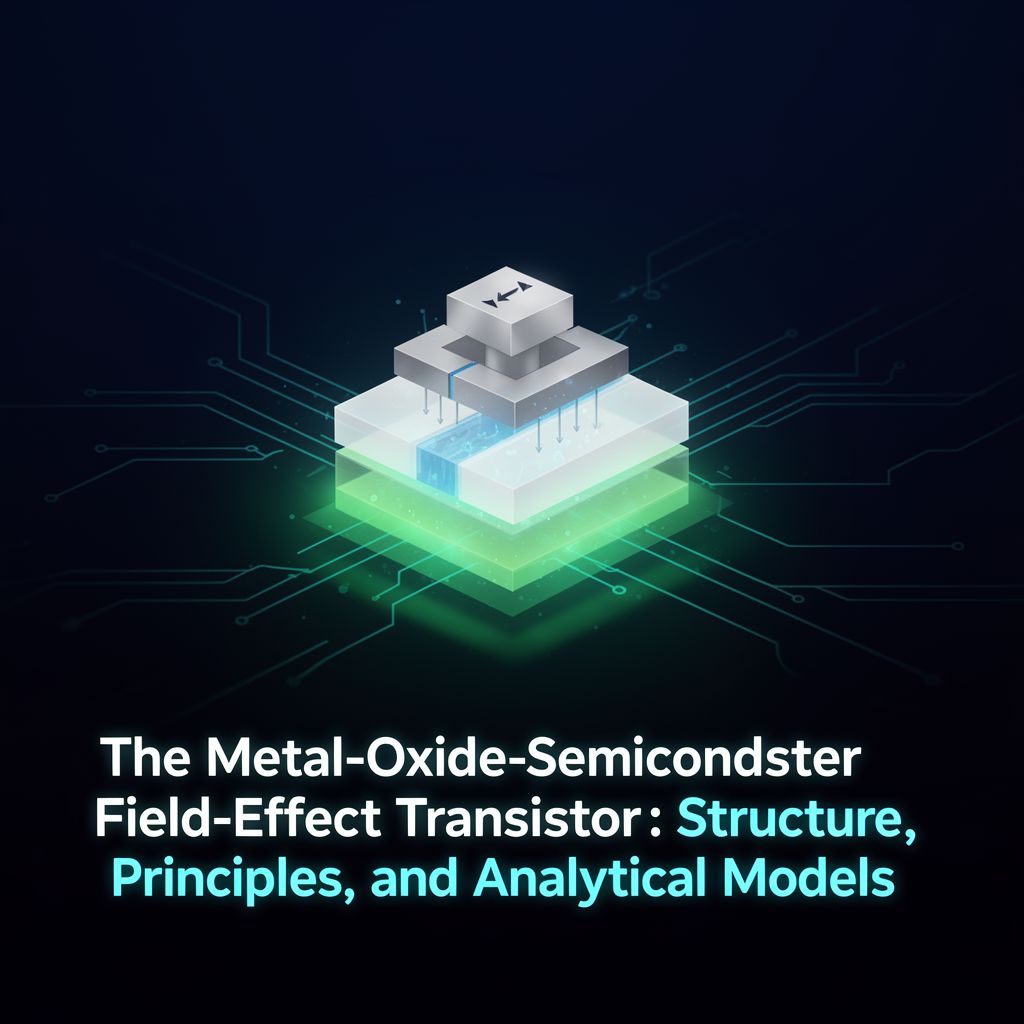
This study material is compiled from a copy-pasted text and an audio transcript.
📚 The Metal-Oxide-Semiconductor Field-Effect Transistor (MOSFET)
🌟 1. Introduction to MOSFETs
The Metal-Oxide-Semiconductor Field-Effect Transistor (MOSFET) is a cornerstone of modern electronics. It is not only the key element of CMOS technology but also arguably the most important component in contemporary electronic devices. This material provides a detailed analysis of its structure, fundamental physics, and electrical characteristics, tracing its evolution over decades. Understanding the MOSFET's evolutionary path is crucial as it reveals driving forces and challenges common to all solid-state technologies. The analysis of the MOSFET serves as a vital case study to explain the success of integrated electronics and emphasizes the continuous need for research and innovation in device design and process flow to sustain this success. This, in turn, requires skilled professionals with a strong background in electron devices.
🏗️ 2. Device Structure and Fundamental Assumptions
The basic structure of a MOSFET involves a specific material sequence along the vertical direction.
2.1. Key Structural Components
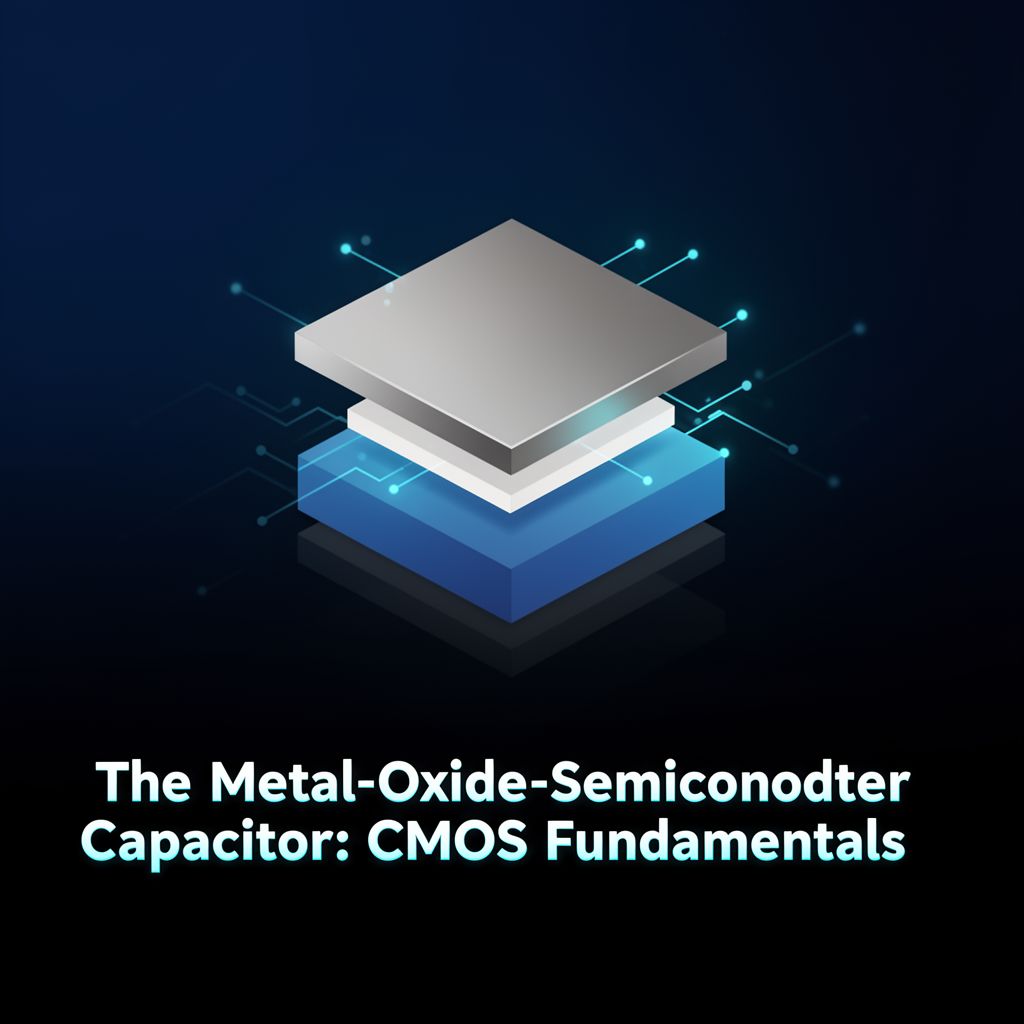
- MOS Material Sequence: The core of the device, consisting of a metal gate, an oxide dielectric, and a semiconductor substrate.
- Semiconductor Substrate:
- ✅ Material: Monocrystalline silicon.
- ✅ Doping: Uniformly p-doped (for an n-channel MOSFET).
- Dielectric Layer:
- ✅ Material: Silicon dioxide (SiO2).
- ✅ Properties: Negligible concentration of microscopic defects and negligible leakage current.
- Gate Material:
- ✅ Assumption: Ideal metal.
- ✅ Property: Electric field screening length is negligibly short.
- Contacts:
- Gate Contact: Connects to the gate material.
- Bulk Contact: Connects to the semiconductor substrate.
- Source (n+) and Drain (n+) Regions: Two highly doped n+ regions located at the silicon surface on opposite sides of the gate stack. Each has an independent contact.
- Source Contact: Connects to the source region.
- Drain Contact: Connects to the drain region.
- 💡 Note: In this analysis, the source is typically considered on the left and the drain on the right of the gate stack.
2.2. Distinguishing from MOS Capacitor
The presence of two independent n+ regions (source and drain) with their own contacts differentiates the MOSFET from an MOS capacitor with a ring. An MOS capacitor with a ring has a single n+ ring region with a single contact, running along the perimeter of the gate stack. The independent nature of the source and drain regions is what enables the MOSFET to function as a transistor, not just a capacitor.
2.3. Dimensionality and Symmetry
- Intrinsic Nature: A MOSFET is intrinsically at least a two-dimensional (2-D) device. Its structure lacks continuous symmetry over the plane corresponding to its vertical cross-section in the source-to-drain direction.
- Simplifying Assumption: For basic analysis, the direction orthogonal to the vertical cross-section (width W) can be assumed to have translational symmetry. This simplifies the analysis by removing dependence on the spatial coordinate along W, making physical quantities dependent only on the source-to-drain vertical cross-section.
- Modern Devices: Deeply-scaled transistors, however, must be considered three-dimensional (3-D) devices due to significant changes in electrostatics and current transport along W, and innovative geometries.
2.4. Four-Terminal Device and Voltage Conventions
- Terminals: The MOSFET is a four-terminal device: Gate, Source, Drain, and Bulk.
- Voltage Reference: For operation, potential differences (voltages) between contacts are critical, not absolute potentials.
- Grounding Convention: To simplify analysis, one contact is typically grounded. In this study, the source contact is always grounded.
- Voltage Notations:
- VGS: Gate-to-Source voltage.
- VDS: Drain-to-Source voltage.
- VBS: Bulk-to-Source voltage.
- The 'S' subscript indicates reference to the grounded source.
- Sign Conventions:
- VGS: No constraint on sign.
- VDS: Always considered positive.
- VBS: Always considered negative.
- ⚠️ Caution: These conventions aim to address conventional working conditions and prevent forward biasing of the n+-drain/p-substrate junctions.
⚙️ 3. Working Principles and Transistor Action
The core of MOSFET operation lies in the channel region, the part of the substrate between the source and drain n+ regions, with length L.
3.1. Gate Control of Electron Concentration
- Electrostatic Coupling: The vertical MOS sequence in the channel region functions similarly to an MOS capacitor. The gate material is electrostatically coupled to the semiconductor substrate through the oxide layer.
- VGS Impact: The gate voltage (VGS) modifies the electrostatic potential and charge in the semiconductor substrate, moving the MOS system through various regimes: accumulation, flat-band, depletion, weak-inversion, and strong-inversion.
- Current Control: Crucially, VGS controls the electron concentration in the channel region. This, in turn, allows VGS to control the current flowing between the source and drain contacts when VDS is applied.
3.2. Current Flow Mechanism
- Nonequilibrium Condition: Applying a voltage (VDS) between contacts creates a nonequilibrium condition, forcing the Fermi level to different energy positions at the contacts, resulting in current flow.
- Drain Voltage Role: VDS creates the nonequilibrium condition and triggers current flow.
- Electron Flow: When a positive VDS is applied, the Fermi level at the drain contact is lowered relative to the source contact. This drives an electron flow from the source to the drain.
- Channel as Bottleneck: The channel region, due to its doping concentration (p-type), typically has the lowest electron concentration and acts as a bottleneck for electron transport between source and drain.
- VGS Modulates Bottleneck:
- Low VGS (Weak-Inversion): Electron flow is weak.
- High VGS (Strong-Inversion): Electron flow is intense.
- 💡 Insight: VGS's impact on channel electron concentration directly translates to its impact on source-to-drain current.
3.3. Transistor Action and Field-Effect
- Transistor Definition: The ability to change the current flowing between two contacts via the voltage applied to a third contact. The term "transistor" is a contraction of "transfer resistor."
- MOSFET as Transistor: The MOSFET exhibits this action, as VGS controls the source-to-drain current.
- Field-Effect: The electrostatic coupling of the gate material with the channel region through electric fields in the oxide layer is the heart of this action, hence "field-effect" transistor.
3.4. Key Features: Field-Effect and Unipolar Nature
- Field-Effect: The gate voltage does not perturb the thermodynamic equilibrium of the semiconductor substrate under stationary conditions (assuming a perfect insulator). VGS changes electron concentration by modifying electrostatic potential and energy band positions, without affecting the total vertical shift of the Fermi level set by VDS.
- Unipolar Transistor: MOSFET operation primarily relies on a single type of charge carrier. For n-channel MOSFETs (n+ source/drain, p-doped substrate), electrons are the main carriers.
- Holes' Secondary Role: Hole concentration is negligible in depletion, weak-inversion, or strong-inversion. Even in accumulation, hole flow is negligible due to lack of forward bias.
- Hole Current: Only a weak current between bulk and drain contacts, mainly from reverse-biased n+-drain/p-substrate junction.
- Comparison to BJT: These two features (field-effect and unipolar nature) distinguish the MOSFET from the Bipolar Junction Transistor (BJT).
📊 4. Analytical Framework for MOSFET Investigation
To quantitatively analyze MOSFET physics and electrical characteristics, solving Poisson's equation and continuity equations for electrons and holes is necessary to determine ϕ, EFn, and EFp as functions of applied voltages.
4.1. Numerical vs. Analytical Solutions
- Numerical Techniques: Commercial simulators solve these equations with minimal physical approximations, providing accurate numerical values for specific device parameters and operating voltages.
- Analytical Calculations: Require significant physical approximations but yield simplified, intuitive, and practical pictures. They provide explicit formulas relating physical quantities and device parameters, crucial for understanding basic physics, ideal operation, and design optimization.
4.2. Preliminary Assumptions and Approximations
- Stationary Condition:
- ✅ All physical quantities are time-independent.
- ✅ Time derivatives of n and p in continuity equations are zero.
- 💡 Note: Results can apply to time-varying voltages if frequency is low enough (quasi-static analysis). Maximum frequency is typically very high (GHz to hundreds of GHz).
- 2-D Device with Translational Symmetry:
- ✅ Dependence on the spatial coordinate along width W is removed from Poisson and continuity equations.
- ✅ Physical quantities depend only on the spatial position over the vertical cross-section (source-to-drain direction).
- Coordinate System (Fig. 2a):
- x-axis: Vertical, directed downwards, origin at oxide-semiconductor interface.
- y-axis: Horizontal, directed from source to drain, origin at the source n+ region boundary with the channel.
- Quasi-Fermi Levels (Fig. 2b, 2c):
- EFp (Holes):
- ✅ Considered flat all over the channel region.
- ✅ Drops to -qVDS within the quasi-neutral n+ drain region (bottleneck for weak hole transport).
- ✅ Energetic position at bulk contact and channel region is the origin of the energy axis.
- EFn (Electrons):
- ✅ Approximated as perfectly flat from source contact to channel boundary, and from drain boundary to drain contact (high doping makes source/drain highly conductive, no parasitic resistance).
- ✅ EFn = 0 at the left (source) boundary of the channel.
- ✅ EFn = -qVDS at the right (drain) boundary of the channel.
- Quasi-Fermi Potential for Electrons (V): V(y) = -EFn(y)/q. V increases from 0 to VDS along the channel.
- ✅ Dependence of EFn and V on x is neglected in the depletion, weak-inversion, and strong-inversion regimes (EFn is flat along x in the depletion layer).
- 💡 Result: Determining ϕ(x,y) and EFn(y) (or V(y)) in the channel region is sufficient for a first-order analytical investigation. Solving the continuity equation for holes is not required due to constant EFp approximation and unipolar nature.
- EFp (Holes):
📏 5. Long-Channel MOSFET Analysis
This section focuses on the "long-channel" MOSFET, where the channel length (L) is sufficiently long to allow specific approximations.
5.1. Gradual-Channel Approximation (GCA)
- Condition: For long L, the electric field component along the y-direction (Fy) is much weaker than along the x-direction (Fx) in the channel. This leads to quasi-1-D vertical electrostatics.
- Approximation: The electrostatics along each vertical cross-section of the channel region (along x-axis at each y position) is treated as "exactly" the electrostatics of a 1-D MOS system (i.e., an MOS capacitor).
- Poisson Equation Simplification:
- From 2-D: ∂²ϕ/∂x² + ∂²ϕ/∂y² = -q/ϵSi (p - n + N+d - N-a)
- To 1-D: d²ϕ/dx² = -q/ϵSi (p - n + N+d - N-a)
- Impact: GCA significantly simplifies analytical calculations, allowing the use of MOS capacitor results.
- Nonequilibrium Consideration: Unlike the MOS capacitor, the MOSFET's substrate is in a nonequilibrium condition (EFn ≠ EFp) due to VDS. This means the 1-D electrostatics can change gradually along the y-direction (from source to drain) as EFn drops.
- Substrate Charge (Qs):
- Derived by integrating the 1-D Poisson equation.
- Qs = ± [2ϵSi kT Na * (e^(-q∆ϕ/kT) + q∆ϕ/kT - 1 + (ni²/Na²) * e^(-qV/kT) * e^(q∆ϕ/kT) - 1 - q∆ϕ/kT)]^(1/2)
- For depletion, weak-inversion, and strong-inversion regimes (most important for MOSFET operation), this simplifies to: Qs ≈ - [2ϵSi kT Na * (qVs/kT + (ni²/Na²) * e^(-qV/kT) * e^(qVs/kT))]^(1/2)
- This formula provides Qs as a function of surface potential (Vs) and quasi-Fermi potential (V).
- Voltage Partition Equation: Relates Qs to applied gate voltage:
VGS - VFB = Vs + Vox = Vs - Qs/Cox
- VFB: Flat-band voltage.
- Vox: Voltage drop over the oxide layer.
- Cox: Oxide capacitance per unit area.
- 💡 Insight: VGS, Vs, and V are interconnected. V changes along the channel due to VDS, causing Vs (and thus Qs) to also change along the channel.
5.2. Inversion Charge (Qinv) and Operating Regimes
Qs can be split into depletion charge (Qdep) and inversion charge (Qinv). The source-to-drain current is proportional to Qinv.
- Qdep: Charge from exposed ionized acceptors in the depletion layer (Qdep = -qNaWd).
- Qinv: Charge from electrons in the inversion layer.
- Qs(Vs,V) = Qdep(Vs,V) + Qinv(Vs,V)
5.2.1. Subthreshold Regime
- Condition: VGS is below the threshold voltage (VT), creating only depletion or weak-inversion.
- Electron Charge: Negligible for the MOS system's electrostatics (n and Qinv are much smaller than Na and Qdep).
- Approximation: First-order Taylor expansion of Qs formula.
- Qdep ≈ - [2ϵSi q Na Vs]^(1/2)
- Qinv ≈ - [ϵSi q Na / (2Vs)]^(1/2) * (kT/q) * (ni²/Na²) * e^(q(Vs-V)/kT)
- Electrostatics (Fig. 4a):
- ✅ Electrostatics along x-direction is nearly independent of y.
- ✅ Vs is almost constant along the channel.
- ✅ Conduction band edge (EC) and valence band edge (EV) at the channel surface are almost flat in the y-direction.
- ✅ Fy (electric field in y-direction) is negligible.
- Current Mechanism: Source-to-drain current is mainly due to diffusion of electrons (from higher n at source to lower n at drain).
5.2.2. ON-State Regime
- Condition: VGS is higher than VT, establishing strong-inversion.
- Electron Charge: Relevant for channel electrostatics.
- Charge-Sheet Approximation (Fig. 3b):
- ⚠️ Challenge: In strong-inversion, the depletion approximation for Qdep is not strictly valid because the depletion layer is not fully depleted of electrons. The Fx profile is not purely triangular.
- ✅ Solution: Treat the inversion charge as a sheet of charge at the semiconductor surface, neglecting its contribution to Vs. This recovers the triangular Fx profile up to the surface, with a vertical discontinuity.
- Qdep ≈ - [2ϵSi q Na Vs]^(1/2) (same as subthreshold)
- Qinv ≈ Qs + [2ϵSi q Na Vs]^(1/2) (where Qs is from the full formula)
- Electrostatics (Fig. 4b):
- ✅ Electrostatics along x-direction is a function of y (due to relevant n and Qinv).
- ✅ Vs increases along the channel (from source to drain) due to reduction of |Qinv| as V increases.
- ✅ Bands at the semiconductor surface significantly bend downwards in the y-direction.
- ✅ Fy (electric field in y-direction) is relevant.
- Current Mechanism: Source-to-drain current is mainly due to drift of electrons (driven by Fy).
5.3. Continuity Equation for Electrons and Drain Current (IDS)
The continuity equation for electrons, under stationary conditions and neglecting generation/recombination, requires the electron current density (Jn) to be constant in the direction of electron flow.
- Jn in Channel (Fig. 5):
- Jn = nµn∇EFn (drift/diffusion formula).
- Parallel to y-axis, directed from drain to source (opposite to electron flow).
- Rapidly decreases moving away from the channel surface (along x) as n decreases.
- Drain Current (IDS) Derivation:
- IDS is the total flux of Jn through a vertical cross-section of the channel, independent of y.
- IDS = -W ∫ Jn(x) dx = -W ∫ nµn (dEFn/dy) dx
- Using V = -EFn/q and ∫ -q n dx = Qinv: IDS = -µn W Qinv (dV/dy) (Local/Differential expression)
- Integral Form: Integrating over the channel length L: IDS = (µn W / L) ∫[0 to VDS] Qinv(V) dV
- Analytical Steps:
- Determine Vs = Vs(VGS, V) by coupling Qs and voltage partition equations.
- Calculate Qinv = Qinv(VGS, V) using relations from Section 5.2.
- Calculate IDS = IDS(VGS, VDS) by integrating Qinv(VGS, V) over V from 0 to VDS.
- Determine V(y) by integrating the differential IDS expression.
5.4. ON-State Operation: Current-Voltage Characteristics
Assuming strong-inversion across the channel, a simplified expression for Vs is Vs ≈ 2|ϕB| + V. Then, Qinv ≈ -Cox(VGS - VFB - 2|ϕB| - V) + [2ϵSi q Na (2|ϕB| + V)]^(1/2). This Qinv is then integrated to find IDS.
5.4.1. Ohmic Regime
- Condition: VDS is very small (VDS ≪ 2|ϕB|).
- Qinv Simplification: V can be neglected in the Qinv formula, making Qinv approximately independent of V and y.
- Qinv ≈ -Cox(VGS - VT)
- VT = VFB + 2|ϕB| + [2ϵSi q Na (2|ϕB|)]^(1/2) / Cox (Threshold Voltage)
- IDS Formula: IDS = µn Cox (W/L) (VGS - VT) VDS
- Characteristics (Fig. 6b):
- Linear Relationship: IDS is linearly proportional to VDS, resembling Ohm's Law.
- Channel Resistance (Rch): Rch = 1 / [µn Cox (W/L) (VGS - VT)].
- VGS Control: Increasing VGS increases IDS and reduces Rch (transistor effect).
- Physical Explanation:
- Qinv (Fig. 6a): Nearly constant along the channel. Increasing VGS increases |Qinv|, meaning more electrons are available, making the channel more conductive.
- VDS Impact: VDS does not significantly change Qinv. It primarily increases Fy, leading to a linear increase in electron drift velocity and thus IDS.
5.4.2. Parabolic Regime
- Condition: VDS is larger than in the ohmic regime but still smaller than 2|ϕB|, so V is not negligible.
- Qinv Simplification: First-order Taylor expansion of the square-root term for depletion charge.
- Qinv ≈ -Cox(VGS - VT - mV)
- m = 1 + Cdep/Cox (where Cdep is related to depletion capacitance)
- 💡 Note: VT here refers to the threshold voltage at the source side (V=0). The "electrostatic threshold voltage" (V'T) increases along the channel (V'T = VT + mV).
- IDS Formula: IDS = µn Cox (W/L) [(VGS - VT) VDS - m (VDS²/2)]
- Characteristics (Fig. 7b):
- Parabolic Relationship: IDS vs. VDS is a parabola.
- Saturation Point: The parabola has a vertex at:
- Vsat_DS = (VGS - VT) / m
- Isat_DS = µn Cox (W/L) * (VGS - VT)² / (2m)
- VGS Control: Increasing VGS increases IDS, and shifts the vertex to higher Vsat_DS and Isat_DS. All vertices lie on a specific parabola.
- Physical Explanation:
- Qinv (Fig. 7a): Decreases along the channel from source to drain due to increasing V. This means the channel becomes less conductive towards the drain.
- VDS Impact: As VDS increases, the channel resistance increases non-linearly, leading to the parabolic IDS dependence.
📈 6. Visualizing MOSFET Characteristics: Plots and Graphs
The understanding of MOSFET operation is greatly enhanced by visualizing its structure and characteristics through plots and graphs. While the actual figures are not provided, their descriptions in the source material allow us to understand what they illustrate.
6.1. Device Structure Schematics (Referencing Fig. 1)
- Purpose: To show the physical layout and components of the MOSFET.
- Content:
- (a) Vertical Cross-Section (Source-to-Drain Direction): This diagram would typically show a layered structure:
- A p-type silicon substrate at the bottom.
- Two heavily doped n+ regions (Source and Drain) embedded in the substrate on either side.
- A thin insulating layer (Silicon Dioxide, SiO2) on top of the channel region (the area between Source and Drain).
- A metal (or polysilicon) gate electrode on top of the oxide.
- Contacts to the Source, Drain, Gate, and Bulk.
- The "channel region" clearly labeled between the Source and Drain under the gate.
- (b) Top View: This would show the device from above, illustrating:
- The rectangular or square gate electrode.
- The Source and Drain regions flanking the gate.
- The width (W) of the channel, which is the dimension perpendicular to the source-to-drain current flow.
- (a) Vertical Cross-Section (Source-to-Drain Direction): This diagram would typically show a layered structure:
- Significance: These schematics are fundamental for grasping the physical arrangement of materials and terminals, which directly influences the device's electrical behavior. They help define the coordinate system (x for vertical, y for horizontal source-to-drain) used in analytical models.
6.2. Energy Band Diagrams (Referencing Fig. 2)
- Purpose: To illustrate the energy levels within the semiconductor under bias, showing how electron and hole concentrations are affected.
- Content:
- (a) Schematic with x and y axes: This would be a simple cross-section diagram, similar to Fig. 1(a), but with the x-axis (vertical, downwards from oxide-Si interface) and y-axis (horizontal, source-to-drain) explicitly marked. This sets the reference for the band diagrams.
- (b) Qualitative Band Diagram along y-direction (Channel Surface): This plot would show the energy bands (Conduction Band Edge EC, Valence Band Edge EV, Intrinsic Fermi Level Ei) and the quasi-Fermi levels (EFn for electrons, EFp for holes) along the channel surface (constant x, varying y).
- It would show EFp as flat, representing the bulk potential.
- It would show EFn starting at the same level as EFp at the source (y=0) and gradually dropping towards the drain (y=L) by an amount proportional to -qVDS.
- The bending of EC and EV would follow EFn, indicating how the electron energy changes along the channel.
- (c) Qualitative Band Diagram along x-direction (Channel Region): This plot would show the energy bands and quasi-Fermi levels vertically (constant y, varying x) from the surface into the bulk.
- It would illustrate the band bending near the surface due to the gate voltage (e.g., downward bending for inversion).
- It would show EFp as flat throughout the bulk and channel.
- It would show EFn as flat within the depletion layer near the surface and then merging with EFp deeper in the bulk, indicating the return to equilibrium.
- Significance: These diagrams are crucial for understanding the underlying physics of carrier transport. They visually explain:
- How VDS creates a "slope" in EFn, driving electron flow.
- How VGS controls band bending at the surface, leading to accumulation, depletion, or inversion.
- The approximations made for EFn and EFp in analytical models.
6.3. Electric Field (Fx) Profiles (Referencing Fig. 3)
- Purpose: To visualize the electric field distribution perpendicular to the channel surface, which dictates charge distribution.
- Content:
- (a) Depletion/Weak-Inversion Regime: This plot would show the electric field Fx (along the x-axis) as a function of depth (x) into the semiconductor.
- It would typically display a triangular profile for Fx, starting from a maximum at the surface and decreasing linearly to zero at the edge of the depletion region.
- The slope of this triangle is determined by the doping concentration (-qNa/ϵSi).
- (b) Strong-Inversion Regime: This plot would show Fx vs. x for strong inversion.
- Without Charge-Sheet Approximation: The profile would be more complex, showing a steeper slope near the surface where the inversion charge (electrons) adds to the ionized acceptor charge, making the Fx profile non-purely triangular.
- With Charge-Sheet Approximation: The plot would simplify Fx to a triangular shape, similar to depletion, but with a sharp vertical discontinuity at the semiconductor surface. This discontinuity represents the "sheet" of inversion charge.
- (a) Depletion/Weak-Inversion Regime: This plot would show the electric field Fx (along the x-axis) as a function of depth (x) into the semiconductor.
- Significance: These profiles are key to understanding the validity and implications of approximations like the depletion approximation and the charge-sheet approximation. They visually explain how the electric field changes with different operating regimes and how these changes relate to the total charge in the substrate (Qs).
6.4. Channel Surface Band Profiles (Referencing Fig. 4)
- Purpose: To illustrate the energy band bending along the channel (y-direction) at the semiconductor surface, directly linking to transport mechanisms.
- Content:
- (a) Subthreshold Regime: This plot would show EC and EV along the y-axis (source to drain) at the channel surface.
- The bands would appear almost flat along the y-direction.
- EFn would still show a slight slope due to VDS, but the band bending itself (relative to EFn) would be minimal.
- (b) ON-State Regime: This plot would show EC and EV along the y-axis at the channel surface.
- The bands would display a significant downward bending from the source side to the drain side of the channel.
- This bending indicates a strong electric field (Fy) along the channel.
- (a) Subthreshold Regime: This plot would show EC and EV along the y-axis (source to drain) at the channel surface.
- Significance: These plots visually differentiate the dominant transport mechanisms:
- Subthreshold: Flat bands imply negligible Fy, so diffusion (driven by concentration gradient) is dominant.
- ON-State: Significant band bending implies a strong Fy, making drift (driven by electric field) the dominant mechanism.
6.5. Current Density (Jn) in Channel (Referencing Fig. 5)
- Purpose: To schematically represent the electron current density within the channel region.
- Content: This diagram would be a cross-section of the MOSFET channel, showing:
- Arrows representing the vector Jn.
- The arrows would be parallel to the y-axis (source-to-drain direction).
- The arrows would point from drain to source (opposite to electron flow direction).
- The density of arrows would be highest near the channel surface (x=0) and rapidly decrease with increasing depth (x), reflecting the decrease in electron concentration away from the surface.
- Significance: This visualization helps in understanding the spatial distribution of current flow and supports the derivation of the total drain current (IDS) by integrating Jn across the channel width and depth.
6.6. Current-Voltage (I-V) Characteristics (Referencing Fig. 6 & Fig. 7)
- Purpose: To show the relationship between drain current (IDS) and applied voltages (VDS, VGS), which are the primary output characteristics of the MOSFET.
- Content:
- (a) Inversion Charge Profile (Fig. 6a - Ohmic Regime): This plot would show the magnitude of inversion charge (|Qinv|) along the channel (y-direction).
- For the ohmic regime, |Qinv| would be depicted as nearly constant from source to drain.
- (b) IDS vs. VDS (Fig. 6b - Ohmic Regime): This plot would show IDS on the y-axis and VDS on the x-axis, with multiple curves for different VGS values.
- Each curve would be a straight line passing through the origin, indicating a linear relationship between IDS and VDS.
- The slope of the lines would increase with increasing VGS, demonstrating that higher VGS leads to lower channel resistance and higher current.
- (a) Inversion Charge Profile (Fig. 7a - Parabolic Regime): This plot would show |Qinv| along the channel (y-direction).
- For the parabolic regime, |Qinv| would be depicted as decreasing from the source side to the drain side of the channel.
- (b) IDS vs. VDS (Fig. 7b - Parabolic Regime): This plot would show IDS on the y-axis and VDS on the x-axis, with multiple curves for different VGS values.
- Each curve would be a parabolic segment, starting from the origin and curving downwards.
- The curves would reach a peak (saturation point) at Vsat_DS, after which the current would ideally flatten out (though this figure only shows up to Vsat_DS).
- The saturation current (Isat_DS) and saturation voltage (Vsat_DS) would increase with increasing VGS.
- A dashed line connecting the vertices of these parabolas would illustrate the relationship between Isat_DS and Vsat_DS.
- (a) Inversion Charge Profile (Fig. 6a - Ohmic Regime): This plot would show the magnitude of inversion charge (|Qinv|) along the channel (y-direction).
- Significance: These I-V characteristics are the most important practical outputs of MOSFET analysis. They define the device's behavior in different operating regions (linear/ohmic, saturation) and demonstrate its ability to amplify signals and switch currents. They are essential for circuit design and device modeling.