 Podit
Podit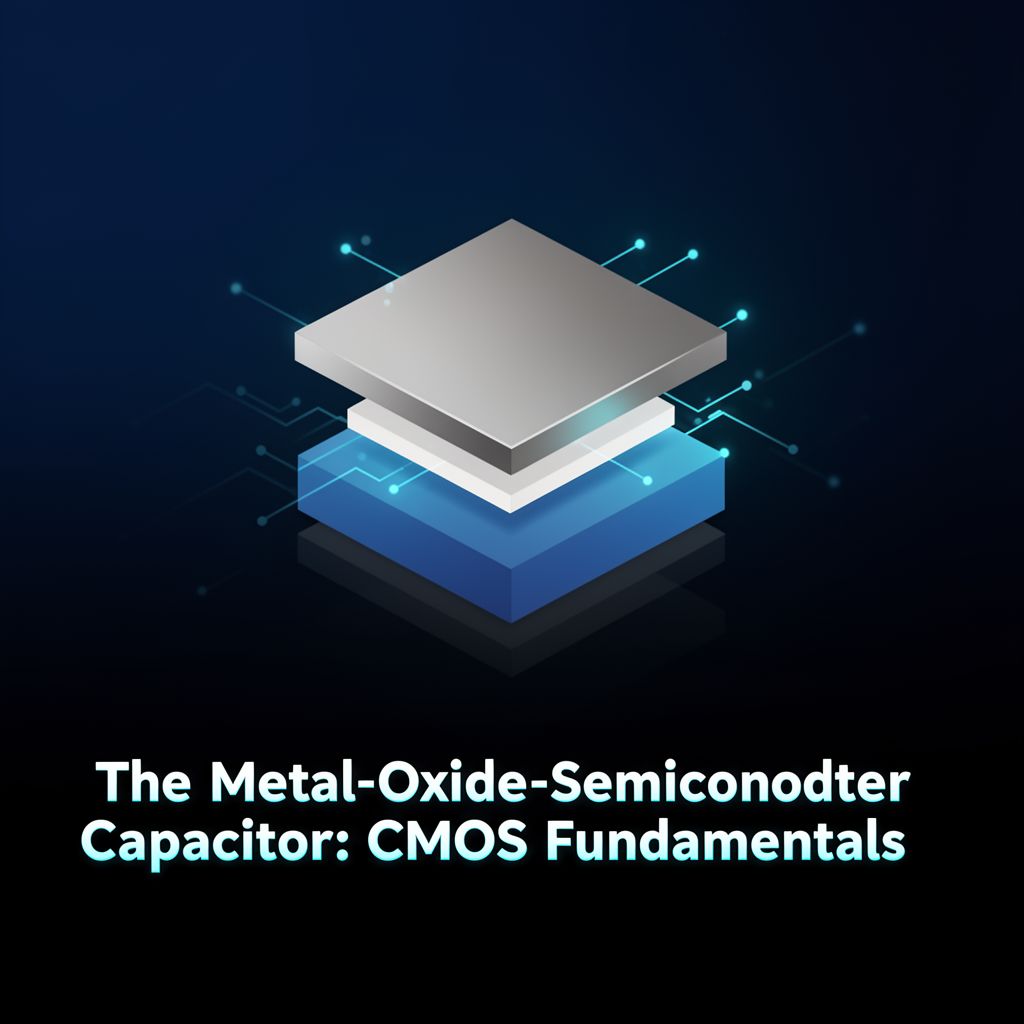
📚 The Metal-Oxide-Semiconductor (MOS) Capacitor: A Comprehensive Study Guide
Source Information:
- Provided Text: Copy-pasted text on "The Metal-Oxide-Semiconductor capacitor" (Sections 1-5.2).
- Lecture Transcript: Audio transcript of a lecture titled "Introduction to the MOS Capacitor: The Foundation of CMOS."
🎯 Introduction and Overview
The Metal-Oxide-Semiconductor (MOS) capacitor is a foundational component in modern electronics, serving as the elementary building block of CMOS technology. Understanding its physics and operating principles is crucial for analyzing more complex CMOS devices, such as the MOS transistor.
Beyond its role in integrated circuits, the MOS capacitor is also:
- ✅ A Test Structure: Used for parametric analysis and reliability assessment of new CMOS process flows. It helps extract vital information like oxide thickness, substrate doping profile, defect density at interfaces, gate leakage current, and time-to-breakdown.
- ✅ A Circuit Component: Utilized as a variable capacitor (VariCap or Varactor) in RF circuits and as the basic unit of charge-coupled devices (CCDs).
This study guide will delve into the device's structure, material assumptions, energy band diagrams, quantitative electrostatic analysis, and small-signal capacitance characteristics, including the critical interpretation of its capacitance-voltage (C-V) plots.
1️⃣ Device Structure and Assumptions
The MOS capacitor is typically analyzed as a one-dimensional (1-D) device, consisting of three vertically stacked layers: a semiconductor substrate, a thin dielectric layer, and a gate material.
1.1 Material Choices and Idealizations
- Semiconductor Substrate:
- Material: Monocrystalline silicon (Si) is the material of choice in CMOS technology.
- Structure: Silicon atoms maintain a periodic spatial arrangement over long distances.
- Doping: For this analysis, we assume a uniformly p-doped substrate. Extending results to n-doped substrates is straightforward.
- Dielectric Layer (Oxide):
- Material: Silicon dioxide (SiO2) is the most important insulator for CMOS.
- Properties:
- Wide energy gap, leading to low free carrier concentration.
- Wide energy barriers that block electron and hole flow between gate and substrate, limiting current.
- High-quality interface with silicon, meaning low density of microscopic defects.
- Assumptions (for ideal device operation):
- Zero electrical conductivity (no current flow).
- No defects in the oxide volume or at the Si/SiO2 interface.
- Drawback: Low dielectric constant (εox = 3.9ε0). This has led to the replacement of SiO2 with "high-k" dielectrics in advanced technologies to improve performance.
- ⚠️ Important Note: In modern devices, leakage current through very thin oxides (few nanometers) is a significant concern, though neglected in this ideal analysis.
- Gate Material:
- Material: Can be either a metal or highly-doped polycrystalline silicon (polysilicon).
- Requirement: High density of free carriers.
- Assumption (for initial analysis): Ideal metal gate.
- Negligible screening length.
- Zero electric field and voltage drop within the material.
- A surface charge screens electric fields from the oxide.
- Polysilicon Gate: Cannot be monocrystalline silicon because it is deposited on a non-monocrystalline dielectric layer. Polysilicon (with regular spatial arrangement over medium distances) is preferred over amorphous silicon.
- Contacts:
- Gate Contact: A voltage (VG) is applied here.
- Bulk Contact: Connected to the semiconductor substrate, typically grounded in analyses.
1.2 Analysis Focus
The primary goal is to investigate the stationary electrostatics of the device as a function of VG and the transient effects resulting from changes in VG over time, assuming no leakage current through the SiO2 layer.
2️⃣ Band Diagram Under Thermodynamic Equilibrium
To understand the MOS capacitor's electrostatics, we begin by examining its energy band diagram when the constituent materials are isolated and individually in thermodynamic equilibrium.
2.1 Isolated Materials and Alignment
- Initial State: Materials (metal, oxide, semiconductor) are considered isolated.
- Assumption: The Fermi level in the metal (E(m)F) is aligned with the conduction band edge (EC) of silicon. This is representative of common gate materials like aluminum or n+ polysilicon.
- Alignment Reference: The vacuum level is used to properly align the band diagrams of different materials.
- Electron affinity of silicon (qχs = 4.05 eV) and SiO2 (qχox = 0.95 eV).
- Work function of the metal (qϕm) and silicon (qϕs, dependent on doping).
- Energy Barriers: For SiO2 (energy gap EG = 9 eV), the barriers blocking electron and hole flow from silicon to the gate are qϕBn = 3.1 eV and qϕBp = 4.8 eV, respectively. These high barriers are crucial for limiting leakage current.
2.2 Formation of the Equilibrium Band Diagram
When the materials are brought together, the Fermi level in the metal (E(m)F) must align with the Fermi level in the substrate (EF) to achieve thermodynamic equilibrium. For a p-doped substrate, EF is close to the valence band edge (EV).
- Band Bending: This alignment causes band bending across the device.
- Direction: Moving E(m)F downwards to align with EF in the substrate results in a downward band bending from right to left in both the silicon and the oxide.
- Gauss's Law at Interface: The electric fields at the interface are related by ϵSi·Fs = ϵox·Fox. This implies Fox has the same sign as Fs and is approximately three times its magnitude (due to dielectric constant differences). Thus, the slope of the bands in the oxide is three times steeper than at the silicon surface, but the bending direction is identical.
- Oxide Region:
- Linear Bending: The band bending in the oxide is linear, indicating a constant electric field (Fox), due to the assumption of no charge within the oxide material.
- Semiconductor Region:
- Non-linear Bending: The band bending in silicon is non-linear because the electric field (F) changes with position.
- Depletion Layer: The downward shift of bands from the bulk to the silicon surface significantly reduces the hole concentration, exposing the negative charge of ionized acceptors. This region is called the "depletion layer."
- Charge Neutrality: The negative charge in the depletion layer is balanced by an equal positive charge at the metal surface, ensuring the total charge in the device is zero.
- Bulk Region: Deep within the silicon, the semiconductor recovers its charge neutrality, and the bands flatten.
📊 Figure 2: Isolated Materials Band Diagram
This figure schematically shows the energy bands of the metal, oxide, and semiconductor when they are isolated. It highlights key parameters like electron affinities (qχs, qχox) and work functions (qϕm, qϕs), which are essential for understanding how the materials align when brought into contact.
📊 Figure 3: MOS Capacitor Band Diagram under Thermodynamic Equilibrium
This plot illustrates the energy band diagram of the MOS capacitor once thermodynamic equilibrium is established.
- Key Features:
- The Fermi level (EF) is constant throughout the entire structure.
- Band bending is evident in both the oxide and the silicon, with a linear slope in the oxide and a non-linear slope in the silicon.
- The formation of a depletion layer in the silicon is clearly visible, where the intrinsic Fermi level (Ei) moves away from the Fermi level (EF).
- The total voltage drop across the device, ϕbi, is the sum of Vs (surface potential in silicon) and Vox (voltage drop across oxide). For our chosen alignment, qϕbi is approximately the energy gap of silicon (≈1V).
3️⃣ Band Diagram with Gate Voltage and Operating Regimes
Applying a gate voltage (VG) to the MOS capacitor shifts the metal's Fermi level (E(m)F) relative to the substrate's Fermi level, altering the entire band diagram and leading to different operating regimes.
3.1 Stationary Conditions and Voltage Relationship
- Stationary Assumption: For initial analysis, we assume a stationary condition where a constant and unique Fermi level (EF) exists throughout the substrate. This implies no net generation or recombination of carriers and no current flow through the oxide.
- Voltage Relation: The total voltage drop across the device is given by: VG + ϕbi = Vs + Vox Where Vs and Vox are positive if the electrostatic potential increases towards the silicon surface and gate, and negative otherwise.
- Flat-Band Voltage (VFB): This equation can be rewritten using the flat-band voltage: VG - VFB = Vs + Vox Where VFB = -ϕbi. At VFB, Vs = Vox = 0, and the bands are flat throughout the device, with no exposed charge.
3.2 Operating Regimes
The MOS capacitor exhibits distinct operating regimes depending on the applied gate voltage (VG) relative to VFB and the threshold voltage (VT).
-
1. Accumulation Regime (VG < VFB)
- Condition: (VG - VFB) is negative, leading to negative Vs and Vox. Bands bend upwards from the bulk to the gate.
- Charge: For a p-doped substrate, the separation between EF and EV at the surface decreases, increasing the hole concentration above the doping level. Holes (majority carriers) accumulate near the surface, creating a net positive charge in the substrate. This is balanced by a negative charge at the metal gate.
- Figure 5(a): Shows upward band bending and accumulated holes.
-
2. Depletion Regime (VG > VFB, moderate)
- Condition: (VG - VFB) is positive, leading to positive Vs and Vox. Bands bend downwards from the bulk to the gate.
- Charge: The hole concentration at the surface is significantly reduced, exposing the negative charge of ionized acceptor dopants. This forms a depletion layer. Electron concentration is still negligible for electrostatics.
- Figure 5(c): Shows downward band bending and a widening depletion layer.
-
3. Weak-Inversion Regime (VG increasing further)
- Condition: As VG increases, the downward band bending becomes more pronounced.
- Charge: The intrinsic Fermi level (Ei) at the silicon surface approaches and then crosses the Fermi level (EF). This causes the electron concentration at the surface to become greater than the hole concentration.
- Terminology: "Inversion" signifies the dominant carrier type at the surface has switched (from holes to electrons). "Weak" indicates that the concentration of these inverted carriers (electrons) is not yet significant enough to dominate the device's electrostatics.
- Figure 5(d): Shows Ei crossing EF at the surface, indicating the onset of weak inversion.
-
4. Strong-Inversion Regime (VG ≥ VT)
- Condition: VG reaches the threshold voltage (VT). The downward band bending is sufficient to make the electron concentration at the silicon surface comparable to, or even higher than, the bulk doping concentration.
- Charge: Electrons become the dominant charge carriers at the surface, forming a thin "inversion layer." These electrons are now highly relevant for the device's electrostatics.
- Threshold Voltage (VT): Defined as the VG value where (EF - Ei) at the silicon surface equals (Ei - EF) in the bulk of the substrate.
- Figure 5(e): Shows significant downward band bending, with EC close to EF at the surface, indicating a high electron concentration in the inversion layer.
3.3 Field-Effect Device Principle
The MOS capacitor is a "field-effect device" because the gate's electrostatic coupling through the oxide directly modifies the band bending and charge in the semiconductor. This change can occur without necessarily perturbing the equilibrium condition within the semiconductor or the uniqueness of its Fermi level, unlike a p-n junction where current flow is required.
📊 Figure 4: Band Diagram with Positive Gate Voltage
This figure illustrates the band diagram of an MOS capacitor under stationary conditions with a positive gate voltage (VG) applied. Compared to Figure 3 (equilibrium), the bands are bent further downwards, indicating a stronger electric field and potential drop. The Fermi level (EF) is still shown as unique in the substrate, reflecting the stationary condition assumption.
📊 Figure 5: MOS Capacitor Operating Regimes
This crucial set of band diagrams (a-e) visually represents the different operating regimes of the MOS capacitor as VG is varied.
- Figure 5(a) (Accumulation): Upward band bending, holes accumulated at the surface.
- Figure 5(b) (Flat-Band): Flat bands, no charge accumulation or depletion.
- Figure 5(c) (Depletion): Downward band bending, depletion layer formed, ionized acceptors exposed.
- Figure 5(d) (Weak-Inversion): Ei crosses EF at the surface, indicating the onset of electron inversion.
- Figure 5(e) (Strong-Inversion): Significant downward band bending, strong inversion layer of electrons formed at the surface. These diagrams are fundamental for understanding the qualitative behavior of the MOS capacitor.
4️⃣ Quantitative Analysis: Poisson Equation and Substrate Charge
For a quantitative understanding of the MOS capacitor's electrostatics, the Poisson equation is solved, focusing on the silicon region due to the idealizations made for the gate and oxide.
4.1 Total Substrate Charge (Qs) as a Function of Surface Potential (Vs)
The Poisson equation in the semiconductor is: d²ϕ/dx² = -q/εSi * (p - n + N+d - N-a)
To simplify, the equation is reformulated in terms of the change in electrostatic potential (∆ϕ) relative to its bulk value (ϕB). The hole (p) and electron (n) concentrations are expressed using Maxwell-Boltzmann statistics and related to ∆ϕ and bulk concentrations (p0, n0). After integration, the electric field (F) as a function of ∆ϕ is obtained. By setting ∆ϕ = Vs (surface potential), the electric field at the silicon surface (Fs) is found, and the total charge in the semiconductor (Qs) is calculated as Qs = -εSiFs.
The resulting equation for Qs is: Qs = ± √[2εSikTNa * (e^(-qVs/kT) + (qVs/kT) - 1 + (ni²/Na²) * (e^(qVs/kT) - (qVs/kT) - 1))]^(1/2) The sign of Qs depends on the device's operating condition.
📊 Figure 7: Total Substrate Charge (Qs) vs. Surface Potential (Vs)
This semilogarithmic plot is crucial for understanding the relationship between the charge in the semiconductor and the surface potential.
- Accumulation (Vs < 0): Qs is positive and increases exponentially with decreasing Vs (more negative). The plot shows a straight line with a slope of -120 mV/dec. This is due to the exponential increase in hole concentration at the surface.
- Flat-Band (Vs = 0): Qs = 0, as expected for charge neutrality.
- Depletion and Weak-Inversion (0 < Vs < 2|ϕB|): Qs is negative and increases approximately with -√(Vs). The dominant charge is from the ionized acceptors in the depletion layer.
- Strong-Inversion (Vs > 2|ϕB|): Qs is negative and increases exponentially with increasing Vs. The plot shows a straight line with a slope of +120 mV/dec. This is due to the exponential increase in electron concentration in the inversion layer.
4.2 Surface Potential (Vs) and Substrate Charge (Qs) as Functions of Gate Voltage (VG)
The next step is to link Vs to the applied gate voltage VG using the relationship derived earlier: VG - VFB = Vs + Vox
Introducing the oxide capacitance per unit area (Cox = εox/tox), this becomes: VG - VFB = Vs - Qs/Cox
Since Qs is a function of Vs (from Eq. 13), this equation allows us to calculate Vs and, consequently, Qs as functions of VG.
- Accumulation:
- Vs increases logarithmically with decreasing VG.
- Qs increases linearly with (VFB - VG).
- The device behaves like a metal-plate capacitor, with most of the voltage drop across the oxide.
- Flat-Band: VG = VFB, Vs = 0, Qs = 0.
- Depletion and Weak-Inversion:
- Vs shows a quadratic then linear dependence on VG.
- Qs has a square root dependence on VG.
- The depletion layer charge (Qdep = -√(2εSiqNaVs)) is dominant.
- The inversion charge (Qinv) increases exponentially with Vs but is still negligible for electrostatics.
- Threshold Voltage (VT): The VG value to reach strong inversion is given by: VT = VFB + 2|ϕB| + (√(2εSiqNa2|ϕB|)) / Cox
- Strong-Inversion:
- Vs increases weakly (logarithmically) above 2|ϕB|, effectively becoming nearly constant.
- The depletion layer width (Wd) and charge (Qdep) reach their maximum values (Wmax_d, Qmax_dep).
- Qs grows linearly with (VG - VT).
- The inversion charge (Qinv) increases linearly with the overdrive voltage (VG - VT): Qinv ≈ -Cox(VG - VT).
- Again, the device behaves like a metal-plate capacitor, with the overdrive voltage dropping mainly across the oxide.
📊 Figure 8: Vs and Qs as Functions of Gate Voltage (VG)
This figure presents two critical plots:
- Figure 8(a) (Vs vs. VG): Shows how the surface potential (Vs) changes with the applied gate voltage (VG).
- In accumulation, Vs changes logarithmically.
- In depletion/weak-inversion, Vs changes more rapidly, initially quadratically, then linearly.
- In strong-inversion, Vs saturates around 2|ϕB|, changing only logarithmically.
- Figure 8(b) (Qs vs. VG): Shows the magnitude of the total substrate charge (|Qs|) as a function of VG, also highlighting the contributions of depletion layer charge (Qdep) and inversion layer charge (Qinv).
- In accumulation, |Qs| increases linearly.
- In depletion/weak-inversion, |Qs| increases with a square root dependence, dominated by Qdep.
- In strong-inversion, |Qs| increases linearly with VG, primarily due to the linear increase in Qinv, while Qdep remains nearly constant at its maximum. These plots are essential for understanding the device's response to gate voltage and the relative importance of different charge components.
5️⃣ Small-Signal Capacitance of the Device
The MOS capacitor is a non-linear device. To characterize its electrical behavior around a bias point, a small-signal (linearized) model is used, primarily involving the small-signal gate capacitance (CG).
5.1 Definition and Relationship
- Definition: CG is defined as the ratio of a small change in substrate charge (dQs) to a small change in gate voltage (dVG): CG = -dQs/dVG (The minus sign indicates Qs becomes more negative as VG increases).
- Series Connection: CG can be considered as the series connection of the substrate capacitance (Cs = -dQs/dVs) and the oxide capacitance (Cox = εox/tox): 1/CG = 1/Cs + 1/Cox
- Upper Limit: CG can never exceed Cox. For modern thin oxides, Cox is typically around 1 µF/cm².
5.2 C-V Plot Under Thermodynamic Equilibrium (Quasi-Static Approach)
The capacitance-voltage (C-V) plot shows CG as a function of VG. The "quasi-static" approach assumes that the substrate remains in thermodynamic equilibrium even when VG is slightly varied.
📊 Figure 9: Quasi-Static C-V Plot
This plot shows the small-signal capacitance (CG) as a function of gate voltage (VG) under the assumption of thermodynamic equilibrium in the substrate. This is often referred to as the "low-frequency C-V curve" because it assumes all charge carriers can respond instantaneously to changes in VG.
- Accumulation (VG << VFB):
- Cs becomes very large (due to large dQs for small dVs).
- CG asymptotically approaches Cox. The device behaves like a parallel plate capacitor with the oxide as the dielectric.
- Flat-Band (VG = VFB):
- Qs = 0.
- Cs is comparable to Cox (Cs ≈ εSi/LD, where LD is the Debye length).
- CG is significantly lower than Cox due to the series connection.
- Depletion and Weak-Inversion (VFB < VG < VT):
- Cs is dominated by the depletion layer capacitance (Cdep = εSi/Wd).
- CG decreases, reaching a minimum value. The formula for CG in this region is approximately: CG ≈ Cox / (1 + (2Cox² * (VG - VFB)) / (εSiqNa))^(1/2)
- This region forms the "bottom" of the C-V curve.
- Strong-Inversion (VG > VT):
- Cs again becomes very large (due to exponential increase in inversion charge with Vs).
- CG asymptotically approaches Cox. The device again behaves like a parallel plate capacitor, but now with the inversion layer acting as the bottom plate.
- At VT, CG is already on its rising branch, not at its minimum. This is because the modulation of electron concentration already contributes significantly to dQs.
5.3 Low-Frequency, High-Frequency, and Deep-Depletion C-V Curves
The quasi-static approximation (thermodynamic equilibrium) is not always valid. The actual CG depends on the frequency of the small-signal dVG relative to the time constants of physical processes in the semiconductor.
-
CG under Accumulation, Depletion, and Weak-Inversion:
- In these regimes, charge modulation involves majority carriers (holes in p-type) or depletion layer width changes.
- These processes are very fast (dielectric relaxation time ~picoseconds).
- Therefore, the substrate can be considered to be in thermodynamic equilibrium even with high-frequency dVG. The C-V curve in these regions is largely independent of frequency.
-
CG under Strong-Inversion: Low-Frequency Regime:
- Mechanism: Modulation of the electron concentration in the inversion layer.
- Requirement: This process relies on generation/recombination of electron-hole pairs, which is relatively slow.
- Frequency: For the substrate to remain near thermodynamic equilibrium, the gate voltage must change slowly (low-frequency signal, typically < few Hz).
- Result: The C-V curve follows the quasi-static (Figure 9) behavior, rising back to Cox. This is the "low-frequency C-V curve."
- Timescale: A rough estimate for the generation time (τG) to form an inversion layer is on the order of seconds for high-quality technologies.
-
CG under Strong-Inversion: High-Frequency Regime:
- Mechanism: The dVG changes too rapidly for generation/recombination processes to modulate the electron concentration in the inversion layer.
- Result: The inversion charge remains constant. Only the depletion layer width is modulated.
- Capacitance: Cs ≈ Cdep ≈ εSi/Wmax_d (since Wd is nearly maximal in strong inversion).
- C-V Curve: The capacitance reaches a minimum at VT and then remains nearly constant at this minimum value as VG increases further into strong inversion. This is the "high-frequency C-V curve."
-
Deep-Depletion:
- If a large, fast voltage pulse is applied, the inversion layer may not form, and the depletion layer can continue to widen beyond its equilibrium maximum (Wmax_d). This leads to a further decrease in capacitance, known as "deep-depletion."
📊 Figure 10: Low-Frequency, High-Frequency, and Deep-Depletion C-V Curves
This figure graphically compares the different C-V responses based on the frequency of the small-signal dVG.
- LF (Low-Frequency) Curve: Matches Figure 9. In strong-inversion, CG rises back to Cox because the inversion layer can form and respond.
- HF (High-Frequency) Curve: In strong-inversion, CG remains at its minimum value (corresponding to Cdep at Wmax_d) because the inversion layer cannot respond to the fast signal.
- DD (Deep-Depletion) Curve: Shows a further drop in capacitance beyond the HF minimum, indicating the depletion layer widening beyond its equilibrium limit due to very fast voltage changes. This plot is essential for understanding the dynamic behavior of the MOS capacitor and how measurement frequency impacts observed capacitance.
📊 Figure 11: Band Diagram During CG Assessment (LF vs. HF)
This figure illustrates the energy band diagrams during the assessment of small-signal capacitance in the strong-inversion regime, highlighting the difference between low-frequency (LF) and high-frequency (HF) signals.
- Figure 11(a) (LF Small-Signal):
- When a bias VG (black lines) is applied, the device is in strong inversion with a single Fermi level (EF) in the substrate.
- With an LF small-signal dVG (magenta lines), the inversion layer electrons can respond. This means the surface potential (Vs) changes very little (dVs ≈ 0), and the change in gate voltage (dVG) is almost entirely dropped across the oxide (dVox ≈ dVG). The substrate remains close to thermodynamic equilibrium.
- Figure 11(b) (HF Small-Signal):
- Again, a bias VG (black lines) puts the device in strong inversion with a single EF.
- With an HF small-signal dVG (magenta lines), the inversion layer electrons cannot respond. To accommodate the change in VG, the depletion layer width must change, leading to a non-negligible change in surface potential (dVs).
- Crucially, the Fermi level for electrons (EFn) splits from the Fermi level for holes (EFp) in the depletion region. This indicates a significant non-equilibrium condition in the semiconductor, as the electron concentration cannot keep up with the rapid changes. This figure visually explains why the capacitance behavior differs so dramatically in strong inversion between LF and HF measurements.