 Podit
Podit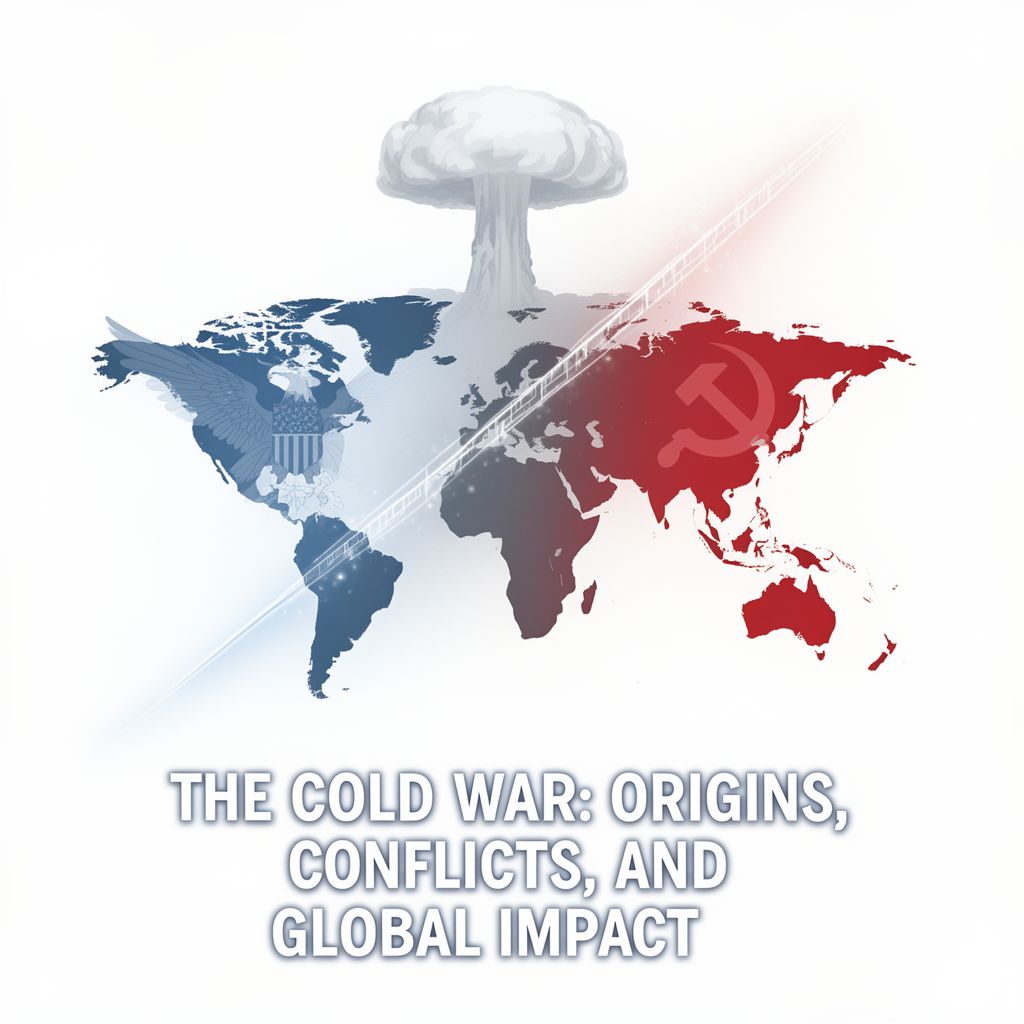
Sesli Özet
5 dakikaKonuyu otobüste, koşarken, yolda dinleyerek öğren.
Sesli Özet
The Cold War: Origins, Conflicts, and Global Impact
Flash Kartlar
25 kartKarta tıklayarak çevir. ← → ile gez, ⎵ ile çevir.
Tüm kartları metin olarak gör
1. What was the Cold War and its primary adversaries?
The Cold War was a 45-year period of intense rivalry and tension following World War II. Its primary adversaries were the USA, championing capitalism and democracy, and the USSR, promoting communism. This confrontation never escalated into direct military conflict between the two superpowers, but manifested through various indirect means.
2. How did the ideological differences between the USA and USSR manifest during the Cold War?
The USA advocated for capitalism and democratic governance, emphasizing individual freedoms and free markets. In contrast, the USSR promoted communism, characterized by state control over the economy and a single-party political system. These fundamental ideological differences fueled their global competition and shaped their foreign policies throughout the Cold War.
3. In what ways did the Cold War conflict manifest, given there was no direct military engagement between the superpowers?
The Cold War manifested through various indirect methods rather than direct military confrontation between the USA and USSR. These included extensive spying operations, diplomatic maneuvers, economic pressure tactics, and proxy wars fought in other nations. This approach allowed the superpowers to compete for influence without triggering a full-scale nuclear war.
4. What was NATO and when was it formed?
NATO stands for the North Atlantic Treaty Organisation, formed in 1949. It was a defensive military alliance established by Western European countries and the USA. Its primary purpose was to provide collective security against the perceived threat of Soviet expansion in Europe, solidifying the Western bloc during the Cold War.
5. How did Stalin's actions in Eastern Europe contribute to the Cold War's division?
After WWII, Stalin's Red Army imposed Communist governments across Eastern Europe, creating a 'buffer zone' of 'satellite states' like Poland and Hungary. These states were directed by Moscow, effectively extending Soviet influence westward. This expansion alarmed the US and its allies, solidifying the ideological and geographical division of Europe.
6. What was the US policy of containment, and why was it adopted?
The US policy of containment was a strategy adopted to prevent the spread of communism beyond its existing borders. It was a direct response to the perceived threat of Soviet expansion into Eastern Europe and other regions. The US aimed to counter communist influence through economic, political, and military means, without directly engaging the USSR in war.
7. Explain the significance of the Truman Doctrine.
The Truman Doctrine, announced in 1947, was a pivotal US foreign policy initiative during the Cold War. It pledged US support to countries threatened by communist expansion or authoritarian regimes. This doctrine marked a shift in US foreign policy, committing the nation to actively resist Soviet influence and support democratic governments globally.
8. What was the Marshall Plan and its primary objective?
The Marshall Plan was an American initiative launched in 1948, providing $12.7 billion in aid to rebuild Western European economies after World War II. Its primary objective was to prevent the spread of communism by alleviating economic hardship and instability, which were seen as fertile ground for communist ideologies. By fostering economic recovery, the US aimed to strengthen democratic governments and counter Soviet influence.
9. Who coined the term 'iron curtain' and what did it signify?
Winston Churchill famously described the division of Europe as an 'iron curtain.' This term, used in his 1946 speech, signified the ideological and physical barrier separating Soviet-controlled Eastern Europe from the democratic Western Europe. It highlighted the lack of free communication and movement between the two blocs, symbolizing the stark division of the continent.
10. How was Germany divided after World War II, and what was Berlin's unique situation?
After WWII, Germany was divided into four occupation zones, eventually consolidating into Western (USA, Britain, France) and Eastern (Soviet) zones. Berlin, despite being deep within the Soviet zone, was also similarly divided into Western and Eastern sectors. This made West Berlin an isolated outpost of capitalism and democracy within Soviet-controlled territory.
11. Describe the Berlin Blockade and the Allied response.
In 1948, Stalin initiated the Berlin Blockade, cutting off all land and water access to West Berlin in response to Western unification efforts in Germany. The USA and Britain countered this by launching the Berlin Airlift, supplying the city entirely by air for nearly a year. This massive logistical operation successfully circumvented the blockade, which was eventually lifted by Stalin in 1949.
12. What was the outcome of the division of Germany and the role of the Stasi?
The division of Germany led to the formal creation of two separate states: West Germany (Federal Republic of Germany) and Soviet-controlled East Germany (German Democratic Republic). In East Germany, the Stasi, the secret police, played a crucial role in maintaining control through extensive surveillance and repression. They monitored citizens to prevent dissent and ensure loyalty to the communist regime.
13. What was the purpose and significance of the Berlin Wall?
The Berlin Wall was constructed in 1961 by East Germany to stop the mass exodus of its citizens, particularly skilled workers, to West Berlin. It became a stark physical symbol of the division between East and West, and of communist repression. The wall effectively sealed off West Berlin, preventing East Germans from escaping to freedom and highlighting the severe restrictions on movement in the Soviet bloc.
14. How did the nuclear age begin and what was its immediate impact on the Cold War?
The nuclear age began with the atomic bombings of Japan in 1945. Its immediate impact on the Cold War was profound when the USSR developed its own atomic bomb in 1949. This development triggered a massive arms race between the two superpowers, fundamentally altering military strategy and international relations by introducing the threat of global annihilation.
15. Explain the concepts of 'deterrent effect' and 'mutually assured destruction' (MAD) during the Cold War.
The 'deterrent effect' referred to the idea that the threat of nuclear retaliation would prevent a first strike by an adversary. 'Mutually Assured Destruction' (MAD) was the doctrine that a full-scale use of nuclear weapons by two opposing sides would result in the complete annihilation of both the attacker and the defender. This concept ensured that neither superpower would initiate a nuclear attack, as it guaranteed their own destruction.
16. When did the Cuban Missile Crisis occur, and who were the key leaders involved?
The Cuban Missile Crisis occurred in 1962 and brought the world closest to nuclear war. The key leaders involved were US President John F. Kennedy, Soviet Premier Nikita Khrushchev, and Cuban leader Fidel Castro. Their decisions and negotiations during this 13-day standoff were critical in resolving the crisis peacefully.
17. What role did Fidel Castro's revolution play in the Cuban Missile Crisis?
Fidel Castro's successful communist revolution in Cuba in 1959 established a Soviet-allied government just 150 kilometers from the US coast. This new communist state provided the USSR with a strategic location to place nuclear missiles, directly threatening the United States. Castro's revolution thus set the stage for the crisis by creating a Soviet foothold in the Western Hemisphere.
18. What action did Soviet leader Nikita Khrushchev take in Cuba that triggered the crisis?
Soviet leader Nikita Khrushchev stationed nuclear missiles in Cuba, just 150 kilometers from the US. This covert deployment was intended to deter a potential US invasion of Cuba and to balance the US missile presence in Turkey. The discovery of these missile sites by US spy planes directly triggered the Cuban Missile Crisis.
19. How did US President John F. Kennedy respond to the discovery of Soviet missiles in Cuba?
Upon discovering the Soviet missiles in Cuba, President John F. Kennedy imposed a naval blockade around the island to prevent further Soviet shipments. He also publicly demanded the immediate removal of the missiles, warning that any missile launch from Cuba would be considered an attack on the United States. Kennedy's firm stance initiated a tense standoff with the Soviet Union.
20. How was the Cuban Missile Crisis ultimately resolved?
After 13 tense days, the Cuban Missile Crisis was resolved through a deal between the US and the USSR. Kennedy publicly pledged not to invade Cuba, and Khrushchev agreed to remove the Soviet missiles from the island. A secret agreement also stipulated that the US would remove its Jupiter missiles from Turkey. This diplomatic resolution averted a potential nuclear war.
21. What was 'détente' and what was SALT I?
Détente was a period of improved relations and reduced tensions between the United States and the Soviet Union following the Cuban Missile Crisis. It aimed to de-escalate the Cold War through diplomacy and cooperation. SALT I, or the Strategic Arms Limitations Talks, was a key outcome of détente, signed in 1972, which limited the number of nuclear weapons held by both superpowers.
22. What was the significance of the Chernobyl nuclear accident in the context of the Cold War?
The Chernobyl nuclear accident in 1986, though not a direct Cold War conflict, highlighted the immense dangers of nuclear technology. It served as a stark reminder of the catastrophic potential of nuclear materials, whether used in weapons or for energy. The disaster underscored the global risks associated with nuclear power and indirectly reinforced the need for arms control and international cooperation.
23. How did the US approach containment in Asia during the Cold War?
In Asia, the US focused on containing communism by supporting pro-Western governments and suppressing communist movements. This involved providing aid and military assistance to countries like Japan and Taiwan to strengthen their economies and defenses. The US aimed to create a bulwark against the spread of communism, particularly after the communist victory in China.
24. Describe the Korean War: its participants, duration, and outcome.
The Korean War, a major proxy conflict of the Cold War, occurred from 1950 to 1953. It involved US-backed South Korea fighting against Chinese-backed North Korea. The war, characterized by brutal trench warfare, resulted in approximately 3 million deaths and ultimately ended in a stalemate. The border between North and South Korea remained largely unchanged, solidifying the division of the peninsula.
25. What were the origins of the Vietnam War, particularly regarding French colonial rule and Ho Chi Minh?
The Vietnam War originated from Vietnam's struggle for independence from French colonial rule. Ho Chi Minh's Viet Minh, employing effective guerrilla tactics, defeated the French in the First Indochina War (1946-1954). After this victory, Vietnam was temporarily divided, setting the stage for the later conflict as the US feared a communist victory in reunification elections.
Bilgini Test Et
15 soruÇoktan seçmeli sorularla öğrendiklerini ölç. Cevap + açıklama.
What was the primary ideological difference between the USA and the USSR that fueled the Cold War?