Ancient Rome and Egypt: Discoveries and Civilizations - kapak
Tarih#ancient rome#ancient egypt#archaeology#king tutankhamun

Ancient Rome and Egypt: Discoveries and Civilizations

This summary explores key aspects of Ancient Rome and Egypt, covering significant archaeological discoveries, daily life, pivotal inventions, and the enduring legacy of these influential civilizations.

ywef2uoyApril 29, 2026 ~20 dk toplam
01

Sesli Özet

5 dakika

Konuyu otobüste, koşarken, yolda dinleyerek öğren.

Sesli Özet

Ancient Rome and Egypt: Discoveries and Civilizations

0:004:59
02

Görsel Özet

İnfografik

Konunun tüm parçalarını tek bakışta gör.

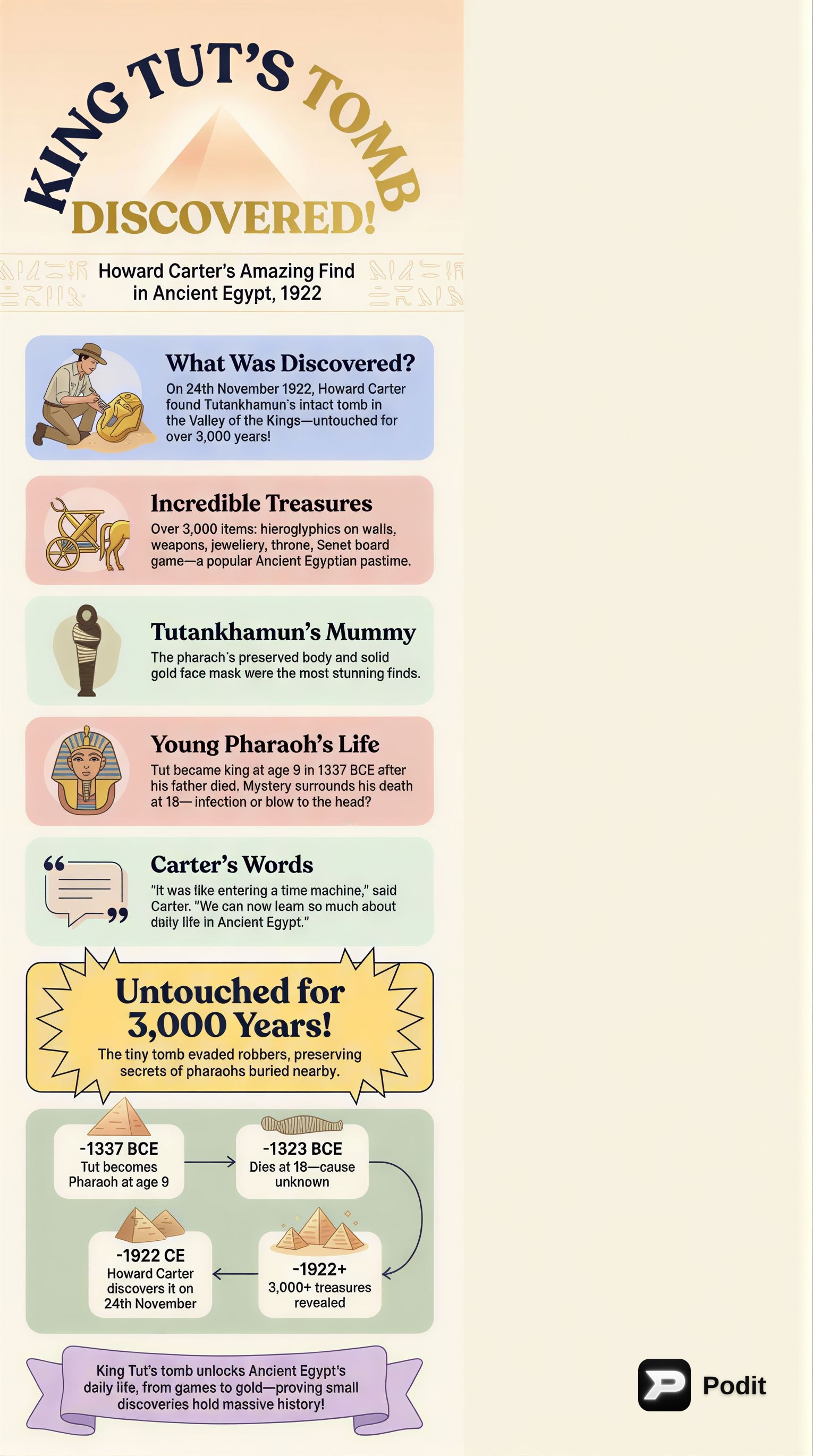
Ancient Rome and Egypt: Discoveries and Civilizations - görsel özet infografik
Tam boyutta görüntüle →
03

Flash Kartlar

25 kart

Karta tıklayarak çevir. ← → ile gez, ⎵ ile çevir.

1 / 25
Tüm kartları metin olarak gör
  1. 1. Who discovered King Tutankhamun's tomb and when?

    King Tutankhamun's tomb was discovered by Howard Carter on November 24, 1922. This discovery was a pivotal moment in archaeology, providing unprecedented insights into ancient Egyptian life due to the tomb's remarkably undisturbed state.

  2. 2. Where was King Tutankhamun's tomb found?

    King Tutankhamun's tomb was found in the Valley of the Kings. This location is famous for being the burial site of many pharaohs and powerful nobles of the New Kingdom, making it a significant archaeological area.

  3. 3. What made King Tutankhamun's tomb particularly significant upon its discovery?

    The tomb was remarkably significant because it remained undisturbed for over 3,000 years, offering an unprecedented opportunity to learn about daily life in Ancient Egypt. Howard Carter described the experience as 'entering a time machine,' highlighting its pristine condition and wealth of information.

  4. 4. Name three types of treasures found in King Tutankhamun's tomb.

    More than 3,000 treasures were found, including hieroglyphics, a golden chariot, weapons, jewelry, and a Senet board game. The most significant finds were Tutankhamun's mummy and his solid gold face mask, providing immense historical and cultural value.

  5. 5. What were the most significant finds in Tutankhamun's tomb?

    The most significant finds in Tutankhamun's tomb were his mummy and his solid gold face mask. These items are iconic symbols of Ancient Egypt and provided invaluable information about the pharaoh and the mummification practices of the era.

  6. 6. At what age did Tutankhamun ascend to the throne and at what age did he die?

    Tutankhamun ascended to the throne at the age of nine in 1337 BCE. He died at the age of eighteen, making his reign relatively short. His early death has been a subject of much historical and scientific inquiry.

  7. 7. What are the main theories regarding Tutankhamun's death?

    Tutankhamun's death at eighteen remains a subject of scientific debate. Theories suggest he may have died from an infection resulting from a broken leg or from a blow to the head. These theories are based on forensic analysis of his remains and historical context.

  8. 8. Describe one medical practice used in Ancient Egypt mentioned in the text.

    Ancient Egyptians used remedies for various infections, such as a mixture of honey with brains for eye ailments. They also used cooked mouse for coughs, showcasing their early attempts at medical treatment, though some methods seem unusual by modern standards.

  9. 9. How did Ancient Egyptians create the first form of paper?

    Ancient Egyptians pioneered the first form of paper, crafted from papyrus reeds found along the Nile. The process involved cutting the inner plant part into strips, flattening them, and then drying them for scribes to use, revolutionizing record-keeping.

  10. 10. What are hieroglyphics and what was their significance in Ancient Egypt?

    Hieroglyphics were a complex system of picture words developed by the Ancient Egyptians. Thousands of symbols represented sounds, letters, and entire words, requiring years of study for scribes to master. They were crucial for recording history, religious texts, and daily life.

  11. 11. What ingredients did Ancient Egyptians use for toothpaste?

    The Ancient Egyptians invented toothpaste, which was a peculiar paste made from salt, mint, pepper, and dried flowers. This invention reflects their attention to oral hygiene, even with unconventional ingredients, demonstrating early health consciousness.

  12. 12. What was the purpose of mummification in Ancient Egypt?

    Mummification was a funerary practice in Ancient Egypt aimed at preserving the body for the afterlife. The process took approximately three months and involved carefully removing organs and treating the body to prevent decay, ensuring the deceased's spiritual journey.

  13. 13. Which organs were typically placed in canopic jars during mummification?

    During mummification, organs like the liver, stomach, and lungs were placed in canopic jars. The heart, however, was typically left in the body, as it was believed to be essential for the individual's journey in the afterlife and judgment.

  14. 14. What was the believed role of the Sphinx in Ancient Egyptian culture?

    The Sphinx, a mythical creature, was believed to guard the pharaohs' tombs. Its imposing presence symbolized protection and power, ensuring the sanctity of the burial sites and deterring grave robbers.

  15. 15. What was the primary function of the pyramids in Ancient Egypt?

    The pyramids served as monumental stone tombs for the pharaohs. These massive structures were built to house the pharaohs' remains and treasures, ensuring their passage to the afterlife and symbolizing their divine status and power.

  16. 16. What types of Roman artifacts were recently unearthed in London?

    Recent discoveries in London unearthed thousands of Roman artifacts at a building site. These included plates and bowls, an entire Roman street, a bear skull, and numerous Roman coins, all found in excellent condition, providing a rich archaeological record.

  17. 17. Approximately when do the Roman artifacts found in London date back to?

    The Roman artifacts found in London, such as plates and bowls, date back 2,000 years. This places their origin around the time of the Roman presence in Britain, providing valuable insights into their daily lives and occupation of the region.

  18. 18. Why do historians believe the Roman artifacts in London were abandoned?

    Historians posit that these items were likely abandoned when the Romans departed London around 410 CE. This departure was possibly due to attacks from Scotland and Germany, forcing the Romans to leave their settlements and possessions behind as they withdrew.

  19. 19. Name two significant engineering marvels of Ancient Rome.

    Roman engineering left an indelible mark, particularly through the construction of straight roads and aqueducts. Roads facilitated military movement and trade across their vast empire, while aqueducts supplied fresh water to cities, showcasing their advanced infrastructure and planning.

  20. 20. What was the Colosseum used for in Ancient Rome?

    The Colosseum served as a major entertainment venue in Ancient Rome. Structurally resembling a modern football stadium, it was where gladiators fought wild animals and other spectacles were held, providing mass entertainment for the Roman public.

  21. 21. What was the purpose of Roman baths?

    Roman baths were centers for washing and bathing, but they also served as important social hubs. People would gather there not only for hygiene but also for exercise, relaxation, and socializing, making them integral to Roman daily life and community.

  22. 22. What was a notable characteristic of the Roman numerical system?

    A notable characteristic of the Roman numerical system, Roman numerals, was that it lacked a symbol for zero. This absence made certain mathematical operations more complex compared to systems that include a zero, but it was effective for their accounting and record-keeping.

  23. 23. Name two prominent professions in Ancient Rome.

    Professions such as engineers and lawyers were prominent in Ancient Rome. Engineers were crucial for constructing their impressive infrastructure like roads and aqueducts, while lawyers played a significant role in their sophisticated legal system and governance.

  24. 24. What does the story 'Horatius at the Bridge' illustrate about Roman culture?

    The story 'Horatius at the Bridge' enriches the cultural narrative of Rome by illustrating heroic deeds and values. It exemplifies Roman virtues such as courage, sacrifice, and patriotism in defending the city against invaders, serving as a moral tale.

  25. 25. How did Ancient Egypt and Rome contribute to subsequent human development?

    Both Ancient Egypt and Rome laid much of the groundwork for subsequent human development. From Egyptian innovations like papyrus and toothpaste to Roman engineering marvels like aqueducts, their contributions in technology, governance, and culture profoundly influenced later civilizations and continue to be studied.

04

Bilgini Test Et

15 soru

Çoktan seçmeli sorularla öğrendiklerini ölç. Cevap + açıklama.

Soru 1 / 15Skor: 0

Who was responsible for the discovery of King Tutankhamun's tomb in the Valley of the Kings?

05

Detaylı Özet

5 dk okuma

Tüm konuyu derinlemesine, başlık başlık.

Ancient Civilizations: Rome and Egypt Study Guide 📚

This study material has been compiled from a lecture audio transcript and various copy-pasted text sources, providing a comprehensive overview of Ancient Rome and Egypt.


🌍 Introduction to Ancient Civilizations

Ancient Rome and Egypt represent foundational pillars of human civilization, each contributing profoundly to our understanding of history, technology, and culture. This guide explores their societal structures, technological advancements, daily life practices, and significant archaeological discoveries, highlighting their lasting impact on human development.


🔍 Archaeological Discoveries and Historical Insights

1. King Tutankhamun's Tomb (Ancient Egypt) 👑

A landmark archaeological event was the discovery of King Tutankhamun's tomb by Howard Carter on November 24, 1922.

  • Location: Valley of the Kings, Egypt.
  • Significance: The tomb was remarkably small and remained undisturbed for over 3,000 years, offering an unprecedented glimpse into Ancient Egyptian daily life. Carter famously described it as "entering a time machine."
  • Contents: Over 3,000 treasures were found, including:
    • Hieroglyphics ✅
    • A golden chariot 🐎
    • Weapons and jewelry 🛡️💎
    • A board game called Senet 🎲
    • The most incredible discovery: Tutankhamun's mummy and his solid gold face mask.
  • Tutankhamun's Life:
    • Became Pharaoh at age nine in 1337 BCE after his father's death.
    • His death at eighteen remains a mystery, with theories suggesting an infection from a broken leg or a blow to the head.

2. Roman Artifacts in London (Ancient Rome) 🏛️

Recent discoveries in London have unearthed thousands of Roman artifacts at a building site.

  • Contents: Plates and bowls, dating back 2,000 years, found in excellent condition.
  • Historical Context: Historians believe these items were abandoned when Romans left London around 410 CE, possibly due to attacks from Scotland and Germany.
  • Further Finds: An entire Roman street, a bear skull (suggesting entertainment at amphitheatres), and numerous Roman coins were recovered from a deep well. This was hailed as the "best find in years" by archaeologists.

💡 Innovations and Daily Life in Ancient Egypt

Ancient Egypt was a hub of innovation, developing several inventions and practices that influenced civilization.

1. Key Egyptian Inventions 🧪

  • Medicine: Developed remedies for various infections.
    • Honey mixed with brains for eye ailments.
    • Cooked mouse used to cure coughs.
  • Paper (Papyrus): The first form of paper was made from papyrus reeds along the Nile.
    • Process: Inner plant parts were cut into strips, flattened, and dried for scribes to write on.
  • Hieroglyphics: The first form of writing, using picture words.
    • Thousands of symbols represented sounds, letters, or whole words.
    • Scribes studied for years to master this complex system.
  • Toothpaste: A peculiar paste for oral hygiene.
    • Made from salt, mint, pepper, and dried flowers.

2. Structures, Beliefs, and Practices 🗿

  • Pyramids: Monumental stone tombs for Pharaohs.
  • Sphinx: A mythical creature believed to guard the Pharaohs' tombs.
  • Mummification: A preservation process for the deceased.
    • Took approximately three months.
    • Organs like the liver, stomach, and lungs were placed in canopic jars.
    • The heart was typically left in the body.
    • The body was covered in salt and wrapped in linen.

🛠️ Innovations and Daily Life in Ancient Rome

Ancient Rome left an indelible mark through its engineering, societal structures, and cultural practices.

1. Engineering Marvels 🏗️

  • Roads: Romans showed how to build straight roads, crucial for military and trade.
  • Aqueducts: Transported fresh water to Roman cities, a testament to their advanced hydraulic engineering.

2. Society, Entertainment, and Professions 🏟️

  • Colosseum: A major entertainment venue, structurally similar to a modern football stadium.
    • Gladiators: Fought against wild animals and each other for public entertainment.
  • Roman Baths: Centers for washing, bathing, and social interaction.
  • Professions: Engineers and lawyers were prominent roles in Roman society.
  • Daily Life: Encompassed distinct aspects of clothes, food, transport, and housing.

3. Roman Numerals 🔢

  • A unique numerical system (e.g., I, V, X, L, C, D, M).
  • Notably lacked a symbol for zero.

4. Roman Stories 📖

  • Horatius at the Bridge: A famous story illustrating Roman heroism and selflessness.

📝 Language Focus and Study Tips

This section highlights key linguistic elements and study strategies.

1. Fact vs. Opinion ✅❓

  • Fact: A statement that can be proven true (e.g., "Tutankhamun became Pharaoh when he was nine years old.").
  • Opinion: A personal belief or judgment that cannot be proven (e.g., "It was like entering a time machine.").

2. Prepositions of Time, Location, and Position 📍

  • Time: on (24th November 1922), in (410 CE), at (this time).
  • Location: in (the Valley of the Kings, London), at (a building site).
  • Position: at (the bottom of a well), on (the walls).

3. Imperative Forms (Instructions/Commands) 🗣️

  • Used to give orders, instructions, or advice.
  • Uses the base form of the verb with no subject (e.g., "Crush some rock salt," "Cut into strips").
  • Can be made polite with "please" (e.g., "Please don't shout in class").
  • Caution: Do not use "you" with imperatives (e.g., "Feed the cat," not "You feed the cat").

4. Expressing Opinions and Beliefs 🤔

  • Use phrases like:
    • "I think that..."
    • "I know that..."
    • "I believe that..."
  • Caution: Do not use a comma after "I think/know/believe that" (e.g., "I think that Romans wore togas," not "I think, that Romans wore togas").

5. Writing a News Report 📰

Follow these steps for effective news reporting:

  1. Research and Planning: Use a mind map to organize facts and ideas.
  2. Writing:
    • Create an interesting headline.
    • Use past tenses to describe events.
    • Include quotations from discoverers.
    • Include both facts and opinions.
  3. Display: Add pictures or photos.
  4. Checklist: Ensure you've used past tenses, direct speech, facts, and opinions.

🌟 Enduring Legacy of Ancient Civilizations

Both Ancient Rome and Egypt laid much of the groundwork for subsequent human development. From the intricate details of King Tutankhamun's tomb to the practical innovations of papyrus and toothpaste, and from the engineering marvels of Roman aqueducts to the societal structures reflected in their daily lives, these civilizations continue to offer invaluable perspectives on human progress. Ongoing archaeological efforts constantly unearth new insights, allowing us to reconstruct and appreciate the complexities of their societies and their continuous quest for knowledge.
Kendi çalışma materyalini oluştur

PDF, YouTube videosu veya herhangi bir konuyu dakikalar içinde podcast, özet, flash kart ve quiz'e dönüştür. 1.000.000+ kullanıcı tercih ediyor.

Sıradaki Konular

Tümünü keşfet
The Enduring Legacy of Ancient Rome: From Republic to Empire

The Enduring Legacy of Ancient Rome: From Republic to Empire

Explore the remarkable journey of Rome, from its Etruscan roots and the establishment of the Republic to its vast imperial expansion, internal transformations, and lasting contributions to civilization.

Özet 10
British Popular Music and Fashion: A Historical Overview

British Popular Music and Fashion: A Historical Overview

This summary explores the evolution of British popular music and its intrinsic link with fashion and youth culture from the post-war era to the digital age, highlighting key genres, artists, and societal impacts.

8 dk Özet 25 15
Pre-Islamic Turkish Political History: Early States

Pre-Islamic Turkish Political History: Early States

An academic overview of the political history of early Turkic states before the advent of Islam, focusing on the Xiongnu, Göktürk, and Uyghur Khaganates.

7 dk Özet 25 15 Görsel
Ottoman Empire's 18th Century Decline

Ottoman Empire's 18th Century Decline

An academic summary of the Ottoman Empire's period of decline in the 18th century, examining internal weaknesses, external pressures, and reform attempts.

7 dk 25 15
Ottoman Empire: Early 20th Century Challenges

Ottoman Empire: Early 20th Century Challenges

Explore the critical internal and external challenges faced by the Ottoman Empire in the early 20th century, leading to its eventual decline and dissolution.

Özet 15 Görsel
Pre-Islamic Turkish Political History

Pre-Islamic Turkish Political History

An academic overview of the political history of Turkic states before the advent of Islam, exploring their foundational characteristics, key empires, and enduring legacies.

4 dk Özet 25 15 Görsel
Cultural Foundations: Art, Music, and Literature in Early 19th Century America

Cultural Foundations: Art, Music, and Literature in Early 19th Century America

Explore the development of American identity through the distinctive art, music, and literature of the early 1800s, reflecting a growing sense of nationhood.

25 15
Life in the Colonies: Daily Routines, Rights, and Justice

Life in the Colonies: Daily Routines, Rights, and Justice

An academic overview of colonial life, covering daily routines, economic activities, urban challenges, the evolution of colonists' rights, and the system of crime and punishment.

5 dk 15