 Podit
Podit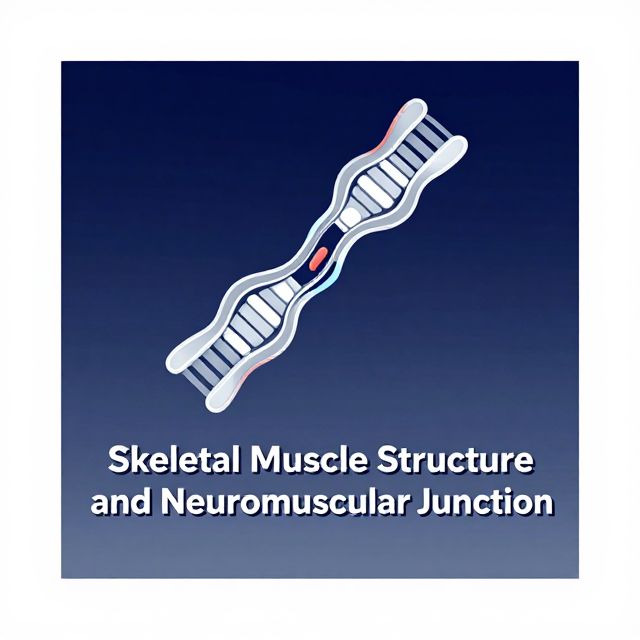
This study material has been compiled and organized from a lecture audio transcript and supplementary copy-pasted text.
📚 Skeletal Muscle Structure and Neuromuscular Junction: A Comprehensive Guide
Introduction
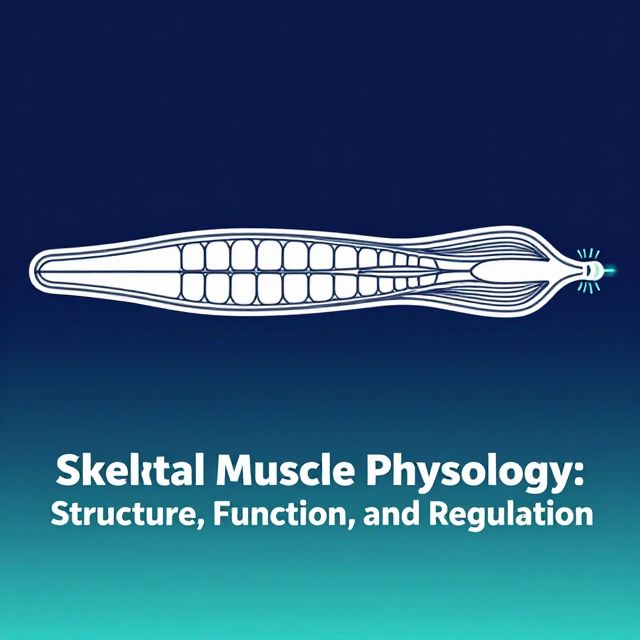
Skeletal muscles are fundamental to movement, posture, and various physiological functions in the human body. This guide delves into the intricate structure of skeletal muscle, from its microscopic components to its innervation by the nervous system, culminating in the detailed mechanism of muscle contraction and relaxation. Understanding these processes is crucial for comprehending both normal physiological function and various pathological conditions.
1. Skeletal Muscle Terminology 📚
Physiology often employs specific terminology, frequently derived from Greek or Latin roots, to describe muscle components.
- Sarco-: A prefix meaning "flesh" or "muscle" (from Greek).
- Sarcolemma: The cell membrane of a single muscle cell. (Sarco + lemma, from plasma membrane).
- Sarcoplasmic Reticulum (SR): The specialized endoplasmic reticulum of muscle cells, crucial for calcium storage and release.
- Sarcomere: The smallest functional and contractile unit of a muscle cell.
- Myo-: A prefix meaning "muscle" (from Greek).
- Myocyte: A single muscle cell. Often referred to as a muscle fiber in physiology.
- Myofilaments: The protein filaments (actin and myosin) that make up sarcomeres.
- Excitable Cells: Skeletal muscle cells are excitable, meaning they can produce action potentials. However, unlike smooth muscle, their action potential production and subsequent contraction are voluntarily controlled by the nervous system and cannot occur spontaneously without neural stimulation.
2. Skeletal Muscle Morphology ✅
2.1. General Characteristics
Skeletal muscle cells exhibit distinct morphological features:
- Cylindrical Shape: They are typically long and cylindrical.
- Multinucleated: Each muscle cell contains several nuclei, located just beneath the sarcolemma.
- No Syncytial Bridges: A key distinction from cardiac muscle is the absence of syncytial bridges (gap junctions) between skeletal muscle cells. This means that electrical stimuli do not directly spread from one skeletal muscle cell to an adjacent one. Contraction is initiated by individual neural input to each fiber or group of fibers.
2.2. Internal Structure: Filaments
The inner side of a skeletal muscle cell is densely packed with cytoskeletal proteins, organized into myofilaments. These are primarily:
- Thin Filaments: Composed mainly of actin, along with regulatory proteins tropomyosin and troponin.
- Thick Filaments: Composed primarily of myosin. These filaments are arranged to form the sarcomere, the fundamental contractile unit. The organized, parallel arrangement of these filaments gives skeletal muscle its characteristic striated pattern under a microscope.
3. Filament Structure in Detail 🔬
3.1. Thin Filaments
Thin filaments are complex structures comprising three main proteins:
- Actin:
- Formed from globular G-actin (globular actin) monomers.
- These G-actin monomers polymerize to form fibrous F-actin (filamentous actin), which resembles a double-stranded helix.
- Each G-actin molecule contains an active site where myosin heads can bind.
- Tropomyosin:
- A fibrous protein that wraps around the F-actin helix.
- In a relaxed muscle, tropomyosin covers the active binding sites on actin, preventing myosin from attaching.
- Troponin:
- A complex of three globular proteins attached to tropomyosin and actin. It has three subunits:
- Troponin C (TnC): Binds calcium ions (Ca²⁺). This binding is crucial for initiating contraction.
- Troponin T (TnT): Binds to tropomyosin, anchoring the troponin complex to the thin filament.
- Troponin I (TnI): Binds to actin, inhibiting the interaction between actin and myosin in the absence of calcium.
- A complex of three globular proteins attached to tropomyosin and actin. It has three subunits:
3.2. Thick Filaments
Thick filaments are primarily composed of myosin:
- Myosin Structure: Each myosin molecule has a long tail and two globular heads.
- Tail Region: Forms the backbone of the thick filament.
- Head Region: Contains two critical sites:
- Actin-binding site: Where the myosin head attaches to actin during contraction.
- ATP-binding site: Where ATP binds and is hydrolyzed.
- ATPase Activity: The myosin head also possesses ATPase enzymatic activity, meaning it can hydrolyze ATP into ADP and inorganic phosphate (Pi). This hydrolysis provides the energy for muscle contraction.
4. Sarcomere Structure and Banding Pattern 📊
The sarcomere is the basic contractile unit, defined by the arrangement of thin and thick filaments.
4.1. Key Lines and Bands
Under a microscope, the sarcomere exhibits a distinct banding pattern:
- Z-lines (Z-discs): Mark the boundaries of a single sarcomere. Thin filaments are anchored to the Z-lines. (From German "zwischen," meaning "between").
- M-line: Located in the very center of the sarcomere. It serves as an anchoring point for the tails of the thick myosin filaments. (From German "mittel," meaning "middle").
- I-band: The lighter regions containing only thin (actin) filaments. Each I-band is bisected by a Z-line. (From "isotropy," indicating uniform appearance).
- A-band: The darker central region of the sarcomere, encompassing the entire length of the thick (myosin) filaments. It includes areas where thick and thin filaments overlap. (From "anisotropy," indicating non-uniform appearance).
- H-zone: A lighter region within the center of the A-band, containing only thick (myosin) filaments and no thin filament overlap. (From German "heller," meaning "light").
4.2. Changes During Contraction 📈
During muscle contraction, the sliding filament mechanism occurs, leading to specific changes in sarcomere structure:
- Sarcomere Length: Shortens.
- H-zone: Shortens and may disappear entirely.
- I-band: Shortens.
- A-band: Does not change in length, as it represents the length of the thick filaments themselves, which do not shorten.
- Filament Lengths: The individual lengths of the thick and thin filaments do not change. Instead, they slide past each other.
- Z-lines: Move closer together.
5. Sarcotubular System 💧
The sarcotubular system is a network of internal membranes critical for transmitting the electrical signal into the muscle fiber and regulating calcium.
5.1. Sarcoplasmic Reticulum (SR)
- The SR is a specialized form of endoplasmic reticulum in muscle cells.
- Its primary function is to store and release calcium ions (Ca²⁺).
- It contains specialized regions called cisternae (or terminal cisternae), which are enlarged sacs that serve as the main storage sites for Ca²⁺.
5.2. Transverse Tubules (T-tubules)
- T-tubules are invaginations of the sarcolemma that penetrate deep into the muscle fiber, running transversely (perpendicular) to the myofibrils.
- They contain extracellular fluid and play a vital role in rapidly transmitting the action potential from the sarcolemma to the interior of the muscle fiber.
5.3. The Triad
- A triad is a structural unit formed by one T-tubule flanked by two terminal cisternae of the sarcoplasmic reticulum.
- These triads are typically located at the junction of the A and I bands in skeletal muscle.
- The close proximity of the T-tubule and SR cisternae is essential for excitation-contraction coupling, allowing for rapid communication between the electrical signal and calcium release.
6. Innervation of Skeletal Muscles 🧠
Skeletal muscle contraction is under voluntary control, orchestrated by the nervous system.
6.1. Motor Neurons (Upper & Lower)
- Upper Motor Neurons: Originate in the frontal cortex (e.g., primary motor cortex) and descend to the brainstem and spinal cord. They synapse with lower motor neurons.
- Lower Motor Neurons (Peripheral Motor Neurons): Their cell bodies are located in the spinal cord (ventral horn) or brainstem. Their axons extend out to innervate skeletal muscle fibers. These are the direct command neurons for muscle contraction.
6.2. Types of Motor Neurons and Muscle Fibers
Peripheral motor neurons are classified based on their size and function:
- A alpha Motor Neurons:
- These are the largest and most myelinated peripheral neurons in the body, leading to fast conduction velocities.
- They innervate extrafusal muscle fibers, which are the main contractile fibers responsible for generating muscle force.
- A gamma Motor Neurons:
- These innervate intrafusal muscle fibers, which are specialized muscle fibers located within muscle spindles.
- Intrafusal fibers do not contribute significantly to muscle force but are crucial for regulating muscle spindle sensitivity.
6.3. Muscle Receptors (Proprioceptors)
Skeletal muscles and tendons contain specialized sensory receptors called proprioceptors, which provide feedback to the nervous system about muscle length, tension, and joint position.
- Muscle Spindles:
- Located within the muscle belly, parallel to extrafusal fibers.
- Composed of intrafusal muscle fibers (nuclear bag fibers and nuclear chain fibers) enclosed in a connective tissue capsule.
- Nuclear Bag Fibers:
- Dynamic Nuclear Bag Fibers: Sense the velocity of muscle stretch (rate of change in length).
- Static Nuclear Bag Fibers: Sense muscle length during movement.
- Nuclear Chain Fibers: Sense static muscle stretch (absolute length).
- Sensory Innervation:
- Type Ia afferents (Primary sensory neurons): Innervate both nuclear bag and nuclear chain fibers, detecting both dynamic and static changes in length.
- Type II afferents (Secondary sensory neurons): Primarily innervate nuclear chain fibers and static nuclear bag fibers, detecting static muscle length.
- Golgi Tendon Organs (GTOs):
- Located in the tendons, in series with extrafusal muscle fibers.
- Innervated by Type Ib afferents.
- They sense muscle tension (force of contraction). When tension becomes too high, GTOs inhibit muscle contraction, protecting the muscle and tendon from injury.
- Free Nerve Endings: Responsible for pain sensation within muscles and connective tissues.
7. The Motor Unit 💪
A motor unit is defined as a single motor neuron and all the muscle fibers it innervates.
- Functional Unit: It is the functional unit of muscle contraction. All muscle fibers within a motor unit contract simultaneously when the motor neuron fires an action potential.
- Size Variation:
- Large Motor Units: Found in large muscles (e.g., back muscles) involved in gross movements and posture. A single motor neuron may innervate hundreds or even thousands of muscle fibers.
- Small Motor Units: Found in muscles requiring fine, precise control (e.g., eye muscles, hand muscles for writing). A single motor neuron may innervate only a few muscle fibers (e.g., 12 fibers).
- Recruitment: The nervous system controls muscle force by recruiting more motor units (increasing the number of active motor neurons) and by increasing the firing rate of individual motor neurons.
8. Neuromuscular Junction (NMJ) ⚡
The neuromuscular junction is the specialized synapse between a motor neuron axon terminal and a muscle fiber.
8.1. Structure of the NMJ
- Presynaptic Terminal: The axon terminal of the motor neuron, containing vesicles filled with the neurotransmitter acetylcholine (ACh).
- Synaptic Cleft: The space between the presynaptic terminal and the muscle fiber.
- Motor End Plate: A specialized region of the muscle fiber's sarcolemma directly beneath the presynaptic terminal. It is highly folded (junctional folds) to increase surface area and contains a high concentration of nicotinic acetylcholine receptors.
8.2. Neurotransmitter Release
- Action Potential Arrival: An action potential arrives at the presynaptic terminal of the motor neuron.
- Calcium Influx: This depolarization opens voltage-gated calcium channels in the presynaptic membrane, leading to an influx of Ca²⁺ into the terminal.
- ACh Release: The increase in intracellular Ca²⁺ triggers the fusion of ACh-containing vesicles with the presynaptic membrane, releasing ACh into the synaptic cleft via exocytosis.
8.3. Postsynaptic Response: End Plate Potential (EPP)
- ACh Binding: ACh diffuses across the synaptic cleft and binds to nicotinic acetylcholine receptors on the motor end plate.
- Ion Channel Opening: These receptors are ligand-gated ion channels. When ACh binds, they open, allowing a rapid influx of positive ions, primarily sodium (Na⁺), into the muscle fiber.
- Depolarization: This influx of positive ions causes a localized depolarization of the motor end plate, known as an End Plate Potential (EPP).
- Graded Potential: EPPs are graded potentials, meaning their amplitude is proportional to the amount of ACh released. They are not action potentials themselves.
- Action Potential Generation: If the EPP is strong enough (which it typically is at the NMJ due to the large amount of ACh released and numerous receptors), it reaches the threshold for activating voltage-gated sodium channels located in the adjacent sarcolemma. This triggers an action potential in the muscle fiber.
9. Excitation-Contraction Coupling 🔗
Excitation-contraction coupling is the sequence of events that links the muscle fiber's action potential to the initiation of muscle contraction.
9.1. Action Potential Propagation
- Sarcolemma Spread: The action potential generated at the motor end plate propagates along the entire sarcolemma of the muscle fiber.
- T-tubule Invasion: The action potential then spreads deep into the muscle fiber via the T-tubules.
9.2. Calcium Release
- Dihydropyridine Receptors (DHPRs): As the action potential travels down the T-tubule, it activates voltage-sensitive dihydropyridine receptors (DHPRs) located on the T-tubule membrane.
- Ryanodine Receptors (RyRs): In skeletal muscle, DHPRs are mechanically coupled to ryanodine receptors (RyRs) located on the adjacent sarcoplasmic reticulum membrane.
- Ca²⁺ Release: Activation of DHPRs causes a conformational change that directly opens the RyRs, which are calcium release channels. This leads to a massive and rapid release of stored Ca²⁺ from the SR cisternae into the sarcoplasm (cytoplasm of the muscle fiber).
9.3. Cross-Bridge Cycle (Sliding Filament Mechanism) 🔄
The released Ca²⁺ initiates the cross-bridge cycle, leading to muscle contraction:
- Resting State: Myosin heads are "energized" (cocked position), having hydrolyzed ATP into ADP + Pi, which remain attached to the myosin head. Tropomyosin covers the actin binding sites.
- Calcium Binding: Ca²⁺ released from the SR binds to Troponin C.
- Conformational Change: This binding causes a conformational change in the troponin-tropomyosin complex, moving tropomyosin away from the active binding sites on actin.
- Cross-Bridge Formation: The energized myosin heads can now bind to the exposed active sites on actin, forming a cross-bridge.
- Power Stroke: The binding of myosin to actin triggers the release of ADP and Pi from the myosin head. This causes the myosin head to pivot, pulling the thin filament (actin) towards the M-line. This movement is called the power stroke.
- ATP Binding and Detachment: A new ATP molecule binds to the ATP-binding site on the myosin head. This binding causes the myosin head to detach from actin.
- ATP Hydrolysis and Re-energizing: The newly bound ATP is hydrolyzed by the myosin ATPase into ADP + Pi. This re-energizes (re-cocks) the myosin head, preparing it for another cycle. This cycle continues as long as Ca²⁺ is present in the sarcoplasm and ATP is available. Each cycle pulls the actin filament further, shortening the sarcomere and leading to muscle contraction.
10. Muscle Relaxation and Energy Requirements 🔋
Muscle relaxation is an active process that also requires energy.
- Cessation of Neural Stimulation: When the motor neuron stops firing, ACh release ceases.
- ACh Breakdown: Acetylcholine in the synaptic cleft is rapidly broken down by the enzyme acetylcholinesterase, preventing further stimulation of the motor end plate.
- No EPP/Action Potential: Without ACh binding, the nicotinic receptors close, the EPP subsides, and no new action potentials are generated in the muscle fiber.
- Calcium Reuptake: Without action potentials propagating down the T-tubules, the DHPRs and RyRs close, stopping Ca²⁺ release. Crucially, sarcoplasmic reticulum Ca²⁺-ATPase pumps (SERCA pumps) actively pump Ca²⁺ back into the SR cisternae, against its concentration gradient. This process requires ATP.
- Tropomyosin Blockade: As Ca²⁺ concentration in the sarcoplasm decreases, Ca²⁺ detaches from Troponin C. This allows the troponin-tropomyosin complex to return to its original position, blocking the actin binding sites.
- Myosin Detachment: With the actin binding sites covered, myosin heads can no longer form cross-bridges. If a myosin head is still attached, the binding of a new ATP molecule will cause its detachment.
- Muscle Relaxation: The muscle fiber returns to its resting length.
Energy Requirements:
- Contraction: ATP is required for the myosin head to detach from actin and to be re-energized for the next power stroke.
- Relaxation: ATP is required for the active pumping of Ca²⁺ back into the sarcoplasmic reticulum by SERCA pumps.
- Rigor Mortis: A lack of ATP (e.g., after death) prevents myosin heads from detaching from actin, leading to a sustained state of muscle contraction known as rigor mortis.
11. Clinical Application: Muscular Dystrophy ⚠️
Muscular dystrophies are a group of genetic disorders characterized by progressive muscle weakness and degeneration (atrophy).
- These conditions often involve defects in structural proteins of the muscle cytoskeleton (e.g., dystrophin), which are crucial for maintaining the integrity and function of muscle fibers.
- Unfortunately, there is currently no cure for many forms of muscular dystrophy.
- The impact can be severe, as respiratory muscles are also skeletal muscles. Atrophy of these muscles can lead to respiratory failure and be life-threatening.
Conclusion
Skeletal muscle function is a marvel of biological engineering, relying on a precise interplay of structural proteins, ion channels, neurotransmitters, and energy. From the initial neural command at the neuromuscular junction to the intricate sliding of filaments within the sarcomere, each step is tightly regulated to ensure efficient and controlled movement. Understanding these mechanisms provides a foundation for appreciating the complexity of human physiology and the basis for various neuromuscular disorders.