 Podit
Podit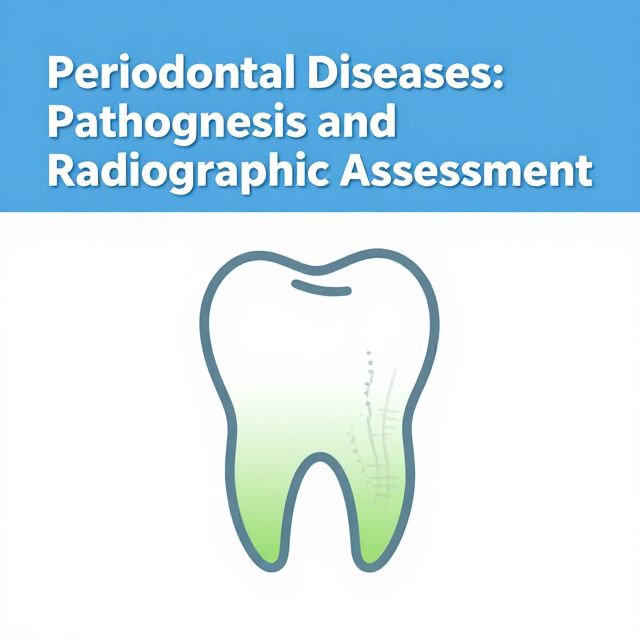
📚 Periodontal Diseases: A Comprehensive Study Guide
Source Information: This study material is compiled from a detailed copy-pasted text (likely a chapter or article) and a lecture audio transcript on Periodontal Diseases.
📝 Introduction to Periodontal Diseases
Periodontal diseases represent a diverse group of inflammatory conditions affecting the soft tissues surrounding teeth, often leading to the destruction of supporting alveolar bone and, ultimately, tooth loss. These conditions are broadly categorized into gingival diseases and periodontitis, each with distinct clinical and pathological features. Understanding their mechanisms, diagnostic approaches, and influencing factors is crucial for effective patient management.
🔬 Disease Mechanism and Classification
1. Pathogenesis and Etiology
Periodontal disease initiates with the interaction between bacterial plaque and the host's immune response.
- Bacterial Plaque: Dental plaque, predominantly composed of gram-negative bacilli and spirochetes, colonizes tooth and root surfaces, extending into the gingival sulcus. These bacteria cause damage either directly through toxin release or, more significantly, indirectly by stimulating the host's inflammatory reactions.
- Host Response: The host's immune system releases inflammatory mediators, particularly from neutrophils, leading to soft tissue destruction and osteoclastic bone resorption.
- Progression: While gingivitis always precedes periodontitis, not all cases of gingivitis progress to the more destructive periodontitis.
2. Classification of Periodontal Diseases
✅ Gingival Diseases: * Characterized by inflammation of the gingiva (gums). * Clinical Signs: Swelling, edema, and erythema (redness). * May or may not be plaque-induced (e.g., viral, fungal infections, mucocutaneous conditions, traumatic injuries). Plaque-induced gingivitis is most common. ✅ Periodontitis: * A more advanced stage, distinguished by clinically detectable loss of soft tissue attachment and supporting bone. * Clinical Forms: Chronic, aggressive (localized or generalized), necrotizing, periodontal abscesses, and lesions associated with endodontic issues. * Clinical Signs: Pocket formation, bleeding, purulent exudate, alveolar crest resorption, and increased tooth mobility. * Progression: Typically progresses in episodic bursts of active inflammation and tissue destruction, interspersed with quiescent periods.
3. Host Factors and Risk Factors
Several factors influence the onset and progression of periodontal disease:
- Systemic Diseases: Diabetes mellitus, Acquired Immunodeficiency Syndrome (AIDS).
- Age: Incidence increases with age.
- Genetic Predisposition: Family history.
- Immune Status: Compromised immunity.
- Occlusal Trauma: Excessive biting forces.
- Stress.
- Lifestyle: Smoking, poor oral hygiene.
- Prevalence: Approximately 23% of the US population has attachment loss >4mm. Aggressive periodontitis is less common (<1%).
📊 Radiographic Assessment of Periodontal Disease
Radiographs are a crucial complementary tool for evaluating periodontal disease, providing unique information about bone status and serving as permanent records of bone changes over time.
1. Role of Radiographs
- Determine the magnitude of alveolar bone destruction.
- Identify local contributing factors.
- Assess features influencing prognosis.
- Aid in evaluating the prognosis of affected teeth and planned prostheses.
2. Limitations of Intraoral Radiographs
⚠️ Intraoral radiographs (bitewing, periapical) have inherent limitations:
- 2D Representation: They provide a 2D view of 3D structures, potentially obscuring bone defects covered by high bone walls. Only interproximal bone is clearly visible.
- Underestimation: May underestimate severe bone loss or fail to detect early destructive lesions.
- Soft Tissue Information: Do not provide information on soft tissue pocket depths.
- Reference Point Issues: The cementoenamel junction (CEJ) as a reference point can be unreliable in cases of over-eruption or severe attrition.
3. Technical Applications
💡 Optimal Technique:
- Image receptor positioned parallel to the tooth's long axis.
- X-ray beam directed perpendicular to the tooth and receptor.
- Bitewing Radiographs: Especially vertical bitewings, are valuable for assessing alveolar bone height.
- Panoramic Images: Generally not recommended for detailed periodontal assessment due to distortion and poor detail.
- kVp: Use 70-80 kVp for alveolar bone radiography.
4. Advanced Imaging Techniques
- Subtraction Radiography: Compares images taken at different times to detect subtle bone changes, but difficult to implement consistently in general practice.
- Cone-Beam Computed Tomography (CBCT):
- Provides 3D visualization, offering a more detailed assessment of complex bone defects (e.g., vertical defects, craters, furcations, buccal/lingual cortical plate loss).
- Limitation: Higher cost and radiation dose compared to conventional radiography. Metal artifacts can also obscure details.
5. Normal Anatomical Appearance
- Alveolar Crest: Thin, opaque cortical bone, typically 0.5-2.0 mm apical to the CEJ of adjacent teeth.
- Posterior Teeth: Crest is parallel to a line connecting adjacent CEJs.
- Anterior Teeth: Crest is often pointed with a distinct cortex.
- Lamina Dura: Continuous with the alveolar crest, forming a sharp angle.
- Gingivitis: No significant changes in underlying bone are visible radiographically.
📈 Imaging Features of Periodontal Disease
Radiographic changes in periodontal disease reflect inflammatory bone destruction, affecting morphology, internal density, and trabecular structure.
1. Alveolar Bone Morphology Changes
- Early Changes: Localized erosion, blunting, and rounding of the alveolar crest, with loss of the sharp angle between the lamina dura and crest.
- Horizontal Bone Loss:
- Reduction in bone height, with the crest remaining parallel to the CEJ but positioned more apically.
- Classified as mild (up to 20% or 1-2mm loss), moderate (20-50%), or severe (>50%).
- Vertical (Angular) Defects:
- Localized bone loss along a single tooth root, forming an oblique angle with the imaginary line connecting adjacent CEJs.
- Can be 3-walled (surrounded by three bone walls), 2-walled, or 1-walled.
- Gutta-percha cones can be inserted into pockets to visualize defect depth.
- Interdental Craters:
- Two-walled, trough-like depressions in the interdental crest, where buccal and lingual cortical walls extend more coronally than the resorbed spongy bone between them. Common in posterior segments.
- Buccal or Lingual Cortical Plate Loss:
- Resorption of the cortical plate adjacent to the tooth, appearing as a semicircular radiolucency on the root surface. Can be difficult to detect without interproximal bone loss.
- Furcation Involvement:
- Bone loss extending into the furcation area of multi-rooted teeth.
- Early sign: Widening of the periodontal ligament (PDL) space in the furcation region.
- Can appear as a distinct radiolucent lesion or, in maxillary molars, a "reverse J" shaped radiolucency.
2. Intra-osseous Density and Trabecular Structure Changes
- Radiolucency: Increased radiolucency (decreased density and number of trabeculae) is seen in acute or early lesions.
- Radiopacity (Sclerosis): Increased radiopacity (thickened, dense trabeculae replacing bone marrow) is common in chronic lesions.
- Combination: Often, a mix of bone loss and sclerosis is observed.
- Associated Findings: Localized mucositis in the maxillary sinus or periosteal reactions on buccal/lingual alveolar processes may occur.
🦠 Other Forms of Periodontal Destruction
1. Periodontal Abscess
- A rapidly progressing, destructive lesion, often originating from a deep soft tissue pocket.
- Radiographic Features: May show no changes acutely; chronically, a radiolucent area often superimposed on the tooth root, sometimes with a bone bridge separating it from the alveolar crest.
2. Aggressive Periodontitis
- A rapid and severe form of periodontitis, typically affecting younger individuals (<30 years old).
- Clinical Presentation: Often a disproportionately severe reaction to minimal plaque accumulation, leading to early tooth loss.
- Classification: Localized (primarily incisors and first molars) or generalized (affecting at least three other teeth).
- Radiographic Features: Characterized by deep vertical bone defects. Maxillary teeth are slightly more frequently affected than mandibular teeth, with common left-right symmetry.
🦷 Dental Conditions Affecting Periodontal Disease
Several dental conditions can exacerbate existing periodontal disease or create an environment conducive to its development.
- Occlusal Trauma: Excessive occlusal forces or normal forces on a compromised periodontium can accelerate bone loss in pre-existing periodontitis. Radiographically, it presents as widened PDL spaces, thickened lamina dura, bone loss, hypercementosis, and root resorption.
- Tooth Mobility: Indicated by widened PDL space, which can appear hourglass-shaped for single-rooted teeth or widened at the apex and furcation for multi-rooted teeth.
- Open Contacts: Spaces between adjacent teeth can lead to food impaction, causing localized inflammation and contributing to periodontal disease.
- Local Irritants:
- Calculus (Tartar): Appears as small, radiopaque deposits, hindering effective cleaning and promoting plaque accumulation.
- Overhanging/Poorly Contoured Restorations: Create plaque traps, making oral hygiene difficult.
- Malpositioned/Tilted Teeth: Can create areas difficult to clean, increasing susceptibility.
✅ Evaluation of Periodontal Treatment
Successful periodontal treatment may show radiographic signs of healing, though not universally.
- Signs of Success: Re-formation of interproximal cortical bone, a sharp angle between the cortex and lamina dura, and sclerosis (increased radiopacity) in previously radiolucent areas.
- Limitations: Radiographs do not directly show the resolution of soft tissue periodontal pockets. Consistent radiographic technique is essential for accurate comparison over time.
🧐 Differential Diagnosis
It is crucial to differentiate periodontal disease from other conditions that may mimic its radiographic presentation.
- Squamous Cell Carcinoma: Can present with irregular bone destruction and atypical widening of the PDL space, often not originating from the gingival sulcus. Careful clinical and radiographic evaluation is needed to avoid misdiagnosis.
- Langerhans Cell Histiocytosis: May cause multiple areas of bone destruction, often in the mid-root region rather than the alveolar crest, giving a "scooped-out" appearance.
- General Rule: Any ill-defined bone destruction lesion without a peripheral bone reaction (sclerosis) should raise suspicion for non-periodontal pathology.
🌍 Systemic Conditions Influencing Periodontal Disease
While these conditions do not cause periodontal disease, they significantly influence its course by impairing the host's defense mechanisms.
- Diabetes Mellitus: Uncontrolled diabetes is a major risk factor, predisposing individuals to more severe and rapid alveolar bone loss and periodontal abscess formation. Well-controlled diabetics typically respond normally to conventional periodontal treatment.
- Acquired Immunodeficiency Syndrome (AIDS): Individuals with AIDS often exhibit a high incidence and severity of periodontitis, characterized by rapid progression and extensive bone sequestration.
- Radiation Therapy: High doses of radiation to oral tissues can have destructive effects on the periodontium, leading to hypovascular, hypocellular, and hypoxic bone. This impairs bone remodeling and increases susceptibility to infection, resulting in rapid bone loss.
- Other Conditions: Hematological disorders (e.g., leukemia, neutropenia), genetic disorders (e.g., Papillon-Lefèvre syndrome, Down syndrome), hormonal changes (e.g., puberty, pregnancy, menopause), and stress can also impact periodontal health.