 Podit
Podit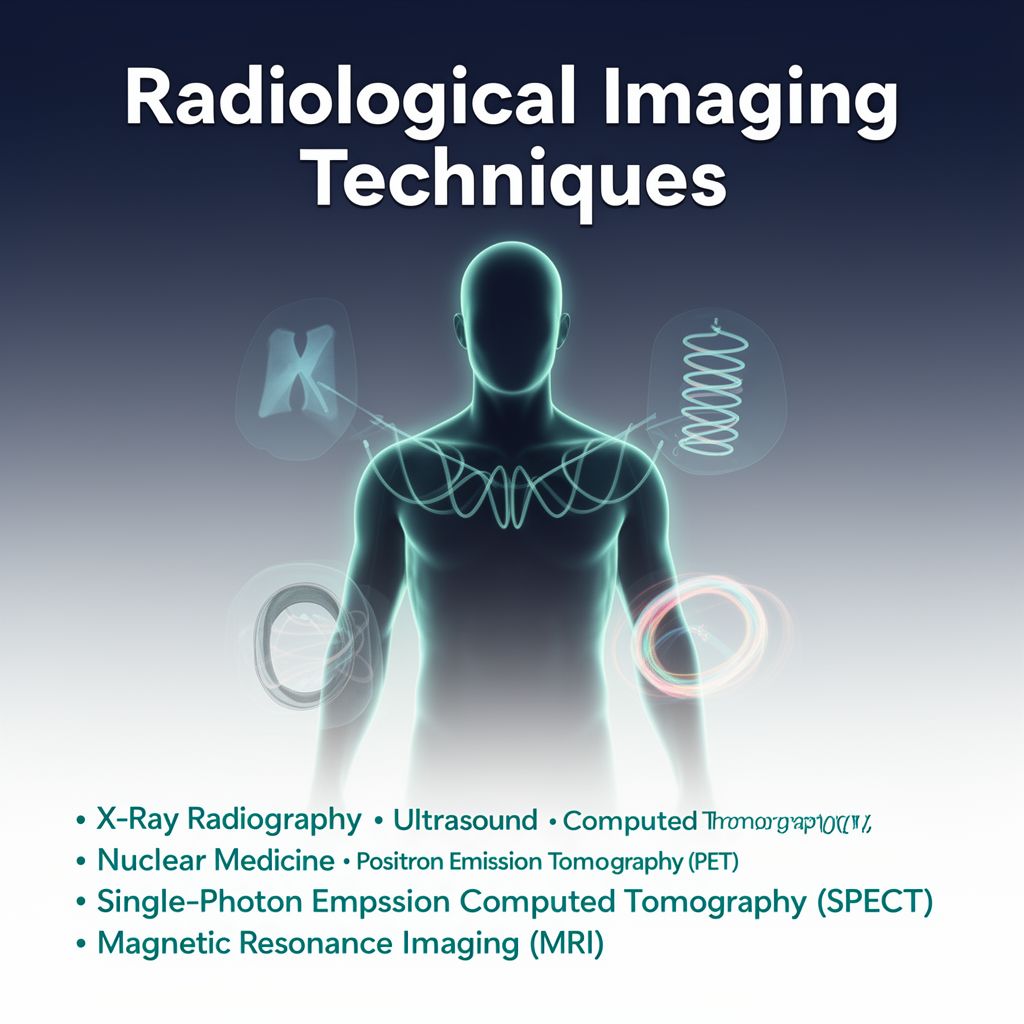
This study material has been compiled from a lecture audio transcript and copy-pasted text provided by the user.
🩺 Radiological Imaging Techniques: A Comprehensive Study Guide
📚 Introduction to Medical Imaging
Radiological imaging techniques are indispensable tools in modern medicine, allowing for non-invasive visualization of the human body's internal structures and functions. These methods aid in diagnosis, treatment planning, and monitoring disease progression. This guide will explore the principles, technologies, and applications of key imaging modalities, including X-ray radiography, Computed Tomography (CT), Single-Photon Emission Computed Tomography (SPECT), and Positron Emission Tomography (PET).
1️⃣ X-Ray Radiography
X-ray radiography is a foundational imaging technique that utilizes X-rays to create images of the body's internal structures.
💡 Principle of X-Ray Generation
The core of X-ray production is the X-ray tube.
- Mechanism: High-energy electrons are generated and accelerated towards a target material (anode). Upon impact, these electrons ionize the target, producing X-rays and heat.
- Target Material: The material of the anode (e.g., Cobalt-60, Technetium) determines the X-ray spectrum.
- Safety Note: An X-ray tube is not radioactive when switched off.
- Parameters:
- Anodic Voltage (kV): Determines the X-ray wavelength. Higher voltage leads to higher energy and shorter wavelengths. X-ray energy is limited by this voltage (e.g., an 80kV tube cannot produce X-rays > 80keV).
- Cathode Current (mA): Controls the number of electrons generated. Less than 1% of electrons produce X-ray photons; the rest generate heat.
- Focal Spot Size: Affects image resolution.
- X-ray Nature: X-rays are photons generated from the electron shell. They exhibit:
- Braking Radiation (Bremsstrahlung): Produces a continuous spectrum.
- Characteristic Radiation: Results from the ejection of electrons, yielding a characteristic spectrum.
⚙️ Beam Control and Interaction
- Collimation: A collimator is a beam-limiting device, analogous to lenses in optics. Since X-rays are emitted isotropically (in all directions) from the tube, collimators focus the radiation into a usable beam.
- Primary Collimation: Focuses the beam entering the patient.
- Secondary Collimation: Focuses radiation exiting the patient, crucial for reducing scatter.
- Collimators are made of X-ray absorbent material.
- Filters: Used to remove undesired wavelengths, particularly low-frequency X-rays that would be absorbed by the skin, and to limit exposure to off-target body parts using compensating filters.
- Absorption and Transmission: X-ray absorption by the body is non-uniform. Tissues are detected based on their differential absorption and transmission.
- Interactions like Bremsstrahlung and Compton scattering occur, necessitating secondary collimation and limiting spatial resolution.
📸 Detection and Amplification
- Image Intensifier: Allows for lower X-ray doses. It uses scintillation to detect non-absorbed X-rays and amplifies the signal via a photocathode and phosphor excitation, captured by a CCD camera.
- Image Detection:
- Classic: X-ray film.
- Modern: Flat panels with large silicon sensors (similar to digital cameras), typically 2000x2000 pixels, storing images in computer memory.
🖼️ Planar X-Ray Techniques
- Skiagraphy (Planar X-ray Projection):
- Based on photochemical reaction and electronic screening digitalization.
- Produces still images.
- Shows the entire depth of the imaged part, leading to tissue shading and overlap.
- High density = high absorbance = low transmission = light color (negative image).
- Skiascopy:
- Based on image amplification and CCD technology.
- Provides real-time, dynamic imaging.
- Also shows the entire depth with tissue shading and overlap.
- High density = high absorbance = low transmission = dark color (positive image).
- Operates at a low frame rate (e.g., 4 frames per second) to reduce patient exposure.
- Uses: Monitoring dynamic processes (e.g., arteriography), guiding precise surgical interventions (e.g., stent placement).
🧪 Contrast Agents and Advanced Techniques
- Problem: Soft tissues have very similar X-ray absorbance, leading to low contrast.
- Solution: Contrast agents are used to enhance visibility.
- Positive Contrast (e.g., iodine): Increases absorption, making structures more visible (e.g., blood vessels).
- Negative Contrast (e.g., air): Decreases absorption (e.g., in intestines).
- Digital Subtraction Angiography (DSA): Addresses the issue of all radio-opaque tissues obscuring soft tissues of interest.
- Process: Two images are taken (one with, one without contrast agent), and the results are subtracted to produce a 'clean' image of soft tissues.
- When performed in a CT scanner, it's called CT Angiography (CTA).
- Densitometry: Measures radiodensity (relative inability of electromagnetic radiation to pass through a material). High absorbance indicates high radiodensity.
- Application: Used to measure the density of biological tissue, e.g., bone density for osteoporosis diagnosis.
2️⃣ Computed Tomography (CT)
CT imaging uses X-rays combined with computer processing to create cross-sectional images (slices) of the body.
💡 Principle & Reconstruction
- Principle: Narrow X-ray images are taken from multiple angles around the patient. These projections are then computationally reconstructed to form a 3D image.
- CT Scanner: The device that performs this process.
- Image Reconstruction Methods:
- Back Projection: A fast method involving backward projection of the incident radiation beam. Can produce many artifacts.
- Interactive Reconstruction: Compares real measured values with estimated values from a theoretical image model. More refined, solving n-equations for n-unknown variables.
- Result: An absorption measure per voxel (3D pixel) at a known location.
📊 Differentiating Tissues (Hounsfield Unit, HU)
- Hounsfield Unit (HU): Used to estimate tissue density/type based on absorption values.
- Procedure:
- Calculate absorption of different X-ray frequencies.
- Correct for artifacts at bone/soft tissue interfaces (Hounsfield effect: high absorption of soft X-rays by bones).
- Reconstruct the 3D image.
- Voxel absorption values are expressed relative to water in Hounsfield units.
- Displayed in shades of gray.
- Customization: Colors on CT images are fully computed and can be adjusted using Hounsfield window and level settings to suit diagnostic needs.
🚀 Special CT Technologies
- Spectral CT: Utilizes advanced chip technology (e.g., Medipix3 from CERN) for much finer tissue differentiation.
- Result: A 3D color image distinguishing muscles, water, fat.
- Note: MRI offers excellent soft tissue imaging without X-rays.
- Dual Source/Dual Energy CT:
- Dual Source CT: Employs two X-ray tubes and two detector systems. Increases speed and shortens acquisition times (e.g., ~80 ms), beneficial for cardiac CT.
- Dual Energy CT: Uses two X-ray tubes with different energies (e.g., 80 + 140 kV). Allows for better quantification of density distribution and differential density analysis.
- Cost: These advanced systems are considerably expensive.
3️⃣ Nuclear Medicine: Scintigraphy, SPECT, and PET
Nuclear medicine techniques detect radiation emitted from within the body, providing functional rather than purely anatomical information.
💡 Scintigraphy Principle
- Detection: Detects radiation emitted by an internal source (radiopharmaceuticals) rather than transmitted radiation.
- Function: Allows observation of metabolism and other physiological processes. The distribution of the radioindicator reflects organ function or pathological conditions.
- Administration: Radiopharmaceuticals can be administered orally, by injection, or through respiration.
- Types of Scintigraphy:
- Dimension-based: Planar (2D projection), Tomographic (3D projection).
- Time-based: Static (screens captured without time dependency), Dynamic (observes processes changing over time).
- Parametric: Qualitative (visual evaluation), Quantitative (obtaining radionuclide parameters).
- Gamma Camera: Also known as a scintillation or Anger camera, it detects and visualizes gamma radiation using a scintillation crystal. Used for static and dynamic imaging.
4️⃣ Single-Photon Emission Computed Tomography (SPECT)
SPECT is a tomographic nuclear medicine technique that provides 3D functional images.
- Principle: Uses a radiopharmaceutical gamma source. A series of images are acquired from multiple directions with rotating scintillation cameras. These images are then reconstructed to localize the source within the body.
- Combination with CT: SPECT is usually combined with a low-dose CT scan to provide anatomical context, as SPECT alone offers functional data but lacks detailed anatomical information.
- Low Dose Mode: SPECT images at low gamma radiation doses with approximate, low-resolution morphological CT images.
- Full-Featured Diagnostic Mode: High-resolution CT images with detailed anatomical information, but with a higher effective dose for the patient.
- Radiopharmaceuticals: Radioisotopes bound to biological molecules target specific organs, tissues, or cells.
- Examples:
- Technetium-99m (99mTcO4-): Pure gamma emitter.
- Iodine-131 (NaI form): Used for thyroid gland imaging.
- Thallium-201 (201Tl): Myocardium perfusion (replaces K).
- Gallium-67 (67Ga): Inflammation, tumors.
- Xenon-133 (133Xe): Lung ventilation.
- Strontium-90 (90Sr): Bones (replaces Ca).
- The isotope and radioligand are chosen based on the target tissue.
- Examples:
- ✅ Advantages:
- Higher contrast than planar scintigraphy.
- Allows for quantification of radiopharmaceuticals in tissues.
- SPECT alone represents less radiation burden than a full CT.
- ⚠️ Disadvantages:
- Quantification accuracy reduced by attenuated radiation (Compton or photoelectric effect).
- Poor spatial resolution compared to MRI.
- Long examination time.
- Radiation dose depends on the decay of the radiopharmaceutical, not imaging duration.
5️⃣ Positron Emission Tomography (PET)
PET is a highly sensitive nuclear medicine technique based on positron annihilation.
- Principle:
- A radiopharmaceutical emitting positrons (β+) is administered.
- When a positron encounters an electron, they undergo annihilation, producing two gamma photons.
- These photons are emitted at 180° to each other, each with 510 keV energy.
- The average positron travels 1-3mm before annihilation.
- A ring of detectors around the patient simultaneously detects these two photons, indicating that the emission occurred along the line connecting the two detection points.
- Most Common Modality: 18F-fluorodeoxyglucose (FDG).
- FDG behaves like glucose and is absorbed by highly metabolically active tissues (e.g., tumor cells).
- Often combined with CT or MRI for enhanced diagnostic accuracy.
- Applications:
- Primary Oncology Diagnostics: Localization and sizing of tumors (>90% of PET use).
- Neurology: Brain activity studies.
- Perfusion: Extracorporeal circulation.
- Myocardium Investigation.
- Radiopharmaceutical Production: Emitters often have very short half-lives, requiring on-site production in medical cyclotrons.
- ✅ Advantages:
- High diagnostic accuracy and spatial resolution.
- Modern devices have higher detection efficiency than SPECT (no collimators needed).
- Bioactive elements used in PET are excreted faster than other radioactive markers in SPECT.
- ⚠️ Disadvantages:
- High technical complexity.
- High purchase price of the device.
- Requires a cyclotron for radiopharmaceutical production.
- Typically performed in hybrid MRI-PET or CT-PET machines.