 Podit
Podit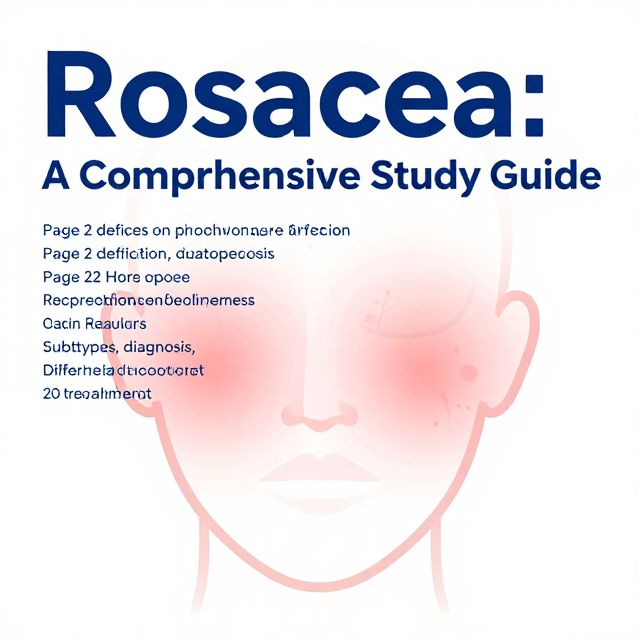
Rosacea: A Comprehensive Study Guide
Source Information: This study material has been compiled and organized from a lecture audio transcript, personal notes, and copy-pasted text (likely from a PDF or PowerPoint presentation). All content has been synthesized and presented in English.
📚 Introduction to Rosacea
Rosacea is a chronic inflammatory skin condition primarily affecting the face. It is characterized by persistent redness, small red bumps (papules), pus-filled lesions (pustules), and visible small blood vessels (telangiectasias). In some cases, it can lead to permanent skin thickening and irregular surface nodularity, known as phymatous changes. Understanding Rosacea involves recognizing its distinct classifications and the complex interplay of factors contributing to its development.
📊 Epidemiology
Rosacea is a relatively common condition with a reported prevalence ranging from 2.3% to 10% of the population.
Risk Factors:
- Fair-skinned individuals (Fitzpatrick skin types I and II) are more susceptible.
- A family history of Rosacea significantly increases an individual's risk.
Gender Distribution:
- More frequently observed in women.
- However, men tend to develop more severe forms, particularly phymatous changes like rhinophyma.
🔬 Pathogenesis: Unraveling the Mechanisms
The development of Rosacea involves multiple interconnected mechanisms. Five key areas contribute to its pathogenesis:
1️⃣ Neurovascular Dysregulation
- ✅ Increased Blood Flow: During flushing attacks, there's a significant increase in blood flow to the skin.
- ✅ Vascular Dilation: Triggered by factors like heat, spicy foods, and alcohol, leading to erythema.
- ✅ TRPV Channels: Transient Receptor Potential Vanilloid channels activate sensory nerve endings, causing neurogenic inflammation. These channels respond to heat, alcohol, and other triggers.
2️⃣ Immune Dysregulation
- ✅ Kallikrein 5 (KLK5): An enzyme that activates the antimicrobial peptide LL-37.
- ✅ LL-37 Antimicrobial Peptide: Increased levels trigger inflammation, contribute to vascular dilation, and promote angiogenesis (new blood vessel formation).
- ✅ Toll-Like Receptors (TLR2): Overexpression, especially in papulopustular Rosacea, amplifies the inflammatory response.
3️⃣ Demodex Mites (Folliculorum and Brevis)
- ✅ Higher Numbers: These mites, normally skin flora, are found in significantly higher numbers in Rosacea patients.
- ✅ Bacillus oleronius: A bacterium associated with Demodex mites, believed to exacerbate local inflammatory responses.
- ✅ Cellular Immune Response: Bacterial antigens activate cellular immune responses.
- ✅ Histopathology: Dense inflammatory infiltrates and perifollicular lymphocytic infiltration are observed in Demodex-associated areas.
4️⃣ UV Radiation's Role
- ✅ Increased Angiogenesis: UV exposure, particularly UVB, increases angiogenesis and vascular dilation.
- ✅ Reactive Oxygen Species (ROS): UV radiation elevates ROS production, causing vascular damage and dermal matrix breakdown.
- ✅ Matrix Metalloproteinases (MMP) Activation: ROS activate MMPs, enzymes with destructive effects on connective tissue.
5️⃣ Skin Barrier Dysfunction
- ✅ Increased Transepidermal Water Loss: Rosacea patients often show increased water loss through the skin.
- ✅ Irritant Permeability: This compromised barrier makes the skin more permeable to irritants, leading to increased sensitivity and dryness.
🩺 Clinical Subtypes and Symptoms
Rosacea is typically divided into four primary clinical subtypes, with Granulomatous Rosacea sometimes considered a fifth.
A. Erythematotelangiectatic Rosacea (ETTR)
- ✅ Key Features: Persistent central facial erythema (redness) and visible telangiectasias (spider veins).
- ✅ Flushing: Transient episodes of redness, often triggered by heat, spicy foods, and alcohol.
- ✅ Skin Sensitivity: Patients frequently report increased skin sensitivity.
B. Papulopustular Rosacea (PPR)
- ✅ Key Features: Small, dome-shaped papules (red bumps) and pustules (pus-filled lesions).
- ✅ Location: Commonly affects the central areas of the face (nose, forehead, cheeks).
- ✅ Distinguishing Feature: Absence of comedones (blackheads/whiteheads), differentiating it from acne vulgaris.
- ✅ Inflammatory Process: Marked by significant inflammation.
C. Phymatous Rosacea
- ✅ Key Features: Skin thickening and enlargement of sebaceous glands.
- ✅ Rhinophyma: The most common form, involving progressive thickening, deformation, and textural changes of the nose.
- ✅ Nodular Components: Phymatous changes can form nodular structures, leading to significant aesthetic disfigurement.
D. Ocular Rosacea
- ✅ Key Features: Affects the eyes, causing dryness, itching, stinging, and blepharitis (eyelid inflammation).
- ✅ Clinical Findings: Redness and swelling of eyelids, conjunctival inflammation.
- ⚠️ Complications: Can lead to severe complications like keratitis (cornea inflammation) and scleritis (inflammation of the white outer eye wall).
Granulomatous Rosacea
- Some authors consider this a subtype, characterized by granulomas and more monomorphic papules on the skin.
🔍 Diagnosis
Diagnosis of Rosacea is primarily clinical.
- ✅ Patient History: Thorough review of symptoms and triggers.
- ✅ Dermatological Examination: Visual inspection of the skin.
- ✅ Dermoscopy: Sometimes used for closer examination of skin lesions.
💡 Differential Diagnosis
It is crucial to differentiate Rosacea from other conditions with similar presentations:
- Seborrheic Dermatitis: Unlike Rosacea, it typically affects the sides of the nose and the scalp.
- Acne Vulgaris: Distinguished by the presence of comedones, younger age of onset, and involvement of the chest and back.
- Lupus Erythematosus: May present with a "butterfly" rash on the face but is associated with systemic symptoms like joint pain.
- Demodicosis: An infestation of Demodex mites, more common in immunosuppressed individuals (e.g., HIV, cancer patients), which can mimic Rosacea.
💊 Treatment and Management Strategies
Treatment aims to control symptoms, reduce flare-ups, and improve quality of life.
A. General Treatment Principles
- ☀️ Sun Protection: Minimize UV exposure and consistently use broad-spectrum sunscreens.
- 🧼 Gentle Skin Cleansing: Use soap-free cleansers to maintain skin pH balance; avoid harsh scrubbing.
- 🚫 Avoid Irritants: Identify and avoid trigger factors like alcohol, spicy foods, and hot beverages.
B. Topical Therapies
- Brimonidine (0.33% gel): Reduces erythema in ETTR via alpha-adrenergic agonist effect (vasoconstriction).
- Oxymetazoline (1% cream): Similar mechanism, effective for persistent redness.
- Metronidazole and Azelaic Acid: First-line for papulopustular lesions due to anti-inflammatory effects.
- Ivermectin (1% cream): Effective in papulopustular Rosacea, targeting Demodex mites and suppressing inflammation.
C. Systemic Therapies
- Doxycycline (low-dose, 40 mg): Long-term treatment for papulopustular lesions, controls inflammation without significant antibiotic effects.
- Isotretinoin: Reserved for resistant cases; beneficial in preventing nasal deformities in phymatous Rosacea.
D. Laser Therapy
- Vascular Lasers (Pulsed Dye Laser - PDL, Intense Pulsed Light - IPL): Highly effective in reducing telangiectasias and persistent erythema by targeting visible blood vessels.
E. Surgical Treatment
- For Phymatous Rosacea:
- Excision: Surgical removal of excess tissue.
- CO2 Laser Therapy: Reshapes affected areas.
- Electrocauterization: Removes thickened skin and improves cosmetic appearance.
The choice of treatment depends on the specific subtype, severity, and individual patient factors, often requiring a multi-faceted approach.