 Podit
Podit
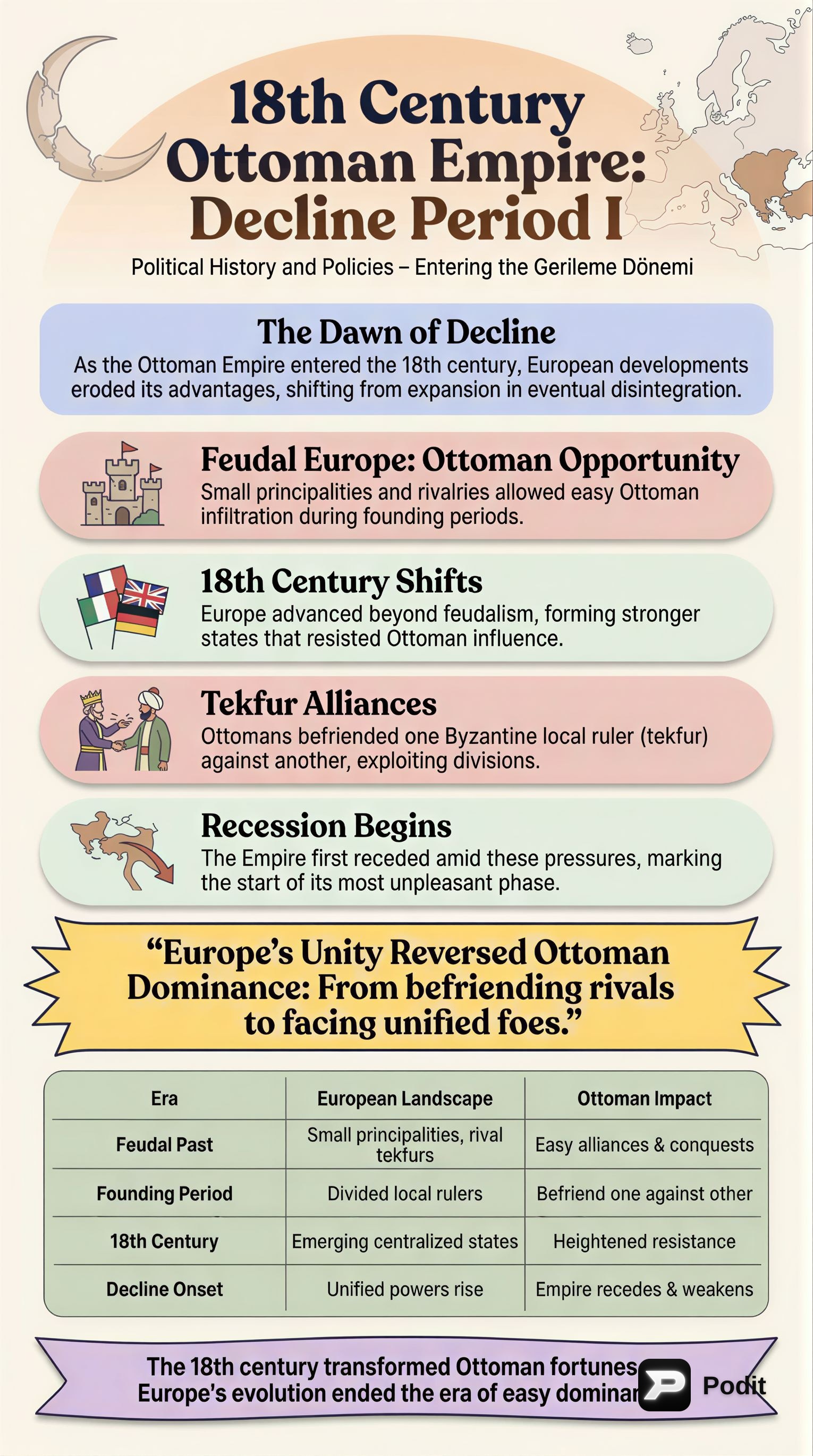
This content is based on a YouTube video.
The Ottoman Empire in the 18th Century: The Period of Decline
Introduction 📚
The 18th century marks a pivotal and challenging era for the Ottoman Empire, often referred to as its 'Decline Period.' During this time, an empire that once spanned three continents began to face significant internal weaknesses and relentless external pressures. Understanding this period is crucial for grasping the broader trajectory of the Ottoman Empire and its eventual dissolution, setting the stage for the "Sick Man of Europe" narrative of the 19th century. This study material will explore the key factors, conflicts, and legacies that defined the Ottoman Empire's 18th-century decline.
I. Understanding the Concept of Decline 📉
The term 'decline' in this context refers to a period characterized by:
- Erosion of Central Authority: Weakening of the Sultan's power and effective governance.
- Military Stagnation: Inability to keep pace with European military advancements.
- Economic Deterioration: Loss of revenue and inability to adapt to global economic shifts.
- Territorial Losses: Significant ceding of lands to rival powers.
- Loss of Prestige: Diminished standing on the international stage.
II. Factors Contributing to Decline: Internal Weaknesses and External Pressures
The 18th century saw a confluence of internal decay and increasing external threats that severely impacted the Ottoman Empire.
A. Internal Weaknesses 📉
The empire's vast internal structure, once a source of strength, became a major vulnerability.
-
Administrative Corruption and Inefficiency:
- Bureaucracy: The once efficient Ottoman administration became plagued by corruption and inefficiency.
- Nepotism and Bribery: These practices became widespread, eroding the central authority and undermining effective governance.
- Impact: This led to a breakdown in law and order, reduced state revenues, and a general weakening of the state's ability to implement reforms or respond to crises.
-
Military Stagnation: The Janissary Corps
- Transformation: The Janissaries, originally an elite fighting force, transformed into a privileged and undisciplined group.
- Focus Shift: Their interests shifted from military prowess to political power and personal gain.
- Consequences: This led to a decline in military effectiveness, resistance to modernization, and frequent interference in state affairs, often through revolts.
-
Economic Struggles:
- Shift in Global Trade Routes: The discovery of new sea routes (e.g., around Africa) bypassed Ottoman-controlled lands, leading to a significant decrease in customs revenues.
- Lack of Industrialization: The empire's inability to industrialize and compete with rapidly industrializing European manufacturing nations meant a constant outflow of silver and gold to purchase European goods.
- Impact: This resulted in economic stagnation, inflation, and a weakening of the empire's financial base.
B. External Pressures ⚔️
Simultaneously, the Ottoman Empire faced formidable challenges from rapidly modernizing European powers.
-
Rising European Powers:
- Primary Adversaries: Russia and Austria emerged as the most significant threats, actively seeking to expand their territories at the Ottomans' expense.
- Modernization: These powers were rapidly modernizing their armies and administrative structures, creating a significant military disparity.
-
Shift in the Balance of Power:
- European Dominance: The balance of power in Europe had shifted dramatically, leaving the Ottomans increasingly vulnerable and on the defensive.
- Territorial Ambitions: European states viewed the weakening Ottoman Empire as an opportunity for territorial gains and strategic advantages.
III. Key Conflicts and Territorial Losses 🌍
The 18th century was punctuated by a series of devastating wars that underscored the empire's declining military and political strength.
A. The Russo-Turkish War (1768-1774)
This conflict was perhaps the most significant and damaging war for the Ottomans in the 18th century.
- Outcome: The war concluded with the signing of the Treaty of Küçük Kaynarca in 1774. ✅
- Significance of the Treaty:
- Territorial Gains for Russia: Russia gained significant territories, including access to the Black Sea, which was a major strategic victory.
- Protection of Orthodox Christians: Crucially, the treaty granted Russia the right to protect Orthodox Christians within the Ottoman Empire. ⚠️ This clause became a persistent pretext for future Russian interference in Ottoman internal affairs, effectively allowing a foreign power to meddle in domestic policy.
- Symbol of Decline: The treaty was a monumental blow to the Ottomans, symbolizing their diminished power and the growing influence of European states.
B. The Austro-Turkish War (1787-1791)
- Further Weakness: This conflict, despite some Ottoman resistance, further demonstrated their military inferiority compared to European forces.
- Resource Drain: These wars not only resulted in territorial losses but also severely drained the empire's already strained resources and morale.
- Reform Attempts: The Ottomans were constantly attempting to implement military reforms inspired by European models, but these efforts were often "too little, too late" to reverse the tide.
IV. Legacy of the 18th Century Decline 📚
The challenges and events of the 18th century had profound and lasting consequences for the Ottoman Empire.
- Combined Impact: The period showcased how a combination of internal decay (administrative corruption, military stagnation) coupled with relentless external pressure from modernizing European powers led to significant territorial losses and a weakening of central authority.
- Symbolic Turning Point: The Treaty of Küçük Kaynarca stands out as a critical turning point, marking a new era in Ottoman-Russian relations and European interventionism.
- Loss of Vitality: The decline was not merely about losing land; it encompassed a loss of prestige, economic vitality, and the fundamental ability to govern effectively.
- Foundation for Future Narratives: This era laid the groundwork for the infamous "Sick Man of Europe" narrative that would come to define the Ottoman Empire in the 19th century, highlighting its perceived weakness and vulnerability to European powers.
💡 Insight: Understanding the specific internal and external factors of the 18th century is key to comprehending why the Ottoman Empire, despite its vast history, entered a prolonged period of decline that ultimately led to its dissolution.