Arterial Supply of the Trunk: Aorta and its Branches - kapak
Sağlık#aorta#arterial system#human anatomy#thoracic aorta

Arterial Supply of the Trunk: Aorta and its Branches

Explore the intricate arterial network of the human trunk, focusing on the aorta's divisions, visceral and parietal branches, and their critical roles in supplying vital organs and structures.

nazaninmz2004January 20, 2026 ~17 dk toplam
01

Flash Kartlar

25 kart

Karta tıklayarak çevir. ← → ile gez, ⎵ ile çevir.

1 / 25
Tüm kartları metin olarak gör
  1. 1. What is the primary function of the aorta in the human circulatory system?

    The aorta is the primary conduit originating from the left ventricle of the heart. Its main function is to distribute oxygenated blood to the entire body, ensuring that all tissues and organs receive the vital oxygen and nutrients they need to function properly. It acts as the main pipeline for systemic circulation.

  2. 2. Where does the aorta originate within the heart?

    The aorta originates directly from the left ventricle of the heart. This powerful muscular chamber pumps oxygenated blood into the aorta, initiating its journey throughout the body. Its origin point is crucial for its role as the main artery.

  3. 3. What are the three main sections of the aorta based on its anatomical position?

    Based on its anatomical position, the aorta is divided into three main sections: the ascending aorta, the aortic arch, and the descending aorta. These divisions reflect its extensive course from the heart, curving over the top, and then extending downwards through the chest and abdomen.

  4. 4. How is the descending aorta further subdivided?

    The descending aorta is further subdivided into two main parts: the pars thoracica aortae, also known as the thoracic aorta, and the pars abdominalis aortae, known as the abdominal aorta. This subdivision is based on whether it passes through the thoracic cavity or the abdominal cavity, each supplying different regions of the trunk.

  5. 5. What is the anatomical extent of the pars thoracica aortae?

    The pars thoracica aortae, or thoracic aorta, extends from the fourth thoracic vertebra (T4) down to the twelfth thoracic vertebra (T12). It traverses the posterior mediastinum within the chest cavity, giving off branches to structures within this region before passing through the diaphragm.

  6. 6. What organs does the thoracic aorta supply, excluding the heart?

    The thoracic aorta supplies various thoracic organs, specifically excluding the heart itself, which has its own coronary circulation. It provides blood to the lungs (via bronchial arteries), esophagus (via esophageal arteries), pericardium (via pericardial arteries), and other mediastinal structures (via mediastinal arteries). It also supplies the chest wall.

  7. 7. How are the branches of the thoracic aorta categorized?

    The branches of the thoracic aorta are categorized into two main types: visceral branches and parietal branches. Visceral branches supply the internal organs within the thoracic cavity, while parietal branches supply the walls of the thoracic cavity, such as muscles and bones.

  8. 8. Name the visceral branches of the thoracic aorta and their target organs.

    The visceral branches of the thoracic aorta include the bronchial arteries, which supply the lungs; the esophageal arteries, supplying the esophagus; the pericardial arteries, supplying the pericardium; and the mediastinal arteries, which supply various structures within the mediastinum. These arteries ensure the vital blood supply to the thoracic viscera.

  9. 9. What are the primary parietal branches of the thoracic aorta?

    The primary parietal branches of the thoracic aorta are the nine pairs of posterior intercostal arteries, which supply the intercostal spaces from the third to the eleventh. Additionally, the subcostal artery (below the twelfth rib) and the superior phrenic artery (supplying the diaphragm) are also parietal branches. These arteries are crucial for the blood supply to the chest wall and diaphragm.

  10. 10. From where do the first and second posterior intercostal arteries originate?

    The first and second posterior intercostal arteries do not originate directly from the thoracic aorta. Instead, they typically originate from the superior intercostal artery, which is a branch of the costocervical trunk, itself a branch of the subclavian artery. This is an important anatomical distinction for the upper intercostal spaces.

  11. 11. Describe the typical arrangement of structures within the intercostal spaces.

    Within the intercostal spaces, the structures are typically arranged from superior to inferior as Vein, Artery, and Nerve (VAN). This consistent order, with the intercostal vein superior, the intercostal artery in the middle, and the intercostal nerve inferior, is clinically significant for procedures like thoracentesis to avoid neurovascular damage.

  12. 12. What specific areas do the posterior intercostal arteries supply?

    The posterior intercostal arteries supply the chest wall and the lateral aspect of the breast. They also give off specific rami that supply the spinal cord, back muscles, and skin. Furthermore, they contribute to the blood supply of the intercostal, pectoral, and serratus anterior muscles, ensuring comprehensive nourishment to these regions.

  13. 13. Name two additional arteries originating from the thoracic aorta and their supply.

    Two additional arteries originating from the thoracic aorta are the subcostal artery and the superior phrenic artery. The subcostal artery runs beneath the twelfth rib, supplying the abdominal wall and muscles in that region. The superior phrenic artery supplies the superior aspect of the diaphragm, contributing to its blood supply.

  14. 14. Where does the pars abdominalis aortae begin and end?

    The pars abdominalis aortae begins after the aorta passes through the aortic hiatus of the diaphragm, typically at the level of the twelfth thoracic vertebra (T12). It extends downwards to the level of the fourth lumbar vertebra (L4), where it terminates by bifurcating into the common iliac arteries.

  15. 15. Into what arteries does the abdominal aorta bifurcate at its termination?

    At its termination, typically at the level of the fourth lumbar vertebra (L4), the abdominal aorta bifurcates into its two terminal branches: the right common iliac artery and the left common iliac artery. These common iliac arteries then further divide to supply the pelvis and lower limbs.

  16. 16. How are the visceral branches of the abdominal aorta categorized?

    The visceral branches of the abdominal aorta are categorized into two groups: single, unpaired branches and paired branches. The single, unpaired branches arise from the anterior surface and primarily supply the digestive system and spleen. The paired branches arise from the lateral surfaces and supply other abdominal organs like the kidneys and gonads.

  17. 17. Name the single, unpaired visceral branches of the abdominal aorta.

    The single, unpaired visceral branches of the abdominal aorta, which arise from its anterior surface, are the celiac trunk, the superior mesenteric artery (SMA), and the inferior mesenteric artery (IMA). These three major arteries are crucial for supplying the gastrointestinal tract and associated organs.

  18. 18. What organs does the celiac trunk collectively supply?

    The celiac trunk, a short and thick artery, quickly divides to collectively supply the lower esophagus, stomach, liver, duodenum (proximal part), pancreas, and spleen. Its three main branches—left gastric, common hepatic, and splenic arteries—ensure a rich blood supply to these vital upper abdominal organs.

  19. 19. Name the three main branches of the celiac trunk.

    The three main branches of the celiac trunk are the left gastric artery, the common hepatic artery, and the splenic artery. These branches diverge almost immediately after the celiac trunk originates from the aorta, distributing blood to the foregut derivatives.

  20. 20. What organs does the superior mesenteric artery (AMS) supply?

    The superior mesenteric artery (AMS) supplies a significant portion of the midgut derivatives. Specifically, it provides blood to the lower duodenum, jejunum, ileum, cecum, ascending colon, and the right half of the transverse colon. It is vital for the absorption of nutrients in the small intestine and initial processing in the large intestine.

  21. 21. Name some key branches of the superior mesenteric artery.

    Key branches of the superior mesenteric artery include the jejunal arteries, ileal arteries, ileocolic artery, right colic artery, and middle colic artery. These branches fan out to supply the various parts of the small intestine and the proximal half of the large intestine, ensuring extensive vascularization.

  22. 22. What organs does the inferior mesenteric artery (AMI) supply?

    The inferior mesenteric artery (AMI) supplies the hindgut derivatives. This includes the left half of the transverse colon, the descending colon, the sigmoid colon, and the upper rectum. It plays a crucial role in the blood supply to the distal large intestine and the final stages of waste processing.

  23. 23. Name some key branches of the inferior mesenteric artery.

    Key branches of the inferior mesenteric artery include the left colic artery, the sigmoid arteries (typically 2-4), and the superior rectal artery. These branches distribute blood to the distal large intestine, from the left transverse colon down to the upper part of the rectum, forming important anastomoses.

  24. 24. What is the significance of anastomoses like the marginal artery of the colon?

    Anastomoses, such as the marginal artery of the colon (of Drummond), are critical for ensuring collateral blood flow to the intestines. If one major artery becomes occluded, these connections can provide an alternative route for blood supply, preventing ischemia and necrosis of the bowel. They are vital for maintaining intestinal viability.

  25. 25. Name the paired visceral branches of the abdominal aorta and their target organs.

    The paired visceral branches of the abdominal aorta include the middle suprarenal arteries, supplying the adrenal glands; the renal arteries, which are the thickest branches and supply the kidneys; and the testicular or ovarian arteries, supplying the gonads (testes in males, ovaries in females) and associated structures. These branches arise from the lateral surfaces of the aorta.

02

Bilgini Test Et

15 soru

Çoktan seçmeli sorularla öğrendiklerini ölç. Cevap + açıklama.

Soru 1 / 15Skor: 0

Which chamber of the heart does the aorta originate from?

03

Detaylı Özet

7 dk okuma

Tüm konuyu derinlemesine, başlık başlık.

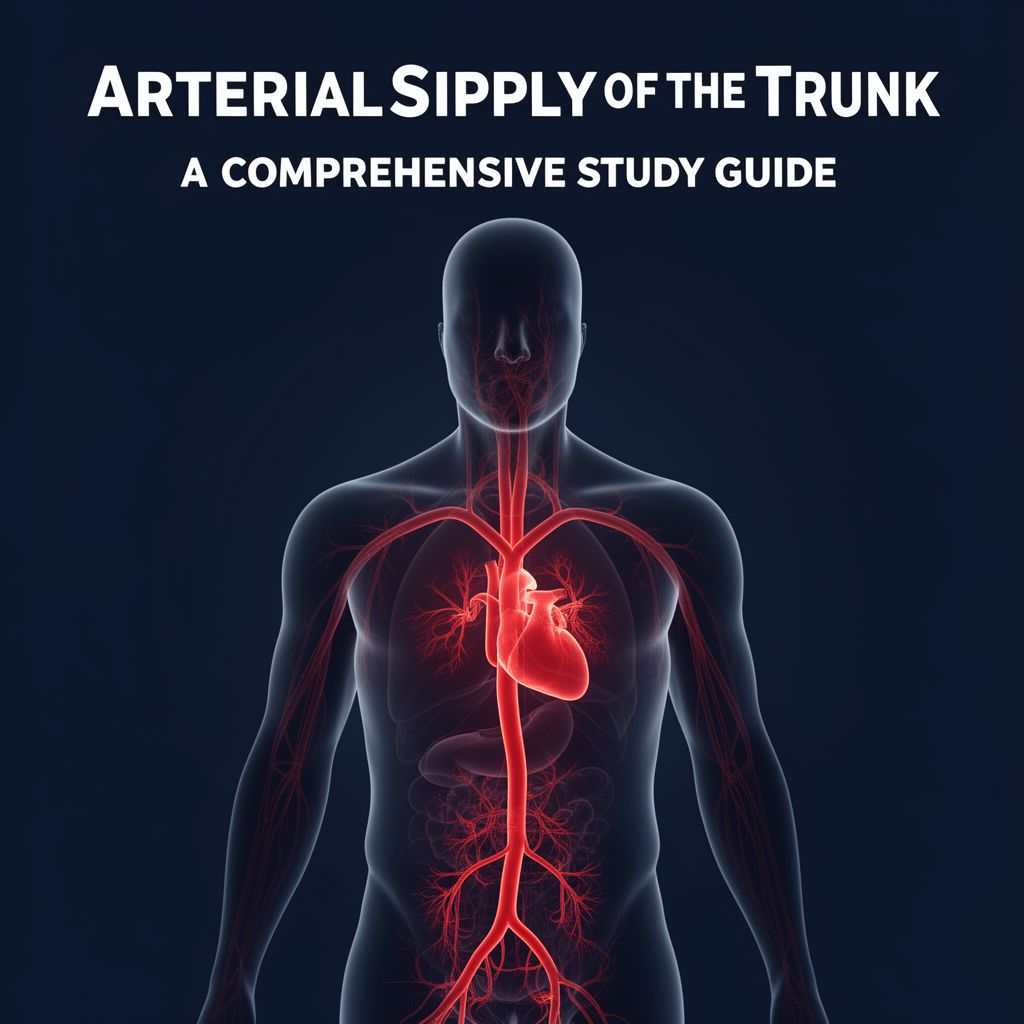
Arterial Supply of the Trunk: A Comprehensive Study Guide

Source Information: This study material has been compiled from a copy-pasted text and a lecture audio transcript.


📚 Introduction to the Aorta and its Divisions

The arterial blood supply of the human trunk is fundamentally driven by the aorta, the largest artery in the body. Originating from the left ventricle of the heart, the aorta is the primary conduit responsible for distributing oxygenated blood to the entire body. Its extensive course is divided into three main sections based on its anatomical position:

  1. Ascending Aorta (Aorta Ascendens): Extends from the left ventricle to the right second intercostal space.
  2. Aortic Arch (Arcus Aortae): Spans from the right second intercostal space to the left second intercostal space, typically at the level of the T4 vertebra.
  3. Descending Aorta (Aorta Descendens): Continues from the aortic arch downwards.

The descending aorta is further subdivided into two major parts:

  • Thoracic Aorta (Pars Thoracica Aortae): Located within the chest cavity.
  • Abdominal Aorta (Pars Abdominalis Aortae): Located within the abdominal cavity.

🫁 Thoracic Aorta (Pars Thoracica Aortae)

The thoracic aorta is the segment of the descending aorta that extends from the T4 to the T12 vertebral levels. Initially positioned to the left of the vertebral column, it gradually approaches the midline as it descends, becoming centrally located at the aortic hiatus.

This section of the aorta is responsible for supplying blood to the thoracic organs (excluding the heart itself) and the chest wall. Its branches are categorized into visceral and parietal.

✅ Visceral Branches of the Thoracic Aorta

These branches supply the organs within the thoracic cavity:

  • Bronchial Arteries (Rr. Bronchiales): 4-5 thin branches that are the nutritive arteries for the lungs.
  • Esophageal Arteries (Rr. Oesophageales): 4-5 thin branches arising from the anterior surface of the aorta, supplying the esophagus.
  • Pericardial Arteries (Rr. Pericardiaci): Small branches distributed on the posterior surface of the pericardium.
  • Mediastinal Arteries (Rr. Mediastinales): Small, thin branches supplying lymph nodes and connective tissue within the mediastinum.

✅ Parietal Branches of the Thoracic Aorta

These branches supply the walls of the thoracic cavity:

  • Posterior Intercostal Arteries (Aa. Intercostales Posteriores):
    • Nine pairs (3rd-11th) arise directly from the thoracic aorta.
    • The 1st and 2nd posterior intercostal arteries originate from the superior intercostal artery (a. intercostalis suprema), which is a branch of the costocervical trunk (truncus costocervicalis) from the subclavian artery.
    • These arteries travel within their respective intercostal spaces, typically in the costal groove.
    • They anastomose with the anterior intercostal arteries (branches of the internal thoracic artery or musculophrenic artery).
    • 💡 Clinical Note: Within the intercostal spaces, the arrangement of structures from superior to inferior is VAN (Vein, Artery, Nerve).
    • Branches of Posterior Intercostal Arteries:
      • Dorsal Ramus (R. Dorsalis): Passes between the necks of adjacent ribs, gives off a spinal ramus (r. spinalis) that enters the vertebral canal to supply the spinal cord, its meninges, and vertebrae. It also supplies back muscles and skin.
      • Collateral Ramus (R. Collateralis): Arises near the costal angle, descends to the superior border of the rib below, and anastomoses with the anterior intercostal artery.
      • Lateral Cutaneous Ramus (R. Cutaneus Lateralis): Supplies the skin.
      • Lateral Mammary Rami (Rr. Mammarii Laterales): Arise from the 3rd-5th intercostal arteries, supplying the lateral part of the breast.
      • Muscular Rami (R. Muscularis): Supply intercostal, pectoral, and serratus anterior muscles.
  • Subcostal Artery (A. Subcostalis): Arises from the thoracic aorta and runs inferior to the 12th rib.
  • Superior Phrenic Artery (A. Phrenica Superior): Arises from the inferior end of the thoracic aorta and distributes to the diaphragm.

🍎 Abdominal Aorta (Pars Abdominalis Aortae)

The abdominal aorta begins after the thoracic aorta passes through the aortic hiatus of the diaphragm (at T12). It extends from T12 to L4, where it terminates by bifurcating into the right and left common iliac arteries. It lies anterior to the vertebral column in the abdominal cavity.

The abdominal aorta supplies both the abdominal wall (parietal branches) and the abdominal organs (visceral branches).

📊 Visceral Branches of the Abdominal Aorta

These branches supply the organs within the abdominal cavity. They are divided into single (unpaired) branches and paired branches.

1️⃣ Single (Unpaired) Visceral Branches

These typically arise from the anterior surface of the aorta and primarily supply organs of the digestive system and the spleen.

  • Celiac Trunk (Truncus Coeliacus):
    • Arises just below the aortic hiatus.
    • A short trunk that quickly divides into three main branches:
      • Left Gastric Artery (A. Gastrica Sinistra): The smallest branch, supplies the lower esophagus (via rr. oesophageales) and the lesser curvature of the stomach. It anastomoses with esophageal branches from the thoracic aorta.
      • Common Hepatic Artery (A. Hepatica Communis): Supplies the liver, stomach, duodenum, and pancreas. It gives rise to:
        • Proper Hepatic Artery (A. Hepatica Propria): Enters the liver, gives off the right gastric artery (a. gastrica dextra) and cystic artery (a. cystica) for the gallbladder.
        • Gastroduodenal Artery (A. Gastroduodenalis): Passes behind the first part of the duodenum, giving off the superior pancreaticoduodenal artery (a. pancreaticoduodenalis superior) and the right gastro-omental (epiploic) artery (a. gastro-omentalis dextra).
      • Splenic Artery (A. Lienalis): The largest branch of the celiac trunk, tortuous in its course along the superior border of the pancreas. Supplies the pancreas (via rr. pancreatici), spleen, and stomach (via short gastric arteries aa. gastrici breves and left gastro-omental artery a. gastro-omentalis sinistra).
  • Superior Mesenteric Artery (A. Mesenterica Superior - AMS):
    • Arises below the celiac trunk.
    • Supplies the lower duodenum, jejunum, ileum, cecum, ascending colon, and the right two-thirds of the transverse colon.
    • Key Branches:
      • Inferior Pancreaticoduodenal Artery (A. Pancreaticoduodenalis Inferior): Supplies the head of the pancreas and adjacent duodenum, anastomosing with the superior pancreaticoduodenal artery.
      • Jejunal and Ileal Arteries (Aa. Jejunales et Aa. Ileales): 12-15 arteries supplying the jejunum and ileum, forming arterial arcades within the mesentery.
      • Ileocolic Artery (A. Ileocolica): Supplies the terminal ileum, cecum (anterior and posterior cecal arteries), and appendix (appendicular artery).
      • Right Colic Artery (A. Colica Dextra): Supplies the ascending colon, anastomosing with the ileocolic and middle colic arteries.
      • Middle Colic Artery (A. Colica Media): Supplies the right two-thirds of the transverse colon, anastomosing with the right colic and left colic arteries to form the marginal artery of the colon (of Drummond).
  • Inferior Mesenteric Artery (A. Mesenterica Inferior - AMI):
    • Supplies the left one-third of the transverse colon, descending colon, sigmoid colon, and the superior part of the rectum.
    • Key Branches:
      • Left Colic Artery (A. Colica Sinistra): Supplies the left one-third of the transverse colon and descending colon, anastomosing with the middle colic artery and sigmoid arteries.
      • Sigmoid Arteries (Aa. Sigmoideae): 2-3 arteries supplying the sigmoid colon, forming anastomoses with each other and with the left colic and superior rectal arteries.
      • Superior Rectal Artery (A. Rectalis Superior): The terminal branch of the AMI, supplies the superior part of the rectum, anastomosing with the middle and inferior rectal arteries.

2️⃣ Paired Visceral Branches

These typically arise from the lateral surfaces of the aorta and supply non-digestive organs.

  • Middle Suprarenal Arteries (A. Suprarenalis Media): A pair of small arteries supplying the adrenal (suprarenal) glands. They anastomose with superior (from inferior phrenic) and inferior (from renal) suprarenal arteries.
  • Renal Arteries (A. Renalis): The thickest branches of the abdominal aorta, arising at the level of L1-L2. They supply the kidneys. The right renal artery passes behind the inferior vena cava.
  • Testicular/Ovarian Arteries (A. Testicularis / A. Ovarica):
    • Arise inferior to the renal arteries.
    • Testicular Arteries: Descend retroperitoneally, cross the ureters and external iliac arteries, enter the inguinal canal, and supply the testes and epididymis.
    • Ovarian Arteries: Descend into the pelvis, supply the ovaries, uterine tubes, and ureters. They anastomose with the uterine artery.

📈 Parietal Branches of the Abdominal Aorta

These branches supply the walls of the abdominal cavity.

  • Paired Parietal Branches:
    • Inferior Phrenic Arteries (A. Phrenica Inferior): A pair of arteries supplying the diaphragm, often arising just above the celiac trunk. They give off superior suprarenal arteries (aa. suprarenales superiores).
    • Lumbar Arteries (Aa. Lumbales): Four pairs of arteries arising from the posterior surface of the aorta, corresponding to the first four lumbar vertebrae. They supply the abdominal wall, back muscles, joints, and skin (via r. dorsalis), and the spinal cord, meninges, and vertebrae (via r. spinalis). They form anastomoses with intercostal, subcostal, iliolumbar, deep circumflex iliac, and inferior epigastric arteries.
  • Single Parietal Branch:
    • Median Sacral Artery (A. Sacralis Mediana): Arises from the posterior aspect of the aorta just above its bifurcation. It descends along the midline over the L4-L5 vertebrae, sacrum, and coccyx, giving off small branches to the rectum and anastomosing with iliolumbar and lateral sacral arteries.

🔚 Aorta Termination: Common Iliac Arteries

The abdominal aorta terminates at the level of the fourth lumbar vertebra (L4) by bifurcating into its two terminal branches:

  • Right Common Iliac Artery (A. Iliaca Communis Dextra)
  • Left Common Iliac Artery (A. Iliaca Communis Sinistra)

These common iliac arteries descend laterally and inferiorly to the sacroiliac joint, where each divides into:

  • Internal Iliac Artery (A. Iliaca Interna): Primarily supplies the pelvic organs, gluteal region, and perineum.
  • External Iliac Artery (A. Iliaca Externa): Continues into the thigh as the femoral artery, supplying the lower limb.

This comprehensive arterial network ensures that all structures within the trunk and beyond receive the vital oxygenated blood necessary for their function.
Kendi çalışma materyalini oluştur

PDF, YouTube videosu veya herhangi bir konuyu dakikalar içinde podcast, özet, flash kart ve quiz'e dönüştür. 1.000.000+ kullanıcı tercih ediyor.

Sıradaki Konular

Tümünü keşfet
The Abdominal Cavity: Anatomy and Topography

The Abdominal Cavity: Anatomy and Topography

A comprehensive educational podcast exploring the anatomy, topography, peritoneum, and neurovascular structures of the human abdominal cavity.

20 dk Özet 25 15
The Digestive System: An Academic Overview

The Digestive System: An Academic Overview

An academic summary of the human digestive system, detailing its organs, processes, and functions, from mechanical breakdown to nutrient absorption and waste elimination.

4 dk Özet 25 15
Therapeutic Strategies and Outcomes: A Medical Guide

Therapeutic Strategies and Outcomes: A Medical Guide

Explore the core concepts of therapeutic strategies and how to measure their outcomes. This podcast provides a comprehensive overview for medical students on effective patient care.

Özet 15
Understanding Genetic Conditions: Mosaicism and Thalassemias

Understanding Genetic Conditions: Mosaicism and Thalassemias

Explore the definitions, types, inheritance, diagnosis, and treatment of mosaicism and thalassemias, two significant genetic conditions.

4 dk 24 15
Understanding Genetic Anemias: Types and Characteristics

Understanding Genetic Anemias: Types and Characteristics

Explore the fundamentals, main groups, and key examples of genetic anemias, including Sickle Cell Disease, Hereditary Spherocytosis, G6PD Deficiency, and Pyruvate Kinase Deficiency.

6 dk 25 15
Surgical Anatomy of the Superior Mesenteric Artery

Surgical Anatomy of the Superior Mesenteric Artery

An in-depth educational podcast on the origin, course, branches, relations, and surgical importance of the Superior Mesenteric Artery (SMA).

23 15
Dilated Cardiomyopathy: Causes, Diagnosis, and Treatment

Dilated Cardiomyopathy: Causes, Diagnosis, and Treatment

An in-depth educational overview of dilated cardiomyopathy, covering its prevalence, diverse etiologies, pathological features, clinical presentation, diagnostic methods, and treatment strategies.

5 dk Özet 25 10
Mastering Your Upper Limb Practical Exam

Mastering Your Upper Limb Practical Exam

Feeling nervous about your upper limb practical exam? This podcast breaks down the essential anatomy you need to know, from bones and muscles to nerves and vessels, to help you ace it!

Özet 23 10