 Podit
Podit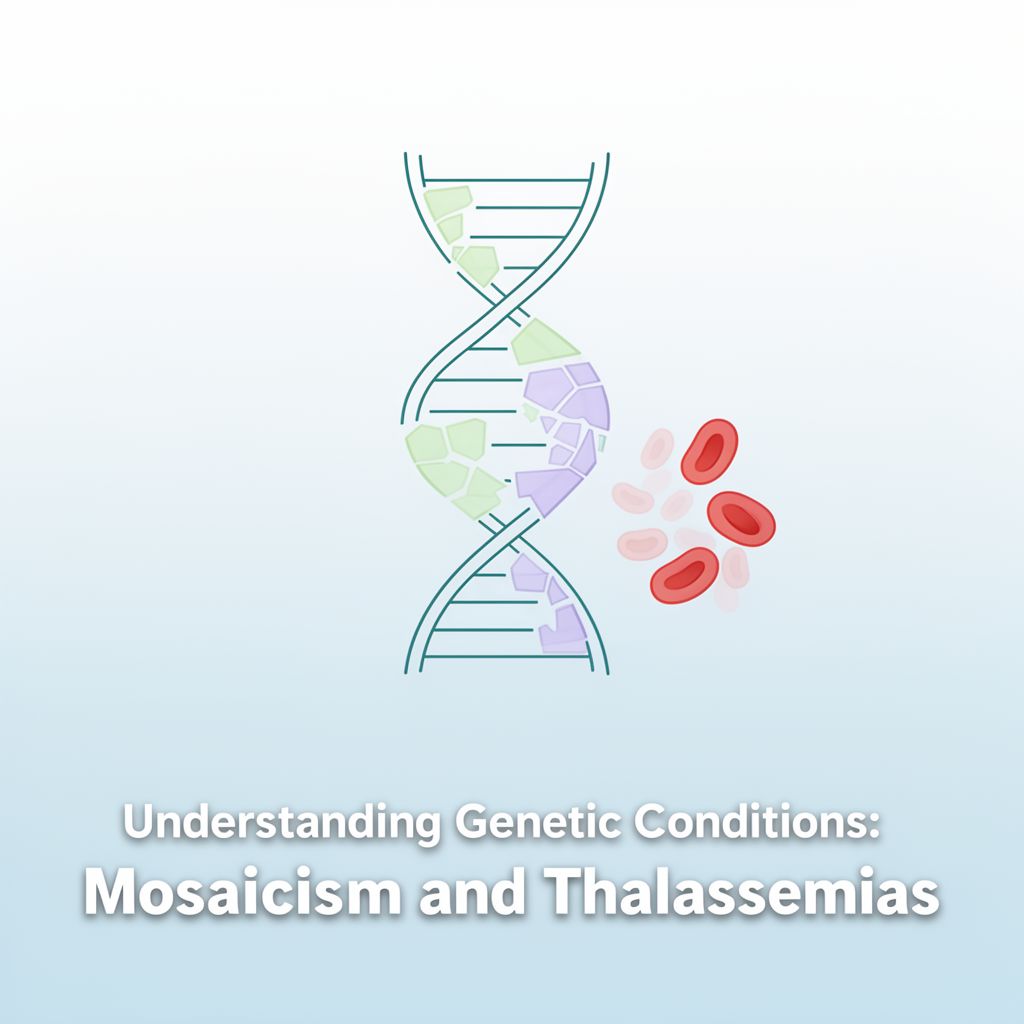
Sesli Özet
4 dakikaKonuyu otobüste, koşarken, yolda dinleyerek öğren.
Sesli Özet
Understanding Genetic Conditions: Mosaicism and Thalassemias
Flash Kartlar
24 kartKarta tıklayarak çevir. ← → ile gez, ⎵ ile çevir.
Tüm kartları metin olarak gör
1. What is the definition of mosaicism in genetics?
Mosaicism is the presence of two or more genetically distinct cell populations within an individual, arising from post-zygotic mutations.
2. Name the two primary types of mosaicism.
The two primary types of mosaicism are somatic mosaicism and gonadal mosaicism, each affecting different cell lines.
3. What characterizes somatic mosaicism?
Somatic mosaicism involves mutations in somatic cells, affecting only part of the body and typically not inherited by offspring.
4. How does gonadal mosaicism differ from somatic mosaicism?
Gonadal mosaicism involves mutations in germline cells, meaning the parent may be phenotypically normal but can transmit these mutations to their offspring.
5. Provide an example of a condition caused by somatic mosaicism.
Segmental neurofibromatosis, caused by somatic mosaicism in the NF1 gene, is an example of a condition resulting from this type of mosaicism.
6. What is the definition of anemia?
Anemia is characterized by a decreased number of red blood cells or a reduced amount of hemoglobin in the blood, impairing oxygen transport.
7. What are the two main pathogenic mechanisms of anemia?
The two main pathogenic mechanisms are inadequate red blood cell production, leading to hypo/aplastic anemia, or increased destruction, causing hemolytic anemia.
8. What are thalassemias?
Thalassemias are inherited blood disorders caused by mutations that affect the production of hemoglobin, the protein essential for oxygen transport.
9. Which genes are affected in Alpha-Thalassemia?
Alpha-Thalassemia results from mutations or deletions in the HBA1 and HBA2 genes, which are responsible for alpha-globin chain production.
10. Describe the Alpha-Thalassemia Silent Carrier subtype.
In the Silent Carrier subtype, one alpha-globin gene is lost, and individuals are usually asymptomatic, showing no significant health issues.
11. What is the characteristic of Alpha-Thalassemia Trait?
Alpha-Thalassemia Trait involves the loss of two alpha-globin genes, typically resulting in mild anemia due to reduced hemoglobin production.
12. What are the symptoms of Hemoglobin H Disease?
Hemoglobin H Disease, caused by the loss of three alpha-globin genes, leads to moderate to severe anemia and splenomegaly.
13. What is Hydrops Fetalis in the context of Alpha-Thalassemia?
Hydrops Fetalis occurs when all four alpha-globin genes are lost, resulting in severe anemia incompatible with life, often causing stillbirth.
14. Which gene is primarily affected in Beta-Thalassemia?
Beta-Thalassemia stems from mutations in the HBB gene, which is responsible for producing beta-globin chains.
15. What defines Beta-Thalassemia Minor?
Beta-Thalassemia Minor describes individuals who are heterozygous for the mutation, typically experiencing only mild anemia.
16. What is another name for Beta-Thalassemia Major?
Beta-Thalassemia Major is also known as Cooley’s Anemia, a severe form requiring regular blood transfusions for survival.
17. Explain a key pathophysiological mechanism of thalassemia.
A key mechanism involves reduced hemoglobin synthesis, leading to an imbalance in globin chains, where excess unpaired chains precipitate in red blood cells, causing hemolysis.
18. Name two common clinical features of thalassemia.
Common clinical features include fatigue, pallor, shortness of breath, growth retardation, and iron overload from transfusions.
19. How is thalassemia typically diagnosed using blood tests?
Diagnosis relies on a Complete Blood Count (CBC) showing microcytic hypochromic anemia and Hemoglobin Electrophoresis to identify variants.
20. What is a definitive diagnostic method for thalassemia?
Genetic Testing is a definitive method used to confirm the presence of HBA or HBB gene mutations, providing a precise diagnosis.
21. What is the primary treatment for severe thalassemia cases?
Severe cases of thalassemia primarily require regular blood transfusions and iron chelation therapy to manage iron overload caused by transfusions.
22. What advanced treatment options are available for thalassemia?
Advanced treatment options include bone marrow transplant for marrow expansion and gene therapy, such as ZYNTEGLO, offering potential cures.
23. How can thalassemia be prevented in high-risk populations?
Prevention is crucial and involves carrier screening through genetic testing in high-risk populations to identify carriers before conception.
24. What prenatal testing methods are used to detect thalassemia in fetuses?
Prenatal testing methods include chorionic villus sampling or amniocentesis, which can detect thalassemia in fetuses early in pregnancy.
Bilgini Test Et
15 soruÇoktan seçmeli sorularla öğrendiklerini ölç. Cevap + açıklama.
What is the primary definition of mosaicism according to the provided text?