 Podit
Podit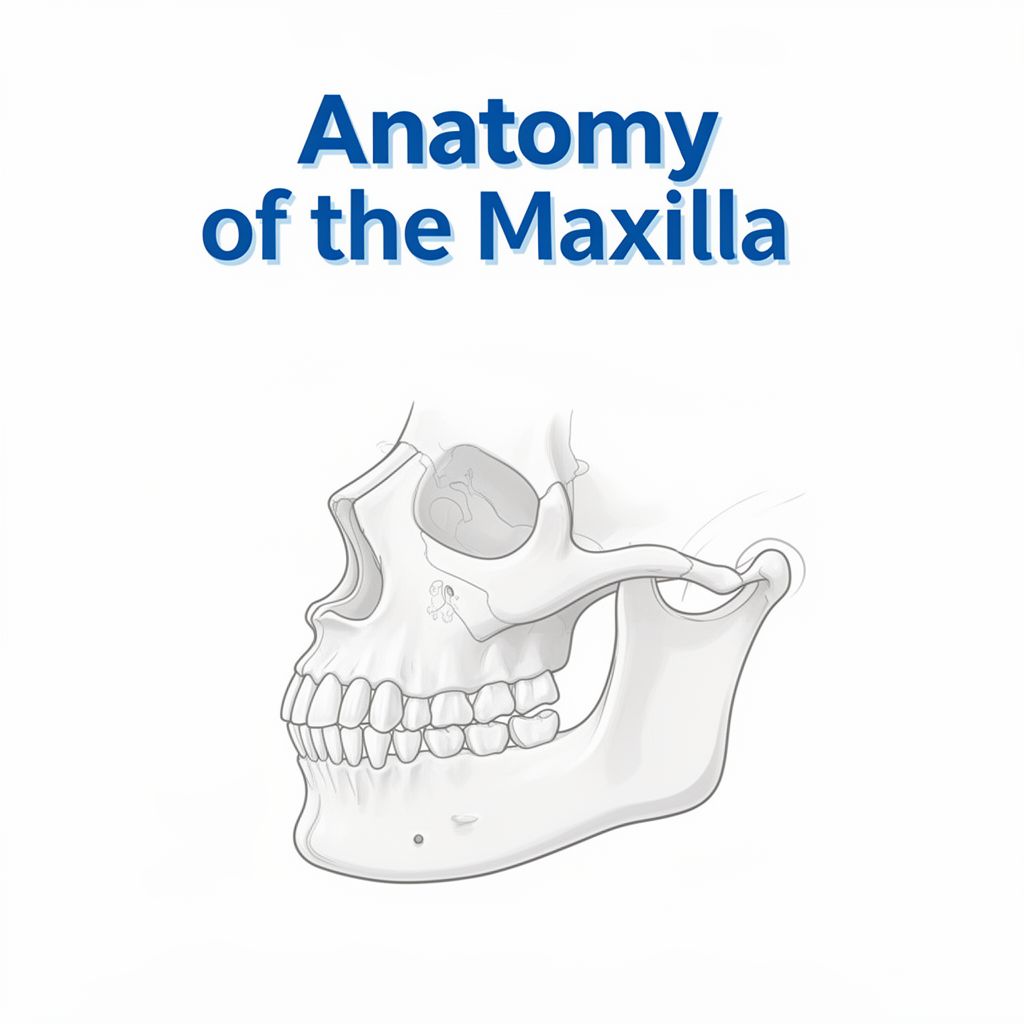
Sesli Özet
5 dakikaKonuyu otobüste, koşarken, yolda dinleyerek öğren.
Sesli Özet
Anatomy of the Maxilla
Flash Kartlar
24 kartKarta tıklayarak çevir. ← → ile gez, ⎵ ile çevir.
Tüm kartları metin olarak gör
1. Which bone is the largest in the facial skeleton?
The maxilla is the largest bone that constitutes the facial skeleton.
2. What is the primary and most well-known function of the maxilla?
Its primary and most well-known function is forming the upper jaw.
3. The maxilla is a key structural component for how many major cavities?
The maxilla helps form the walls of four major cavities: oral, nasal, orbit, and the maxillary sinus.
4. Which bony socket for the eye does the maxilla help form?
The maxilla helps form the floor of the orbit, the bony socket that houses the eye.
5. What is the name of the large cavity contained within the body of the maxilla?
It is the maxillary sinus, which is the largest of the paranasal sinuses.
6. Name one of the two 'fossae' (depressions) the maxilla helps to form.
The maxilla contributes to the formation of the infratemporal fossa and the pterygopalatine fossa.
7. Name one of the two 'fissures' (gaps) the maxilla helps to create.
The maxilla plays a role in creating the orbital fissure and the pterygomaxillaris fissure.
8. What are the two main anatomical components of the maxilla?
The maxilla consists of a central body, known as the 'corpus maxillae', and four distinct processes.
9. What is the name of the maxillary process that articulates with the cheekbone?
The processus zygomaticus is the process that articulates with the cheekbone.
10. Which process of the maxilla extends upwards to connect with the frontal bone?
The processus frontalis extends upwards from the maxilla to connect with the frontal bone.
11. What is the function of the processus alveolaris?
It is the thick ridge of bone that contains the tooth sockets for the upper teeth.
12. Which process forms a large part of the hard palate, or the roof of the mouth?
The processus palatinus projects horizontally to form a large part of the hard palate.
13. How many distinct surfaces does the corpus maxillae have?
The corpus maxillae, or body of the maxilla, presents four distinct surfaces.
14. What is the name of the anterior (front) surface of the maxillary body?
The front surface of the maxillary body is called the facies anterior.
15. Which surface of the maxilla is its posterior surface?
The facies infratemporalis is the posterior surface of the maxillary body.
16. What is the name for the surface of the maxilla that faces the nasal cavity?
The surface facing the nasal cavity is called the facies nasalis.
17. What is the most significant feature found on the facies nasalis?
The most significant feature on this surface is a large opening called the 'hiatus maxillaris'.
18. What is the function of the hiatus maxillaris?
The hiatus maxillaris serves as a passageway connecting the nasal cavity to the maxillary sinus.
19. Which is the largest of all the paranasal sinuses?
The maxillary sinus is the largest of all the paranasal sinuses.
20. What is the typical size of the maxillary sinus?
The maxillary sinus typically measures between 2.5 to 3 centimeters.
21. In a complete skull, what happens to the size of the hiatus maxillaris opening?
In a complete skull, the opening is significantly narrowed by parts of several adjacent bones.
22. Which part of the ethmoid bone helps to constrict the hiatus maxillaris?
The hiatus maxillaris is constricted by the processus uncinatus of the ethmoid bone.
23. Which part of the inferior nasal concha helps narrow the hiatus maxillaris?
The processus maxillaris of the inferior nasal concha helps to narrow the opening.
24. Which part of the palatine bone helps narrow the hiatus maxillaris?
The lamina perpendicularis of the palatine bone constricts the hiatus maxillaris.
Bilgini Test Et
10 soruÇoktan seçmeli sorularla öğrendiklerini ölç. Cevap + açıklama.
According to the podcast, what is the primary and most well-known function of the maxilla?