Unpacking American Culture: Identity, Media, & Diversity - kapak
Eğitim#american culture#cultural studies#identity#national myths

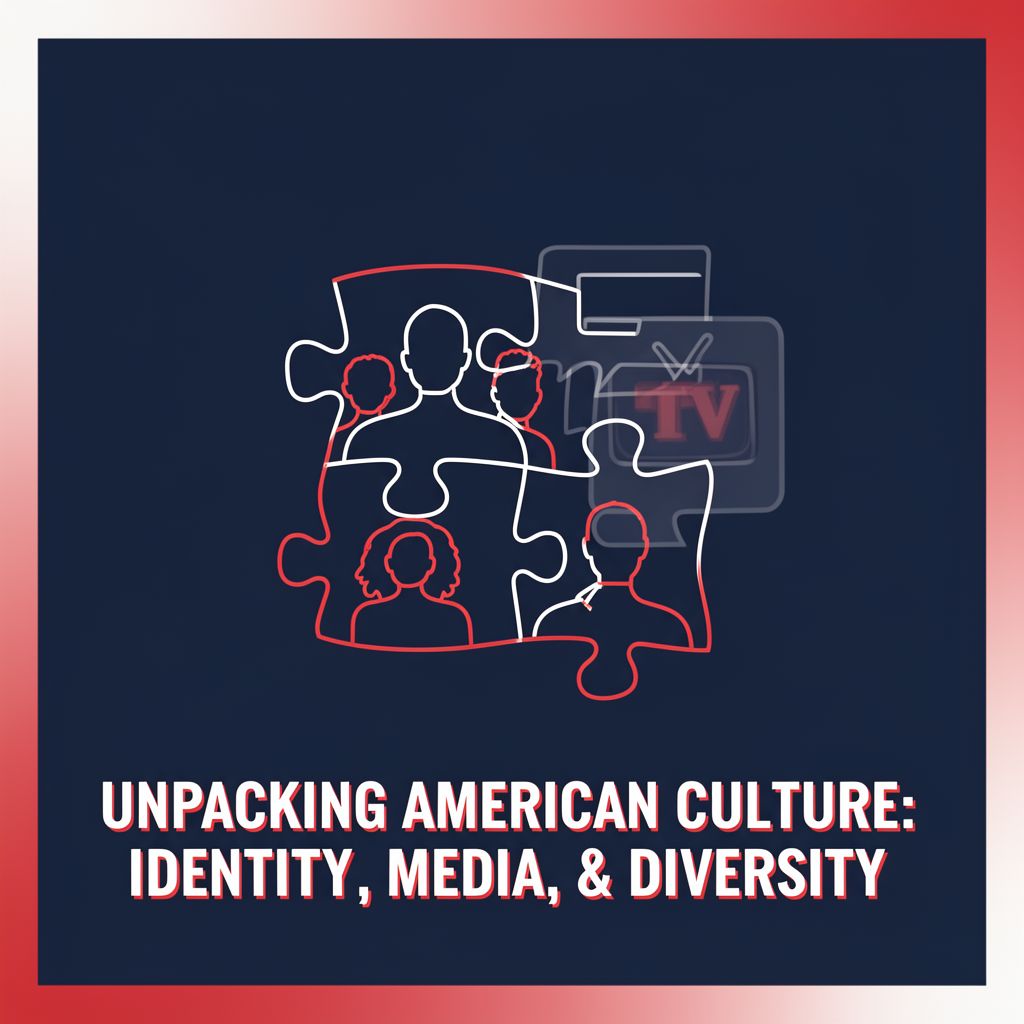
Unpacking American Culture: Identity, Media, & Diversity

Explore key concepts in American Cultural Studies: how identity is formed, media's influence, consumerism, and the role of diversity and social change in shaping American culture.

kahyaaliJanuary 11, 2026 ~19 dk toplam
01

Sesli Özet

5 dakika

Konuyu otobüste, koşarken, yolda dinleyerek öğren.

Sesli Özet

Unpacking American Culture: Identity, Media, & Diversity

0:004:50
02

Flash Kartlar

22 kart

Karta tıklayarak çevir. ← → ile gez, ⎵ ile çevir.

1 / 22
Tüm kartları metin olarak gör
  1. 1. What is the primary focus of American Cultural Studies, as introduced?

    It explores how American culture is made and understood, focusing on identity, media, and diverse groups.

  2. 2. Which authors' book is referenced for insights into American Cultural Studies?

    Neil Campbell and Alasdair Kean's book is referenced for insights into American Cultural Studies.

  3. 3. What are some key aspects explored in American Cultural Studies according to the introduction?

    Key aspects include how identity is built, how media shapes the world, and how diverse groups reshape the cultural landscape.

  4. 4. What concept is often used to construct American identity?

    American identity is often constructed through powerful national myths, which are foundational narratives.

  5. 5. Define the 'American Dream'.

    The 'American Dream' is the idea that anyone can achieve success through hard work and determination, regardless of their background.

  6. 6. What does the 'frontier spirit' represent in American national myths?

    The 'frontier spirit' suggests rugged individualism, self-reliance, and endless possibilities for expansion and reinvention.

  7. 7. What is a critical perspective on national myths like the 'American Dream'?

    National myths are often idealized and can hide the complexities and inequalities that exist within society.

  8. 8. Why is it important to question who benefits from national myths?

    Questioning helps understand whose experiences are included or excluded by these foundational narratives and why they matter.

  9. 9. How does media influence our understanding of America?

    Media shapes our understanding of the world, our values, and our desires, acting as a powerful tool beyond mere entertainment.

  10. 10. What is the connection between commercials and consumerism?

    Commercials often encourage buying into a certain lifestyle or vision of happiness, directly linking to consumerism.

  11. 11. Explain the role of consumerism in American culture.

    Consumerism is a huge part of American culture, where buying things defines status and connects individuals to larger cultural narratives.

  12. 12. Can popular culture only reinforce dominant ideas?

    No, popular culture can also be a space where people challenge dominant ideas, express dissent, and create new meanings.

  13. 13. What does it mean that 'America isn't a monolith'?

    It means America is a vibrant tapestry of different races, ethnicities, genders, sexualities, and social classes, not a single, uniform entity.

  14. 14. Name some diverse groups mentioned in the context of American culture.

    African Americans, Latinx communities, Indigenous peoples, and Asian Americans are mentioned as diverse groups.

  15. 15. What challenges do diverse groups often face in the American context?

    Diverse groups often face unique challenges and systemic barriers while navigating their identities within American culture.

  16. 16. How do gender roles and expectations contribute to cultural change?

    Gender roles and expectations evolve, and movements for LGBTQ+ rights challenge traditional norms, pushing for greater inclusion and change.

  17. 17. What is the nature of culture according to the text?

    Culture is not static; it is constantly being negotiated, contested, and transformed by the people who live it.

  18. 18. How do social movements contribute to shaping American culture?

    Social movements, protests, and everyday acts of resistance are part of the ongoing process of defining what America means.

  19. 19. What is a key characteristic of American culture according to Campbell and Kean?

    American culture is described as a complex, often contradictory, and incredibly dynamic system.

  20. 20. What is the main takeaway about culture from the discussion?

    The main takeaway is that culture isn't just something observed; it's something participated in, always changing and being made.

  21. 21. Why is critical questioning important in understanding the world?

    Critical questioning is essential for truly understanding the complex forces at play in society and the world around us.

  22. 22. Which chapters of Campbell and Kean's book likely cover diversity and social change?

    Chapters 6 and 7 of Campbell and Kean's book likely cover diversity, difference, and the drive for social change.

03

Bilgini Test Et

15 soru

Çoktan seçmeli sorularla öğrendiklerini ölç. Cevap + açıklama.

Soru 1 / 15Skor: 0

According to the introduction, what is the primary focus of American Cultural Studies as presented in the lecture?

04

Detaylı Özet

4 dk okuma

Tüm konuyu derinlemesine, başlık başlık.

This study material is based on insights drawn from a lecture discussing Chapters 3, 5, 6, and 7 of the book American Cultural Studies: An Introduction to American Culture by Neil Campbell and Alasdair Kean (Fourth Edition).


🇺🇸 American Cultural Studies: Key Concepts from Campbell & Kean

📚 Introduction to American Cultural Studies

Welcome to a comprehensive overview of American culture through the lens of cultural studies. This guide explores how American identity is constructed, the pervasive influence of media and consumerism, and the dynamic interplay of diversity and social change within the United States. By understanding these core concepts, we gain a clearer picture of the complex forces shaping American society.


1️⃣ Chapter 3: Constructing American Identity and National Myths

This section delves into the complex question of what it means to be "American" and how this identity is shaped by powerful, often idealized, national narratives.

📚 Key Concept: American Identity

  • Definition: Not a simple, monolithic concept, but a complex and often contested idea.
  • Construction: Identity is actively "made" and "understood" through various cultural processes.

💡 The Role of National Myths

National myths are foundational narratives that deeply influence how people perceive themselves and their nation.

  • Purpose: They provide a shared understanding, values, and a sense of collective purpose.
  • Examples:
    • The American Dream: The belief that anyone can achieve success through hard work and determination, regardless of background.
    • The Frontier Spirit: Emphasizes rugged individualism, self-reliance, and the idea of endless possibilities for expansion and reinvention.

⚠️ Critique of National Myths

While powerful, these myths are often idealized and can obscure underlying realities.

  • Idealization: They present a simplified, often utopian, version of reality.
  • Concealment: They can hide complexities, inequalities, and systemic issues within society.
  • Exclusion: It's crucial to ask:
    • Who benefits from these myths?
    • Whose experiences and narratives do they exclude or marginalize?

2️⃣ Chapter 5: Media, Consumerism, and Popular Culture's Influence

This section examines the profound impact of media, consumerism, and popular culture on American values, beliefs, and desires.

📚 Key Concept: Media as a Shaping Force

Media is more than just entertainment; it's a powerful tool that actively shapes our understanding of the world.

  • Influence: Shapes values, beliefs, and desires.
  • Forms: Movies, TV shows, music, advertising, social media.

📈 Consumerism in American Culture

Consumerism is a central aspect of American culture, extending beyond mere purchasing.

  • Beyond Products: It's not just about buying goods, but about buying into specific lifestyles, visions of happiness, and success.
  • Identity & Status: Products and brands often define personal status and connect individuals to broader cultural narratives.
  • Advertising's Role: Commercials sell not just products, but aspirations and a particular way of life.

💡 Popular Culture: Reinforcement and Challenge

Popular culture serves as a dynamic space with dual functions.

  • Reinforcement: It can reinforce dominant societal ideas and norms.
  • Challenge & Dissent: It also provides a platform for individuals and groups to:
    • Challenge existing ideas.
    • Express dissent.
    • Create new meanings and alternative narratives.
  • Dynamic Interplay: Popular culture is a constant negotiation between established norms and emerging counter-narratives.

3️⃣ Chapters 6 & 7: Diversity, Difference, and the Drive for Social Change

These chapters highlight the rich diversity of American culture and the ongoing struggles for social change, emphasizing that culture is a constantly evolving process.

📚 Key Concept: America as a Diverse Tapestry

America is not a homogeneous entity but a vibrant collection of diverse groups.

  • Dimensions of Diversity: Includes various races, ethnicities, genders, sexualities, and social classes.
  • Identity Navigation: Different groups navigate their identities within the broader American context, often facing unique challenges.

🌍 Diverse Communities and Their Contributions

  • Examples: African Americans, Latinx communities, Indigenous peoples, Asian Americans.
  • Experiences: These groups contribute significantly to American culture while often confronting systemic barriers and unique struggles.

⚧️ Gender, Sexuality, and Social Movements

  • Evolving Roles: Gender roles and expectations have continuously evolved over time.
  • LGBTQ+ Rights: Movements for LGBTQ+ rights actively challenge traditional norms and advocate for greater inclusion and equality.

✅ Culture as a Dynamic Process

Culture is not static; it is perpetually in motion.

  • Negotiation: Constantly negotiated between different groups and ideologies.
  • Contestation: Often a site of conflict and disagreement.
  • Transformation: Continuously reshaped and redefined by its participants.

✊ Mechanisms of Social Change

Social change is driven by various forms of collective and individual action.

  • Collective Action: Social movements and protests play a crucial role in advocating for change.
  • Everyday Resistance: Daily acts of resistance, both large and small, contribute to cultural shifts.
  • Redefining America: These ongoing processes shape what "America" means and who has the power to define its cultural landscape.

💡 Key Takeaways: A Dynamic Cultural Landscape

American cultural studies, as presented by Campbell and Kean, reveals that American culture is:

  • Complex: Involving multiple layers and interpretations.
  • Contradictory: Often holding opposing ideas or values simultaneously.
  • Dynamic: Constantly changing, evolving, and being reshaped by its people.

Understanding culture requires active engagement and critical inquiry. Keep asking critical questions to truly grasp the world around you and your place within it.

Kendi çalışma materyalini oluştur

PDF, YouTube videosu veya herhangi bir konuyu dakikalar içinde podcast, özet, flash kart ve quiz'e dönüştür. 1.000.000+ kullanıcı tercih ediyor.

Sıradaki Konular

Tümünü keşfet
Regionalism in American Culture: A Deep Dive

Regionalism in American Culture: A Deep Dive

Explore how geography, history, and economics shape distinct cultural identities across the United States. Discover the unique flavors of American regionalism.

4 dk Özet 25 15
Film Form, Ideology, and Representation in American Cinema

Film Form, Ideology, and Representation in American Cinema

An academic analysis of how American films represent race, class, gender, sexuality, and ability, exploring film form, dominant ideologies, and cultural studies concepts like encoding and decoding.

10 dk Özet 25 15
The Talented Mr. Ripley: Chapters 1-10 Summary and Analysis

The Talented Mr. Ripley: Chapters 1-10 Summary and Analysis

An academic summary and analysis of the initial chapters of Patricia Highsmith's 'The Talented Mr. Ripley,' focusing on Tom Ripley's character development, deceptive nature, and his evolving relationship with Dickie Greenleaf.

5 dk Özet 25 15
Britain's Evolving Social and Cultural Landscape

Britain's Evolving Social and Cultural Landscape

An academic summary exploring Britain's multicultural society, advancements in gender and LGBTQ+ rights, and the transformation of its arts and cultural landscape in the 21st century.

7 dk Özet 25 15
Interwar Britain: Society, Culture, and Politics

Interwar Britain: Society, Culture, and Politics

Explore the profound social, cultural, and political transformations in Britain during the interwar years, from changing gender roles and technological advancements to economic unrest and the rise of fascism.

7 dk 15
Earth Systems and Resources Overview

Earth Systems and Resources Overview

An academic summary of Earth's physical systems, including plate tectonics, soil dynamics, atmospheric composition, global climate drivers, and oceanic phenomena like ENSO.

8 dk 15 Görsel
Introduction to Geography for KPSS Examination

Introduction to Geography for KPSS Examination

This summary provides a formal academic overview of introductory geography, covering its fundamental concepts, branches, and key principles relevant for the KPSS examination.

5 dk Özet 25 15 Görsel
Introduction to Geography for KPSS-MEB AGS 2026

Introduction to Geography for KPSS-MEB AGS 2026

This audio summary provides an academic overview of foundational geographical concepts relevant to the KPSS-MEB Field Knowledge Examination, specifically focusing on introductory geography principles.

5 dk Özet 25 15 Görsel