Film Form, Ideology, and Representation in American Cinema - kapak
Eğitim#film studies#cultural studies#ideology#representation

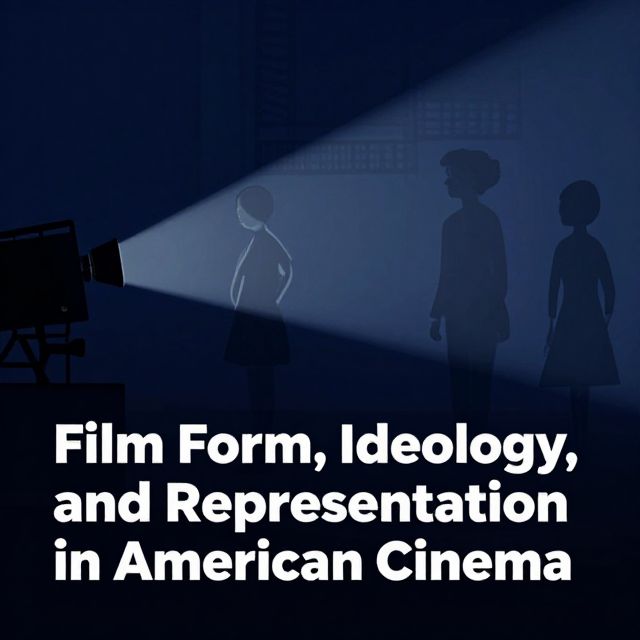
Film Form, Ideology, and Representation in American Cinema

An academic analysis of how American films represent race, class, gender, sexuality, and ability, exploring film form, dominant ideologies, and cultural studies concepts like encoding and decoding.

kahyaaliApril 4, 2026 ~29 dk toplam
01

Sesli Özet

11 dakika

Konuyu otobüste, koşarken, yolda dinleyerek öğren.

Sesli Özet

Film Form, Ideology, and Representation in American Cinema

0:0010:44
02

Flash Kartlar

25 kart

Karta tıklayarak çevir. ← → ile gez, ⎵ ile çevir.

1 / 25
Tüm kartları metin olarak gör
  1. 1. What is the primary purpose of studying American film history according to the text?

    Studying American film history provides insights into how diverse American groups have been treated. Cinematic images actively shape perceptions in the real world, making film analysis crucial for understanding societal views and their evolution.

  2. 2. How does the text define the relationship between film and real life?

    The text states that understanding the connections between film and real life requires grasping how film represents people and objects, how social groupings are formed, and how individuals interact with socio-cultural structures. Film images actively shape real-world perceptions.

  3. 3. What is the fundamental difference between "film form" and "content"?

    Film form refers to the unique elements that distinguish a film and dictates how content is expressed, while content signifies what a work is about. The two are inextricably linked, with form often following content to create meaning.

  4. 4. Explain the principle that "form follows content" in film analysis.

    The principle "form follows content" suggests that a work's subject matter should determine its formal expression. For example, similar stories can convey different tones based on the artistic choices made in their presentation, highlighting how form shapes interpretation.

  5. 5. List the five primary aspects of film form introduced in the text.

    The five primary aspects of film form are literary design, visual design, cinematography, editing, and sound design. These elements collectively contribute to how a film expresses its content and influences viewer comprehension.

  6. 6. What elements are encompassed within "literary design" in film form?

    Literary design includes elements derived from the script and story, such as plot, setting, characters, dialogue, and thematic subtexts. It also incorporates literary devices like metaphor, irony, and satire to enrich the narrative.

  7. 7. Define "mise-en-scène" and identify its two main components according to the text.

    Mise-en-scène is a French term referring to everything within an individual shot. Its two main components are visual design and cinematography. Visual design covers sets, costumes, lighting, etc., while cinematography concerns how the camera records these elements.

  8. 8. What aspects are included in "visual design" within mise-en-scène?

    Visual design involves choices related to sets, costumes, makeup, lighting, color, and actor performance. These elements are crucial for establishing the film's aesthetic and contributing to the overall mood and meaning of a scene.

  9. 9. How does "cinematography" contribute to film form?

    Cinematography concerns how the camera records visual elements, including framing, lenses, camera angle, movement, and focus. These choices significantly impact viewer perception; for instance, bright lighting can evoke comfort, while shadows can suggest threat.

  10. 10. Explain the role of "editing" (montage) in creating meaning or narrative in film.

    Editing, or montage, refers to how individual shots are assembled to create meaning or narrative. Editorial decisions, such as shot selection and length, influence audience attention, identification with characters, and the overall rhythm and flow of the story.

  11. 11. How does "sound design" influence viewer interpretation in film?

    Sound design is a crucial formal axis where artistic choices in sound, including dialogue audibility and musical scores, profoundly direct viewer interpretation. For example, ominous music can transform a romantic scene into one of suspicion, guiding emotional responses.

  12. 12. What is the disparity mentioned between American ideals and lived experience?

    The text highlights a disparity between the American ideal of equality, enshrined in foundational documents, and the lived experience of various groups. Historically, many groups were excluded, and barriers, biases, and misunderstandings persist despite avowed principles.

  13. 13. When do stereotypes become problematic according to the text?

    Stereotypes become problematic when they are used to favor certain groups over others, perpetuating unequal opportunities. They reduce complex human diversity to judgmental assumptions, leading to discrimination and marginalization.

  14. 14. Which groups have historically held more privilege in American society?

    Historically, white individuals of Anglo-Saxon descent, men, and heterosexuals have held more privilege in American society. This privilege often translates into greater social power and opportunities compared to marginalized groups.

  15. 15. How does the text define a "minority group"?

    The term 'minority group' often refers to groups with less social power, irrespective of their numerical size. These groups typically face marginalization and unequal opportunities within the dominant societal structure.

  16. 16. What is "ideology" in the context of American society?

    Ideology refers to shared belief systems that are often unquestioned and naturalized, appearing 'self-evident.' Dominant ideologies structure how a culture perceives itself and others, upholding certain values as worthy and influencing societal norms.

  17. 17. Identify the dominant ideology discussed in American society and films.

    The dominant ideology discussed is 'white patriarchal capitalism.' This ideology comprises the superiority of Western European descent, male dominance and heterosexual marriage, and success measured by material wealth, permeating American society and films.

  18. 18. Explain the three components of "white patriarchal capitalism."

    "White patriarchal capitalism" consists of three components: 'white' (superiority of Western European descent), 'patriarchal' (male dominance and heterosexual marriage), and 'capitalism' (success measured by material wealth). This ideology shapes societal values and power structures.

  19. 19. What is the "glass ceiling" and which groups does it typically affect?

    The "glass ceiling" refers to an invisible barrier that prevents non-white, non-male, and non-heterosexual individuals from reaching top executive levels. Racist, sexist, and homophobic attitudes contribute to this barrier, limiting career advancement for marginalized groups.

  20. 20. How are social differences like race, gender, and class interconnected, leading to "compounded oppression"?

    Social differences like race, gender, class, sexuality, and ability are interconnected, leading to compounded oppression for individuals at their intersections. This means that individuals belonging to multiple marginalized groups often experience intensified forms of discrimination and disadvantage.

  21. 21. Define "hegemony" in the context of ideological struggles.

    Hegemony explains how social control is continually re-negotiated across eras and cultures. It refers to the ongoing struggle for consent to maintain dominant ideologies, which are disseminated through both obvious and subtle means.

  22. 22. Differentiate between Repressive State Apparatuses (RSAs) and Ideological State Apparatuses (ISAs).

    Repressive State Apparatuses (RSAs), like armies and police, enforce control through violence. Ideological State Apparatuses (ISAs), such as schools, family, church, and media, spread ideology through example and education, often without conscious awareness or direct force.

  23. 23. Provide examples of Ideological State Apparatuses (ISAs) mentioned in the text.

    Examples of Ideological State Apparatuses (ISAs) include schools, family, church, and media (like film, television, and the internet). These institutions subtly disseminate dominant ideologies through education, cultural norms, and entertainment.

  24. 24. How does the mass media function as an Ideological State Apparatus?

    The mass media, encompassing film, television, and the internet, is a pervasive Ideological State Apparatus. It profoundly influences cultural ideas and ideologies by reinforcing or challenging hegemonic dominance, often shaping societal perceptions and values.

  25. 25. What is the text's argument against viewing Hollywood films as merely "entertainment"?

    The text argues that viewing Hollywood films as merely 'entertainment' overlooks their role as significant cultural artifacts. Films, as ISAs, actively participate in shaping cultural ideas and ideologies, making them more than just mindless escapism.

03

Bilgini Test Et

15 soru

Çoktan seçmeli sorularla öğrendiklerini ölç. Cevap + açıklama.

Soru 1 / 15Skor: 0

According to the text, what is the primary distinction between 'film form' and 'content'?

04

Detaylı Özet

8 dk okuma

Tüm konuyu derinlemesine, başlık başlık.

This study material has been compiled and organized from a copy-pasted text and a lecture audio transcript provided by the user.


🎬 Film Form, Representation, and American Ideologies: A Study Guide

📚 Introduction to Film Analysis and Representation

This study guide explores how American films represent various social categories like race, class, gender, sexuality, and ability. By analyzing American film history, we gain crucial insights into the treatment of diverse groups in society. Cinematic images are powerful; they actively shape how people are understood and experienced in the "real world." To comprehend the intricate connections between film and real life, we must first grasp fundamental concepts related to film form, American history, and cultural studies.

🎥 Understanding Film Form

Film form refers to the unique elements that make a film distinct from other art forms. It's about how a story or content is expressed, rather than just what the story is about. Form and content are deeply intertwined, with the principle "form follows content" suggesting that the subject matter should dictate its artistic expression. Different formal choices can drastically alter a viewer's interpretation of the same content.

Form vs. Content:

  • Content: What a work is about (e.g., a rose, a love story).
  • Form: How that content is expressed (e.g., a sonnet, a comedy, a drama).

5️⃣ Key Aspects of Film Form:

  1. Literary Design 📝

    • Encompasses elements derived from the script and story ideas.
    • Includes: Plot, setting, characters, dialogue, film title, and underlying thematic meanings or subtexts.
    • Devices: Films utilize literary devices like metaphor, irony, satire, and allegory.
    • Example: A black comedy uses its literary design to evoke humor from dark subjects, while a drama aims for serious engagement.
  2. Visual Design (Mise-en-scène) 🖼️

    • A French term meaning "what goes into each individual shot."
    • Includes: Sets, costumes, makeup, lighting, color, and actors' performances and arrangement before the camera.
    • Impact: These choices significantly affect viewer feelings. A brightly lit room might feel comfortable, while the same room with heavy shadows could feel threatening. A single person in red in a gray crowd draws focus.
  3. Cinematography 📸

    • How the camera records the visual elements dictated by the literary design.
    • Includes: Framing, lenses, camera angle, camera movement, and focus (what is sharp vs. blurry).
    • Impact: Shooting up at a character creates a different feeling than an eye-level shot. Keeping only one couple in focus on a dance floor directs viewer attention to them.
  4. Editing (Montage) ✂️

    • Refers to how individual shots are assembled to create meaning or tell a story.
    • Choices: Filmmakers select takes, arrange shots, and determine shot length.
    • Impact: Breaking up a group conversation with individual close-ups forces attention on specific characters. Longer shots create contemplative moments, while short, quick shots are used for action sequences.
  5. Sound Design 🔊

    • The artistic choices made with the film's soundtrack.
    • Includes: Dialogue audibility, musical scores, sound effects.
    • Impact: Dialogue can be made easy or difficult to hear to direct attention. Music profoundly influences viewer comprehension; ominous music during a romantic scene can create suspicion, altering the scene's perceived meaning.

💡 Insight: Analyzing film requires looking beyond just the story (content) to understand how these formal elements contribute to meaning and representation. For instance, a film showing a white man in bright, eye-level shots with pleasant music, contrasted with a Native American man in dark, tilted, choppy shots with brooding music, subtly biases the viewer's perception, even if the narrative content seems neutral.

🇺🇸 American Ideologies and Social Structures

The foundational American ideal of equality, enshrined in documents like the Declaration of Independence ("all men are created equal"), has historically been contradicted by the exclusion and unequal treatment of various groups, including women, people of African descent, and Native Americans. While the Constitution is a "living document" that has evolved, disparities between these ideals and lived experiences persist.

📊 Categorization, Stereotypes, and Power Dynamics

  • Categorization: Individuals are often grouped by shared traits (race, gender, income, ability).
  • Shorthand: These groupings become "shorthand" (e.g., "working-class Latino"), often accompanied by assumed traits.
  • Stereotypes: When these oversimplified and overgeneralized assumptions become standardized, they form stereotypes. While they may contain a "kernel of truth," they reduce complex human diversity to judgmental assumptions and are problematic when used to favor certain groups.
  • Minority Groups: This term often refers to groups with less social power, regardless of their numerical size (e.g., women, despite being a numerical majority, often hold less social power than men).
  • Marginalization: Minority groups are often kept on the margins of power by being pitted against each other or excluded from the national identity.

🏛️ Ideology and Dominant Ideologies

  • Ideology: A system of beliefs shared by a group, considered inherently true and acceptable, often unquestioned and "naturalized" (appearing "self-evident").
  • Dominant Ideologies: Pervasive systems of belief that structure how a culture thinks about itself, defining what is worthy, meaningful, and valuable.
  • White Patriarchal Capitalism: The dominant ideology in the United States, comprising:
    • White: Belief in the superiority of people of Western and Northern European descent.
    • Patriarchal: Belief that men are the most important members of society, entitled to greater power, with sexuality condoned only within heterosexual marriage.
    • Capitalism: Belief that success and worth are measured by material wealth, promoting an unhindered "free market" economy.

⚠️ Impact of Dominant Ideology: This ideology naturalizes the idea that wealthy white men deserve greater social privilege and protects these privileges by degrading other groups. Historically, capitalism has often worked against minority groups, with the wealthy consolidating power. Racist, sexist, and homophobic attitudes contribute to a "glass ceiling," excluding non-white, non-male, and non-heterosexual individuals from top executive positions.

🤝 Intersectionality of Social Differences

Social differences (race, gender, class, sexuality, ability) are not discrete categories but are interconnected. An individual can experience compounded oppression based on multiple intersecting identities (e.g., a Black lesbian woman may face discrimination on three levels).

🔄 Hegemony and State Apparatuses

  • Hegemony: The ongoing struggle to maintain the consent of the people to a system that governs them. It's a dynamic process where social control is continually won and re-negotiated, allowing for both maintenance and alteration of dominant ideologies.
  • Ideological Struggle: A constant political process bombarding individuals with messages about how the world should function.

1️⃣ Repressive State Apparatuses (RSAs) ⚔️

  • Enforce social control through overt, often violent, means.
  • Examples: Armies, police forces, wars, terrorism, torture.
  • Historical Context: Ku Klux Klan, political assassinations, police brutality, hate crimes, Jim Crow Laws.

2️⃣ Ideological State Apparatuses (ISAs) 🏫

  • Spread ideology through subtle means, winning over "hearts and minds" by example and education, often without conscious awareness.
  • Examples: Schools, family, church, and media (including film and television).
  • Function: They teach skills but also instill beliefs about society and how to be "productive" citizens.
  • Internalized Ideology: When individuals adopt socially constructed ideological assumptions into their sense of self. This can lead to ego-destructive discrimination, where individuals limit their own potential or experience self-hatred due to internalizing societal biases (e.g., women aren't good at math, people in wheelchairs can't be leaders).

🌍 Culture and Cultural Studies

  • Culture: The characteristic features of a civilization or state, or the typical behavior of a group. It's the "real-world" manifestation of ideology.
  • "High" vs. "Low" Art: Historically, "true" culture was equated with Western high art (classical music, literature). Today, culture encompasses everyday life, including popular forms like movies, TV, and music, which reach broader audiences.
  • Dominant Culture vs. Subcultures: The culture of the most powerful group becomes the norm. Subcultures (marginalized groups) can influence the dominant culture, but often through:
    • Commodification: Turning something into a product for sale.
    • Incorporation: Stripping an ideology or cultural artifact of its "dangerous" or critical meanings to make it palatable for the mainstream.
    • Example: Men wearing earrings, initially a political "coming out" gesture for gay men, became a depoliticized fashion commodity.

🧐 Cultural Studies: Analyzing Cultural Texts

  • An interdisciplinary field that views every cultural artifact (film, book, song, advertisement) as a "text" expressing the ideologies of its authors and the culture that produced it.
  • Representation: The systems (language, art, media) we use to communicate and understand our world, showing us mediated versions of reality, not "real life" itself.

💬 Encoding and Decoding Meaning in Film

Meaning-making in cultural texts, especially films, involves two stages:

  1. Encoding (Production) 🎬

    • The actual production of the text, where filmmakers embed meaning, consciously or unconsciously.
    • Auteur Studies: Analyzes a director's body of work to find common stylistic choices and themes, arguing that a filmmaker's personality and social position influence encoded meanings.
    • Ideological Messages: While not all films are propaganda, all encode ideologies, reflecting the cultural and ideological standards of their creators. Filmmakers, shaped by dominant ideologies, may unconsciously embed biases.
  2. Decoding (Reception) 👂

    • The audience's reception and interpretation of a text, influenced by their own conscious and unconscious cultural and ideological positioning.
    • Types of Readings:
      • Dominant Readings: Align with how the text was encoded.
      • Oppositional Readings: Actively question the encoded ideological assumptions.
      • Negotiated Readings: Resist some aspects of the encoding while accepting others.
    • Hollywood's Role: Often promotes films as "mindless escapism," which is itself an ideological assumption that obscures their political significance.
    • Impact: While oppositional readings may not radically denounce dominant cinema, widespread shifts in such readings can eventually alter ideological assumptions in future texts, leading to changes in what is considered acceptable representation (e.g., overtly racist or sexist images are less accepted today).

💡 Conclusion

Understanding American cinema requires a comprehensive analysis of both its form and content, recognizing their inseparable nature. Films, as powerful Ideological State Apparatuses, actively participate in the ongoing hegemonic negotiation of dominant ideologies, particularly white patriarchal capitalism. The processes of encoding and decoding highlight how ideological messages are embedded in and interpreted from cultural texts, shaping societal perceptions of race, class, gender, sexuality, and ability. By examining these intricate relationships, we gain critical insights into how cinematic representations reflect, reinforce, and occasionally challenge the socio-cultural structures of the United States.
Kendi çalışma materyalini oluştur

PDF, YouTube videosu veya herhangi bir konuyu dakikalar içinde podcast, özet, flash kart ve quiz'e dönüştür. 1.000.000+ kullanıcı tercih ediyor.

Sıradaki Konular

Tümünü keşfet
Whiteness and American Film: Representation and Assimilation

Whiteness and American Film: Representation and Assimilation

An academic summary exploring the constructed nature of whiteness in American cinema, examining the assimilation of European immigrant groups and the persistent 'Othering' of Arab Americans.

7 dk Özet 25 15
Regionalism in American Culture: A Deep Dive

Regionalism in American Culture: A Deep Dive

Explore how geography, history, and economics shape distinct cultural identities across the United States. Discover the unique flavors of American regionalism.

4 dk Özet 25 15
Unpacking American Culture: Identity, Media, & Diversity

Unpacking American Culture: Identity, Media, & Diversity

Explore key concepts in American Cultural Studies: how identity is formed, media's influence, consumerism, and the role of diversity and social change in shaping American culture.

4 dk Özet 22 15
Development of Contemporary African American Fiction

Development of Contemporary African American Fiction

An academic overview of the development of contemporary African American fiction, exploring its narrative techniques, linguistic features, and key socio-historical and theoretical concepts.

7 dk Özet 25 15
African Americans and American Film: A Historical Overview

African Americans and American Film: A Historical Overview

This summary explores the historical evolution of cinematic representations of African Americans, from early stereotypes to contemporary portrayals, examining their reflection of social change and the ongoing struggle for equitable representation in Hollywood.

6 dk Özet 25 15
Earth Systems and Resources Overview

Earth Systems and Resources Overview

An academic summary of Earth's physical systems, including plate tectonics, soil dynamics, atmospheric composition, global climate drivers, and oceanic phenomena like ENSO.

8 dk 15 Görsel
Introduction to Geography for KPSS Examination

Introduction to Geography for KPSS Examination

This summary provides a formal academic overview of introductory geography, covering its fundamental concepts, branches, and key principles relevant for the KPSS examination.

5 dk Özet 25 15 Görsel
Introduction to Geography for KPSS-MEB AGS 2026

Introduction to Geography for KPSS-MEB AGS 2026

This audio summary provides an academic overview of foundational geographical concepts relevant to the KPSS-MEB Field Knowledge Examination, specifically focusing on introductory geography principles.

5 dk Özet 25 15 Görsel