 Podit
Podit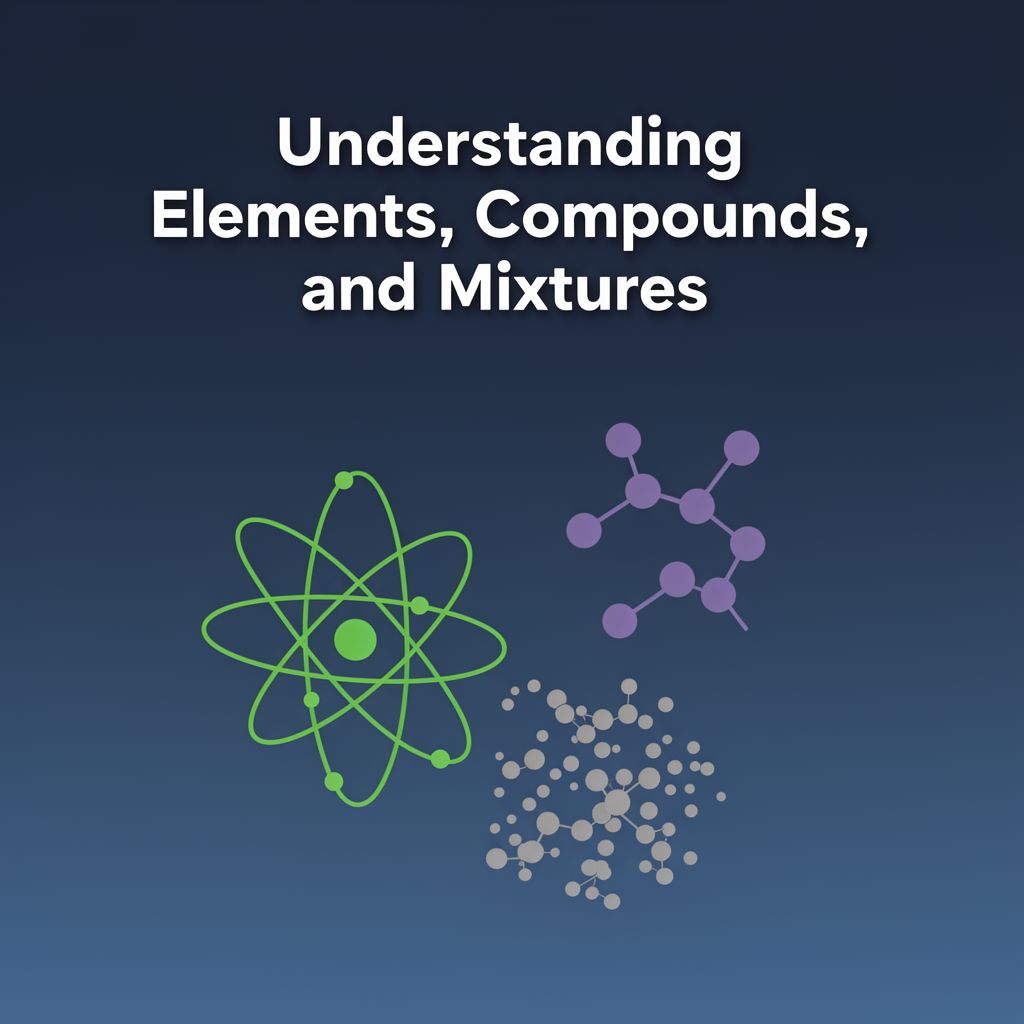
📚 Elements, Compounds, and Mixtures: The Building Blocks of Matter
Source Information: This study material has been compiled from a lecture audio transcript and copy-pasted text provided by the user.
🌍 Introduction to the Building Blocks of Matter
Everything around us, from the air we breathe to the ground we walk on, is composed of matter. To understand the nature of matter, it's essential to classify it into its fundamental categories. This study guide will explore the three primary classifications: elements, compounds, and mixtures. Understanding these distinctions provides a crucial framework for comprehending how different substances are organized and interact at a molecular level, laying a solid foundation for further chemical exploration.
1️⃣ Elements: The Simplest Forms of Matter
📚 Definition: An element is a pure substance consisting only of atoms that all have the same number of protons in their atomic nuclei.
✅ Key Characteristics:
- Pure Substance: Elements are considered pure substances.
- Indivisible by Chemical Means: They cannot be broken down into simpler substances by ordinary chemical reactions.
- Unique Properties: Each element possesses distinct physical and chemical properties that differentiate it from all other elements.
- Atomic Uniformity: Every atom within a sample of an element is identical in its atomic structure, specifically in its proton count. This uniformity gives an element its distinct identity and characteristic behavior.
- Fundamental Building Blocks: Think of elements as the primary building blocks from which all other forms of matter are constructed.
💡 Insight: The concept of an element is crucial because it represents the most basic form of matter that retains its chemical identity. Any attempt to decompose an element through chemical reactions will be unsuccessful, as it is already in its simplest chemical form.
2️⃣ Compounds: Chemically United Elements
📚 Definition: A compound is a pure substance formed when two or more different elements are chemically combined in a fixed ratio.
✅ Key Characteristics:
- Pure Substance: Like elements, compounds are pure substances.
- Chemical Combination: Elements combine through the formation of chemical bonds. This is a chemical change.
- Fixed Ratio: The proportion of each element by mass in a given compound is always constant. For example, water (H₂O) always has two hydrogen atoms for every one oxygen atom.
- New Properties: The resulting compound has properties entirely different from those of its constituent elements.
- Example: Hydrogen (H₂) is a flammable gas, and oxygen (O₂) supports combustion, but when they combine to form water (H₂O), water is a liquid that extinguishes fires.
- Separation by Chemical Means: Compounds can be broken down into their constituent elements, but only through chemical reactions (e.g., electrolysis to separate water into hydrogen and oxygen).
⚠️ Important Distinction: The fixed ratio and the formation of new properties through chemical bonding are what differentiate a compound from a simple physical association of elements.
3️⃣ Mixtures: Physical Combinations of Substances
📚 Definition: A mixture is a substance containing two or more different substances (which can be elements or compounds) that are physically combined but not chemically bonded.
✅ Key Characteristics:
- Physical Combination: Components are physically mixed, not chemically bonded.
- Retain Individual Properties: Each component in a mixture retains its individual chemical properties.
- Variable Ratios: The components of a mixture can be present in variable ratios; their proportions are not fixed.
- Example: You can have a little sugar in your tea or a lot; it's still a sugar-water mixture.
- Separation by Physical Means: Components can often be separated by physical methods without undergoing a chemical reaction.
- Examples: Filtration (separating sand from water), distillation (separating alcohol from water), evaporation (separating salt from water).
📊 Types of Mixtures
Mixtures are broadly categorized into two types based on their uniformity:
3.1 Homogeneous Mixtures (Solutions)
- Uniform Composition: Have a uniform composition and appearance throughout.
- Evenly Distributed: Components are evenly distributed and indistinguishable to the naked eye.
- Examples: Saltwater, air (a mixture of gases like nitrogen, oxygen, argon), brass (an alloy of copper and zinc).
3.2 Heterogeneous Mixtures
- Non-Uniform Composition: Have a non-uniform composition.
- Unevenly Distributed: Components are not evenly distributed, and individual components can often be visibly distinct.
- Examples: Sand and water, oil and water, a salad, granite (a rock with visible different minerals).
✅ Distinguishing Elements, Compounds, and Mixtures: A Summary
Understanding the differences between these three classifications is fundamental to chemistry.
| Feature | Elements | Compounds | Mixtures | | :------------------ | :-------------------------------------- | :--------------------------------------------- | :----------------------------------------------- | | Composition | One type of atom | Two or more different elements chemically bonded | Two or more substances physically combined | | Purity | Pure substance | Pure substance | Impure substance | | Ratio | N/A (single type of atom) | Fixed ratio by mass | Variable ratio | | Properties | Unique to the element | New properties, different from constituents | Components retain their original properties | | Separation | Cannot be broken down by chemical means | Only by chemical reactions | By physical means (filtration, evaporation, etc.) | | Representation | Symbol (e.g., O, H, Fe) | Chemical formula (e.g., H₂O, CO₂) | No fixed formula (e.g., air, saltwater) |
This foundational knowledge will serve you well as you continue to explore the fascinating world of chemistry!