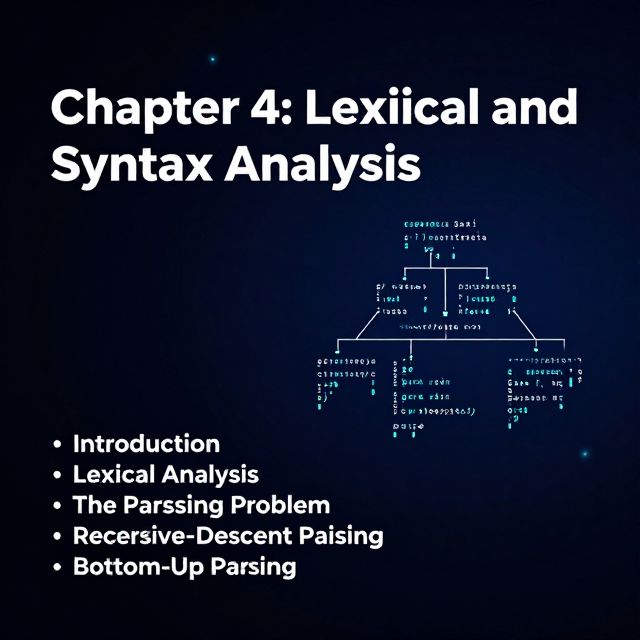
Syntax Analysis and Parsing Techniques - kapak
Teknoloji#syntax analysis#parsing#lexical analysis#lr parser

Syntax Analysis and Parsing Techniques

Explore the fundamentals of syntax analysis, lexical analysis, and different parsing approaches, including LL and the widely used LR parsers.

cinepApril 20, 2026 ~14 dk toplam
01

Flash Kartlar

25 kart

Karta tıklayarak çevir. ← → ile gez, ⎵ ile çevir.

1 / 25
Tüm kartları metin olarak gör
  1. 1. What is the primary focus of the content regarding language implementation?

    The content focuses on the fundamental concepts of syntax analysis and parsing in language implementation. It aims to explain the essential components and methodologies involved in understanding how programming languages are processed, specifically focusing on lexical analysis and different parsing techniques, especially LR parsers. This understanding is crucial for anyone interested in compilers and interpreters.

  2. 2. Why is understanding syntax analysis and parsing crucial for compiler design?

    Understanding syntax analysis and parsing is crucial because these processes form the bedrock of how source code is transformed into executable instructions. They are essential for anyone interested in the inner workings of compilers and interpreters. These stages ensure that the program's structure is correctly analyzed and represented before further processing.

  3. 3. What is the initial step in syntax analysis?

    The initial step in syntax analysis is lexical analysis. This process involves scanning the input program to isolate its small-scale parts, known as tokens. Lexical analysis prepares the raw source code by breaking it down into a structured stream of well-defined units for the subsequent parsing phase.

  4. 4. What is the primary role of a lexical analyzer?

    A lexical analyzer's primary role is to function as a pattern matcher. It scans the input program and isolates its small-scale parts, called tokens. This process effectively breaks down the raw source code into a structured stream of tokens, which then serves as the input for the parsing stage.

  5. 5. What are 'tokens' in the context of lexical analysis?

    Tokens are the basic building blocks of a language, representing the small-scale parts isolated by a lexical analyzer. They can include keywords, identifiers, operators, and literals. For example, in 'int x = 10;', 'int', 'x', '=', and '10' are all tokens, each with a specific meaning to the language.

  6. 6. Provide an example of how the statement 'int x = 10;' would be tokenized.

    In the statement 'int x = 10;', the lexical analyzer would identify 'int' as a keyword, 'x' as an identifier, '=' as an operator, and '10' as a literal. Each of these components is a token, representing a fundamental unit of the programming language. This tokenization prepares the statement for the next stage of processing.

  7. 7. How does lexical analysis prepare the input for parsing?

    Lexical analysis prepares the input for parsing by breaking down the raw source code into a structured stream of tokens. Instead of raw characters, the parsing phase receives well-defined units like keywords, identifiers, and operators. This initial step is crucial for ensuring that the subsequent syntactic scrutiny can operate on meaningful language constructs.

  8. 8. What are the two primary objectives of a parser?

    The two primary objectives of a parser are, first, to detect any syntax errors present in the program, ensuring it adheres to the language's grammatical rules. Second, it aims to produce a parse tree, which is a hierarchical representation of the program's syntactic structure. This parse tree is vital for subsequent phases like semantic analysis and code generation.

  9. 9. What is a parse tree and why is it significant?

    A parse tree is a hierarchical representation of a program's syntactic structure. It visually depicts how expressions are grouped and how statements are structured according to the grammar. Its significance lies in being vital for subsequent phases of compilation, such as semantic analysis and code generation, by providing a structured view of the code.

  10. 10. What are the two broad categories into which parsers can be classified?

    Parsers can be broadly categorized into two main types: top-down and bottom-up. These categories describe the direction in which the parse tree is constructed relative to the grammar's start symbol and the input string. Each category employs different strategies for analyzing the program's syntax.

  11. 11. What is an example of a top-down parser?

    A notable example of a top-down parser is the recursive-descent parser. This type of parser is classified as an LL parser, which processes the input from left-to-right and constructs a leftmost derivation. Recursive-descent parsers typically involve a set of recursive procedures to match input to grammar rules.

  12. 12. What does 'LL' stand for in the context of an LL parser?

    In the context of an LL parser, 'LL' stands for Left-to-right scanning of the input and constructing a Leftmost derivation. This indicates the direction of input processing and the type of derivation sequence the parser attempts to build. LL parsers are a type of top-down parser.

  13. 13. How do recursive-descent parsers typically operate?

    Recursive-descent parsers typically involve a set of recursive procedures, where each procedure corresponds to a non-terminal in the grammar. They attempt to match the input to the grammar rules from the start symbol downwards. This approach essentially tries to find a derivation for the input string by expanding non-terminals from the top of the parse tree.

  14. 14. What kind of derivation does an LL parser construct?

    An LL parser constructs a leftmost derivation. This means it processes the input from left-to-right and, at each step, expands the leftmost non-terminal in the sentential form. This characteristic is fundamental to its top-down parsing strategy, working from the grammar's start symbol to match the input.

  15. 15. How does bottom-up parsing build the parse tree?

    Bottom-up parsing builds the parse tree from the leaves up to the root. It starts with the input symbols (leaves) and progressively combines them into higher-level syntactic constructs (internal nodes) until the entire input is reduced to the grammar's start symbol (root). This is in contrast to top-down parsing, which starts from the root.

  16. 16. What is a 'handle' in bottom-up parsing?

    In bottom-up parsing, a 'handle' refers to a specific substring of the current sentential form that corresponds to the right-hand side of a production rule. The parser must correctly locate this handle and reduce it to its corresponding non-terminal. Identifying the correct handle is a core challenge for bottom-up parsers.

  17. 17. Give an example of identifying and reducing a handle in bottom-up parsing.

    If the grammar has a rule 'Expression -> Number + Number', and the parser sees '5 + 3' in the input, it needs to identify '5 + 3' as the handle. Once identified, this handle is then reduced to 'Expression'. This reduction step replaces the right-hand side of the production with its corresponding non-terminal, moving up the parse tree.

  18. 18. Which family of parsers is most common and widely used for bottom-up parsing?

    Among the various bottom-up parsing techniques, the LR family of shift-reduce parsers stands out as the most common and widely used approach. LR parsers are highly effective due to their ability to handle a large class of grammars and detect errors early in the parsing process, making them a cornerstone in compiler design.

  19. 19. What is a key characteristic of an LR parser regarding derivation?

    A key characteristic of an LR parser is its ability to trace a rightmost derivation in reverse. Instead of starting from the grammar's start symbol and deriving the rightmost non-terminal, an LR parser begins with the input string and works backward. It identifies the production rules that were applied last in a rightmost derivation sequence.

  20. 20. How does an LR parser trace a rightmost derivation in reverse?

    An LR parser traces a rightmost derivation in reverse by starting with the input string and working backward. It identifies the production rules that were applied last in a rightmost derivation sequence. This means it finds a handle (a substring matching a production's right-hand side) and reduces it to the corresponding non-terminal, effectively reversing a derivation step.

  21. 21. Why are LR parsers considered powerful in compiler design?

    LR parsers are considered powerful in compiler design due to their ability to handle a large class of grammars and detect errors early in the parsing process. Their efficient and robust syntax analysis capabilities, stemming from their ability to trace a rightmost derivation in reverse, make them a cornerstone for building reliable compilers.

  22. 22. What does 'shift-reduce' refer to in the context of LR parsers?

    'Shift-reduce' refers to the two primary actions performed by LR parsers. A 'shift' action moves the next input symbol onto a stack, while a 'reduce' action replaces a sequence of symbols on the stack (a handle) with a non-terminal, according to a grammar rule. These actions are fundamental to building the parse tree bottom-up.

  23. 23. What is the main challenge for bottom-up parsers?

    The main challenge for bottom-up parsers lies in identifying the correct substring of the current sentential form that corresponds to the right-hand side of a production rule. This specific substring is known as a 'handle'. Correctly locating and reducing this handle to its corresponding non-terminal is critical for successful parsing.

  24. 24. How do LR parsers handle grammar classes and error detection?

    LR parsers are known for their ability to handle a large class of grammars, making them very versatile. They also excel at detecting errors early in the parsing process, often as soon as a syntax error is encountered. This early error detection is a significant advantage for providing useful feedback to programmers.

  25. 25. What is the overall process from raw source code to the input for parsing?

    The overall process starts with raw source code, which is then fed into a lexical analyzer. The lexical analyzer performs pattern matching to break down the code into a structured stream of tokens. This stream of tokens, representing the basic building blocks of the language, then serves as the well-defined input for the parsing phase.

02

Bilgini Test Et

15 soru

Çoktan seçmeli sorularla öğrendiklerini ölç. Cevap + açıklama.

Soru 1 / 15Skor: 0

What is the primary function of a lexical analyzer?

03

Detaylı Özet

4 dk okuma

Tüm konuyu derinlemesine, başlık başlık.

This study material has been compiled from a lecture audio transcript and a summary document.


📚 Understanding Syntax Analysis and Parsing in Language Implementation

🎯 Introduction to Language Processing

Syntax analysis and parsing are fundamental concepts in the implementation of programming languages. They form the bedrock of how source code is transformed into executable instructions, making them crucial for anyone interested in the inner workings of compilers and interpreters. This guide will explore the essential components and methodologies involved in processing programming languages, focusing on lexical analysis and various parsing techniques, particularly the prominent LR parsers.

1️⃣ Lexical Analysis: The First Step 📝

Before a program's structure can be fully understood, it must first be broken down into its most basic components. This initial phase is handled by the lexical analyzer.

✅ Role of the Lexical Analyzer

  • Pattern Matcher: The lexical analyzer acts as a pattern matcher, scanning the input program.
  • Token Isolation: Its primary function is to isolate small-scale parts of the program, known as tokens.
  • Input for Parsing: These tokens form a structured stream that serves as the input for the subsequent parsing phase.

📚 What are Tokens?

Tokens are the basic building blocks of a language. They represent meaningful units such as:

  • Keywords: Reserved words (e.g., int, if, while).
  • Identifiers: Names given to variables, functions, etc. (e.g., x, myFunction).
  • Operators: Symbols performing operations (e.g., =, +, -).
  • Literals: Constant values (e.g., 10, "hello").

💡 Example: Tokenization

Consider the statement: int x = 10; The lexical analyzer would identify:

  • int as a keyword
  • x as an identifier
  • = as an operator
  • 10 as a literal

This process effectively breaks down raw source code into well-defined units, preparing it for deeper syntactic scrutiny.

2️⃣ Parsing Fundamentals: Building Structure 🌳

Following lexical analysis, the parsing phase begins. This stage is critical for understanding the grammatical structure of the program.

✅ Primary Objectives of a Parser

  1. Detect Syntax Errors: Ensure the program adheres to the language's grammatical rules.
  2. Produce a Parse Tree: Generate a hierarchical representation of the program's syntactic structure.

📚 The Parse Tree

A parse tree visually depicts how expressions are grouped and how statements are structured according to the grammar. It is vital for subsequent phases like semantic analysis and code generation.

📊 Types of Parsers

Parsers are broadly categorized into two main types based on how they construct the parse tree:

  • Top-Down Parsers: Start from the grammar's start symbol and try to derive the input string.
  • Bottom-Up Parsers: Start from the input symbols and try to reduce them to the grammar's start symbol.

3️⃣ Top-Down Parsing: From Root to Leaves ⬇️

Top-down parsers attempt to build the parse tree from the root (start symbol) down to the leaves (input tokens).

📚 Recursive-Descent Parsers (LL Parsers)

  • Example: A notable example of a top-down parser is the recursive-descent parser.
  • Classification: These are classified as LL parsers.
    • L1 (Left-to-right scan): They process the input from left to right.
    • L2 (Leftmost derivation): They construct a leftmost derivation of the input.
  • Mechanism: Recursive-descent parsers typically involve a set of recursive procedures, where each procedure corresponds to a non-terminal in the grammar. They attempt to match the input to the grammar rules by expanding non-terminals from the top of the parse tree downwards.

4️⃣ Bottom-Up Parsing: From Leaves to Root ⬆️

Bottom-up parsers build the parse tree from the input symbols (leaves) up to the start symbol (root).

⚠️ The Parsing Problem for Bottom-Up Parsers

The core challenge for bottom-up parsers is to identify the correct substring of the current sentential form that corresponds to the right-hand side of a production rule. This specific substring is known as a handle. The parser must correctly locate this handle and reduce it to its corresponding non-terminal.

💡 Example: Handle Reduction

Consider a grammar rule: Expression -> Number + Number If the parser sees the input sequence 5 + 3, it needs to:

  1. Identify 5 + 3 as the handle.
  2. Reduce this handle to Expression.

📚 LR Parsers: The Most Common Approach

The LR family of shift-reduce parsers is the most common and widely used bottom-up parsing approach in compiler design.

✅ Key Characteristics of LR Parsers

  • Shift-Reduce Mechanism: They operate by shifting input tokens onto a stack and then reducing sequences of symbols on the stack to non-terminals according to grammar rules.
  • Rightmost Derivation in Reverse: A key characteristic of an LR parser is its ability to trace a rightmost derivation in reverse.
    • Instead of starting from the grammar's start symbol and deriving the rightmost non-terminal at each step, an LR parser begins with the input string.
    • It then works backward, identifying the production rules that were applied last in a rightmost derivation sequence.
  • Efficiency and Power: This reverse tracing allows for efficient and powerful syntax analysis. LR parsers can handle a large class of grammars and are known for their ability to detect errors early in the parsing process, making them a cornerstone in compiler design.
Kendi çalışma materyalini oluştur

PDF, YouTube videosu veya herhangi bir konuyu dakikalar içinde podcast, özet, flash kart ve quiz'e dönüştür. 1.000.000+ kullanıcı tercih ediyor.

Sıradaki Konular

Tümünü keşfet
Syntax Analysis and Parsing Techniques in Language Implementation

Syntax Analysis and Parsing Techniques in Language Implementation

Explore the core concepts of syntax analysis, lexical analysis, and different parsing approaches, including LL and the powerful LR shift-reduce parsers.

Özet 25 15
Compiler Design: Lexical Analysis and Parsing Techniques

Compiler Design: Lexical Analysis and Parsing Techniques

Explore the challenges of naive state diagrams in lexical analysis, simplification techniques like character classes, and the fundamental concepts of parsing, including top-down and bottom-up approaches, left recursion, and predictive parsing.

Özet 25 15
Lexical and Syntax Analysis in Language Processors

Lexical and Syntax Analysis in Language Processors

Explore the fundamental stages of language implementation: lexical analysis (scanning) and syntax analysis (parsing), their roles, and theoretical underpinnings.

Özet 25 15
Understanding Data Types in Programming Languages

Understanding Data Types in Programming Languages

Explore the fundamental concepts of data types, including primitive types, character strings, arrays, and associative arrays, and their implementation in programming.

Özet 25 15
A Brief History of Programming Languages

A Brief History of Programming Languages

Explore the evolution of programming languages from early pioneers and low-level systems to modern high-level and object-oriented paradigms, covering key innovations and their impact.

Özet 25 15
Programming Language Semantics and Attribute Grammars

Programming Language Semantics and Attribute Grammars

This podcast explores attribute grammars for language definition and delves into three primary methods for describing programming language semantics: operational, denotational, and axiomatic semantics.

Özet 25 15
Understanding Pseudocode, Algorithms, and Data Integrity

Understanding Pseudocode, Algorithms, and Data Integrity

Explore the fundamentals of pseudocode, including assignment, conditional, and iteration statements, alongside essential algorithm design methods, data validation, and testing techniques for robust software development.

Özet 25
C++ Pointers and References Explained

C++ Pointers and References Explained

An in-depth educational podcast on C++ pointers and references, covering their nature, usage, syntax, and common pitfalls in object-oriented programming.

Özet 23 15