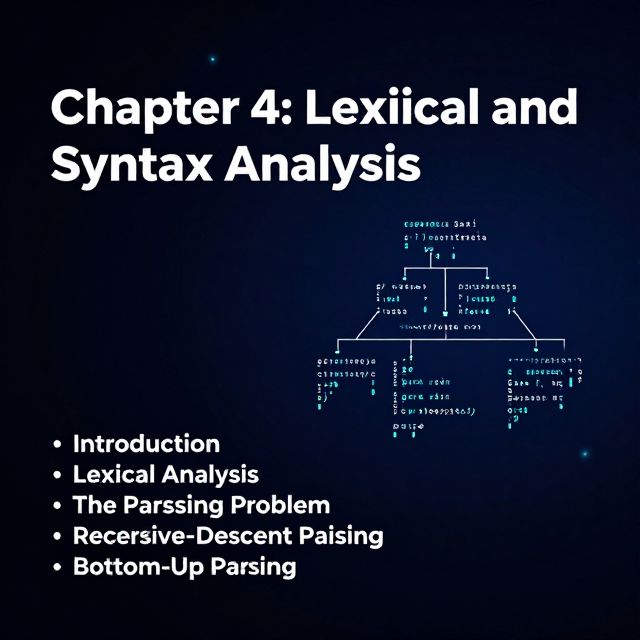
Lexical and Syntax Analysis in Language Processors - kapak
Teknoloji#lexical analysis#syntax analysis#compiler design#programming languages

Lexical and Syntax Analysis in Language Processors

Explore the fundamental stages of language implementation: lexical analysis (scanning) and syntax analysis (parsing), their roles, and theoretical underpinnings.

cinepApril 20, 2026 ~15 dk toplam
01

Flash Kartlar

25 kart

Karta tıklayarak çevir. ← → ile gez, ⎵ ile çevir.

1 / 25
Tüm kartları metin olarak gör
  1. 1. Why is source code analysis crucial in language implementation systems?

    Source code analysis is crucial because, regardless of the system's approach (compilation, interpretation, or hybrid), the system must fully comprehend the program's structure before execution. This foundational understanding ensures the program can be correctly processed and run. It's the initial step that translates human-readable code into a form the machine can understand and act upon.

  2. 2. What formal description is most commonly used for the syntax of a source language?

    The most common formal description used for the syntax of a source language is Backus-Naur Form, or BNF. BNF provides a precise and unambiguous way to define the grammatical rules of a programming language. This formal description is essential for building compilers and interpreters that can correctly parse and understand the structure of programs.

  3. 3. What is the role of the Lexical Analyzer in a compiler?

    The Lexical Analyzer, also known as the Scanner, is the first component that processes raw source code. Its role is to read the source code and break it down into smaller, meaningful units called tokens. It essentially converts a stream of characters into a stream of tokens, which are the basic building blocks for further analysis.

  4. 4. Define 'tokens' in the context of lexical analysis.

    Tokens are the smallest meaningful units generated by the lexical analyzer from the raw source code. They represent the basic building blocks of a program, such as keywords, identifiers, operators, and numerical values. Each token belongs to a specific category and carries semantic information that is crucial for the next phase of analysis.

  5. 5. What is the primary function of the Syntax Analyzer (Parser)?

    The primary function of the Syntax Analyzer, or Parser, is to examine the sequence of tokens produced by the lexical analyzer and determine whether they conform to the grammar rules of the programming language. It verifies the syntactic correctness of the program. Essentially, it checks if the tokens are arranged in a valid structure according to the language's rules.

  6. 6. What is the culmination of the analytical process involving lexical and syntax analysis?

    The culmination of the analytical process involving lexical and syntax analysis is the generation of a Parse Tree. This tree visually depicts the hierarchical structure of the program, illustrating how different parts of the code are organized according to the language's defined grammar. It provides a structured representation of the program's syntax.

  7. 7. What is another common name for the Lexical Analyzer?

    Another common name for the Lexical Analyzer is the Scanner. This name reflects its function of 'scanning' the raw source code character by character to identify and group them into meaningful units. The terms are often used interchangeably in the field of compiler design.

  8. 8. What is a 'lexeme' in lexical analysis?

    A lexeme is a sequence of characters in the source program that matches the pattern for a token and is grouped together by the lexical analyzer. For example, the keyword 'if' is a lexeme that corresponds to the 'keyword' token category. It's the actual textual content that forms a token.

  9. 9. Provide examples of common token categories.

    Common token categories include identifiers (e.g., variable names), keywords (e.g., 'if', 'while'), numeric literals (e.g., '123', '3.14'), and operators (e.g., '+', '=', '*'). These categories help classify the basic building blocks of a program, allowing the parser to understand their role in the program's structure.

  10. 10. How can a lexical analyzer be theoretically modeled?

    From a theoretical standpoint, a lexical analyzer can be effectively modeled as a finite automaton. This model is suitable because lexical analysis involves recognizing patterns in a sequential stream of characters without needing to remember complex nested structures. Finite automata are well-suited for recognizing regular languages, which describe the patterns of tokens.

  11. 11. How are the patterns recognized by a lexical analyzer typically described?

    The patterns recognized by a lexical analyzer are typically described using regular grammars or regular expressions. Regular expressions provide a concise and powerful way to define the character sequences that constitute valid lexemes for each token category. These descriptions guide the construction of the finite automaton that implements the scanner.

  12. 12. Why is lexical analysis considered the 'low-level' phase of syntax processing?

    Lexical analysis is considered the 'low-level' phase because it focuses on the smallest, fundamental language elements, such as individual characters and their grouping into lexemes and tokens. It deals with the raw input stream without understanding the overall program structure. This contrasts with syntax analysis, which deals with higher-level structural relationships.

  13. 13. How does the parser interact with the lexical analyzer?

    The parser interacts with the lexical analyzer by calling upon it whenever it requires the next token from the source program. This on-demand interaction means the parser does not directly process individual characters. Instead, it operates on the stream of tokens provided by the lexical analyzer, simplifying the parser's task.

  14. 14. What steps does the lexical analyzer typically perform when invoked?

    When invoked, the lexical analyzer typically performs a series of steps: it reads characters from the input program, groups them into a lexeme, determines the appropriate token category for that lexeme, and then returns both the token and the lexeme to the parser. This process ensures that the parser receives well-defined, meaningful units.

  15. 15. What is another common name for the Syntax Analyzer?

    Another common name for the Syntax Analyzer is the Parser. This name highlights its function of 'parsing' the stream of tokens to construct a hierarchical representation of the program's structure. The terms are often used interchangeably in the context of compiler design.

  16. 16. What is the primary responsibility of the parser regarding tokens?

    The parser's primary responsibility is to ascertain whether the sequence of tokens produced by the lexical analyzer constitutes a syntactically valid program. It checks if the tokens are arranged according to the grammar rules of the programming language. This ensures that the program's structure is correct and meaningful.

  17. 17. What kind of program structures does the parser analyze?

    The parser analyzes larger, more complex program structures than the lexical analyzer. These include expressions (e.g., 'a + b'), statements (e.g., 'if (x > 0) { ... }'), program blocks (e.g., functions, loops), and even complete program units. It builds a hierarchical understanding of how these structures relate to each other.

  18. 18. How can a syntax analyzer be theoretically modeled?

    From a theoretical perspective, a syntax analyzer can be modeled as a pushdown automaton. This model is more powerful than the finite automaton used for lexical analysis because it includes a stack, allowing it to handle context-free grammars and recognize nested structures. This capability is essential for parsing programming language syntax.

  19. 19. What type of grammar is employed for syntax analysis?

    The type of grammar employed for syntax analysis is a context-free grammar. These grammars are powerful enough to describe the hierarchical structure of most programming languages. They are commonly written using Backus-Naur Form (BNF), which provides a formal notation for defining the structural rules of programs.

  20. 20. What is Backus-Naur Form (BNF) and what is its purpose?

    Backus-Naur Form (BNF) is a formal notation used to describe context-free grammars that define the structural rules of programs. Its purpose is to provide a precise and unambiguous way to specify the syntax of a programming language. This formal description is crucial for designing and implementing parsers.

  21. 21. Provide an example of a BNF rule and explain what it specifies.

    An example of a BNF rule is '<assignment> → <identifier> = <expression>'. This rule specifies that an assignment statement must consist of an identifier, followed by the equals symbol, and then an expression. It defines the sequence and types of components that make up a valid assignment statement in the language.

  22. 22. How do parsers use BNF rules?

    Parsers use BNF rules as a blueprint to verify that programs adhere to the language's syntax. They take the stream of tokens and attempt to match them against the patterns defined by the BNF rules. If the token sequence can be derived from the start symbol of the grammar using these rules, the program is considered syntactically correct.

  23. 23. What are the advantages of using a formal description of syntax like BNF?

    The advantages of using a formal description of syntax like BNF are significant. Parsers can be built directly from BNF specifications, simplifying their implementation. Many parsing algorithms and parser generators leverage these grammar rules to guide how input programs should be analyzed, ensuring consistency and correctness. It provides a clear, unambiguous definition of the language's structure.

  24. 24. What are the general benefits of separating lexical and syntax analysis?

    The separation of lexical and syntax analysis offers several benefits. It simplifies the parser by allowing it to operate on tokens rather than raw characters, making its logic less complex. It enhances efficiency through the optimization of the lexical analyzer, which can be highly optimized for character processing. Furthermore, it improves portability, as the parser itself is often portable, even if parts of the lexical analyzer might be platform-specific.

  25. 25. How does the separation of lexical and syntax analysis simplify the parser?

    The separation simplifies the parser by allowing it to deal with a higher-level input stream of tokens instead of individual characters. This means the parser doesn't need to worry about low-level details like whitespace or character grouping. Its logic can focus solely on the grammatical structure of the program, making it less complex and easier to design.

02

Bilgini Test Et

15 soru

Çoktan seçmeli sorularla öğrendiklerini ölç. Cevap + açıklama.

Soru 1 / 15Skor: 0

What is the initial crucial step in language implementation systems, regardless of whether they use compilation, interpretation, or hybrid approaches?

03

Detaylı Özet

5 dk okuma

Tüm konuyu derinlemesine, başlık başlık.

📚 Chapter 4: Lexical and Syntax Analysis - Study Guide

Source Information: This study material has been compiled from a lecture audio transcript and copy-pasted text provided by the user.


🎯 Introduction to Language Analysis

Language implementation systems, whether they rely on compilation, interpretation, or hybrid approaches (like Just-In-Time (JIT) compilation), all share a fundamental initial step: the thorough analysis of source code. Before any program can be executed, the system must fully comprehend its structure as written by the programmer. This foundational understanding is almost universally based on a formal description of the source language's syntax, most commonly utilizing Backus-Naur Form (BNF).

The process of analyzing source code involves two primary phases:

  1. Lexical Analysis (Scanning): The initial phase where raw source code is broken down into basic, meaningful units.
  2. Syntax Analysis (Parsing): The subsequent phase where these units are checked against the language's grammar rules to ensure structural correctness.

The ultimate output of this analytical process is typically a Parse Tree, which visually represents the hierarchical structure of the program, illustrating how different parts of the code are organized according to the language's defined grammar.


🔍 The Two Phases of Language Processing

The syntax analysis step of a language processor is typically divided into two main components: the Lexical Analyzer and the Syntax Analyzer.

1. Lexical Analysis (Scanning) 📝

The Lexical Analyzer, often called the Scanner, performs the low-level analysis of the source code.

Role:

  • Processes the raw sequence of characters directly from the source program.
  • Groups these characters into meaningful units called lexemes.
  • Assigns each lexeme to a specific token category.

📚 Tokens: Tokens are the basic building blocks of a program. They represent categories of lexemes.

  • Examples of Token Categories:
    • identifiers (e.g., myVariable, calculateSum)
    • keywords (e.g., if, while, for, int)
    • numeric literals (e.g., 123, 3.14)
    • operators (e.g., +, -, =, *)
    • delimiters (e.g., ;, (, ))

💡 Implementation:

  • In most language processors, the lexical analyzer is implemented as a dedicated function or module.
  • The parser calls the lexical analyzer whenever it needs the next token from the source program.
  • Steps for each call:
    1. Reads characters from the input program.
    2. Groups them into a lexeme.
    3. Determines the token category of the lexeme.
    4. Returns both the token and the lexeme to the parser.
  • This means the parser does not directly process individual characters; instead, it operates on the stream of tokens provided by the lexical analyzer.

2. Syntax Analysis (Parsing) 🌳

The Syntax Analyzer, also known as the Parser, performs the high-level analysis of the program structure.

Role:

  • Works directly with the tokens produced by the lexical analyzer.
  • Determines whether the sequence of tokens forms a syntactically valid program according to the language's grammar rules.
  • Analyzes larger program structures.

📚 Structures Analyzed:

  • Expressions (e.g., a + b * c)
  • Statements (e.g., x = y;, if (condition) { ... })
  • Program Blocks (e.g., { ... })
  • Complete Program Units (e.g., functions, classes)

📐 Formal Description of Syntax: Backus-Naur Form (BNF)

Nearly all syntax analyzers are based on a formal description of the programming language syntax. The most common formal notation is Backus-Naur Form (BNF).

Purpose of BNF:

  • BNF is used to describe context-free grammars (CFG), which define the structural rules of programs.
  • It provides a precise and unambiguous way to specify the syntax of a programming language.

📝 BNF Rule Example: Consider the rule: <assignment> → <identifier> = <expression>

  • This rule states that an assignment statement (<assignment>) must consist of:
    1. An identifier (e.g., a variable name)
    2. Followed by the assignment operator =
    3. Followed by an expression (e.g., a value or calculation)
  • Parsers use such BNF rules to verify that programs adhere to the language's syntax.

🧠 Theoretical Models for Analysis

From a theoretical perspective, both lexical and syntax analysis can be modeled using specific computational machines and grammars.

  • Lexical Analyzer (Scanner):

    • Can be modeled as a finite automaton.
    • The patterns it recognizes (for tokens) are described using regular grammars or regular expressions.
    • 📚 Regular Grammars: A formal, restricted type of grammar that generates regular languages, recognizable by finite automata. They are crucial for lexical analysis and pattern matching due to their efficiency.
  • Syntax Analyzer (Parser):

    • Can be modeled as a pushdown automaton. This is a more powerful computational model than a finite automaton, capable of handling the recursive nature of programming language syntax.
    • The grammar used for syntax analysis is a context-free grammar (CFG), commonly written using BNF.

🚀 Advantages of Separating Lexical and Syntax Analysis

Separating the overall syntax analysis into two distinct phases—lexical and syntax analysis—offers several significant benefits in compiler and interpreter design:

  1. Simplicity ✅:

    • Less complex approaches can be used for lexical analysis, as it deals with smaller, more localized patterns.
    • Separating these concerns simplifies the design and implementation of the parser, allowing it to focus solely on the structural relationships between tokens rather than individual characters.
  2. Efficiency 📈:

    • The separation allows for the optimization of the lexical analyzer. Since it's a frequently called component, optimizing its performance (e.g., by using efficient finite automata implementations) can significantly speed up the overall analysis process.
  3. Portability 🌍:

    • Parts of the lexical analyzer might be platform-dependent (e.g., handling character encodings specific to an operating system).
    • However, the parser, which operates on abstract tokens defined by the language's grammar, is generally more portable across different systems. This modularity makes it easier to adapt the language processor to new environments.

💡 Summary

In essence:

  • Lexical analysis handles the smallest elements of the language, converting raw characters into meaningful tokens.
  • Syntax analysis handles the structural relationships between these tokens, ensuring the program adheres to the language's grammar.

Together, these two phases form the crucial front-end of a compiler or interpreter, ensuring that a program is both lexically and syntactically correct before further processing can occur.
Kendi çalışma materyalini oluştur

PDF, YouTube videosu veya herhangi bir konuyu dakikalar içinde podcast, özet, flash kart ve quiz'e dönüştür. 1.000.000+ kullanıcı tercih ediyor.

Sıradaki Konular

Tümünü keşfet
Syntax Analysis and Parsing Techniques in Language Implementation

Syntax Analysis and Parsing Techniques in Language Implementation

Explore the core concepts of syntax analysis, lexical analysis, and different parsing approaches, including LL and the powerful LR shift-reduce parsers.

Özet 25 15
Syntax Analysis and Parsing Techniques

Syntax Analysis and Parsing Techniques

Explore the fundamentals of syntax analysis, lexical analysis, and different parsing approaches, including LL and the widely used LR parsers.

Özet 25 15
Compiler Design: Lexical Analysis and Parsing Techniques

Compiler Design: Lexical Analysis and Parsing Techniques

Explore the challenges of naive state diagrams in lexical analysis, simplification techniques like character classes, and the fundamental concepts of parsing, including top-down and bottom-up approaches, left recursion, and predictive parsing.

Özet 25 15
Programming Language Semantics and Attribute Grammars

Programming Language Semantics and Attribute Grammars

This podcast explores attribute grammars for language definition and delves into three primary methods for describing programming language semantics: operational, denotational, and axiomatic semantics.

Özet 25 15
Describing Programming Language Syntax and Semantics

Describing Programming Language Syntax and Semantics

Explore the fundamental concepts of syntax and semantics in programming languages, from formal definitions and BNF to ambiguity and static semantics.

Özet 25 15
Programming Language Data Types and Memory Management

Programming Language Data Types and Memory Management

An in-depth look into record types, tuples, unions, pointers, references, heap allocation, garbage collection, and type checking in programming languages.

Özet 25 15
Understanding Data Types in Programming Languages

Understanding Data Types in Programming Languages

Explore the fundamental concepts of data types, including primitive types, character strings, arrays, and associative arrays, and their implementation in programming.

Özet 25 15
A Brief History of Programming Languages

A Brief History of Programming Languages

Explore the evolution of programming languages from early pioneers and low-level systems to modern high-level and object-oriented paradigms, covering key innovations and their impact.

Özet 25 15