Describing Programming Language Syntax and Semantics - kapak
Teknoloji#programming languages#syntax#semantics#bnf

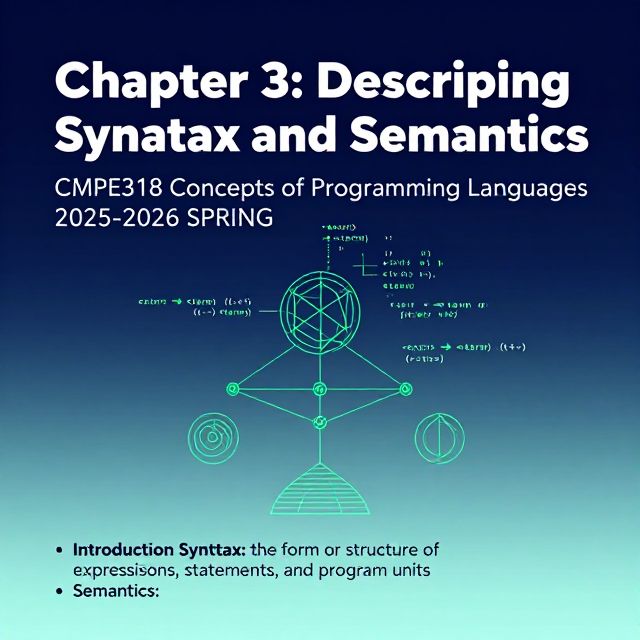
Describing Programming Language Syntax and Semantics

Explore the fundamental concepts of syntax and semantics in programming languages, from formal definitions and BNF to ambiguity and static semantics.

cinepApril 20, 2026 ~17 dk toplam
01

Flash Kartlar

25 kart

Karta tıklayarak çevir. ← → ile gez, ⎵ ile çevir.

1 / 25
Tüm kartları metin olarak gör
  1. 1. What is syntax in the context of programming languages?

    Syntax refers to the form or structure of expressions, statements, and program units. It dictates the rules for how code must be written to be considered grammatically correct, much like grammar rules in natural languages. For example, it defines the structure of a 'while' loop or the placement of semicolons.

  2. 2. How does semantics differ from syntax in programming languages?

    While syntax deals with the form of code, semantics defines the meaning of these expressions, statements, and program units. It explains what a syntactically correct piece of code actually does. For instance, the syntax of a 'while' loop defines its structure, but its semantics explain that the embedded statement executes repeatedly as long as a condition is true.

  3. 3. Provide an example to illustrate the semantics of a Java `while` statement.

    For a Java `while (boolean_expr) statement`, its semantics dictate that if the `boolean_expr` evaluates to true, the `statement` executes, and control returns to re-evaluate the expression. If the `boolean_expr` evaluates to false, control proceeds past the loop, meaning the `statement` is not executed.

  4. 4. Why are both syntax and semantics crucial for programming language definition?

    Together, syntax and semantics provide a complete definition of a language. Syntax ensures code is well-formed, while semantics ensures it has a clear, unambiguous meaning. This complete definition is vital for various users, including language designers, compiler implementers, and programmers, to correctly understand, build, and use the language.

  5. 5. Which aspect of programming languages is generally easier to describe, syntax or semantics, and why?

    Describing syntax is generally easier than semantics. This is partly because there are concise, universally accepted notations for syntax, such as Backus-Naur Form (BNF). For semantics, however, such widely accepted and formal notations are not yet as developed or universally adopted, making its formal description more challenging.

  6. 6. In formal language theory, what is the distinction between a 'sentence' and a 'language'?

    In formal language theory, a 'sentence' is defined as a string of characters formed over a specific alphabet. A 'language,' on the other hand, is a set of such sentences. Essentially, a language comprises all the valid strings of characters that conform to its defined rules, with each valid string being a sentence.

  7. 7. Explain the terms 'lexeme' and 'token' with examples in programming.

    A 'lexeme' is the smallest syntactic unit of a language, such as an asterisk (*), a variable name (sum), or a keyword (if). A 'token' is a category of lexemes. For example, 'sum' and 'if' might both be categorized as 'identifier' tokens, while '*' would be an 'operator' token.

  8. 8. What is a 'recognizer' in the context of formal language definition?

    A recognizer is a mechanism designed to determine whether a given string of characters belongs to a specific language. It essentially checks if the input string conforms to the language's defined rules. In compilers, the syntax analysis component, known as a parser, acts as a recognizer.

  9. 9. How does a 'generator' function in formal language definition, and how can it be used to verify syntax?

    A generator is a device that produces sentences of a language according to its rules. To verify the syntax of a statement, one can compare its structure to the rules of the generator. If the statement can be produced by the generator's rules, it is considered syntactically correct.

  10. 10. What was the significance of the discovery regarding the relationship between formal generation and recognition devices?

    The close relationship between formal generation and recognition devices was a pivotal discovery in computer science. It provided a foundational understanding for formal languages and compiler design theory, showing how rules for generating valid language constructs could also be used to recognize them efficiently.

  11. 11. What does BNF stand for, and what is its primary purpose in programming languages?

    BNF stands for Backus-Naur Form. It is a formal notation used to describe the syntax of programming languages. BNF provides a powerful and precise way to define the grammatical rules, making it a cornerstone for language design and compiler construction, and is equivalent to Context-Free Grammars.

  12. 12. Who were the key figures in the development of BNF, and what were its origins?

    BNF was initially developed by Noam Chomsky in the mid-1950s for natural languages. It was later adapted by John Backus for the Algol 58 programming language. This adaptation made it a fundamental tool for formally defining programming language syntax and became widely adopted.

  13. 13. In BNF, what is the difference between 'nonterminal symbols' (abstractions) and 'terminals'?

    'Nonterminal symbols,' also known as abstractions, are enclosed in angle brackets (e.g., <if_stmt>) and represent classes of syntactic structures that can be further broken down. 'Terminals' are symbols without angle brackets (e.g., 'if', '(', 'sum') and correspond to lexemes or tokens, representing the basic, irreducible elements of the language.

  14. 14. Describe the structure of a BNF 'rule' and provide a simple example.

    A BNF rule consists of a left-hand side (LHS), which is a nonterminal symbol, and a right-hand side (RHS), which is a string of terminals and/or nonterminals. The LHS is defined by the RHS. For example, a rule might be `<if_stmt> ::= if ( <logic_expr> ) <stmt>`, where `::=` means 'is defined as'.

  15. 15. What constitutes a 'grammar' in the context of BNF?

    A grammar in BNF is a collection of BNF rules. These rules collectively define the complete syntax of a language. A grammar also includes a designated 'start symbol,' which is the nonterminal from which all valid sentences of the language can be derived through a series of rule applications.

  16. 16. Explain the process of 'derivation' in BNF.

    Derivation is the process of repeatedly applying BNF rules, starting from the grammar's designated start symbol. In each step, a nonterminal on the right-hand side of a rule is replaced by its definition, until a sentence composed entirely of terminal symbols is produced. This sequence shows how a valid program construct is formed.

  17. 17. What is a 'parse tree' and what does it visually represent?

    A parse tree is a hierarchical visual representation of a derivation. It illustrates how a sentence (a program construct) is derived from the grammar's start symbol by showing the application of BNF rules. Each node in the tree represents a symbol, and its children represent the symbols on the right-hand side of the rule applied.

  18. 18. Define 'ambiguity' in the context of programming language grammars.

    A grammar is considered ambiguous if a single sentence (a valid program construct) can have two or more distinct parse trees. This means there are multiple ways to interpret the syntactic structure of the same piece of code according to the grammar's rules, leading to potential confusion about its meaning.

  19. 19. Why is grammar ambiguity problematic for compilers?

    Ambiguity is problematic for compilers because they rely on parse trees to determine the unique meaning of language structures and generate appropriate machine code. If a structure has multiple parse trees, its meaning cannot be uniquely determined, leading to unpredictable or incorrect code generation, which is unacceptable for reliable software.

  20. 20. How can common forms of ambiguity, such as those related to operator precedence, be managed in grammar design?

    Ambiguity related to operator precedence (e.g., multiplication before addition) can often be managed by carefully structuring the grammar. This involves defining rules that implicitly enforce the desired precedence and associativity. Parser generators like YACC and Bison also provide mechanisms to handle such ambiguities by allowing explicit precedence rules.

  21. 21. What is EBNF, and what are its main advantages over standard BNF?

    EBNF stands for Extended Backus-Naur Form. It introduces simple extensions to BNF, such as square brackets `[]` for optional parts, parentheses `()` with vertical bars `|` for alternative parts, and curly braces `{}` for zero or more repetitions. Its main advantage is conciseness, making grammars easier to read and write.

  22. 22. Does EBNF increase the descriptive power of BNF? Explain why or why not.

    No, EBNF does not add more descriptive power than BNF. Anything that can be expressed in EBNF can also be expressed in standard BNF, albeit often with more rules and less conciseness. EBNF is simply a more convenient and compact notation for expressing the same set of context-free grammars.

  23. 23. What are 'static semantics' in programming languages?

    Static semantics refers to rules that govern the legal forms of programs but go beyond what can be described by context-free syntax (BNF/EBNF). These rules ensure logical consistency, such as requiring variables to be declared before use or ensuring operands in an expression have compatible data types.

  24. 24. Why are static semantics rules referred to as 'static'?

    These rules are called 'static' because the analysis required to check them can be performed at compile time, before the program is actually executed. This allows many potential errors, like type mismatches or undeclared variables, to be caught early in the development process, rather than during runtime.

  25. 25. What are 'attribute grammars' used for in the context of programming language definition?

    Attribute grammars are used to formally describe and check static semantics. They extend context-free grammars by adding attribute values to grammar symbols. These attributes carry semantic information, and evaluation rules and predicates are used to ensure their consistency throughout the program structure, thus enforcing semantic constraints.

02

Bilgini Test Et

15 soru

Çoktan seçmeli sorularla öğrendiklerini ölç. Cevap + açıklama.

Soru 1 / 15Skor: 0

In programming languages, what does 'syntax' primarily refer to?

03

Detaylı Özet

7 dk okuma

Tüm konuyu derinlemesine, başlık başlık.

This study material has been compiled from lecture notes (copy-pasted text) and an audio transcript for the CMPE318 Concepts of Programming Languages course, Spring 2025-2026.


📚 Chapter 3: Describing Syntax and Semantics in Programming Languages

1. Introduction to Syntax and Semantics

Understanding how programming languages are structured and interpreted is fundamental to computer science. This involves two core concepts: syntax and semantics.

  • Syntax 📚: Refers to the form or structure of expressions, statements, and program units. It dictates the rules for how code must be written to be considered grammatically correct.
  • Semantics 📚: Defines the meaning of these expressions, statements, and program units. It explains what a syntactically correct program actually does.

Together, syntax and semantics provide a complete definition of a programming language. This definition is crucial for various stakeholders:

  • Other Language Designers: To understand existing language features.
  • Implementers: To build compilers and interpreters.
  • Programmers: To correctly use the language.

Example (Java while statement):

  • Syntax: while (boolean_expr) statement
  • Semantics: If boolean_expr evaluates to true, statement is executed, and control returns to re-evaluate boolean_expr. If boolean_expr is false, control proceeds past the while construct.

While often discussed separately, syntax and semantics are closely related. In a well-designed language, the syntax should strongly suggest the statement's intended meaning. Describing syntax is generally easier than semantics, as concise and universally accepted notations exist for syntax, but not yet for semantics.

2. The General Problem of Describing Syntax: Terminology

To formally describe the syntax of a language, specific terminology is used:

  • Sentence 📚: A string of characters over a defined alphabet.
  • Language 📚: A set of sentences over an alphabet.
  • Lexeme 📚: The lowest-level syntactic unit of a language (e.g., *, sum, if).
  • Token 📚: A category of lexemes (e.g., identifier, assignment_operator).

Example (Java): index = 2 * count + 17; | Lexeme | Token | | :-------- | :---------------- | | index | identifier | | = | assignment_operator | | 2 | integer_literal | | * | mult_operator | | count | identifier | | + | addition_operator | | 17 | integer_literal | | ; | semicolon |

3. Formal Definition of Languages

Formal definitions of languages can be approached in two ways:

3.1. Recognizers

  • A recognizer is a mechanism (e.g., a program) that determines whether a given input string belongs to a specific language.
  • It reads strings and indicates if they are "in" the language (accepts) or "not in" the language (rejects).
  • ✅ The syntax analysis part of a compiler, often called a parser, acts as a recognizer, determining if a program is syntactically correct.

3.2. Generators

  • A generator is a device that produces all valid sentences of a language.
  • One can verify the syntax of a statement by comparing it with the structure generated by the device.
  • 💡 The close connection between formal generation and recognition devices for the same language was a pivotal discovery in computer science, foundational to formal languages and compiler design theory.

4. Formal Methods for Describing Syntax: BNF and Context-Free Grammars

4.1. Context-Free Grammars (CFGs)

  • Developed by Noam Chomsky in the mid-1950s to describe the syntax of natural languages.
  • They define a class of languages called context-free languages.

4.2. Backus-Naur Form (BNF)

  • Invented by John Backus in 1959 to describe the syntax of Algol 58.
  • ✅ BNF is formally equivalent to context-free grammars.

4.3. BNF Fundamentals

  • Abstractions (Nonterminal Symbols) 📚: Represent classes of syntactic structures and are enclosed in angle brackets (e.g., <if_stmt>).
  • Terminal Symbols 📚: Are lexemes or tokens that appear literally in the language (e.g., if, (, identifier).
  • Rule (Production) 📚: Has a Left-Hand Side (LHS), which is a nonterminal, and a Right-Hand Side (RHS), a string of terminals and/or nonterminals.
    • Example: <if_stmt> → if ( <logic_expr> ) <stmt>
  • Grammar 📚: A finite, non-empty set of rules.
  • Start Symbol 📚: A special nonterminal from which all derivations begin.
  • Alternative RHSs: A nonterminal can have multiple RHSs, separated by |.
    • Example: <stmt> → <single_stmt> | begin <stmt_list> end
  • Syntactic Lists: Described using recursion.
    • Example: <ident_list> → identifier | identifier, <ident_list>

4.4. Derivations and Parse Trees

  • Derivation 📚: A repeated application of grammar rules, starting with the start symbol and ending with a sentence (a string of only terminal symbols).
    • Sentential Form 📚: Every string of symbols in a derivation.
    • Sentence 📚: A sentential form consisting only of terminal symbols.
    • Leftmost Derivation: One where the leftmost nonterminal in each sentential form is expanded first.
  • Parse Tree 📚: A hierarchical representation of a derivation, visually showing the syntactic structure of a sentence.

Example Derivation: <program> => <stmts> => <stmt> => <var> = <expr> => a = <expr> => a = <term> + <term> => a = <var> + <term> => a = b + <term> => a = b + const

Example Parse Tree for A = B * (A + C):

       <assign>
          |
    <id> = <expr>
    /    \
   A      <expr>
          |
       <id> * <expr>
       /    \
      B      <expr>
             |
           ( <expr> )
           /        \
          <expr>    <expr>
          |         |
       <id> + <expr> <id>
       /    \       \
      A      <expr>  C
             |
            <id>
            |
            C

4.5. Ambiguity in Grammars

  • Ambiguous Grammar ⚠️: A grammar is ambiguous if it generates a sentence that has two or more distinct parse trees.
  • Problem: Compilers often base the semantics (meaning) of structures on their syntactic form (parse tree). If a structure has multiple parse trees, its meaning cannot be uniquely determined, leading to incorrect code generation.
  • Example: A = B + C * A can have two parse trees, one where + has precedence and one where * has precedence, leading to different interpretations.

Addressing Ambiguity:

  • Operator Precedence: Can be enforced by introducing different "layers" of expressions and subexpressions in the grammar.
    • Example: <expr> → <expr> + <term> | <term> and <term> → <term> * <factor> | <factor> ensures * has higher precedence than +.
  • Operator Associativity: Specifies which operator takes precedence when two operators of the same precedence appear consecutively (e.g., A - B - C). Left associativity ((A-B)-C) is common for arithmetic operators.
    • Example: <expr> → <expr> + const | const (left-associative) vs. <expr> → const + <expr> | const (right-associative).
  • Good News ✅: Common forms of ambiguity (precedence & associativity) can often be handled by carefully structuring the grammar or by using parser generators like YACC and Bison.

5. Extended BNF (EBNF)

  • Purpose: EBNF is a few simple extensions to BNF that make expressing grammars more convenient and concise.
  • Equivalence: EBNF is no more "powerful" than BNF; anything expressible in EBNF can also be expressed in BNF.
  • Usage: Widely used as the de facto standard for defining programming languages.

EBNF Extensions:

  • Optional parts: Placed in square brackets [].
    • Example: <func_call> → ident ([<expr_list>]) (meaning expr_list is optional)
  • Alternative parts: Placed inside parentheses and separated by vertical bars () |.
    • Example: <term> → <term>(+|-) const (meaning + or -)
  • Repetitions (0 or more): Placed inside curly braces {}.
    • Example: <ident> → letter {letter|digit} (meaning a letter followed by zero or more letters or digits)

BNF vs. EBNF Example: | BNF | EBNF | | :---------------------------------------- | :--------------------------------- | | <expr> → <expr> + <term> | <expr> → <term> {(+ | -) <term>} | | | <expr> - <term> | | | | <term> | | | <term> → <term> * <factor> | <term> → <factor> {(* | /) <factor>} | | | <term> / <factor> | | | | <factor> | |

6. Static Semantics

6.1. Limitations of Context-Free Grammars

  • CFGs (and thus BNF/EBNF) cannot describe all syntactic rules of programming languages.
  • Troublesome categories:
    • Context-free but cumbersome (e.g., requiring operands in an expression to be of compatible types).
    • Non-context-free (e.g., a variable must be declared before it is used).

6.2. Definition of Static Semantics

  • Static Semantics 📚: Refers to the legal forms of programs that go beyond context-free syntax. These rules are not directly related to the program's meaning during execution but rather to its structural correctness.
  • Static Analysis: These rules are called "static" because the analysis required to check them can be performed at compile time, before program execution.
  • Many static semantic rules relate to type constraints (e.g., type checking).

6.3. Attribute Grammars

  • Purpose: A formal mechanism devised to describe and check static semantics.
  • Definition 📚: An attribute grammar extends a context-free grammar G = (S, N, T, P) with:
    1. Attribute Values: For each grammar symbol x, a set A(x) of attribute values. These attributes carry semantic information.
    2. Evaluation Rules: For each production rule, a set of functions that define how attribute values are computed for the nonterminals in that rule.
    3. Predicates: A set of Boolean conditions to check for attribute consistency (e.g., type compatibility).
  • Primary Value:
    • Specification of static semantics.
    • Aid in compiler design for static semantics checking.
  • 💡 Although not always formally used, the basic concepts of attribute grammars are informally applied in every compiler.
Kendi çalışma materyalini oluştur

PDF, YouTube videosu veya herhangi bir konuyu dakikalar içinde podcast, özet, flash kart ve quiz'e dönüştür. 1.000.000+ kullanıcı tercih ediyor.

Sıradaki Konular

Tümünü keşfet
Programming Language Semantics and Attribute Grammars

Programming Language Semantics and Attribute Grammars

This podcast explores attribute grammars for language definition and delves into three primary methods for describing programming language semantics: operational, denotational, and axiomatic semantics.

Özet 25 15
Lexical and Syntax Analysis in Language Processors

Lexical and Syntax Analysis in Language Processors

Explore the fundamental stages of language implementation: lexical analysis (scanning) and syntax analysis (parsing), their roles, and theoretical underpinnings.

Özet 25 15
Programming Language Data Types and Memory Management

Programming Language Data Types and Memory Management

An in-depth look into record types, tuples, unions, pointers, references, heap allocation, garbage collection, and type checking in programming languages.

Özet 25 15
Understanding Data Types in Programming Languages

Understanding Data Types in Programming Languages

Explore the fundamental concepts of data types, including primitive types, character strings, arrays, and associative arrays, and their implementation in programming.

Özet 25 15
A Brief History of Programming Languages

A Brief History of Programming Languages

Explore the evolution of programming languages from early pioneers and low-level systems to modern high-level and object-oriented paradigms, covering key innovations and their impact.

Özet 25 15
Names, Bindings, and Scopes in Programming Languages

Names, Bindings, and Scopes in Programming Languages

Explore fundamental concepts of names, variables, binding, scope, and named constants in programming languages, crucial for understanding program execution and design.

Özet 25 15
Understanding Pragmatics in Language

Understanding Pragmatics in Language

Explore pragmatics: the study of meaning communicated by speakers and interpreted by listeners, considering context, speaker intention, and social distance.

Özet 25 15
First Language Acquisition: Concepts and Developmental Stages

First Language Acquisition: Concepts and Developmental Stages

This summary explores first language acquisition, differentiating it from learning. It details early developmental stages, including cooing, babbling, one-word, two-word, and telegraphic speech, alongside the development of morphological, syntactic, and semantic knowledge.

5 dk Özet 25 15