Understanding Pseudocode, Algorithms, and Data Integrity - kapak
Teknoloji#pseudocode#algorithms#programming#computer science

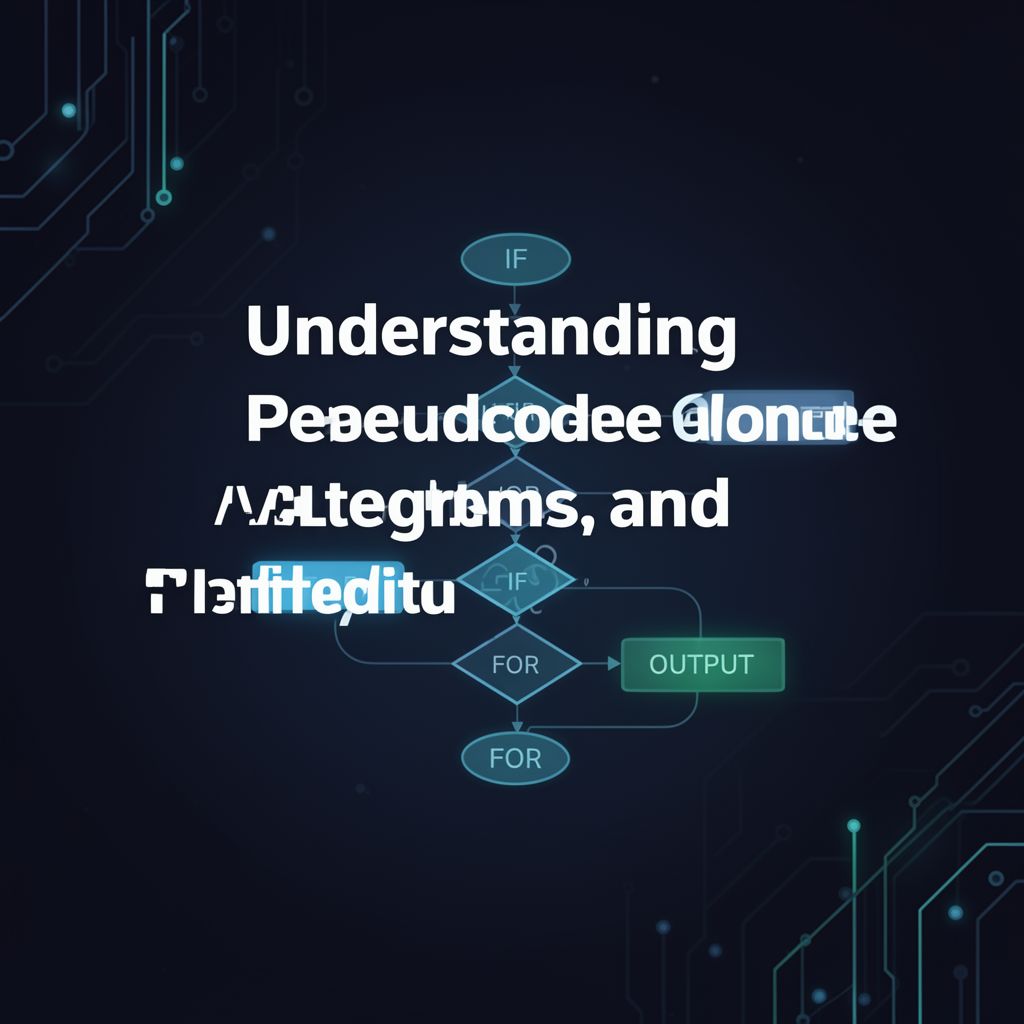
Understanding Pseudocode, Algorithms, and Data Integrity

Explore the fundamentals of pseudocode, including assignment, conditional, and iteration statements, alongside essential algorithm design methods, data validation, and testing techniques for robust software development.

cmykslJanuary 22, 2026 ~11 dk toplam
01

Flash Kartlar

25 kart

Karta tıklayarak çevir. ← → ile gez, ⎵ ile çevir.

1 / 25
Tüm kartları metin olarak gör
  1. 1. What is the primary purpose of pseudocode in algorithm design?

    Pseudocode serves as a straightforward method for illustrating an algorithm's actions. It uses English keywords similar to high-level programming languages but without strict syntax rules, making it easier for humans to understand the logic before actual coding. It acts as a bridge between human language and programming language, facilitating the design process.

  2. 2. How does pseudocode handle data items within an algorithm?

    In pseudocode, data items processed by the algorithm are assigned meaningful names. These names function much like variables and constants in actual programming languages, allowing for clear identification and manipulation of data. This practice enhances readability and helps in clearly identifying what each piece of data represents throughout the algorithm's execution.

  3. 3. Describe one key convention for writing pseudocode to ensure consistency and readability.

    One key convention for writing pseudocode is to indent repeated or selected statements by two spaces within conditional and loop structures. This visual formatting clearly indicates the blocks of code that belong to a specific condition or loop. This practice significantly improves the readability and understanding of the algorithm's flow, making it easier to follow the logic.

  4. 4. Explain the function of the 'leftarrow' operator (<-) in pseudocode.

    The 'leftarrow' operator (<-) is used for assignment statements in pseudocode. It assigns the value of the expression on its right side to the variable or item specified on its left side. This is fundamental for storing and updating values within an algorithm, similar to the '=' operator in many programming languages, allowing data to be manipulated and stored.

  5. 5. List three mathematical operators commonly used in pseudocode expressions.

    Three mathematical operators commonly used in pseudocode expressions are '+' for addition, '-' for subtraction, and '*' for multiplication. Other operators include '/' for division, '^' for raising to a power, and '()' for grouping expressions. These operators enable the algorithm to perform various arithmetic calculations within assignment statements.

  6. 6. What is the main purpose of conditional statements in an algorithm?

    Conditional statements are vital when an algorithm needs to perform different actions based on variable values or specific conditions. They allow the program to make decisions, executing one block of code if a condition is true and potentially another if it's false. This enables dynamic and responsive algorithm behavior, adapting to different inputs or states.

  7. 7. Describe the structure and use of the IF...THEN...ELSE...ENDIF statement.

    The IF...THEN...ELSE...ENDIF structure is used for conditions that evaluate to true or false. If the specified condition is true, the statements following THEN are executed. If the condition is false and an ELSE path exists, the statements after ELSE are executed. The entire block is always concluded with ENDIF, clearly marking the end of the conditional logic.

  8. 8. How can complex conditions be formed in pseudocode using logical operators?

    Complex conditions in pseudocode can be formed using logical operators such as AND, OR, and NOT. These operators combine or modify simpler conditions to create more sophisticated decision-making criteria. For example, (Age < 18 AND HasPermission = TRUE) creates a condition that is true only if both sub-conditions are met, allowing for more nuanced algorithm behavior.

  9. 9. When would you use a CASE OF...OTHERWISE...ENDCASE structure instead of IF...THEN...ELSE...ENDIF?

    The CASE OF...OTHERWISE...ENDCASE structure is preferred when an algorithm needs to handle choices among several different discrete values of a single variable. Unlike IF...THEN...ELSE...ENDIF, which is best for binary (true/false) conditions, CASE OF provides a cleaner way to manage multiple distinct paths based on a variable's specific value, with an OTHERWISE clause for all other cases, improving readability for multi-way branching.

  10. 10. What is the primary function of iteration structures in pseudocode?

    The primary function of iteration structures, also known as loops, is to repeat a block of actions multiple times. This is essential for tasks that require processing lists of data, performing calculations until a certain condition is met, or executing a set number of operations. Loops automate repetitive processes, making algorithms more efficient and concise.

  11. 11. Explain the FOR...TO...NEXT loop and its typical use case.

    The FOR...TO...NEXT loop is used for a set, predetermined number of repetitions. It's efficient because the loop counter is automatically managed, incrementing through a specified range. This loop is particularly useful for tasks like iterating through an array or list a fixed number of times, such as reading values into a list or performing an action for each item in a collection.

  12. 12. What is a key characteristic of the REPEAT...UNTIL loop regarding execution?

    A key characteristic of the REPEAT...UNTIL loop is that the actions within the loop are guaranteed to be performed at least once. This is because the exit test (the UNTIL condition) occurs at the end of the loop, making it a post-condition loop. The loop continues to repeat its block of code until the specified condition becomes true, ensuring at least one execution.

  13. 13. How does the WHILE...DO...ENDWHILE loop differ from the REPEAT...UNTIL loop in terms of condition testing?

    The WHILE...DO...ENDWHILE loop differs from REPEAT...UNTIL because its condition test occurs at the beginning of the loop, making it a pre-condition loop. This means that if the condition is initially false, the actions within the WHILE loop may never execute. In contrast, REPEAT...UNTIL always executes at least once before testing the condition, guaranteeing initial execution.

  14. 14. What is the purpose of the INPUT statement in pseudocode? Provide an example.

    The INPUT statement in pseudocode is used to obtain data from an external source, typically a user, and store it in a variable. It facilitates data entry into the algorithm, allowing for interactive programs. For example, INPUT Name would prompt the user to enter a value, which would then be stored in the variable Name for further processing.

  15. 15. How is the OUTPUT statement used in pseudocode? Give an example.

    The OUTPUT statement in pseudocode is used to display information to the user, either on a screen or printed. It can be followed by a string literal, a variable, or a list of values to be displayed. For instance, OUTPUT 'Your name is ', Name would display the literal text 'Your name is ' followed by the current value stored in the Name variable, providing feedback to the user.

  16. 16. Define the standard algorithm method of 'totalling'.

    Totalling is a standard algorithm method that involves keeping a running sum of values. It typically starts with an accumulator variable initialized to zero, and then values are successively added to this variable within a loop. This method is commonly used to calculate the sum of a series of numbers, such as total marks for a class or the total cost of items.

  17. 17. Explain the 'counting' standard algorithm method.

    Counting is a standard algorithm method used to track the number of times a specific action occurs or how many items meet a certain criterion. It involves initializing a counter variable to zero and incrementing it by one each time the desired event or condition is met. This is useful for tasks like counting students who passed an exam or the number of valid entries.

  18. 18. What is the purpose of a 'linear search' algorithm?

    A linear search algorithm systematically inspects each item in a list, one by one, from beginning to end, to find a match for a target value. It typically uses a flag variable to indicate whether the item has been found. While simple to implement, it can be inefficient for very large lists as it may need to check every element in the worst-case scenario.

  19. 19. Describe the 'bubble sort' method for arranging list items.

    The bubble sort method arranges list items into a specific order (ascending or descending) by repeatedly comparing adjacent elements. If two adjacent elements are in the wrong sequence, they are swapped. This process is repeated in multiple passes through the list until no more swaps are needed, indicating the list is fully sorted. It's a simple but often inefficient sorting algorithm.

  20. 20. What is the difference between data validation and data verification?

    Data validation is the automated checking by a program to ensure data is reasonable and adheres to predefined rules before it's accepted into a system, preventing incorrect data from entering. Data verification, on the other hand, checks that data has been accurately copied or transferred from one source to another, ensuring its integrity during transcription or migration. Validation checks reasonableness, verification checks accuracy of transfer.

  21. 21. Name and describe two types of data validation checks.

    Two types of data validation checks are range checks and type checks. A range check ensures that a value falls within specified minimum and maximum bounds, preventing illogical or out-of-scope entries. A type check confirms that the data entered is of the correct data type, such as ensuring a numeric field only contains numbers, preventing data type mismatches.

  22. 22. Explain what a 'presence check' in data validation ensures.

    A presence check in data validation ensures that essential data fields are not left blank. It verifies that a value has actually been entered into a required field, preventing incomplete records or missing critical information. This is crucial for maintaining data integrity and ensuring all necessary data is captured before processing.

  23. 23. How do 'check digits' contribute to data validation?

    Check digits contribute to data validation by detecting entry errors, particularly transcription mistakes. A check digit is calculated from the other digits in a code (e.g., product codes, ISBNs) using a specific algorithm. When the code is entered, the check digit is recalculated and compared to the entered one; a mismatch indicates an error, helping to catch typos.

  24. 24. Describe one method of data verification for input data.

    One method of data verification for input data is double entry. In this method, the same data is entered twice, typically by different operators or at different times. The two entries are then compared, and any discrepancies highlight potential errors in transcription. This process ensures a higher level of accuracy for critical data by cross-referencing inputs.

  25. 25. What is the purpose of using 'test data' in evaluating a solution?

    The purpose of using test data is to determine if a solution or algorithm functions as intended and meets its requirements. A comprehensive set of test data helps evaluate the program's behavior under various conditions, identifying bugs, confirming correct outputs, and ensuring robustness before deployment. It's crucial for quality assurance.

02

Detaylı Özet

6 dk okuma

Tüm konuyu derinlemesine, başlık başlık.

📚 Understanding Pseudocode, Algorithms, and Data Integrity

This study material is compiled from various sources, including copy-pasted text and a lecture audio transcript, to provide a comprehensive overview of pseudocode, fundamental algorithmic concepts, and data integrity principles.


1. Pseudocode Fundamentals 📝

Pseudocode is a simple, informal method for describing an algorithm. It acts as a bridge between human language and programming code, outlining the steps an algorithm takes without adhering to the strict syntax rules of any specific programming language. Its primary goal is to make algorithms easily understandable to humans.

Key Characteristics and Conventions:

  • English Keywords: Uses English words that resemble high-level programming language commands (e.g., INPUT, OUTPUT).
  • Meaningful Names: Data items (variables, constants) are given descriptive names.
  • No Strict Syntax: Unlike programming languages, pseudocode is not bound by rigid grammatical rules, allowing for flexibility in expression.
  • Consistency is Key: To ensure clarity and understandability, consistent writing conventions are crucial.
    • ✅ A non-proportional font is often used.
    • ✅ All keywords (e.g., INPUT, OUTPUT, THEN, ELSE) are written in CAPITAL LETTERS.
    • ✅ Names for data items and subroutines start with a Capital Letter.
    • ✅ Statements within conditional or loop structures are indented by two spaces for readability.

2. Pseudocode Statements and Structures 🛠️

2.1. Assignment Statements

Assignment statements give a value to a variable or data item.

  • Operator: The <- operator is used.
  • Syntax: Variable <- Expression
    • The Variable on the left receives the value of the Expression on the right.
    • The Expression can be a single value or multiple values combined using mathematical operators.
  • Mathematical Operators:
    • + : Add
    • - : Subtract
    • * : Multiply
    • / : Divide
    • ^ : Raise to the power
    • () : Group
  • Examples:
    • Cost <- 10 (Assigns the value 10 to Cost)
    • Price <- Cost * 2 (Calculates Price as twice Cost)
    • Gender <- "M"
    • Chosen <- False
    • Tax <- Price * 0.12

2.2. Conditional Statements

These statements allow an algorithm to perform different actions based on specific conditions.

  • Purpose: To decide which action to take based on variable values.
  • Types:
    1. IF...THEN...ELSE...ENDIF:
      • Used for conditions that evaluate to TRUE or FALSE.
      • If the condition is TRUE, the THEN path is followed.
      • If the condition is FALSE, the ELSE path (if present) is followed.
      • The statement concludes with ENDIF.
      • Comparison Operators: >, <, =, >=, <=, <> (not equal).
      • Logical Operators: AND, OR, NOT for complex conditions.
      • Example:
        IF Age < 18
        THEN
          OUTPUT "Child"
        ELSE
          OUTPUT "Adult"
        ENDIF
        
      • Nested IF Statements: An IF statement can be placed within another IF's THEN or ELSE path, requiring further indentation.
    2. CASE OF...OTHERWISE...ENDCASE:
      • Used for choosing among several distinct values.
      • The value of a variable determines which path is taken.
      • OTHERWISE specifies actions for any values not explicitly listed.
      • The statement concludes with ENDCASE.
      • Example:
        CASE OF Grade
          "A" : OUTPUT "Excellent"
          "B" : OUTPUT "Good"
          "C" : OUTPUT "Average"
        OTHERWISE
          OUTPUT "Improvement is needed"
        ENDCASE
        

2.3. Iteration (Loop Structures)

Iteration involves repeating a set of actions within an algorithm.

  • Purpose: To execute a block of code multiple times.
  • Types:
    1. FOR...TO...NEXT Loop:
      • Set Number of Repetitions: Used when the number of iterations is known beforehand.
      • Efficiency: The loop counter is automatically managed, making it efficient for tasks like processing elements in a fixed-size list.
      • Example:
        FOR Counter <- 1 TO 10
          OUTPUT "*"
        NEXT Counter
        
    2. REPEAT...UNTIL Loop:
      • Unknown Repetitions: Used when the number of iterations is not known in advance.
      • Post-Condition Loop: Actions are always performed at least once, as the condition to exit the loop is tested at the end.
      • Example:
        Total <- 0
        Mark <- 0
        REPEAT
          Total <- Total + Mark
          OUTPUT "Enter value for mark, -1 to finish"
          INPUT Mark
        UNTIL Mark = -1
        
    3. WHILE...DO...ENDWHILE Loop:
      • Unknown Repetitions: Similar to REPEAT...UNTIL, but the actions are only performed while a given condition is TRUE.
      • Pre-Condition Loop: The condition is tested at the beginning. If the condition is initially FALSE, the loop's actions may never execute.
      • Example:
        Total <- 0
        OUTPUT "Enter value for mark, -1 to finish"
        INPUT Mark
        WHILE Mark <> -1 DO
          Total <- Total + Mark
          OUTPUT "Enter value for mark, -1 to finish"
          INPUT Mark
        ENDWHILE
        

2.4. Input and Output Statements

These statements handle the flow of data into and out of the algorithm.

  • INPUT: Used for data entry.
    • Typically followed by a variable where the entered data will be stored.
    • Example: INPUT Name
  • OUTPUT: Used to display information.
    • Can display strings, variables, or lists of values on a screen or print them.
    • Example: OUTPUT "Your name is ", Name

3. Standard Algorithm Methods 📊

Algorithms frequently employ common patterns to solve problems efficiently.

  • Totalling: Keeping a running sum of values.
    • Example: Total <- Total + StudentMark[Counter]
  • Counting: Tracking the number of times an action occurs or items meet a criterion.
    • Example: PassCount <- PassCount + 1
  • Finding Maximum, Minimum, and Average:
    • Maximum/Minimum: Iterating through a list to identify the highest or lowest value. Often initialized to the first item in the list or an extreme possible value.
    • Average: Calculated by dividing the total sum of values by the count of values (Average <- Total / ClassSize).
  • Linear Search: Systematically inspecting each item in a list, one by one, to find a match.
    • Uses a Found flag (Boolean variable) to indicate if the item has been located.
  • Bubble Sort: A sorting algorithm that repeatedly steps through the list, compares adjacent elements, and swaps them if they are in the wrong order. This process is repeated until no swaps are needed, indicating the list is sorted.

4. Data Integrity: Validation and Verification ⚠️

Ensuring data is accurate and reliable is crucial for any computer system.

  • Purpose: To accept only reasonable and accurate data inputs.

4.1. Validation

Validation is the automated checking performed by a program to ensure that data is reasonable and acceptable before it is processed or stored. If data fails validation, an error message should be displayed, and the user prompted to re-enter.

  • Types of Validation Checks:
    • Range Check: Ensures a value falls within specified upper and lower bounds (e.g., marks between 0 and 100).
    • Length Check: Verifies that data has an exact or reasonable number of characters (e.g., password length of 8 characters).
    • Type Check: Confirms that the entered data is of the expected data type (e.g., an integer for "number of brothers").
    • Presence Check: Ensures that data has been entered and not left blank (e.g., a required email address).
    • Format Check: Checks if characters conform to a predefined pattern (e.g., a product code like CUB9999).
    • Check Digit: A final digit calculated from other digits in a code, used to detect data entry errors like mistyping or transposition (e.g., ISBNs, barcodes).

4.2. Verification

Verification is the process of checking that data has been accurately copied from one source to another (e.g., from a paper form to a computer, or between system components).

  • Methods for Input Data:
    • Double Entry: Data is entered twice, often by different operators. The system compares both entries and flags discrepancies.
    • Screen/Visual Check: A user manually reviews the data displayed on the screen against the original source document or their own knowledge to confirm accuracy.

5. Test Data 💡

Test data is essential for evaluating whether a solution (algorithm or program) functions as intended.

  • Purpose: To determine if a solution works correctly and robustly.
  • Types of Test Data:
    • Normal Data:
      • Description: Typical, expected inputs that the program should handle correctly.
      • Use: To confirm that the actual results produced by the solution match the expected results.
      • Example: For an algorithm calculating average marks (0-100), 50, 50, 50, 50, 50, 50, 50, 50, 50, 50 with an expected result of 50.
    • Abnormal (Erroneous) Data:
      • Description: Inputs that are invalid, unexpected, or outside the normal operating range.
      • Use: To prove that the solution correctly rejects unsuitable data and handles errors gracefully, demonstrating its robustness.
      • Example: For marks (0-100), inputs like -5 or 105 would be abnormal data.

Kendi çalışma materyalini oluştur

PDF, YouTube videosu veya herhangi bir konuyu dakikalar içinde podcast, özet, flash kart ve quiz'e dönüştür. 1.000.000+ kullanıcı tercih ediyor.

Sıradaki Konular

Tümünü keşfet
Algorithmic Structures of Operations

Algorithmic Structures of Operations

This audio summary explores fundamental algorithmic structures, including conditional logic, iterative processes, and their representation in natural language, pseudocode, and flowcharts, applied to various problem-solving scenarios.

5 dk Özet 25 15
C++ Pointers and References Explained

C++ Pointers and References Explained

An in-depth educational podcast on C++ pointers and references, covering their nature, usage, syntax, and common pitfalls in object-oriented programming.

Özet 23 15
Understanding Data Types in Programming Languages

Understanding Data Types in Programming Languages

Explore the fundamental concepts of data types, including primitive types, character strings, arrays, and associative arrays, and their implementation in programming.

Özet 25 15
A Brief History of Programming Languages

A Brief History of Programming Languages

Explore the evolution of programming languages from early pioneers and low-level systems to modern high-level and object-oriented paradigms, covering key innovations and their impact.

Özet 25 15
Syntax Analysis and Parsing Techniques

Syntax Analysis and Parsing Techniques

Explore the fundamentals of syntax analysis, lexical analysis, and different parsing approaches, including LL and the widely used LR parsers.

Özet 25 15
Programming a Cricket League Management System

Programming a Cricket League Management System

This podcast details the requirements for developing a cricket league management system, covering data structures, scoring rules, input validation, point calculation, and output for club statistics.

5 dk 25
Mastering Modular Programming: Understanding and Using Modules

Mastering Modular Programming: Understanding and Using Modules

In this podcast, you will learn in detail what modular structures are in programming, how to create and use them, and why they are so important. Discover the key advantages of using modules, such as reducing code repetition, simplifying debugging, and enhancing code reusability.

8 dk Özet 24 15
Python Lists: Variables, Loops, and Debugging

Python Lists: Variables, Loops, and Debugging

Explore Python lists, variables, loops, and debugging techniques for creating robust and user-friendly programs, based on the Tech Co. case study.

23 dk Özet 25 15