 Podit
Podit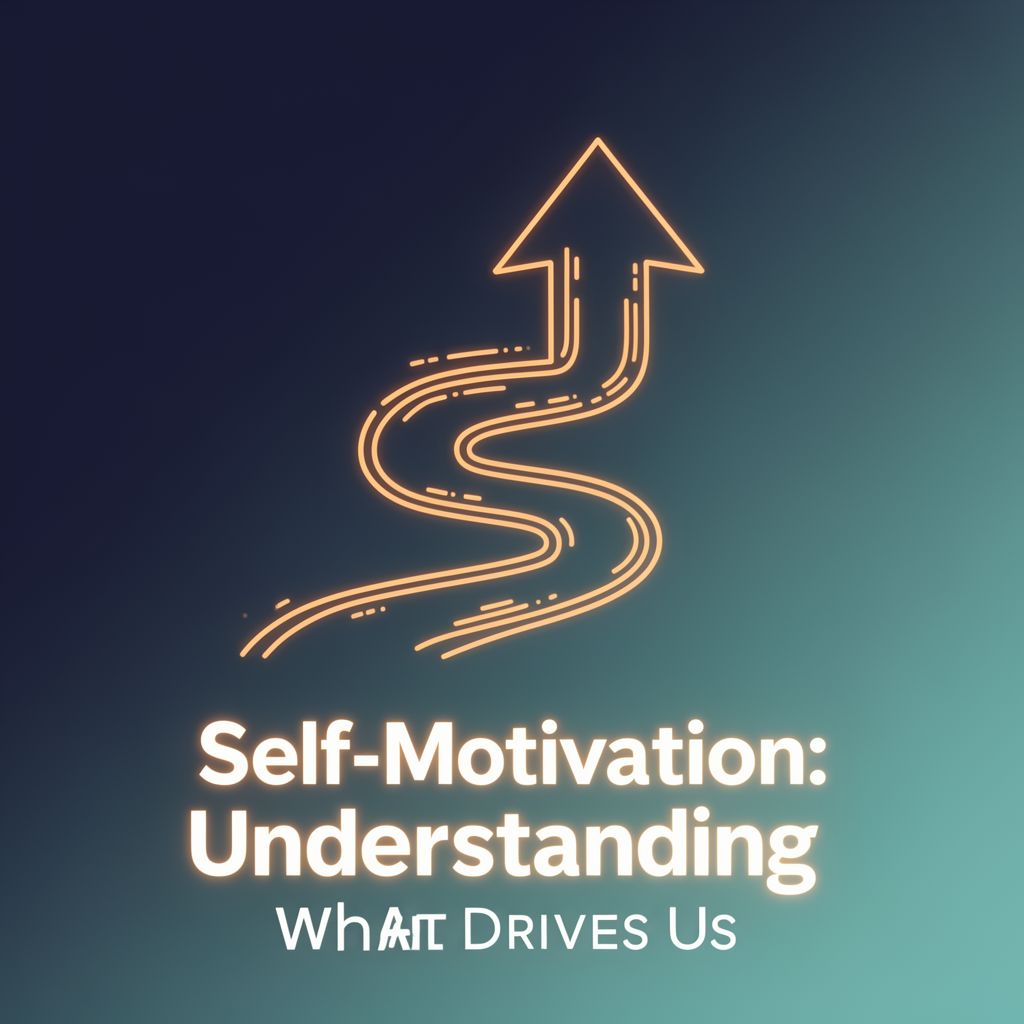
📚 Self-Motivation: A Comprehensive Study Guide
Source Information: This study material has been compiled from a combination of copy-pasted text and a lecture audio transcript.
🎯 Introduction to Motivation
Motivation is a fundamental aspect of human behavior, driving individuals towards their goals. It is not merely a fleeting feeling but a complex process resulting from the interaction between an individual and their situation. Understanding motivation is crucial for personal growth and achieving objectives.
1️⃣ What is Motivation?
Motivation is the process that arouses and sustains goal-directed behavior. The term "Motivation" originates from the Latin word "movere," meaning "to move."
📚 Key Definitions:
- Stephen Robbins: Defines motivation as "the process that accounts for an individual’s intensity, direction, and persistence of effort towards attaining a goal."
- Fred Luthans: Describes motivation as "a process that starts with physiological and psychological deficiency or need that activates a behavior or a drive that is aimed at a goal or incentive."
✅ Core Concepts:
- Needs: Created by physiological or psychological imbalances (e.g., hunger, desire for belonging).
- Drives (or Motives): Internal states set up to alleviate needs.
- Incentives: Anything that will alleviate a need and reduce the drive, acting as the goal.
2️⃣ Understanding Motives and Their Characteristics
Motives can be broadly categorized into three types, each influencing behavior differently. Regardless of the type, motivation exhibits three basic characteristics.
📊 Types of Motives:
-
Primary Motives:
- ✅ Unlearned and physiologically based.
- These are fundamental biological needs.
- Examples: Hunger, thirst, avoidance of pain, maternal concerns, physical needs.
- Note: These do not necessarily take precedence over general and secondary motives in all situations.
-
General Motives:
- ✅ Unlearned but not physiologically based.
- They induce a certain amount of stimulation.
- Examples: Curiosity, manipulation, activity, affection.
-
Secondary Motives:
- ✅ Learned and not physiologically based.
- These are acquired through experience and social interaction.
- Examples: Power, achievement, affiliation, security, status.
💡 Detailed Look at Secondary Motives:
-
Power Motive:
- A need to influence people to change their attitudes or behavior.
- Involves controlling people and activities, being in a position of authority.
- Gaining control over information and resources.
- Defeating an opponent or enemy.
-
Achievement Motive:
- A need for excellence and success.
- Doing better than competitors, attaining or surpassing difficult goals.
- Solving complex problems, carrying out challenging assignments successfully.
- Developing better ways to do things.
-
Affiliation Motive:
- A need for social connection and belonging.
- Being liked by many people, being accepted as part of a group/team.
- Maintaining harmonious relations and avoiding conflicts.
- Participating in pleasant social activities.
-
Security Motive:
- A need for protection and stability.
- Having a secure job, being protected against loss of income.
- Protection against illness or disability.
- Avoiding tasks or decisions with a risk of failure and blame.
- Note: Security is often based on fear or the potential loss of something.
-
Status Motive:
- A need for recognition and prestige.
- Having symbols of success (e.g., the right car, clothes, job, company, university degree, neighborhood, club membership).
- Having executive privileges.
📈 Three Basic Characteristics of Motivation:
- Activation: The initiation or production of behavior.
- Persistence: Continued efforts or determination to achieve a goal, often despite obstacles.
- Intensity: The vigor or strength of responding that accompanies motivated behavior.
3️⃣ Two Types of Motivation
Motivation drives our behaviors and can be broadly categorized into external and internal types.
-
External Motivation (Extrinsic):
- You perform an activity because it will bring some reward or benefit at the end.
- The motivation comes from outside the individual.
- Example: Job hunting (for a job/income), working (for pay).
-
Internal Motivation (Intrinsic):
- You do something purely because you enjoy the activity itself.
- The motivation comes from within the individual.
- Benefits: Leads to more enjoyment, interest, excitement, confidence, persistence, creativity, happiness, and self-esteem.
4️⃣ Major Theories of Motivation
Understanding motivation has been significantly shaped by various theories, broadly categorized into need, cognitive, and reinforcement approaches.
I. Need Approaches:
These theories focus on internal states or deficiencies that drive behavior.
1. Maslow’s Hierarchy of Needs Theory:
- Assumption: An individual's behavior at any moment is determined by their strongest need.
- Hypothesis: Within every human being, there exists a hierarchy of five needs. Individuals strive to fulfill lower-level needs before progressing to higher ones.
- The Five Needs (from lowest to highest):
- Physiological: Basic needs like hunger, thirst, shelter, sex, air, rest.
- Safety: Security and protection from physical and emotional harm, stability, order, law, tenure, pension, insurance.
- Social (Love-Belonging): Affection, belongingness, acceptance, friendship, family and group acceptance.
- Esteem: Need for both self-esteem (self-respect, autonomy, achievement) and external esteem (status, recognition, attention, responsibility, prestige, independence).
- Self-Actualization: The drive to become what one is capable of becoming; includes growth, achieving one’s potential, self-fulfillment, intense job challenge, creative expansion.
2. Alderfer’s ERG Theory:
- A variation and simplification of Maslow's hierarchy.
- Three Groups of Needs:
- Existence Needs: Physical and material wants (similar to Maslow's physiological and safety needs).
- Relatedness Needs: Desires for interpersonal relationships (similar to Maslow's social and external esteem needs).
- Growth Needs: Desires to be creative and productive, to use one’s skills (similar to Maslow's self-esteem and self-actualization needs).
- Key Differences from Maslow:
- Allows for regression (moving down the hierarchy if higher needs are frustrated).
- More than one need can be active at a time.
3. Herzberg’s Motivation-Hygiene Theory (Two-Factor Theory):
- Conclusion: People have two different categories of needs that affect job satisfaction and dissatisfaction.
- Hygiene Factors:
- Sources of dissatisfaction when absent or inadequate.
- Do not motivate, but prevent dissatisfaction.
- Examples: Company policy, supervision, relationship with supervisor, work conditions, salary, relationship with peers, personal life, status, security.
- Motivating Factors:
- Sources of satisfaction and motivation.
- Lead to positive satisfaction.
- Examples: Achievement, recognition, work itself, responsibility, advancement, growth.
4. McClelland’s Learned Needs Theory (Achievement Motivation Theory):
- Focuses on three needs that are learned or acquired over time.
- Three Needs:
- Need for Achievement (nAch): The drive to excel, to achieve in relation to a set of standards, to strive to succeed. (Detailed earlier under Secondary Motives)
- Need for Power (nPow): The need to make others behave in a way that they would not have behaved otherwise. (Detailed earlier under Secondary Motives)
- Need for Affiliation (nAff): The desire for friendly and close interpersonal relationships. (Detailed earlier under Secondary Motives)
📝 Summarizing the Various Need Theories:
| Maslow | Alderfer | Herzberg | McClelland | | :----------------- | :---------- | :-------------- | :------------------ | | Self-Actualization | Growth | Motivators | Need for Achievement | | Esteem | | | Need for Power | | Love (Social) | Relatedness | | Need for Affiliation | | Safety & Security | Existence | Hygiene Factors | | | Physiological | | | |
II. Cognitive Approaches:
These theories explain the thoughts about effort, including the decision to expend effort, the level of effort to exert, and how effort can be made to persist over time.
1. Expectancy Theory:
- Involves three key cognitions/perceptions:
- Expectancy (E-link): The perceived probability that effort will lead to task performance.
- Instrumentality (I-link): The perceived probability that performance will lead to rewards or outcomes.
- Valence: The anticipated value of a particular outcome to an individual.
- Formula: Motivation = Expectancy x Instrumentality x Valence. If any component is zero, motivation is zero.
2. Equity Theory / Social Comparison:
- Premise: The decision to exert effort is a function of social comparison.
- Involves three relevant perceptions:
- Perceptions of outcomes received from performing a task (e.g., pay).
- Perceptions of inputs required to perform a task (e.g., effort, skill).
- Perceptions of the outcomes and inputs of a reference person (someone else).
- Equity Exists If: (Outcomes Self / Inputs Self) = (Outcomes Reference Person / Inputs Reference Person)
- Implications: Inequity (feeling under-rewarded or over-rewarded) can lead to demotivation, reduced effort, or seeking to change the situation.
- Summary: Strongest when predicting absence and turnover behaviors; weakest when predicting differences in employee productivity.
3. Goal-Setting Theory:
- Key Role: Goals play a crucial role in bringing purpose to life and motivating individuals.
- Criteria for Realistic Goals: Should be difficult enough to challenge, but not impossible to reach.
- How Goals Motivate (Four Ways):
- Direction: Specific goals direct focus to relevant activities.
- Effort: Encourage more intense levels of effort towards difficult goals.
- Persistence: Specific, difficult goals encourage individuals to persist longer at a task.
- Connection: Forces a connection between dreams and reality.
- Exception: May be less effective in high "uncertainty avoidance" cultures.
4. Cognitive Evaluation Theory / Competence Motivation Theory:
- Premise: The introduction of extrinsic rewards for work effort that was previously rewarded intrinsically will tend to decrease the overall level of a person’s motivation.
- Implication: External rewards can undermine intrinsic motivation.
- Summary: When extrinsic rewards are given for intrinsically rewarded behavior, it can decrease overall motivation.
III. Reinforcement Theory or Operant Conditioning:
Focuses on how rewards and reinforcements sustain motivation over time (Behavior Modification).
1. The Law of Effect:
- Principle:
- Behavior that leads toward rewards tends to be repeated.
- Behavior that leads toward no rewards or punishment tends to be avoided.
- Key Factors: The type of reinforcer and the timing (schedule) of reinforcement are crucial.
2. Reinforcers Which Strengthen Behavior:
- Purpose: To increase the probability of a desired behavior in the future.
- a. Positive Reinforcement: Administering pleasant consequences (rewards) contingent on exhibiting the correct behavior.
- b. Avoidance Learning (Negative Reinforcement): Withholding something unpleasant when a desired behavior is engaged in.
- Example: An annoying alarm is avoided when a machine is used properly.
- Example (Social Learning): Arriving on time avoids the boss yelling.
3. Reinforcers Which Weaken Behavior:
- Purpose: To decrease the probability of an undesirable behavior in the future.
- a. Punishment: Administering unpleasant consequences following an undesirable behavior.
- b. Extinction: When there are no rewards for a behavior which was previously rewarded, causing the behavior to cease.
5️⃣ Biological Explanations of Motivation
Beyond psychological theories, biological factors also play a role in motivation.
1. Arousal Theory:
- Concept: People are motivated to maintain an optimum level of arousal—neither too high nor too low.
- Curiosity Motive: Helps us understand our environment and is driven by the need for an optimal arousal level.
2. Yerkes-Dodson Law:
- Principle: A degree of psychological arousal helps performance, but only up to a certain point.
- Optimum Level: The optimum level of arousal depends on the difficulty of the task.
- For simple tasks, higher arousal can be beneficial.
- For complex tasks, lower arousal is often optimal.
- Individual Differences: Each person has an optimum level of stimulation they like to maintain.
✅ Key Takeaways
- Need Theories: Individuals differ in their levels and types of needs (Maslow, Alderfer, Herzberg, McClelland). Be aware of these individual differences.
- Goal Setting Theory: Clear and difficult goals lead to higher levels of employee productivity by providing direction, encouraging effort, and fostering persistence.
- Expectancy Theory: Offers a powerful explanation for employee productivity, absenteeism, and turnover by linking effort, performance, and valued rewards.
- Equity Theory: Strongest when predicting absence and turnover behaviors, but weaker for predicting differences in employee productivity, as it highlights the impact of perceived fairness.
- Cognitive Evaluation Theory: Be cautious when introducing extrinsic rewards for intrinsically motivated behaviors, as it can decrease overall motivation.
- Reinforcement Theory: Behavior can be shaped and sustained through positive reinforcement, avoidance learning, punishment, and extinction.
- Arousal Theory & Yerkes-Dodson Law: Individuals seek an optimal level of arousal, which varies based on task complexity and individual preferences.