Pragmatics: Understanding Meaning Beyond Words - kapak
Eğitim#pragmatics#linguistics#communication#speaker meaning

Pragmatics: Understanding Meaning Beyond Words

This summary explores pragmatics, the study of speaker meaning and context in communication. It covers concepts like deixis, reference, inference, presupposition, speech acts, and politeness.

carpedi3mFebruary 12, 2026 ~24 dk toplam
01

Sesli Özet

7 dakika

Konuyu otobüste, koşarken, yolda dinleyerek öğren.

Sesli Özet

Pragmatics: Understanding Meaning Beyond Words

0:006:36
02

Flash Kartlar

25 kart

Karta tıklayarak çevir. ← → ile gez, ⎵ ile çevir.

1 / 25
Tüm kartları metin olarak gör
  1. 1. What is pragmatics?

    Pragmatics is the study of 'invisible' meaning, focusing on how individuals interpret what is meant even when it is not explicitly stated. It investigates how more is communicated than is literally said, relying on shared assumptions and expectations between speakers and listeners. This field is crucial for understanding the complexities of human communication beyond literal word meanings.

  2. 2. What is 'speaker meaning' and why is it crucial in communication?

    Speaker meaning refers to the intention behind a speaker's words, which may differ from the literal meaning. It is crucial because successful communication depends on interpreting this intended reference, not just the basic conceptual meaning of words. Without understanding speaker meaning, misunderstandings can easily arise, as illustrated by the 'war' anecdote where context clarified the speaker's specific historical reference.

  3. 3. Explain the significance of the 'war' anecdote in pragmatics.

    The 'war' anecdote highlights that while words may have basic conceptual meanings, their interpretation is heavily dependent on context and the speaker's intended reference. The tourists initially assumed 'the war' meant World War II, but the local boy referred to 'the war with the English' in 1745. This demonstrates the necessity of understanding 'speaker meaning' and the role of shared background knowledge for successful communication, even when using seemingly simple terms.

  4. 4. How does context influence the interpretation of meaning?

    The interpretation of meaning is profoundly influenced by context, which includes both linguistic context (co-text) and physical context. Context helps clarify ambiguous terms and allows listeners to infer intended meanings that are not explicitly stated. Our pre-existing knowledge and mental representation of the world, including time and place, are crucial for correctly interpreting linguistic expressions within their specific situations.

  5. 5. Define linguistic context, also known as co-text.

    Linguistic context, or co-text, refers to the surrounding words in a phrase or sentence that clarify the intended meaning of ambiguous terms. For example, the word 'bank' can have multiple meanings, but its co-text (e.g., 'river bank' vs. 'money bank') helps disambiguate it. This surrounding linguistic information is vital for accurate interpretation of individual words or phrases.

  6. 6. What is physical context in pragmatics?

    Physical context involves the real-world situation in which language is used, including the time, place, and objects present. It provides crucial non-linguistic cues that aid in interpreting utterances. For instance, a sign for 'Heated Attendant Parking' is understood to mean a heated parking area with an attendant, not a place to park a heated person, due to our understanding of the physical environment and common sense.

  7. 7. Provide an example of how physical context aids interpretation.

    An advertisement for 'Babies' Sale' is a good example. Without the physical context of a store selling goods, one might literally interpret it as babies being for sale. However, our understanding of the physical environment (a retail store) and common knowledge allows us to infer that it refers to clothes or items for babies, even though the word 'clothes' is not explicitly present. This demonstrates how our mental representation of the physical world is crucial for interpretation.

  8. 8. What role does our mental representation of the physical world play in interpretation?

    Our mental representation of the physical world, including our knowledge of time, place, and common practices, is crucial for interpreting linguistic expressions. It allows us to make inferences and understand meanings that are not explicitly stated. This internal model helps us navigate ambiguous situations and correctly interpret signs, advertisements, and everyday conversations by providing a framework for understanding the speaker's intentions within a given physical setting.

  9. 9. What is deixis?

    Deixis refers to words or expressions that cannot be interpreted without knowledge of the context, particularly the physical context of the speaker. These words act as 'pointers' that anchor language to specific aspects of the communicative situation. Their meaning shifts depending on who is speaking, where, and when, making them highly context-dependent.

  10. 10. Give examples of deictic expressions.

    Common examples of deictic expressions include words like 'here,' 'there,' 'now,' 'then,' 'this,' and 'that.' Pronouns such as 'you,' 'me,' 'he,' 'she,' and 'it' are also deictic. These terms require the listener to know the speaker's location, time of utterance, or the specific individuals being referred to in order to be fully understood.

  11. 11. Name and briefly describe the three categories of deixis.

    The three categories of deixis are person deixis, spatial deixis, and temporal deixis. Person deixis refers to people (e.g., 'you,' 'me,' 'them'). Spatial deixis refers to location (e.g., 'here,' 'there,' 'this'). Temporal deixis refers to time (e.g., 'now,' 'then,' 'yesterday'). These categories help organize how language points to elements within the communicative context.

  12. 12. How are deictic expressions interpreted?

    Deictic expressions are interpreted based on the speaker's intended person, place, or time at the moment of utterance. Their meaning is relative to the speaker's viewpoint, often distinguishing between proximity and distance. For example, 'here' means near the speaker, while 'there' means away from the speaker. Understanding the speaker's position in the physical and temporal context is essential for correctly interpreting these terms.

  13. 13. Define reference in pragmatics.

    Reference is an act performed by a speaker or writer to enable a listener or reader to identify something. It's the process by which language users connect linguistic expressions to entities in the real world. Importantly, words themselves do not refer; rather, people refer using words, proper nouns, noun phrases, or pronouns to point to specific things or concepts.

  14. 14. Who performs reference, and how?

    Reference is performed by people – speakers or writers – not by words themselves. They use various linguistic forms such as proper nouns (e.g., 'Chomsky'), noun phrases (e.g., 'the ruined cathedral'), or pronouns (e.g., 'he,' 'it') to enable their audience to identify a particular entity. The success of reference depends on the listener's ability to correctly identify the intended referent based on context and shared knowledge.

  15. 15. What is inference in pragmatics?

    Inference is the additional information a listener uses to establish a connection between what is said and what is meant. It's a cognitive process where listeners go beyond the literal meaning of an utterance to deduce the speaker's intended message. This often involves drawing on background knowledge, context, and shared assumptions to fill in unstated information.

  16. 16. Explain the 'Chomsky' example in relation to inference.

    The 'Chomsky' example, where someone asks 'Can I look at your Chomsky?', illustrates inference. The listener infers that 'Chomsky' refers to a book written by Chomsky, not the person himself. This inference is made possible by the listener's background knowledge that people typically borrow books, not authors. It demonstrates how listeners use contextual cues and common sense to establish a connection between a name and an associated object.

  17. 17. What is anaphora?

    Anaphora describes subsequent references to an already introduced entity in a text or conversation. It's a linguistic device that helps maintain cohesion and avoid repetition. The first mention of an entity is called the antecedent, and subsequent mentions using pronouns or definite noun phrases are the anaphoric expressions that refer back to it.

  18. 18. Differentiate between an antecedent and an anaphoric expression.

    An antecedent is the initial mention of an entity in a discourse, establishing its presence. An anaphoric expression is a subsequent linguistic unit (often a pronoun or a definite noun phrase) that refers back to that previously introduced antecedent. For example, in 'A boy was washing a puppy. The puppy started struggling, and he got wet,' 'a boy' and 'a puppy' are antecedents, while 'the puppy' (second mention) and 'he' are anaphoric expressions.

  19. 19. What is presupposition?

    Presupposition refers to what a speaker assumes is true or known by a listener before making an utterance. It's an underlying assumption that is taken for granted in a statement. For example, 'Your brother is waiting outside' presupposes that the listener actually has a brother. These assumptions are often crucial for the coherence and understanding of a conversation.

  20. 20. How does the 'constancy under negation' test work for presuppositions?

    The 'constancy under negation' test helps identify presuppositions by checking if an underlying assumption remains true even when the main statement is negated. If a statement and its negative form share the same underlying assumption, that assumption is a presupposition. For instance, 'My car is a wreck' and 'My car is not a wreck' both presuppose 'I have a car,' confirming 'I have a car' as a presupposition.

  21. 21. What are speech acts?

    Speech acts are actions performed by a speaker through an utterance. These actions go beyond merely conveying information and include functions like requesting, commanding, questioning, informing, promising, or apologizing. For example, saying 'I'll be there at six' is not just a statement, but performs the speech act of promising.

  22. 22. Distinguish between direct and indirect speech acts.

    A direct speech act uses a syntactic structure typically associated with its communicative function; for example, an interrogative structure ('Did you eat the pizza?') directly functions as a question. An indirect speech act, however, uses a syntactic structure for a function other than its typical one, such as using an interrogative to make a request ('Can you pass the salt?'). Indirect speech acts often serve politeness functions.

  23. 23. Why are indirect speech acts often used for politeness?

    Indirect speech acts are often used for politeness because they are generally perceived as more gentle and less imposing than direct commands or requests. By phrasing a request as a question (e.g., 'Could you close the door?') instead of a direct command ('Close the door!'), the speaker offers the listener an option to decline, thereby showing respect for their autonomy and 'negative face.' This makes the interaction less face-threatening.

  24. 24. How is politeness defined in linguistics?

    In linguistics, politeness is closely tied to the concept of 'face,' which is an individual's public self-image. It refers to the strategies speakers use to maintain or save face for themselves and others in social interactions. Politeness aims to mitigate potential threats to face, ensuring smooth and harmonious communication. Cultural norms significantly influence what is considered polite.

  25. 25. What is 'face' in the context of politeness?

    In the context of politeness, 'face' refers to an individual's public self-image or the emotional and social sense of self that everyone has and expects everyone else to recognize. It's the respect that an individual has for himself or herself, and the maintenance of that self-esteem in interaction. People strive to maintain their own face and respect the face of others during communication.

03

Bilgini Test Et

15 soru

Çoktan seçmeli sorularla öğrendiklerini ölç. Cevap + açıklama.

Soru 1 / 15Skor: 0

What is the primary focus of pragmatics as described in the text?

04

Detaylı Özet

7 dk okuma

Tüm konuyu derinlemesine, başlık başlık.

📚 Pragmatics: Understanding "Invisible" Meaning in Communication

This study material is compiled from a copy-pasted text and a lecture audio transcript, providing a comprehensive overview of pragmatics.


🎯 Introduction to Pragmatics: Beyond Literal Meaning

Pragmatics is the study of "invisible" meaning, focusing on how we understand what is meant even when it isn't explicitly said or written. It delves into how speakers (or writers) and listeners (or readers) rely on shared assumptions and expectations to communicate effectively. Essentially, pragmatics investigates how "more is always being communicated than is said."

Consider the classic example of two American tourists in Scotland who asked a local boy about a ruined cathedral. When asked when it was damaged, the boy replied, "in the war." The tourists initially assumed he meant World War II, which had ended only two decades prior. However, the ruins looked much older. Upon clarifying, they learned he referred to "the war with the English," which formally ended in 1745. This anecdote highlights that while words might have the same basic conceptual meaning, their interpretation heavily depends on context and the speaker's intended reference. Understanding "speaker meaning" is crucial for successful communication.


🌍 The Role of Context in Interpretation

The interpretation of meaning is profoundly influenced by context, which can be categorized into two main types:

1. Linguistic Context (Co-text)

📚 Definition: The set of other words used in the same phrase or sentence.

  • The surrounding co-text strongly affects what a word probably means.
  • Example: The word "bank" is a homonym (a single form with multiple meanings).
    • If used with "steep" or "overgrown," we understand it refers to a river bank.
    • If used with "withdraw some cash," we understand it refers to a financial institution.

2. Physical Context

📚 Definition: The actual physical situation, time, and place in which linguistic expressions are encountered.

  • Our mental representation of these physical aspects helps us interpret meaning.
  • Example 1: A sign reading "Heated Attendant Parking" 🅿️.
    • Literally, it could mean parking a heated attendant.
    • However, our pre-existing knowledge and the physical context (a parking garage) lead us to interpret it as a heated parking area with an attendant.
  • Example 2: An advertisement for "Babies' Sale" 👶.
    • We infer it refers to clothes for babies, not the sale of babies themselves, even though the word "clothes" is absent.

📍 Deixis: Pointing via Language

📚 Definition: Words that cannot be interpreted without knowledge of the immediate context, especially the physical context of the speaker. Deixis means "pointing" via language.

Deictic expressions are categorized by what they point to:

  • Person Deixis: Refers to people.
    • Examples: you, me, she, him, it, them
  • Spatial Deixis: Refers to location.
    • Examples: here, there, near that
  • Temporal Deixis: Refers to time.
    • Examples: now, then, yesterday, today, tomorrow, last week

Key Concept: Deictic expressions are interpreted based on the speaker's intended person, place, or time, often distinguishing between proximity (e.g., this, here, now) and distance (e.g., that, there, then) relative to the speaker.

  • Example: "You'll have to bring it back tomorrow because she isn't here today." 🗓️
    • Without context (who "you" is, what "it" is, who "she" is, where "here" is, and which "tomorrow/today"), the sentence is vague.
  • 💡 Insight: A bar owner's sign "Free Beer Tomorrow" uses temporal deixis to encourage return visits, knowing "tomorrow" will always be one day away.

🗣️ Reference, Inference, Anaphora, and Presupposition

These concepts explain how speakers use language to identify entities and how listeners make connections to understand meaning.

1. Reference

📚 Definition: An act by which a speaker (or writer) uses language to enable a listener (or reader) to identify something.

  • Words themselves don't refer; people refer using words.
  • We can use proper nouns (e.g., Chomsky, Jennifer), other nouns in phrases (e.g., a writer, my friend), or pronouns (e.g., he, she, it).
  • The reference of an expression like "the war" is not inherent but depends on who is using it.
  • Example: Referring to a person who drives a loud motorcycle as "Mr. Kawasaki" uses a brand name to identify a person.

2. Inference

📚 Definition: Additional information used by the listener to create a connection between what is said and what must be meant.

  • Successful reference often depends more on the listener's ability to infer than on their dictionary knowledge.
  • Example 1: Waiter asks, "Where's the spinach salad sitting?" Reply: "He's sitting by the door." 🥗
    • Inference: "If X is a customer who ordered spinach salad, then X can be referred to as 'the spinach salad'."
  • Example 2: "Can I look at your Chomsky?" 📖
    • Inference: "If X is the name of a writer, then X can be used to identify a copy of a book by that writer."

3. Anaphora

📚 Definition: Subsequent reference to an already introduced entity.

  • The antecedent is the first mention of an entity.
  • Anaphoric expressions are subsequent mentions that refer back to the antecedent.
  • Example: "We saw a funny home video about a boy washing a puppy in a small bath. The puppy started struggling and shaking and the boy got really wet. When he let go, it jumped out of the bath and ran away."
    • Antecedents: "a boy," "a puppy"
    • Anaphoric expressions: "The puppy," "the boy," "he," "it"
  • Anaphoric connections often rely on inference:
    • "We found a house to rent, but the kitchen was very small." (Inference: A house has a kitchen.)
    • "I caught a bus and asked the driver if it went near the downtown area." (Inference: A bus has a driver.)

4. Presupposition

📚 Definition: What a speaker (or writer) assumes is true or known by a listener (or reader) when making an utterance.

  • Example 1: "Your brother is waiting outside." 👨‍👦
    • Presupposition: You have a brother.
  • Example 2: "Why did you arrive late?" ⏰
    • Presupposition: You did arrive late.
  • Example 3: "When did you stop smoking?" 🚬
    • Presuppositions: You used to smoke, and you no longer do so.
  • Constancy Under Negation Test: A presupposition remains true even when the sentence containing it is negated.
    • "My car is a wreck." / "My car is not a wreck."
    • Presupposition (constant): I have a car.

💬 Speech Acts and Politeness

Language is not just used to describe things; it is also used to do things.

1. Speech Acts

📚 Definition: Actions performed by a speaker with an utterance, such as requesting, commanding, questioning, or informing.

  • Example: Saying "I'll be there at six" performs the speech act of "promising."

Direct vs. Indirect Speech Acts

  • Direct Speech Act: Uses a syntactic structure typically associated with its function.
    • Interrogative for Question: "Did you eat the pizza?" ❓
    • Imperative for Command: "Eat the pizza!" 🍕
    • Declarative for Statement: "You ate the pizza."
  • Indirect Speech Act: Uses a syntactic structure for a function other than its typical one. Often used for politeness.
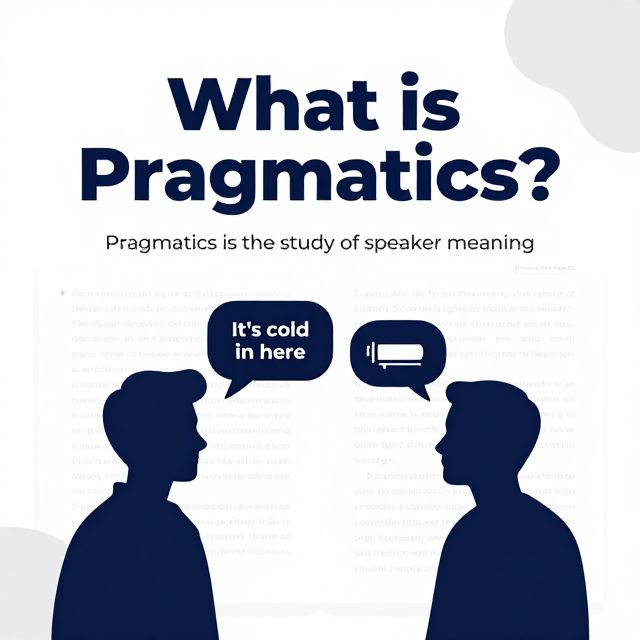
    • Example 1: Using an interrogative to make a request: "Can you pass the salt?" (You're not asking about ability, but requesting an action).
    • Example 2: Using a declarative to make a request: "You left the door open." (Said to someone entering a cold room, this is an indirect request to close the door).
  • ⚠️ Misunderstanding: If a listener fails to recognize an indirect speech act, communication can break down. (e.g., "Do you know where the Ambassador Hotel is?" "Oh sure, I know where it is." walks away)

2. Politeness and Face

📚 Definition (Politeness): Showing awareness and consideration for another person's "face." 📚 Definition (Face): Your public self-image; the emotional and social sense of self that everyone has and expects others to recognize.

  • Face-Threatening Act: An utterance that challenges another person's self-image.
    • Example: A direct command like "Give me that paper!" implies social power, which can be threatening if not genuinely possessed.
  • Face-Saving Act: An utterance that lessens the potential threat to another's face.
    • Indirect speech acts are often face-saving because they remove the assumption of social power (e.g., "Could you pass me that paper?").

Negative Face vs. Positive Face

  • Negative Face: The need to be independent and free from imposition.
    • Face-saving acts: Show concern about imposition.
    • Examples: "I'm sorry to bother you...", "I know you're busy, but..."
  • Positive Face: The need to be connected, to belong, to be a member of the group.
    • Face-saving acts: Show solidarity and draw attention to common goals.
    • Examples: "Let's do this together...", "You and I have the same problem, so..."

💡 Cultural Differences: What is considered polite varies significantly across cultures. Directness might be valued in some cultures as a sign of solidarity, while others prefer indirectness to avoid imposition. Misunderstandings arise when these pragmatic norms clash.


✅ Conclusion: The Dynamics of Pragmatic Understanding

Pragmatics is an essential field for understanding the complexities of human communication. It goes beyond the literal meanings of words to encompass speaker intention and contextual interpretation. By studying context, deixis, reference, inference, anaphora, presupposition, speech acts, and politeness, we gain insight into how successful communication is not just about decoding words, but about actively interpreting what speakers intend to convey within a given context. This makes pragmatics a dynamic and culturally nuanced aspect of language study.
Kendi çalışma materyalini oluştur

PDF, YouTube videosu veya herhangi bir konuyu dakikalar içinde podcast, özet, flash kart ve quiz'e dönüştür. 1.000.000+ kullanıcı tercih ediyor.

Sıradaki Konular

Tümünü keşfet
Understanding Pragmatics in Language

Understanding Pragmatics in Language

Explore pragmatics: the study of meaning communicated by speakers and interpreted by listeners, considering context, speaker intention, and social distance.

Özet 25 15
Pragmatics: Concepts, Types, Context, Speech Acts, and Cooperation

Pragmatics: Concepts, Types, Context, Speech Acts, and Cooperation

This audio summary explores the foundational concepts of pragmatics, pragmatic competence, various kinds of pragmatics, the role of context, speech act theory, and Grice's cooperative principle.

7 dk Özet 25 15
The Linguistic and Sociological Significance of "Hello"

The Linguistic and Sociological Significance of "Hello"

An academic exploration of the word "hello," examining its etymology, historical evolution, sociolinguistic functions, and contemporary usage in human communication.

6 dk Özet 25 15
Discourse Analysis: Interpreting Language Beyond Sentences

Discourse Analysis: Interpreting Language Beyond Sentences

This summary explores discourse analysis, examining how language users interpret meaning in texts and conversations, focusing on cohesion, coherence, the co-operative principle, and background knowledge.

5 dk Özet 25 15
First Language Acquisition: Concepts and Developmental Stages

First Language Acquisition: Concepts and Developmental Stages

This summary explores first language acquisition, differentiating it from learning. It details early developmental stages, including cooing, babbling, one-word, two-word, and telegraphic speech, alongside the development of morphological, syntactic, and semantic knowledge.

5 dk Özet 25 15
Discourse Analysis: Concepts and Applications

Discourse Analysis: Concepts and Applications

This audio summary provides an academic overview of discourse analysis, exploring key concepts such as cohesion, coherence, speech events, conversation analysis, turn-taking, and linguistic hedges.

6 dk Özet 25 15
The Global Power and Linguistic Diversity of English

The Global Power and Linguistic Diversity of English

An academic overview of English's global influence, historical evolution, social implications of its variations, and the rich linguistic landscape of Britain, including indigenous and non-indigenous languages.

7 dk Özet 25 15
German Vocabulary and Phrases: Lessons 8-10

German Vocabulary and Phrases: Lessons 8-10

This summary covers key German vocabulary and phrases from Lessons 8, 9, and 10, focusing on daily activities, object descriptions, personal preferences, and various forms of communication.

7 dk Özet 25 15