 Podit
Podit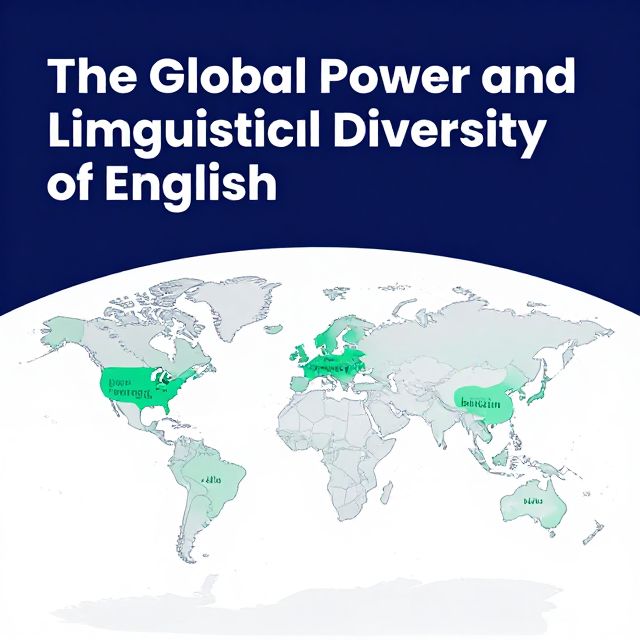
The Dynamic Landscape of the English Language: Global Power, History, and Diversity
Source Information: This study material is compiled from a copy-pasted text and a lecture audio transcript.
📚 Introduction: The Global Reach and Intricate Nature of English
English stands as arguably the most dominant language globally, spoken to some degree by approximately two billion people and holding official or semi-official status in over 60 countries. Despite its widespread influence, English is far from uniform, exhibiting significant internal diversity. This study guide explores the historical evolution of English, its social dimensions, the complex linguistic tapestry present within Britain, and the ongoing debates surrounding its authority and usage.
🌍 The Global Power and Internal Diversity of English
English's global dominance is undeniable, yet it is characterized by immense internal variation.
📊 Key Statistics on English's Global Presence
- Approximately 2 billion people speak English to some degree.
- It holds official or semi-official status in over 60 countries.
- In the UK, 92% of the population speaks English as their first language (Census 2011).
🗺️ Internal Diversity within the UK
Despite its small geographical size, the UK exhibits immense linguistic diversity. Moving just a few miles, for example, from Manchester to Liverpool, can reveal radical changes in accent and vocabulary. This highlights that global power does not equate to linguistic uniformity.
🏛️ Lack of Central Authority
Unlike countries such as France, which has the "Académie Française" to regulate its language, Britain lacks an official government academy for English.
- ✅ Authority: Primarily rests with dictionaries, notably the Oxford English Dictionary (OED).
- 📚 Descriptive vs. Prescriptive: Dictionaries like the OED adopt a descriptive approach, recording how language is actually used and the meanings words hold for people. This contrasts with a prescriptive approach, which dictates how words should be used, often assigning fixed meanings.
- 💡 Insight: This descriptive approach allows English to evolve organically, reflecting its users rather than being rigidly controlled.
📜 History of English: A "Mongrel" Language
English is often described as a "mongrel" language, a product of various linguistic influences from invaders and cultural exchanges throughout its history.
1️⃣ Old English (5th – 11th Century)
- Origins: Brought by Germanic tribes (Angles, Saxons, and Jutes) from Northern Europe.
- Characteristics: Closely resembled German.
- Key Work: The epic poem Beowulf is the most famous work from this period.
2️⃣ Middle English (11th – 15th Century)
- Norman Conquest (1066): The invasion by William the Conqueror from France drastically changed the language.
- French Influence: French became the language of the court, law, and administration, introducing thousands of French words (e.g., beef, pork, court, parliament) into the English lexicon, while common people continued to speak English.
3️⃣ Modern English (16th Century onwards)
- Standardization: The invention of the printing press and the publication of the King James Bible helped standardize English and make it more accessible.
- William Shakespeare: Credited as a highly influential figure, contributing thousands of words and phrases still in common use today.
- Global Spread: The expansion of the British Empire spread English to Africa, Asia, and the Caribbean.
- 📚 Pidgin Languages: Simplified versions for communication between groups speaking different languages.
- 📚 Creoles: When pidgin languages become the native tongue of a community, developing more complex grammar and vocabulary.
- Latin's Legacy: Although its influence declined, Latin was widely taught in grammar schools until the mid-20th century, serving as a symbol of culture and education, particularly for university entrance in fields like religion, medicine, and law. Many institutions retained Latin mottos.
🗣️ Speech and Social Identity in Britain
In modern Britain, language serves as a powerful social marker, with accents and dialects often revealing a person's social class and regional background.
🎭 Regional and Social Dialects
- Significant Variation: Accents and dialects vary significantly over short distances (e.g., Glasgow, Liverpool, West Midlands, East London).
- Distinctive Varieties: Includes Black British English / Black English Vernacular (BEV) and Multicultural London English / Jafaican (MLE), influenced by Afro-Caribbean communities.
- ✅ Social Indicator: An accent often reveals more about a person's social class than their geographic origin. Non-standard speech is more common among those with less formal education or who have lived in one place for a long time.
👑 Received Pronunciation (RP)
- Aliases: Also known as "The Queen's English," "BBC English," or "Oxford English."
- Historical Status: Until the mid-20th century, RP was considered the standard, and regional accents were often viewed as a sign of a lack of education. The BBC even required announcers to speak only RP.
- Decline and Shifting Perceptions:
- 💡 1960s Cultural Shift: The rise of popular culture (e.g., The Beatles, Michael Caine) made regional accents "cool" and acceptable.
- 📉 Current Usage: Today, only about 3% of the population speaks pure RP. "Marked RP" is now often considered posh, snobbish, or outdated.
- Post-WWII Arts: British arts became more realistic, incorporating regional accents in media and focusing on working-class life.
- Tolerance: Attitudes towards accents became more tolerant in the late 20th century. Even public figures like the Queen and Margaret Thatcher adapted their speech to sound more modern and relatable.
📈 Current Perceptions and Strategic Use of Accents
- Prestige: A moderate RP accent is still often linked to intelligence and success.
- Positive Views: Regional accents like Yorkshire and those from rural areas are generally viewed positively.
- Less Liked: Big city accents (e.g., Birmingham, Liverpool) are often less favored.
- Advertising: Businesses strategically use accents:
- Soft accents (e.g., Glasgow) convey friendliness and trustworthiness.
- Local accents promote regional products.
- Teaching English: RP is still used in teaching English, but this can create difficulties for foreign learners who struggle to understand real British accents.
⚠️ Taboo Words and Political Correctness
The use of language, particularly taboo words, has evolved significantly, reflecting changing social attitudes and legal frameworks.
- Mid-20th Century: Swear words were largely considered taboo in mass media and literary works until the 1950s.
- Legal Reforms: The Obscene Publications Act of 1959 permitted the publication of previously prohibited works if they had literary merit, reflecting more liberal social attitudes.
- Public Breakthrough: Swear words remained absent from TV and radio until 1965, when critic Kenneth Tynan swore on live television, causing public outrage.
- Modern Usage: Today, occasional profanities are common in dramatic works shown after 9 p.m., with fewer limitations on language.
- Evolving Sensitivity: Certain words, once acceptable, have become taboo due to changing social norms.
- Example: The word 'nigger' (e.g., in a 1932 song) is now unacceptable.
- Example: 'Cripple' has become taboo, replaced by 'handicapped' or 'disabled,' though even these terms are carefully used.
- ✅ Political Correctness: Most people in Britain respect political correctness, which is embedded in law to restrict discrimination, insult, and marginalization.
📚 Linguistic Authority and Standardization
Despite the variety, English has never had a legislative body to control it, relying instead on descriptive practices.
- No Academy: Proposals for an English academy from poets and authors in the 17th and 18th centuries never materialized.
- OED's Role: The Oxford English Dictionary records how language is actually used (descriptive approach), contrasting with a prescriptive approach that dictates usage.
- Vocabulary Scope:
- A foreign learner needs ~1,500 words for intermediate communication.
- An educated native speaker has ~20,000 active and ~40,000 passive words.
- The full OED contains ~750,000 words, covering English from Anglo-Saxon times to the present.
- Global Inclusions: Until the mid-1970s, the OED mainly recorded British and American English. Today, it recognizes many forms, including Australian, Indian, South African English, slang, and internet English.
- American English Influence: Since the 1980s, British organizations have increasingly adopted American-style management practices.
- Formal Correctness: Studies, such as one on online dating, show that "net-speak" (e.g., bad grammar, non-standard spelling like 'ur', 't', 'u') can negatively impact communication, suggesting that formally correct English still carries prestige.
🌳 Linguistic Diversity: Indigenous Celtic Languages
Britain, while predominantly English-speaking, has a rich history of indigenous Celtic (Gaelic) languages that predate English.
- Origins: Gaelic languages date back to around the 4th century BC. Anglo-Saxon invasions in the 5th century AD pushed Celtic peoples to the west and north, leading to separate development of languages like Welsh, Irish, Scottish Gaelic, Cornish, and Manx.
- Revival Efforts: Cornish and Manx, which nearly disappeared, are now subject to revival efforts through education and cultural programs.
🏴 Welsh
- Historical Decline: After the Act of Union in 1536, English became the language of government and education, causing Welsh to decline.
- Revival: The 20th century saw a strengthening of Welsh identity and efforts to protect the language.
- ✅ Welsh Language Act (1993): Gave Welsh equal status with English in public life.
- Current Status: Around 600,000 people in Wales speak Welsh. It is used in schools, road signs, and official documents.
- Cultural Significance: Welsh has one of Europe's oldest literary traditions, celebrated at festivals like the Royal National Eisteddfod. Strong Welsh-language media exists (radio, TV channel S4C).
🇮🇪 Irish (Irish Gaelic / Erse)
- Historical Decline: Widely spoken until the Act of Union (1801), after which English became dominant, especially in cities.
- Revival: The late 19th-century Republican independence movement adopted Irish as a symbol of national identity.
- Republic of Ireland: Since partial independence in 1921, Irish is the first official language, taught in schools, and supported by media. Over 1 million out of 3.5 million people speak both Irish and English.
- Northern Ireland: More politicized, linked to nationalist politics. Efforts since 1972 support its use in education, media, and cultural life (e.g., Irish-language newspaper Lá, bilingual schools). The 2011 Census showed over 10% of the population had some knowledge of Irish.
🏴 Scots
- Relation to Old English: Spoken mainly in the Lowlands of Scotland, closely related to Old English.
- Literary Tradition: Despite being associated with lower social classes, it has an important literary tradition (e.g., Robert Burns, Walter Scott, Robert Louis Stevenson). Burns Night (January 25) celebrates Robert Burns.
- Debated Status: Its official recognition as a language versus a dialect remains debated, limiting official support and reliable data.
🏴 Scottish Gaelic
- Origins: Began in the 5th century with Gaelic tribes from Ireland settling in the Highlands and Western Isles.
- Decline: Declined due to urbanization and historical events like the Highland Clearances. Speakers dropped from ~250,000 in 1891 to fewer than 58,000 in 2011 (~1% of Scotland’s population).
- Modern Support: Now taught in schools, broadcast on TV and radio, and supported by the government. Gaelic culture is celebrated at festivals like the Royal National Mod.
🌐 Linguistic Diversity: Non-Indigenous Languages
Britain's history of global expansion and immigration has led to significant non-indigenous linguistic diversity.
- Immigration Waves: A steady flow of immigration, increasing substantially in the 20th century, brought people from West Africa, the Caribbean, India, Pakistan, and Hong Kong.
- Settlement Patterns: Immigrants settled in areas with work and affordable housing (e.g., London, Leicester, Birmingham, major ports).
- Major Non-Indigenous Languages: Languages from the Asian subcontinent are the most widely spoken among minorities, including Urdu (Pakistan), Hindi, Bengali, Punjabi, and Gujarati (India).
- Support and Bilingualism: These languages are protected by educational policies that provide tuition in native languages and established mass media (newspapers, radio, TV). Many children grow up speaking both English and their community language.
- Other Communities: Polish immigrants, for example, often settled in rural areas and provincial towns, working in light industry and agriculture, with a smaller cultural impact despite their numbers.
✅ Conclusion: The Dynamic Nature of English
English is a globally dominant language characterized by profound internal diversity and a lack of a centralized prescriptive authority, relying instead on descriptive dictionaries. Its history is a testament to continuous evolution, shaped by successive invasions and cultural exchanges. The social implications of English are evident in how accents and dialects serve as markers of identity and class, with attitudes towards Received Pronunciation and regional speech having shifted significantly over time. Furthermore, Britain's linguistic landscape is enriched by its ancient indigenous Celtic languages, many of which have undergone revival efforts, and by the diverse non-indigenous languages brought by immigrant communities. This intricate interplay of historical development, social perception, and linguistic coexistence highlights English as a dynamic and ever-changing global phenomenon.