Pragmatics: Concepts, Types, Context, Speech Acts, and Cooperation - kapak
Eğitim#pragmatics#linguistics#communication theory#speech acts

Pragmatics: Concepts, Types, Context, Speech Acts, and Cooperation

This audio summary explores the foundational concepts of pragmatics, pragmatic competence, various kinds of pragmatics, the role of context, speech act theory, and Grice's cooperative principle.

carpedi3mMarch 30, 2026 ~23 dk toplam
01

Sesli Özet

7 dakika

Konuyu otobüste, koşarken, yolda dinleyerek öğren.

Sesli Özet

Pragmatics: Concepts, Types, Context, Speech Acts, and Cooperation

0:007:17
02

Flash Kartlar

25 kart

Karta tıklayarak çevir. ← → ile gez, ⎵ ile çevir.

1 / 25
Tüm kartları metin olarak gör
  1. 1. What is the primary focus of Pragmatics as a field of study?

    Pragmatics is defined as the study of how individuals comprehend and produce communicative or speech acts within specific conversational situations. It investigates how meaning is constructed and interpreted beyond the literal words, focusing on the context and intentions of the speakers.

  2. 2. How do Leech, Sperber, and Wilson differentiate between types of meaning in verbal communication within pragmatics?

    They differentiate between two types of meaning: the informative intent, also known as sentence meaning, and the communicative intent, referred to as speaker meaning. Sentence meaning is the literal meaning of the words, while speaker meaning is what the speaker intends to convey in a particular context.

  3. 3. Define pragmatic competence according to Bachman and Palmer.

    Pragmatic competence refers to the ability to investigate the communicative intentions of language users. It enables individuals to generate and interpret discourse by connecting utterances, sentences, and texts with their inherent meanings, the intentions of the language users, and the pertinent features of the language use setting.

  4. 4. What is Pragmalinguistics and what linguistic resources does it involve?

    Pragmalinguistics focuses on the linguistic resources employed to convey communicative acts and relational or interpersonal meanings. These resources include pragmatic strategies like directness, indirectness, routines, and other linguistic forms that can either soften or intensify communicative acts.

  5. 5. Explain the concept of Sociopragmatics as described by Leech.

    Sociopragmatics addresses the social perceptions that underpin a participant's interpretation and performance of communicative action. Essentially, it concerns appropriate social behavior in communication, considering how social factors influence language use and understanding.

  6. 6. What is Psychopragmatics and who introduced this concept?

    Psychopragmatics, introduced by Naoum, examines the cognitive aspects of pragmatic performance. It specifically investigates how and to what extent pragmatic performance is influenced by particular cognitive conditions, bridging the gap between cognitive processes and pragmatic language use.

  7. 7. How does Song define "context" in the realm of discourse?

    Song defines context as the environment in which a discourse unfolds. It encompasses all the relevant background information and situational factors that influence the interpretation and production of language in a communicative act.

  8. 8. According to Li, what is linguistic context?

    Linguistic context refers to what has already been stated within an utterance. It includes the words, phrases, and sentences that precede or follow a particular linguistic element, influencing its meaning and interpretation.

  9. 9. Describe physical context as one of Li's four types of context.

    Physical context encompasses the actual physical environment where communication takes place. This includes the location of communication, the presence of objects, and any ongoing events that are observable and relevant to the interaction.

  10. 10. What does social context refer to in Li's framework?

    Social context pertains to the social relationship between speakers and hearers. It considers factors such as their roles, status, familiarity, and cultural norms, all of which influence how messages are formulated and interpreted.

  11. 11. Explain epistemic context as identified by Li.

    Epistemic context indicates the shared knowledge between both the speaker and the hearer. This includes common ground, mutual beliefs, and background information that both participants are aware of, which helps in understanding implied meanings.

  12. 12. Who originated Speech Act Theory and what is its core premise?

    Speech Act Theory was originated by Austin. Its core premise is that speakers utilize language not merely to state things, but to perform actions. Language is seen as a tool for doing things, rather than just describing them.

  13. 13. Define Austin's locutionary act.

    The locutionary act is the utterance of a sentence possessing a determinate sense and reference. It is the act of saying something, involving the literal meaning of the words, their grammatical structure, and their phonetic realization.

  14. 14. What is an illocutionary act according to Austin?

    An illocutionary act involves the performance of an action, such as making a statement, offer, or promise, by virtue of the conventional force associated with the utterance or its explicit performative paraphrase. It is the speaker's intention or the force behind the utterance.

  15. 15. Describe Austin's perlocutionary act.

    The perlocutionary act concerns the effects produced on the audience through the utterance of a sentence. These effects are specific to the circumstances of the utterance and can include persuading, annoying, or surprising the hearer, among others.

  16. 16. What is the assertive illocutionary point according to Searle?

    The assertive illocutionary point is achieved when speakers represent how things are in the world. This includes acts like stating, asserting, claiming, or reporting, where the speaker commits to the truth of the proposition.

  17. 17. Explain the commissive illocutionary point in Searle's theory.

    The commissive illocutionary point involves speakers committing themselves to performing an action. Examples include promising, vowing, or offering, where the speaker undertakes an obligation for future conduct.

  18. 18. What is the directive illocutionary point as proposed by Searle?

    The directive illocutionary point is achieved when speakers attempt to induce hearers to perform an action. This includes acts like ordering, requesting, advising, or inviting, aiming to get the hearer to do something.

  19. 19. Describe the declarative illocutionary point in Searle's framework.

    The declarative illocutionary point occurs when speakers effect changes in the world at the moment of utterance simply by stating that they do. These are often institutional acts, such as declaring war, marrying, or baptizing, where the utterance itself constitutes the action.

  20. 20. What is the expressive illocutionary point according to Searle?

    The expressive illocutionary point is realized when speakers convey their attitudes regarding objects and facts in the world. This includes acts like apologizing, thanking, congratulating, or complaining, expressing the speaker's psychological state.

  21. 21. What is a significant critique of Speech Act Theory, as observed by Barron?

    Barron observes that Speech Act Theory has been critiqued for regarding the hearer as playing a passive role and for disregarding interactional aspects. It is considered limited in explaining real conversational dynamics because it overlooks the relationship of speech acts to other speech acts within a broader discourse context.

  22. 22. Who introduced the Cooperative Principle and what is its main purpose?

    The Cooperative Principle was introduced by Grice. Its main purpose is to differentiate between what is explicitly stated and what is implied in an utterance, suggesting that participants in a conversation operate under a covert assumption to ensure effective communication.

  23. 23. State Grice's Cooperative Principle in its full form.

    Grice's Cooperative Principle states: 'Make your conversational contribution such as is required, at the stage at which it occurs, by the accepted purpose or direction of the talk exchange in which you are engaged.' It's an overarching guideline for rational communication.

  24. 24. What are the two main requirements of Grice's Maxims of Quantity?

    The Maxims of Quantity dictate that one should make their contribution as informative as required, but not more informative than required. Speakers should provide sufficient information without being overly verbose or redundant.

  25. 25. Explain Grice's Maxims of Quality.

    The Maxims of Quality instruct speakers to strive for truthfulness. This means avoiding statements they believe to be false and refraining from making statements for which they lack adequate evidence. Honesty and evidence are key.

03

Bilgini Test Et

15 soru

Çoktan seçmeli sorularla öğrendiklerini ölç. Cevap + açıklama.

Soru 1 / 15Skor: 0

According to the text, what is the primary focus of pragmatics?

04

Detaylı Özet

6 dk okuma

Tüm konuyu derinlemesine, başlık başlık.

This study material has been compiled from a lecture audio transcript and copy-pasted text provided by the user.


Pragmatics: Understanding Language in Context 📚

Introduction

This study material introduces the fundamental concepts of pragmatics, a crucial field in linguistics that explores how meaning is constructed and interpreted in real-world communication. We will delve into pragmatic competence, various kinds of pragmatics, the essential role of context, Speech Act Theory, and Grice's Cooperative Principle. Understanding these areas provides a comprehensive framework for analyzing the intricate nature of human communication.

1. Concepts of Pragmatics and Pragmatic Competence

1.1. What is Pragmatics? 💡

Pragmatics is the study of how individuals understand and produce communicative acts or speech acts within concrete speech situations, typically conversations. It distinguishes between two types of meaning in verbal communication:

  • Informative Intent (Sentence Meaning): The literal meaning of the words and grammatical structure.
  • Communicative Intent (Speaker Meaning): The meaning the speaker intends to convey, which often goes beyond the literal words.
    • Scholarly References: Leech (1983), Sperber and Wilson (1986).

1.2. Pragmatic Competence ✅

Pragmatic competence refers to the ability to investigate and understand the communicative intentions of language users. It enables individuals to:

  • Produce and interpret discourse effectively.
  • Link utterances, sentences, and texts with their meanings.
  • Connect meanings with the intentions of language users.
  • Relate meanings to the relevant features of the language use setting.
    • Scholarly Reference: Bachman and Palmer (2010).

2. Kinds of Pragmatics 📊

Pragmatics can be categorized into three distinct types, each focusing on a different aspect of language use:

2.1. Pragmalinguistics

  • Focus: The linguistic resources available for conveying communicative acts and relational or interpersonal meanings.
  • Resources: Includes pragmatic strategies such as directness and indirectness, routines, and other linguistic forms that can soften or intensify communicative acts.

2.2. Sociopragmatics

  • Focus: The social perceptions underlying a participant's interpretation and performance of communicative action.
  • Essence: Concerns appropriate social behavior in communication.
    • Scholarly Reference: Leech (1983).

2.3. Psychopragmatics

  • Focus: The cognitive side of pragmatics, examining how and to what extent pragmatic performance is subjected to specific cognitive conditions.
    • Scholarly Reference: Naoum (2001).

3. The Concept of Context 🌍

Context is defined as "the environment in which a discourse occurs" (Song, 2010). It is crucial for understanding the intended meaning of an utterance. Li (2007) identifies four main types of context:

3.1. Linguistic Context

  • Definition: Refers to what has already been said within the utterance or discourse.
  • Example: In "I saw her yesterday," the meaning of "her" depends on previous mentions of a female.

3.2. Physical Context

  • Definition: Encompasses the physical environment where communication takes place, including objects present and ongoing events.
  • Example: Saying "Put it there" requires the listener to see where "there" is in the physical space.

3.3. Social Context

  • Definition: Pertains to the social relationship between speakers and hearers.
  • Example: The way you speak to a close friend differs from how you speak to a professor.

3.4. Epistemic Context

  • Definition: Indicates the shared knowledge between both the speaker and the hearer.
  • Example: An inside joke relies on shared epistemic context between the participants.

4. Speech Act Theory 🗣️

Originated by Austin, Speech Act Theory posits that speakers use language not just to say things, but to do things.

4.1. Austin's Three Components of Speech Acts

  1. Locutionary Act: 💬 The utterance of a sentence with a determinate sense and reference. It's the act of saying something.
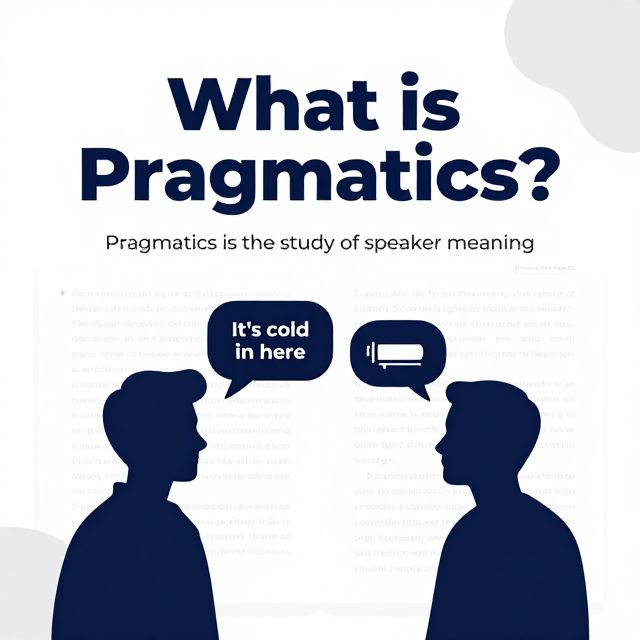
    • Example: Saying the words "It's cold in here."
  2. Illocutionary Act: 🎯 The making of a statement, offer, promise, etc., by virtue of the conventional force associated with the utterance. It's the intention or force behind what is said.
    • Example: By saying "It's cold in here," the speaker might be requesting someone to close the window.
  3. Perlocutionary Act: 👂 The bringing about of effects on the audience by means of uttering the sentence. These effects are specific to the circumstances of the utterance.
    • Example: The listener, upon hearing "It's cold in here," closes the window (the effect).

4.2. Searle's Five Illocutionary Points

Searle further refined the theory, proposing five types of illocutionary points speakers can achieve:

  1. Assertive: 📝 Speakers represent how things are in the world (e.g., stating, claiming, reporting).
  2. Commissive: 🙏 Speakers commit themselves to doing something (e.g., promising, vowing, offering).
  3. Directive: 🗣️ Speakers try to get hearers to do something (e.g., ordering, requesting, advising).
  4. Declarative: ✨ Speakers do things in the world at the moment of the utterance solely by virtue of saying that they do (e.g., declaring war, marrying, baptizing).
  5. Expressive: 🎭 Speakers express their attitudes about objects and facts of the world (e.g., thanking, apologizing, congratulating).
    • Scholarly Reference: Nordquist (2014).

4.3. Critique of Speech Act Theory ⚠️

As Barron (2003) notes, Speech Act Theory has been criticized for:

  • Regarding the hearer as playing a passive role.
  • Disregarding interactional aspects of conversation.
  • Being limited in explaining real conversational dynamics because it overlooks the relationship of speech acts to other speech acts within a broader discourse context.

5. The Cooperative Principle ✅

To explain the distinction between what is directly uttered and what is implied, Grice proposed the Cooperative Principle. This principle suggests that participants in a conversation operate under a covert assumption to ensure effective communication.

5.1. Grice's Cooperative Principle

"Make your conversational contribution such as is required, at the stage at which it occurs, by the accepted purpose or direction of the talk exchange in which you are engaged."

5.2. Grice's Four Maxims

This principle is elaborated through four maxims, which include nine sub-maxims:

5.2.1. Maxims of Quantity

  • Make your contribution as informative as is required.
  • Do not make your contribution more informative than is required.

5.2.2. Maxims of Quality

  • Try to make your contribution one that is true.
  • Do not say what you believe to be false.
  • Do not say that for which you lack adequate evidence.

5.2.3. Maxim of Relation

  • Be relevant.

5.2.4. Maxims of Manner

  • Be perspicuous (clear).
  • Avoid obscurity of expression.
  • Avoid ambiguity.
  • Be brief.
  • Be orderly.

5.3. Example: Doctor-Patient Dialogue 🩺

Consider this exchange:

  • Doctor: "What is your complaint?"
  • Patient: "I cannot lose weight. I am getting fatter and fatter."
  • Doctor: "Eat less and do sports regularly."
  • Patient: "O.K. Thanks!"

In this example:

  • The patient's response adheres to the Maxim of Quantity (informative enough) and the Maxim of Relation (relevant to the doctor's question).
  • The doctor's advice, based on the patient's information, also follows the Cooperative Principle by providing a relevant and informative solution. The interaction is cooperative, even if the doctor's advice lacks a direct directive force regarding compliance.

Conclusion

This overview has systematically presented the core tenets of pragmatics. We have defined pragmatics as the study of meaning in context and pragmatic competence as the ability to interpret communicative intentions. The discussion then moved to the various kinds of pragmatics—pragmalinguistics, sociopragmatics, and psychopragmatics—each addressing different facets of language use. The critical role of context was explored through its linguistic, physical, social, and epistemic dimensions. Furthermore, Speech Act Theory, with its locutionary, illocutionary, and perlocutionary acts, and Searle's five illocutionary points, provided a framework for understanding language as action. Finally, Grice's Cooperative Principle and its maxims of Quantity, Quality, Relation, and Manner were detailed as fundamental guidelines for effective and coherent conversation. These concepts collectively form the bedrock for analyzing and understanding the intricate nature of human communication.
Kendi çalışma materyalini oluştur

PDF, YouTube videosu veya herhangi bir konuyu dakikalar içinde podcast, özet, flash kart ve quiz'e dönüştür. 1.000.000+ kullanıcı tercih ediyor.

Sıradaki Konular

Tümünü keşfet
Pragmatics: Understanding Meaning Beyond Words

Pragmatics: Understanding Meaning Beyond Words

This summary explores pragmatics, the study of speaker meaning and context in communication. It covers concepts like deixis, reference, inference, presupposition, speech acts, and politeness.

6 dk Özet 25 15
Understanding Pragmatics in Language

Understanding Pragmatics in Language

Explore pragmatics: the study of meaning communicated by speakers and interpreted by listeners, considering context, speaker intention, and social distance.

Özet 25 15
Discourse Analysis: Interpreting Language Beyond Sentences

Discourse Analysis: Interpreting Language Beyond Sentences

This summary explores discourse analysis, examining how language users interpret meaning in texts and conversations, focusing on cohesion, coherence, the co-operative principle, and background knowledge.

5 dk Özet 25 15
Discourse Analysis: Cohesion, Coherence, and Interpretation

Discourse Analysis: Cohesion, Coherence, and Interpretation

This summary explores discourse analysis, examining how language is understood beyond individual sentences, focusing on cohesion, coherence, conversational principles, and the role of background knowledge in interpretation.

4 dk Özet 25 15
First Language Acquisition: Concepts and Developmental Stages

First Language Acquisition: Concepts and Developmental Stages

This summary explores first language acquisition, differentiating it from learning. It details early developmental stages, including cooing, babbling, one-word, two-word, and telegraphic speech, alongside the development of morphological, syntactic, and semantic knowledge.

5 dk Özet 25 15
Discourse Analysis: Concepts and Applications

Discourse Analysis: Concepts and Applications

This audio summary provides an academic overview of discourse analysis, exploring key concepts such as cohesion, coherence, speech events, conversation analysis, turn-taking, and linguistic hedges.

6 dk Özet 25 15
The Global Power and Linguistic Diversity of English

The Global Power and Linguistic Diversity of English

An academic overview of English's global influence, historical evolution, social implications of its variations, and the rich linguistic landscape of Britain, including indigenous and non-indigenous languages.

7 dk Özet 25 15
The Linguistic and Sociological Significance of "Hello"

The Linguistic and Sociological Significance of "Hello"

An academic exploration of the word "hello," examining its etymology, historical evolution, sociolinguistic functions, and contemporary usage in human communication.

6 dk Özet 25 15