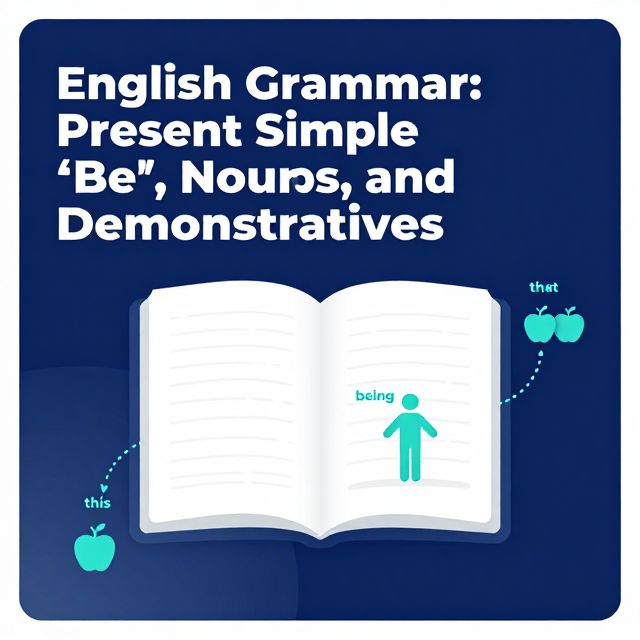
English Grammar: Present Simple 'Be', Nouns, and Demonstratives - kapak
Eğitim#english grammar#verb to be#nouns#demonstratives

English Grammar: Present Simple 'Be', Nouns, and Demonstratives

An academic summary covering the present simple form of the verb 'to be', the usage of singular and plural nouns, and the application of demonstrative pronouns in English grammar.

adibayuFebruary 23, 2026 ~20 dk toplam
01

Sesli Özet

5 dakika

Konuyu otobüste, koşarken, yolda dinleyerek öğren.

Sesli Özet

English Grammar: Present Simple 'Be', Nouns, and Demonstratives

0:004:37
02

Flash Kartlar

25 kart

Karta tıklayarak çevir. ← → ile gez, ⎵ ile çevir.

1 / 25
Tüm kartları metin olarak gör
  1. 1. What are the three fundamental aspects of English grammar covered in this content?

    This content focuses on three crucial aspects: the present simple form of the verb 'to be', the correct usage of singular and plural nouns, and the application of demonstrative pronouns. Mastering these elements is essential for constructing clear and grammatically sound sentences in English.

  2. 2. What is the primary function of the verb 'to be' in English grammar?

    The verb 'to be' is fundamental for expressing states, facts, and personal details. It is used to convey information such as a person's name, nationality, age, or current status, forming the backbone of many descriptive sentences.

  3. 3. How is a positive statement structured using the present simple form of 'to be'?

    In positive statements, the structure involves a subject pronoun or noun followed by the appropriate form of 'be'. For example, 'I am in this class' or 'She is South Korean.' This basic structure allows for clear and direct communication of facts or states.

  4. 4. Provide examples of common contractions used with 'to be' in positive statements.

    Contractions are frequently used in spoken English to shorten phrases. For 'I am,' it becomes 'I'm.' 'She is' contracts to 'She's,' and 'They are' becomes 'They're.' These contractions make speech more fluid and natural.

  5. 5. How do you form a negative statement using the verb 'to be'?

    To form a negative statement with 'to be', the word 'not' is added directly after the verb 'be'. For instance, 'I am not in this class' or 'He is not South Korean.' This simple addition negates the original positive statement.

  6. 6. What are some common contractions for negative statements with 'to be'?

    Common contractions for negative forms include 'I'm not' (from 'I am not'), 'He isn't' or 'He's not' (from 'He is not'), and 'We aren't' or 'We're not' (from 'We are not'). These contractions offer flexibility in expressing negation.

  7. 7. What is the rule regarding the placement of the subject pronoun or noun relative to the verb 'be' in statements?

    A critical rule is that the subject pronoun or noun always precedes the verb 'be' in statements. This consistent order helps maintain clarity and grammatical correctness, ensuring the listener or reader understands who or what the statement is about.

  8. 8. Explain how to form a question using the verb 'to be'.

    To form a question with 'be', the verb is placed before the subject pronoun or noun. For example, instead of 'You are in this class,' it becomes 'Are you in this class?' This inversion signals that the sentence is an inquiry.

  9. 9. How are short answers structured for 'to be' questions in the positive form?

    Positive short answers are structured as 'Yes, I am,' 'Yes, he/she/it is,' or 'Yes, you/we/they are.' It is crucial to remember that contractions are not used in positive short answers; one must say 'Yes, she is,' not 'Yes, she's.'

  10. 10. How are short answers structured for 'to be' questions in the negative form?

    Negative short answers are structured as 'No, I'm not,' 'No, he/she/it isn't,' or 'No, you/we/they aren't.' These forms allow for a concise and grammatically correct way to respond negatively to a 'to be' question.

  11. 11. What is the critical rule regarding contractions in positive short answers?

    A critical rule states that contractions are not used in positive short answers. For example, one must say 'Yes, she is,' and not 'Yes, she's.' This rule ensures proper formal and grammatical usage in concise affirmative responses.

  12. 12. How are questions typically structured when using question words like 'How old,' 'Where,' or 'What' with 'to be'?

    When using question words, the structure is typically 'Question word + be + subject.' For instance, 'How old are you?' or 'Where are you from?' This pattern allows for specific information to be requested using the verb 'to be'.

  13. 13. When are the indefinite articles 'a' and 'an' used?

    The indefinite articles 'a' and 'an' are used exclusively with singular nouns. They indicate that the noun is non-specific or one of many. These articles are never used with plural nouns, as they specifically denote a single item.

  14. 14. What is the rule for using the indefinite article 'a'? Provide an example.

    The indefinite article 'a' precedes nouns that begin with a consonant sound. For example, 'a sandwich' or 'a wallet.' It is important to consider the sound, not just the letter, at the beginning of the noun when applying this rule.

  15. 15. What is the rule for using the indefinite article 'an'? Provide an example.

    The indefinite article 'an' is used before nouns that begin with a vowel sound. For example, 'an email' or 'an airport.' Similar to 'a', the determining factor is the initial sound of the noun, not necessarily the first letter, to ensure correct usage.

  16. 16. When are the indefinite articles 'a' and 'an' NOT used?

    The indefinite articles 'a' and 'an' are not used with plural nouns. They are specifically for singular, non-specific items. For example, you would say 'pens' not 'a pens,' as 'a' and 'an' imply singularity.

  17. 17. What is the general rule for forming the plural of most nouns in English?

    Most nouns form their plural by simply adding '-s' to the end of the word. For instance, 'pen' becomes 'pens,' and 'book' becomes 'books.' This is the most common and straightforward method for pluralization in English.

  18. 18. How do nouns ending in '-s' or '-ch' typically form their plural? Provide examples.

    Nouns ending in '-s' or '-ch' typically form their plural by adding '-es'. Examples include 'address' becoming 'addresses' and 'watch' becoming 'watches.' This addition helps with pronunciation when the singular form already ends in a sibilant sound.

  19. 19. Explain the rule for forming the plural of nouns ending in '-y' preceded by a consonant. Provide examples.

    For nouns ending in '-y' that are preceded by a consonant, the '-y' is changed to '-ies' to form the plural. For example, 'country' transforms into 'countries,' and 'nationality' becomes 'nationalities.' This rule ensures proper spelling and pronunciation.

  20. 20. What are irregular plural nouns, and why are they important?

    Irregular plural nouns are words that do not follow the standard rules for pluralization (adding -s, -es, or -ies). They have unique forms that must be memorized, such as 'man' becoming 'men' or 'child' becoming 'children.' Their importance lies in their frequent use in everyday English, making memorization crucial for correct communication.

  21. 21. Provide three examples of irregular plural nouns mentioned in the text.

    The text mentions several irregular plural nouns that do not follow standard rules. Common examples include 'man' becoming 'men,' 'child' becoming 'children,' and 'person' becoming 'people.' These forms require memorization as they do not adhere to typical pluralization patterns.

  22. 22. What is the main purpose of demonstrative pronouns?

    Demonstrative pronouns are used to indicate specific items and their proximity to the speaker. They help to point out whether an object is near or far, and whether it is singular or plural, making communication more precise and contextual.

  23. 23. When should 'this' be used as a demonstrative pronoun? Provide an example.

    'This' is used with a singular noun that is near the speaker. For example, 'This is my bag here.' It specifically points to one item that is within close proximity to the person speaking, indicating its singular nature and closeness.

  24. 24. When should 'that' be used as a demonstrative pronoun? Provide an example.

    'That' is used for a singular noun that is far away from the speaker. For example, 'That is Paola's bag over there.' It indicates a single item that is at a distance, distinguishing it from items that are near.

  25. 25. When should 'these' be used as a demonstrative pronoun? Provide an example.

    'These' is used for plural nouns that are near the speaker. For example, 'These are our bags here.' It points to multiple items that are in close proximity, indicating both plurality and closeness.

03

Bilgini Test Et

15 soru

Çoktan seçmeli sorularla öğrendiklerini ölç. Cevap + açıklama.

Soru 1 / 15Skor: 0

According to the text, what is the primary function of the verb 'to be' in English grammar?

04

Detaylı Özet

5 dk okuma

Tüm konuyu derinlemesine, başlık başlık.

English Grammar Fundamentals: Present Simple 'Be', Nouns, and Demonstratives

📚 Source Information: This study material has been compiled from a lecture audio transcript and copy-pasted text provided by the user. All content has been consolidated and organized for clarity.


📝 Introduction to Fundamental English Grammar

This study guide covers essential building blocks of English grammar, focusing on the present simple form of the verb 'to be', the correct usage of singular and plural nouns, and the application of demonstrative pronouns. Mastering these concepts is crucial for constructing clear, grammatically correct sentences and improving overall English proficiency.


1️⃣ The Present Simple Form of 'To Be'

The verb 'to be' is fundamental for expressing states, facts, and personal details such as name, nationality, age, or status.

1.1 Positive Statements ✅

In positive statements, the structure involves a subject (noun or pronoun) followed by the appropriate form of 'be'.

  • Forms:

    • I am (e.g., I am in this class.)
    • He/She/It is (e.g., She is South Korean.)
    • You/We/They are (e.g., They are from Japan.)
  • Contractions (Common in spoken English):

    • I'm (e.g., I'm in this class.)
    • He's/She's/It's (e.g., She's South Korean.)
    • You're/We're/They're (e.g., They're from Japan.)

💡 Key Point: The subject (noun or pronoun) always comes before the verb 'be' in statements.

  • Correct: He's South Korean.
  • Incorrect: Is South Korean.

1.2 Negative Statements ❌

To form negative statements, add 'not' immediately after the verb 'be'.

  • Forms:

    • I am not (e.g., I am not in this class.)
    • He/She/It is not (e.g., He is not South Korean.)
    • You/We/They are not (e.g., We are not from Japan.)
  • Contractions:

    • I'm not (e.g., I'm not in this class.)
    • He isn't / He's not (e.g., He isn't South Korean. OR He's not South Korean.)
    • She isn't / She's not (e.g., She isn't 24 years old. OR She's not 24 years old.)
    • We aren't / We're not (e.g., We aren't from Japan. OR We're not from Japan.)

1.3 Questions with 'Be' ❓

To form questions, the verb 'be' is placed before the subject (noun or pronoun).

  • Structure: Be + Subject + ...?

    • Am I in this class?
    • Is she South Korean?
    • Are they from Japan?
  • Short Answers:

    • Positive Short Answers:
      • Yes, I am.
      • Yes, he/she/it is.
      • Yes, you/we/they are.
      • ⚠️ Important: Do NOT use contractions in positive short answers. Say "Yes, she is," NOT "Yes, she's."
    • Negative Short Answers:
      • No, I'm not.
      • No, he/she/it isn't. (Also acceptable: No, he's not.)
      • No, you/we/they aren't. (Also acceptable: No, you're not.)
  • Questions with Question Words:

    • Structure: Question Word + Be + Subject + ...?
    • How old are you? (Asking about age)
    • Where are you from? (Asking about place)
    • What's your name? (Asking about a thing/detail)

2️⃣ Nouns and Their Forms

Nouns are words that name people, places, things, or ideas. Understanding their forms is key to correct sentence structure.

2.1 Indefinite Articles: 'A' and 'An' 📚

  • We use 'a' or 'an' only with singular nouns.
  • 'A' is used before nouns that begin with a consonant sound.
    • Examples: a sandwich, a wallet, a book, a university (university starts with a 'yoo' sound, which is a consonant sound).
  • 'An' is used before nouns that begin with a vowel sound (a, e, i, o, u).
    • Examples: an email, an airport, an hour (hour starts with an 'ow' sound, which is a vowel sound).
  • ⚠️ Caution: We do NOT use 'a' or 'an' with plural nouns.

2.2 Plural Nouns 📊

Most nouns form their plural by following specific rules, but some are irregular.

  • 1. Add '-s' for most nouns:

    • Singular: pen → Plural: pens
    • Singular: bag → Plural: bags
  • 2. Add '-es' to nouns ending in -s, -sh, -ch, -x, -z:

    • Singular: address → Plural: addresses
    • Singular: watch → Plural: watches
    • Singular: bus → Plural: buses
    • Singular: box → Plural: boxes
  • 3. Change '-y' to '-ies' after a consonant:

    • If a noun ends in '-y' and the letter before it is a consonant, change '-y' to '-ies'.
    • Singular: country → Plural: countries
    • Singular: nationality → Plural: nationalities
    • (But: keykeys because 'e' is a vowel before 'y')
  • 4. Irregular Plurals: Some nouns have unique plural forms that must be memorized.

    • Singular: man → Plural: men
    • Singular: child → Plural: children
    • Singular: person → Plural: people
    • Singular: foot → Plural: feet
    • Singular: mouse → Plural: mice

3️⃣ Demonstrative Pronouns: This, That, These, Those

Demonstrative pronouns are used to point out specific items and indicate their proximity (near or far) to the speaker.

  • 'This' (Singular, Near)

    • Used for a single noun that is close to you.
    • Example: This is my bag here. (The bag is right next to you.)
  • 'That' (Singular, Far)

    • Used for a single noun that is further away from you.
    • Example: That is Paola's bag over there. (The bag is not close.)
  • 'These' (Plural, Near)

    • Used for multiple nouns that are close to you.
    • Example: These are our bags here. (The bags are right next to you.)
  • 'Those' (Plural, Far)

    • Used for multiple nouns that are further away from you.
    • Example: Those are your bags over there. (The bags are not close.)

3.1 Questions with Demonstratives ❓

When forming questions with demonstratives, the verb 'be' comes before the demonstrative pronoun.

  • Correct: Is that your bag over there?
  • Incorrect: That is your bag over there?

💡 Conclusion

A solid grasp of these foundational grammar points is essential for effective communication in English.

  • Understanding the Present Simple 'Be' allows you to describe states, facts, and personal information accurately.
  • Correctly using articles 'a' and 'an' and forming plural nouns ensures precision in your language.
  • Employing demonstrative pronouns ('this, that, these, those') helps you clearly indicate objects and their location.

By mastering these concepts, you build a strong base for more advanced English grammar. Keep practicing!
Kendi çalışma materyalini oluştur

PDF, YouTube videosu veya herhangi bir konuyu dakikalar içinde podcast, özet, flash kart ve quiz'e dönüştür. 1.000.000+ kullanıcı tercih ediyor.

Sıradaki Konular

Tümünü keşfet
English Grammar Essentials: Future Forms, Reported Speech, and Passives

English Grammar Essentials: Future Forms, Reported Speech, and Passives

An educational overview of key English grammar concepts including future tenses, reported speech, passive structures, and causatives, designed for language learners.

25 15
English Grammar: Conditionals, Passive, Pronouns, Adjectives, and Vocabulary

English Grammar: Conditionals, Passive, Pronouns, Adjectives, and Vocabulary

An academic overview of key English grammar structures including second conditional, passive voice forms, reflexive pronouns, compound adjectives, and essential advertising vocabulary.

5 dk Özet 25 15
An Overview of Essential English Phrasal Verbs

An Overview of Essential English Phrasal Verbs

This academic summary provides a structured overview of common English phrasal verbs, detailing their meanings and usage for enhanced linguistic comprehension.

4 dk 25 15
English Expressions: Degree, Frequency, and Regret

English Expressions: Degree, Frequency, and Regret

Explore English adverbs for degree and frequency, and structures for expressing past regret and hypothetical situations.

6 dk Özet 25
English Language Essentials: Grammar, Vocabulary, and Culture

English Language Essentials: Grammar, Vocabulary, and Culture

Explore key English grammar points, essential vocabulary, common idioms, and a detailed look at the cello's musical significance.

7 dk Özet 25
Mastering Prepositions: Your Guide to 'In,' 'On,' and 'At'

Mastering Prepositions: Your Guide to 'In,' 'On,' and 'At'

Ever wonder how to use 'in,' 'on,' and 'at' correctly? This podcast breaks down prepositions, explaining their role in English and giving you clear examples for time, place, and direction.

4 dk 25
English Grammar Essentials: Tenses, Modals, and Articles

English Grammar Essentials: Tenses, Modals, and Articles

Explore fundamental English grammar, covering past and present habits, various tenses, modals for ability and obligation, articles, comparisons, and future forms.

8 dk Özet 25 15
English Grammar Essentials: Articles, Adjectives, and Connectors

English Grammar Essentials: Articles, Adjectives, and Connectors

This podcast provides an in-depth look at fundamental English grammar concepts, including definite and indefinite articles, adjective types, and various connective elements.

8 dk Özet