 Podit
Podit
📚 English Grammar Fundamentals: A Comprehensive Study Guide
This study material is compiled from various sources, including a lecture audio transcript and grammar bank texts. It aims to provide a clear, structured, and detailed overview of fundamental English grammar principles, covering past and present habits, various tenses, modal verbs for ability and obligation, article usage, comparisons, and future expressions. This guide will help you build a solid foundation for improving your English proficiency.
1. Expressing Past and Present Habits & Mastering Past Tenses
1.1 Past Habits and States
✅ Used to
- Definition: Used to describe actions or states that were true over a period of time in the past but are no longer true now.
- Form:
used to + infinitive(e.g., I used to live in Singapore as a child.) - Usage:
- Can be used with both action verbs (e.g., go, do) and non-action verbs (e.g., be, have).
- Often refers to something that is not true now.
- To emphasize a contrast with the present, use
not... any more / any longerwith the present simple (e.g., I used to go to the gym, but I don't (go) any more / any longer.) Never used tois often used instead ofdidn't use to(e.g., I never used to like football.)
- ⚠️ Important Note:
Used todoes not exist in the present tense. (❌ NOT I use to get up early.)
✅ Past Simple for Repeated Actions/States
- Usage: For repeated actions or states in the past, the
past simple(often with an adverb of frequency like often) can be used, and the meaning is often the same asused to.- Example: We used to go to the cinema on Saturdays. OR We often went to the cinema on Saturdays.
- ⚠️ When to use Past Simple ONLY:
- If you mention exact dates or the number of times an action happened.
- If the action happened only once.
- Example: We went to the cinema on Saturday. (This refers to a single event, so
used tois incorrect here.)
💡 Insight: Don't confuse used to / didn't use to (do something) with be used to and get used to (doing something).
Be used to: To be accustomed to something (e.g., I am used to getting up early every day.)Get used to: To become accustomed to something (e.g., Lola can't get used to living in Delhi.)
1.2 Present Habits
✅ Present Simple + Adverbs of Frequency
- Usage: For present habits, use a verb in the
present simple, often with an adverb of frequency (e.g., usually, normally).- Example: I usually meet my friends at weekends.
- Example: English houses usually have gardens.
1.3 Past Tenses
✅ Past Simple
- Definition: Used for finished actions in the past.
- Usage:
- When we say, ask, or know when they happened.
- Example: They were in Mexico in 2016.
- Example: What time did you get up this morning?
- For repeated actions in the past.
- Example: When I lived in Paris, I often went to watch Paris St-Germain.
- Remember irregular verbs.
- When we say, ask, or know when they happened.
✅ Past Continuous
- Definition: Used to talk about an action in progress at a specific time in the past.
- Form:
was / were + verb + -ing - Usage:
- To describe a past action in progress which was interrupted by another action (expressed in the past simple). The two actions are usually linked by
whenoras.- Example: I was driving along the motorway when it started snowing.
- For two actions happening at the same time, often with
while.- Example: While I was doing the housework, the children were playing in the garden.
- To set the scene at the beginning of a story or anecdote.
- Example: It was a cold night and it was raining. I was watching TV in the living room.
- To describe a past action in progress which was interrupted by another action (expressed in the past simple). The two actions are usually linked by
- ⚠️ Important Note: Do not use the past continuous with non-action verbs. (❌ NOT We were needing petrol.)
✅ Past Perfect
- Definition: Used to talk about an action that happened before another action in the past.
- Form:
had + past participle - Usage:
- When we want to talk about an earlier past action relative to another past action.
- Example: When they turned on the TV, the match had already finished. (The match finished before they turned on the TV.)
- Compare: When they arrived, John went out. (John arrived, then they went out.) vs. When they arrived, John had gone out. (John went out before they arrived.)
- When we want to talk about an earlier past action relative to another past action.
✅ Narrative Tenses Together
- When telling stories, these tenses work together:
Past Continuous: Sets the scene (e.g., It was raining, I was watching TV.)Past Simple: Describes what happened (e.g., I heard a knock, I got up.)Past Perfect: Explains what happened before the previous past action (e.g., The person who had knocked had disappeared.)
2. Ability, Obligation, and Future Expressions
2.1 Ability and Possibility
✅ Can / Could
Can: Expresses present ability (e.g., I can speak three languages fluently.)Could: Expresses past ability (e.g., Our daughter could play the violin when she was three.)- Limitations:
Canis a modal verb and only has a present form.
✅ Be able to
- Form:
be able to + infinitive - Usage:
- Used for ability and possibility in all other tenses and forms where
cancannot be used (e.g., present perfect, infinitive, gerund, future).- Example (Present Perfect): Archie has been able to swim since he was three.
- Example (Infinitive): I'd like to be able to ski.
- Example (Gerund): I love being able to stay in bed late.
- Example (Future): You'll be able to practise your English in Australia.
- Can sometimes be used in the present and past instead of
can / couldto be more formal.- Example: Fortunately, I am able to accept your invitation.
- Used for ability and possibility in all other tenses and forms where
2.2 Obligation and Prohibition
✅ Have to / Must
- Definition: Both express obligation or something that is necessary to do.
- Form:
have to / must + infinitive - Distinction:
Have to: More common for general, external obligations (rules, laws).- Example: You have to switch off your phone during take-off.
- Example: I have to wear a shirt and tie at work. (It's the company rule.)
Must: More common for specific (on one occasion) or personal obligations.- Example: You must be on time tomorrow because there's a test.
- Example: You must see this film - it's amazing! (Strong recommendation/personal decision.)
- Example: I must buy a new shirt - this one is too old now. (My own decision.)
- Tense Usage:
Have to: A normal verb, exists in all tenses and forms (e.g., I had to wear a uniform, I hate having to get up early).Must: A modal verb, only exists in the present, but can be used with a future meaning.
✅ Don't have to
- Definition: Expresses no obligation; it is not necessary to do something.
- Example: You don't have to pay - this museum is free. (You can pay if you want, but it's not obligatory.)
✅ Mustn't
- Definition: Expresses prohibition; it is not allowed to do something.
- Example: You mustn't park here. (It's prohibited/against the law.)
- Alternatives:
Can'torare not allowed tocan often be used instead ofmustn't.- Example: You can't / are not allowed to park here.
2.3 Advice and Recommendation
✅ Should / Shouldn't
- Form:
should / shouldn't + infinitive - Usage:
- To give advice or an opinion.
Shouldis not as strong asmust / have to.- Example: You should take warm clothes with you to Dublin.
- Example: You shouldn't drink so much coffee.
- To say if we think something is the right or wrong thing to do.
- Can also be used for strong recommendations (similar to
must / have toin this context).
- To give advice or an opinion.
- Alternative:
Ought to / ought not tocan be used instead ofshould / shouldn't.- Example: You ought to take warm clothes with you.
2.4 Future Expressions
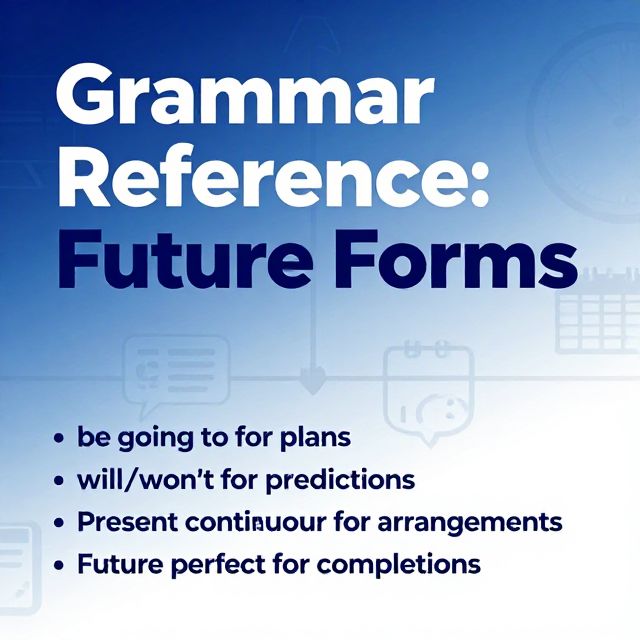
✅ Be going to
- Form:
be going to + infinitive - Usage:
- For plans and intentions that have already been decided.
- Example: My sister's going to adopt a child.
- Example: Are you going to buy a new car?
- To make a prediction about the future, especially when there is some evidence.
- Example: Look at those black clouds. I think it's going to rain.
- Example: Barcelona are going to win. They're playing really well.
- For plans and intentions that have already been decided.
✅ Will / Won't
- Form:
will / won't + infinitive - Usage:
- For instant decisions.
- Example: I'll have the steak.
- For promises.
- Example: I won't tell anybody where you are.
- For offers.
- Example: I'll carry that bag for you.
- For general predictions.
- Example: You'll love New York!
- To talk about future facts.
- Example: Next year Christmas Day will be on a Thursday.
- For instant decisions.
✅ Shall
- Usage: Used with
Iandwefor offers and suggestions when they are questions.- Example: Shall I help you with your homework? (Offer)
- Example: Shall we eat out tonight? (Suggestion)
✅ Present Continuous for Future
- Form:
be + verb + -ing - Usage:
- For future arrangements that are fixed and definite.
- Example: Diana and Jamie are getting married in October.
- Example: We're meeting at 10 o'clock tomorrow.
- Often used with verbs relating to travel arrangements (e.g., go, come, arrive, leave).
- Example: He's arriving tomorrow and leaving on Thursday.
- For future arrangements that are fixed and definite.
- 💡 Insight: There is often little difference between the present continuous and
be going tofor future plans/arrangements.Be going toshows a decision has been made.Present continuousemphasizes that arrangements have been made.
3. Articles, Comparisons, and Perfect Tenses
3.1 Articles (a/an, the, no article)
✅ A / An
- Usage:
- With singular countable nouns when we mention something for the first time.
- Example: I saw an old man with a dog.
- When we say what something is or what somebody does.
- Example: It's a nice house.
- Example: She's a lawyer.
- In exclamations with
What...!- Example: What an awful day!
- With singular countable nouns when we mention something for the first time.
✅ The
- Usage:
- When we talk about something we've already mentioned.
- Example: I saw an old man with a dog. The dog was barking.
- When it's clear what we're referring to.
- Example: The bell rang and my father opened the door.
- When there's only one of something.
- Example: The moon goes round the Earth.
- With places in a town (e.g.,
cinema, theatre).- Example: I'm going to the cinema tonight.
- With superlatives.
- Example: It's the best restaurant in town.
- When we talk about something we've already mentioned.
✅ No Article
- Usage:
- When speaking in general (with plural and uncountable nouns).
- Example: Love is more important than money.
- Example: I love flowers. (General) vs. I love the flowers in my garden. (Specific)
- With some nouns after
at / to / from(e.g.,home, work, school, church).- Example: She's not at home today.
- Example: The children are at school.
- Before meals, days, and months.
- Example: I never have breakfast.
- Before
next / last + day, week, etc.- Example: See you next week.
- In expressions of frequency.
- Example: I have classes three times a week.
- When speaking in general (with plural and uncountable nouns).
3.2 Comparisons and Superlatives
✅ Comparatives
- Definition: Used to compare two people, places, things, or actions.
- Forms (Adjectives):
- Short adjectives:
adjective + -er + than(e.g., My car is a bit older than yours.) - Long adjectives:
more + adjective + than(e.g., Berlin is more expensive than Budapest.) - Equality/Inequality:
(not) as + adjective + as(e.g., The new sofa isn't as comfortable as the old one.)
- Short adjectives:
- Forms (Adverbs):
- Short adverbs:
adverb + -er + than(e.g., My father drives faster than me.) - Long adverbs:
more + adverb + than(e.g., He walks more slowly than I do.) - Equality/Inequality:
(not) as + adverb + as(e.g., Max doesn't speak English as well as his wife.)
- Short adverbs:
- Irregular Comparatives:
good→betterbad→worsefar→further / farther
- 💡 Insight: After
thanoras, you can use an object pronoun (me, him, her) or a subject pronoun + auxiliary verb (I am, he is).- Example: She's taller than me. OR She's taller than I am.
✅ Superlatives
- Definition: Used to compare one person, thing, or action with all others in its group.
- Forms (Adjectives):
- Short adjectives:
the + adjective + -est(e.g., Kevin is the tallest player in the team.) - Long adjectives:
the most + adjective(e.g., Oslo is the most expensive capital city in Europe.) - Least expensive:
the least + adjective(e.g., The small bag is the least expensive.)
- Short adjectives:
- Forms (Adverbs):
the most + adverb(e.g., Who dresses the most stylishly in your family?)
- Irregular Superlatives:
good→bestbad→worst
- Usage:
- We normally use
thebefore superlatives, but possessive adjectives can also be used (e.g., my best friend). - Often used with the present perfect +
ever.- Example: It's the best book I've ever read.
- Use
in(NOTof) before places after a superlative.- Example: It's the longest bridge in the world.
- We normally use
✅ The same as
- Usage: To say that two people, places, things, etc., are identical.
- Example: Her dress is the same as mine.
3.3 Present Perfect Tenses
✅ Present Perfect Simple
- Form:
have / has + past participle - Usage:
- For past experiences when we don't say exactly when they happened.
- Example: Sally has never met Bill's ex-wife.
- Example: Have you ever lost your credit card?
Everandneverare often used with past experiences.
- For recent past actions when we focus on the present result.
- Example: I've cut my finger! (The result is the cut now.)
Justis often used before the main verb in this context.- Example: Our train has just left!
- With
yetandalready.Already: In affirmative sentences, before the main verb (e.g., I've already seen this film.)Yet: In negative sentences and questions, at the end of the phrase (e.g., My brother hasn't found a new job yet. Have you finished your homework yet?)
- For past experiences when we don't say exactly when they happened.
- ⚠️ Distinction from Past Simple:
Present Perfect: Focuses on whether an action happened or its result, without specifying when.Past Simple: Focuses on when an action happened, usually with a past time expression (e.g., yesterday, last week).- Example: I've been to Tokyo twice. (In my life up to now, no specific time.)
- Example: I went there in 2010 and 2023. (Specific occasions.)
✅ Present Perfect Continuous
- Form:
have / has been + verb + -ing - Usage:
- For continuous or repeated actions that have been happening very recently, usually just finished, or have visible present results.
- Example: Your eyes are red. Have you been crying? (Visible result)
- With
forandsincewith action verbs (e.g., learn, work, go) to talk about actions which started in the past and are still true now.- Example: They've been working here for two years.
- Example: How long have you been learning English?
- For continuous or repeated actions that have been happening very recently, usually just finished, or have visible present results.
- ⚠️ Important Note: With non-action verbs, use the
present perfect simple(NOT continuous). (❌ NOT They've been knowing each other for ten years.) - 💡 Insight:
Liveandworkare often used in either thepresent perfect simpleorpresent perfect continuouswith the same meaning.- Example: I've lived here since 2010. OR I've been living here since 2010.
4. Action and Non-Action Verbs
4.1 Present Simple
- Usage: For things that are always true or happen regularly.
- Example: I live in Santiago. She works in a restaurant.
- Often used with adverbs of frequency (e.g., usually, never) or expressions of frequency (e.g., every day, once a week).
4.2 Present Continuous
- Usage: For actions in progress at the time of speaking or around now. These are normally temporary, not habitual, actions.
- Example: The phone's ringing. House prices are going up very fast at the moment.
4.3 Distinction
✅ Action Verbs
- Describe actions (e.g., cook, make).
- Can be used in both the
present simpleandpresent continuous.- Example: I'm making lunch. (Now) I usually make lunch at the weekend. (Habit)
✅ Non-Action Verbs (State Verbs)
- Describe states or feelings (e.g., be, need, love, know, believe, agree, belong, depend, forget, hate, hear, like, matter, mean, prefer, realize, recognize, remember, seem, suppose, want).
- Are generally NOT used in the
present continuous, even if referring to 'now'.- Example: I need them now! (NOT I'm needing them now!)
- Verbs of the senses (e.g., look, smell, taste, sound) are also normally non-action.
✅ Verbs with Both Meanings
- A few verbs can have both an action and a non-action meaning, depending on context.
Have:- Non-action (possession): I have a cat now.
- Action (part of an activity): I can't talk now. I'm having lunch.
Think:- Non-action (opinion): I think this music's great.
- Action (process of thinking about something): What are you thinking about?