 Podit
Podit
📚 English Grammar Fundamentals: Articles, Adjectives, and Connectors
Source Information: This study material has been compiled from a lecture audio transcript titled "Introduction to English Grammar Fundamentals" and supplementary copy-pasted text provided by the user. All content has been consolidated and presented in English.
🎯 Introduction
This study guide provides a comprehensive overview of fundamental English grammar concepts, focusing on articles, adjective types and placements, and various connectors and modifiers. The aim is to offer a clear and structured understanding of these essential elements for effective communication.
1️⃣ Articles: Definite and Indefinite
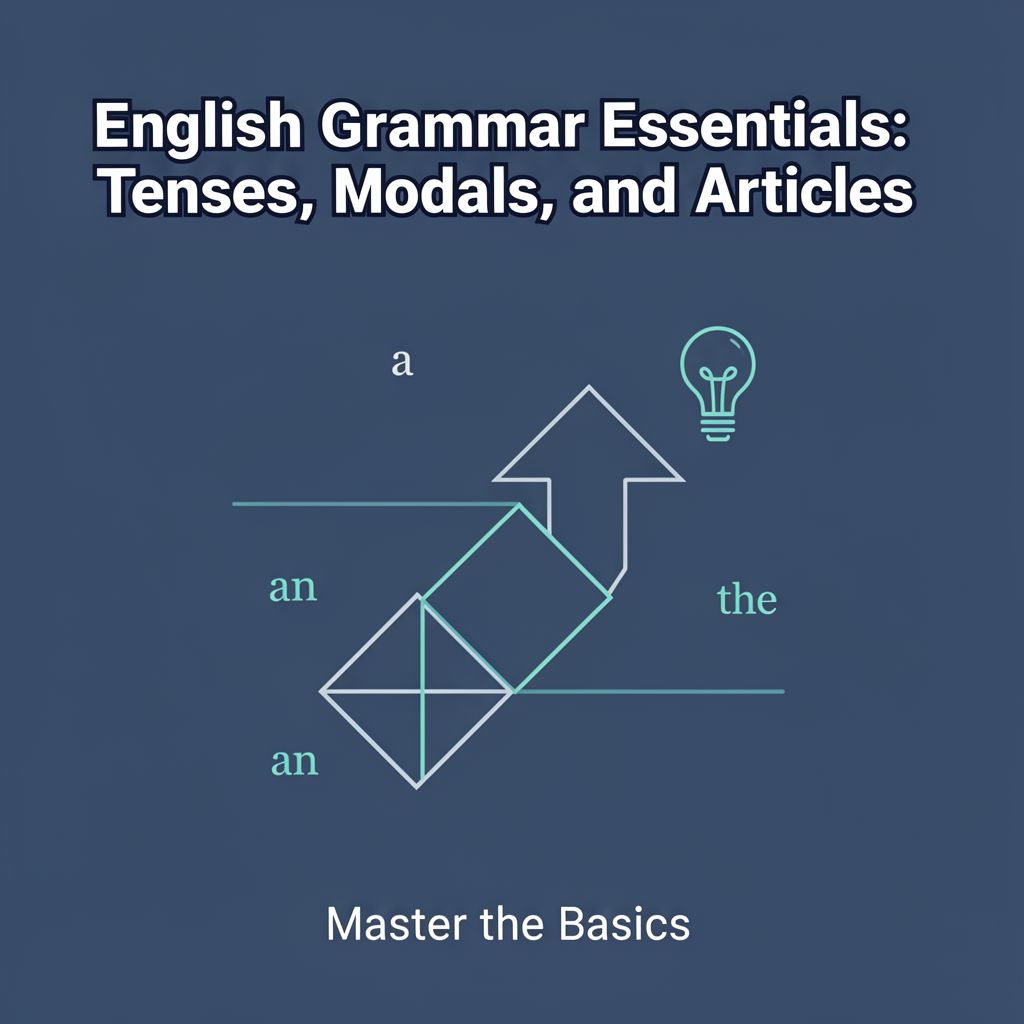
Articles are words that define whether a noun is specific or unspecific.
1.1. 📚 The Definite Article: "The"
The definite article "the" is used when both the speaker and listener know exactly which "thing" is being referred to.
✅ Usage Scenarios:
- Previously Mentioned: When referring back to something already introduced.
- 💡 Example: "I saw a dog. The dog was cute." (First mention is indefinite, subsequent mention is definite).
- Unique in Context: When there is only one of a particular item in the given context.
- Clearly Identified: When the identity of the item is already clear or uniquely defined.
1.2. 📚 The Indefinite Articles: "A" and "An"
The indefinite articles "a" and "an" are used when referring to something unknown, unspecified, or being mentioned for the first time.
✅ Usage Scenarios:
- Unknown/Unspecified: When the specific item is not identified.
- 💡 Example: "I saw a movie." (The specific film is not named).
- First Mention: When introducing something for the first time.
⚠️ "A" vs. "An" Rule:
- Use "an" before words starting with a vowel sound (e.g., an apple, an hour).
- Use "a" before words starting with a consonant sound (e.g., a cat, a university).
2️⃣ Adjectives: Types and Placement
Adjectives are words that describe or modify nouns. Their position relative to the noun can vary.
2.1. 📚 Attributive Adjectives
Attributive adjectives are placed directly before the noun they modify.
- 💡 Examples:
- "spicy food"
- "beautiful cottage"
2.2. 📚 Predicative Adjectives
Predicative adjectives appear after a linking verb (e.g., be, look, seem, feel) and describe the subject of the sentence.
- 💡 Examples:
- "The day is nice." (Here, "nice" describes "the day" after the verb "is").
- "This movie looks really terrible."
- "The flag was red, blue, and white."
2.3. 📚 Adjectives with Indefinite Pronouns
When an adjective modifies an indefinite pronoun (e.g., someone, somebody, something, anyone, anything, nothing, everyone), it typically follows the pronoun.
- 💡 Examples:
- "something interesting"
- "everyone missing"
- "nobody sane"
3️⃣ Pronominal Usage
📚 Definition: A word is considered pronominal when it stands in for or replaces a noun.
✅ Key Point: Indefinite pronouns often function pronominally, meaning they are used without an accompanying noun.
- 💡 Examples:
- "I need something." (Here, "something" replaces a specific noun like "a book" or "a tool").
- "Everyone is here."
4️⃣ Connectors and Modifiers
These elements add depth, nuance, and structure to sentences by showing relationships between ideas.
4.1. 📚 Adversative Expressions
Adversative expressions are used to convey contrast or opposition. This contrast can be explicit or implied through the meaning of the sentence.
- 💡 Example: "It's not easy but difficult."
- ✅ Common Keywords: rather, instead, not... but
4.2. 📚 Repudiative Expressions
Repudiative expressions serve to reject or correct a previous hypothesis or statement. They often overlap with adversative expressions.
- 💡 Example: "It's not easy but difficult." (This corrects an assumption that something might be easy).
- ✅ Common Keywords: rather, instead, not... but
4.3. 📚 Reminder Expressions
Reminder expressions are used to recall information or add an extra thought smoothly.
- 💡 Examples:
- "By the way, don't forget your keys."
- "Don't forget to submit your assignment."
- ✅ Common Phrases: by the way, don't forget
4.4. 📚 Alternative Expressions
Alternative expressions are used to present choices or options.
- 💡 Examples:
- "You can either study or watch a movie."
- "Finish your work, otherwise you'll miss the deadline."
- ✅ Common Keywords: either... or, otherwise, or
4.5. 📚 Intensifiers
Intensifiers are words or phrases used to strengthen or emphasize the meaning of another word, often an adjective or adverb.
- 💡 Examples:
- "The food was very delicious."
- "She is really talented."
- "That's an absolutely brilliant idea."
- ✅ Common Intensifiers: very, really, extremely, absolutely
5️⃣ Additional Grammatical Concepts
5.1. 📚 Adverb Clause Markers
An adverb clause marker is a word or phrase that introduces an adverbial clause. An adverbial clause is a dependent clause that functions as an adverb, modifying a verb, an adjective, or another adverb. These clauses provide information about time, place, manner, cause, condition, or purpose.
- ✅ Common Markers: when, because, although, if, while, as
- 💡 Example Concept: "A person achieves everything they want." (The bold part functions as a clause modifying "everything," though a direct marker isn't explicitly shown in this specific example, the concept refers to words that introduce such clauses).
5.2. 📚 Postpositions
Postpositions are words that follow their object, similar to how prepositions precede their object. While less common in English than prepositions, they do exist and function similarly, indicating relationships of place, time, or direction.
- ✅ Function: Similar to prepositions, but placed after the noun or pronoun they relate to.
- 💡 Example (less common in standard English, but conceptually): "ten years ago" (where "ago" functions like a postposition to "ten years").