 Podit
Podit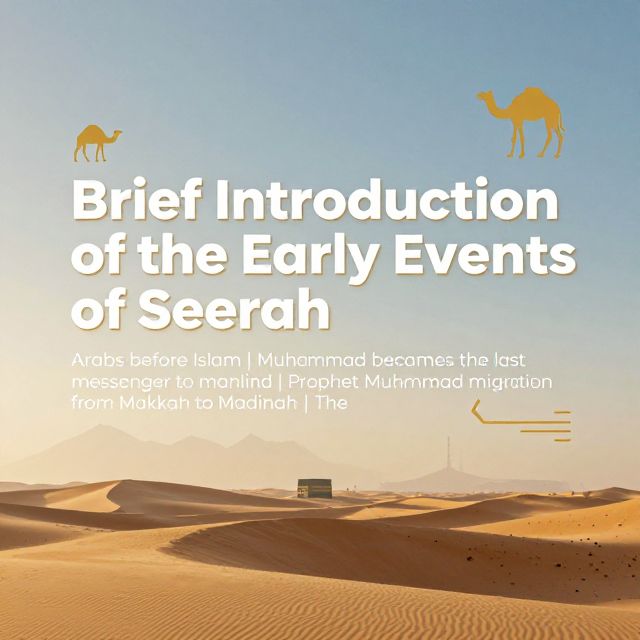
Early Events of Seerah: A Comprehensive Study Guide
Source Information: This study material has been compiled and organized from a provided copy-pasted text and a lecture audio transcript.
📚 Introduction to the Early Events of Seerah
This guide provides a structured overview of the early events in the Seerah, the life story of Prophet Muhammad (peace be upon him). Understanding these foundational events is crucial for grasping the historical context and development of Islam. We will explore the state of Arabia before Islam, the Prophet's call to monotheism, the pivotal migration to Madinah, and the significant early battles that shaped the nascent Muslim community, culminating in a surprising peace initiative.
🌍 Arabs Before Islam: A Land of Turmoil
Before the advent of Islam, the Arabian Peninsula was characterized by widespread suffering, hatred, racism, and incessant warfare. ⚠️ Tribal conflicts were rampant, driven by desires for money, power, and honor, leading to prolonged and destructive engagements.
- Internal Strife: Tribes frequently fought each other, creating a fragmented and unstable society.
- Regional Conflicts: Surrounding empires, such as the Romans and Persians, were also in constant conflict, resulting in massive casualties.
- Proxy Wars: These empires often exploited Arab tribal rivalries, paying certain tribes to fight on their behalf.
- Ghassanids: Fought for the Roman Empire.
- Manathirah: Served as agents for the Persian Empire.
- These proxy tribes often clashed with each other while their powerful patrons observed from a distance.
This "pitiable environment" was the backdrop against which Prophet Muhammad was born and raised.
🕌 Prophet Muhammad Becomes the Last Messenger to Mankind
It was into this chaotic world that Allah chose Muhammad as His final messenger. His divine mission was to guide humanity towards:
- ✅ Faith (Tawhid): Belief in one God.
- ✅ Ethics: Moral conduct and justice.
- ✅ Brotherhood: Unity and equality among people.
- ✅ Peace: Harmony and an end to conflict.
When Prophet Muhammad began calling the people of Makkah to Islam, he faced significant opposition:
- Makkah Leaders' Fear: The leaders of Makkah feared losing their authority, positions, and privileges if they accepted his message.
- Resistance to Change: They found it difficult to abandon their entrenched "evil lifestyles," which included:
- Idol worship
- Drinking and gambling
- Infanticide (burying infant girls alive)
- Raiding and stealing
- Murder
- Growing Enmity: Prophet Muhammad's unwavering insistence on changing these practices made him an enemy in the eyes of the Makkans and other Arab tribes.
➡️ Prophet Muhammad Migrates to Madinah (Hijrah)
The persecution by the Quraysh, Prophet Muhammad's own tribe, intensified. They attempted to kill him and his followers. This severe oppression led to a pivotal event in Islamic history:
- The Hijrah (Migration): Prophet Muhammad and the Muslims migrated from Makkah to Madinah. This marked the establishment of the first Muslim society in Madinah.
- Quraysh's Actions: Upon the Muslims' departure, the Quraysh seized all the wealth and properties left behind by the hundreds of migrating Muslims, investing these stolen assets in their trade caravans.
- Declaration of War: When the Prophet and his followers later attempted to intercept some of these Quraysh caravans traveling between Makkah and Syria, the Quraysh responded by declaring an all-out war against the nascent Muslim community.
⚔️ Early Conflicts: Shaping the Muslim Community
The declaration of war by the Quraysh led to a series of significant battles that tested the resilience and faith of the early Muslims.
1️⃣ The Battle of Badr (2 AH / 624 CE)
- First Major Encounter: This was the first serious military confrontation between the Muslims and the Quraysh.
- Timing & Location: It occurred during Ramadan in the second year after the Hijrah, near the village of Badr, situated between Makkah and Madinah.
- Forces:
- Quraysh Army: Approximately 1,000 fighters.
- Muslim Army: A small, relatively unprepared force of just over 300 fighters.
- Outcome: The Muslims achieved an astonishing and decisive victory against a force three times their size. The Quraysh suffered heavy losses, including 70 of their leaders and fighters. 💡 Accounts mention angels participating in the fight, supporting the Muslims. This defeat deeply pained the Quraysh, who vowed revenge.
2️⃣ The Battle of Uhud (3 AH / 625 CE)
- Quraysh's Revenge: In the third year after Hijrah, the Quraysh returned with a larger army, determined to annihilate the Muslims.
- Timing & Location: The armies met near Mount Uhud, a few miles north of Madinah.
- Forces:
- Quraysh Army: Approximately 2,000 fighters.
- Muslim Army: Around 700 fighters.
- Outcome: The Muslims initially gained the upper hand. However, a critical error occurred when some Muslim archers disobeyed the Prophet's strict orders to hold their positions. This disobedience allowed the Quraysh cavalry to flank the Muslim army, turning the tide of the battle.
- ✅ The Muslims suffered a loss, with about 70 martyrs, including Hamzah, the Prophet's uncle.
- ⚠️ Despite the setback, the Quraysh failed to achieve their ultimate goal of destroying the Muslim community entirely.
3️⃣ The Battle of the Trench (Al-Khandaq) (5 AH / 627 CE)
- Confederate Invasion: In the fifth year after Hijrah, the Quraysh, allied with other hostile tribes from around Arabia, launched their most ambitious attack yet. Their objective was to invade Madinah, capture or kill Prophet Muhammad and the Muslim leaders, and eradicate Islam from Arabia.
- Forces: A massive confederate army of 10,000 pagan fighters.
- Muslim Strategy: Faced with this overwhelming force, Salman Al-Farisi (may Allah be pleased with him) suggested a creative defensive strategy: digging a long trench around Madinah.
- 💡 Everyone, including the Prophet himself, worked tirelessly to complete the trench.
- ✅ This innovative defense successfully prevented the pagan army from entering the city.
- Divine Intervention: Allah further aided the Muslims by sending severe weather conditions, including strong winds, which scattered the pagan tents and belongings. Angels also contributed by instilling insecurity among the enemy forces.
- Outcome: The confederate army eventually withdrew, their evil goal thwarted. This event demonstrated the power of strategic planning combined with divine support.
🕊️ Peace Initiative Toward Quraysh
Following these intense conflicts, Prophet Muhammad made a surprising and strategic move towards the Quraysh. Instead of continuing the cycle of warfare, he decided to respond to their aggression with a peaceful initiative. This significant development laid the groundwork for future diplomatic efforts and marked a new phase in the relationship between the Muslims and the Quraysh, which will be explored in subsequent studies.