IELTS Academic Writing Task 1: A Beginner's Guide for 2026 - kapak
Eğitim#ielts#academic writing#task 1#english proficiency

IELTS Academic Writing Task 1: A Beginner's Guide for 2026

This summary provides a comprehensive guide for beginners approaching IELTS Academic Writing Task 1 in 2026, covering requirements, assessment criteria, and strategic preparation methods.

baharghnyApril 23, 2026 ~20 dk toplam
01

Sesli Özet

6 dakika

Konuyu otobüste, koşarken, yolda dinleyerek öğren.

Sesli Özet

IELTS Academic Writing Task 1: A Beginner's Guide for 2026

0:005:48
02

Görsel Özet

İnfografik

Konunun tüm parçalarını tek bakışta gör.

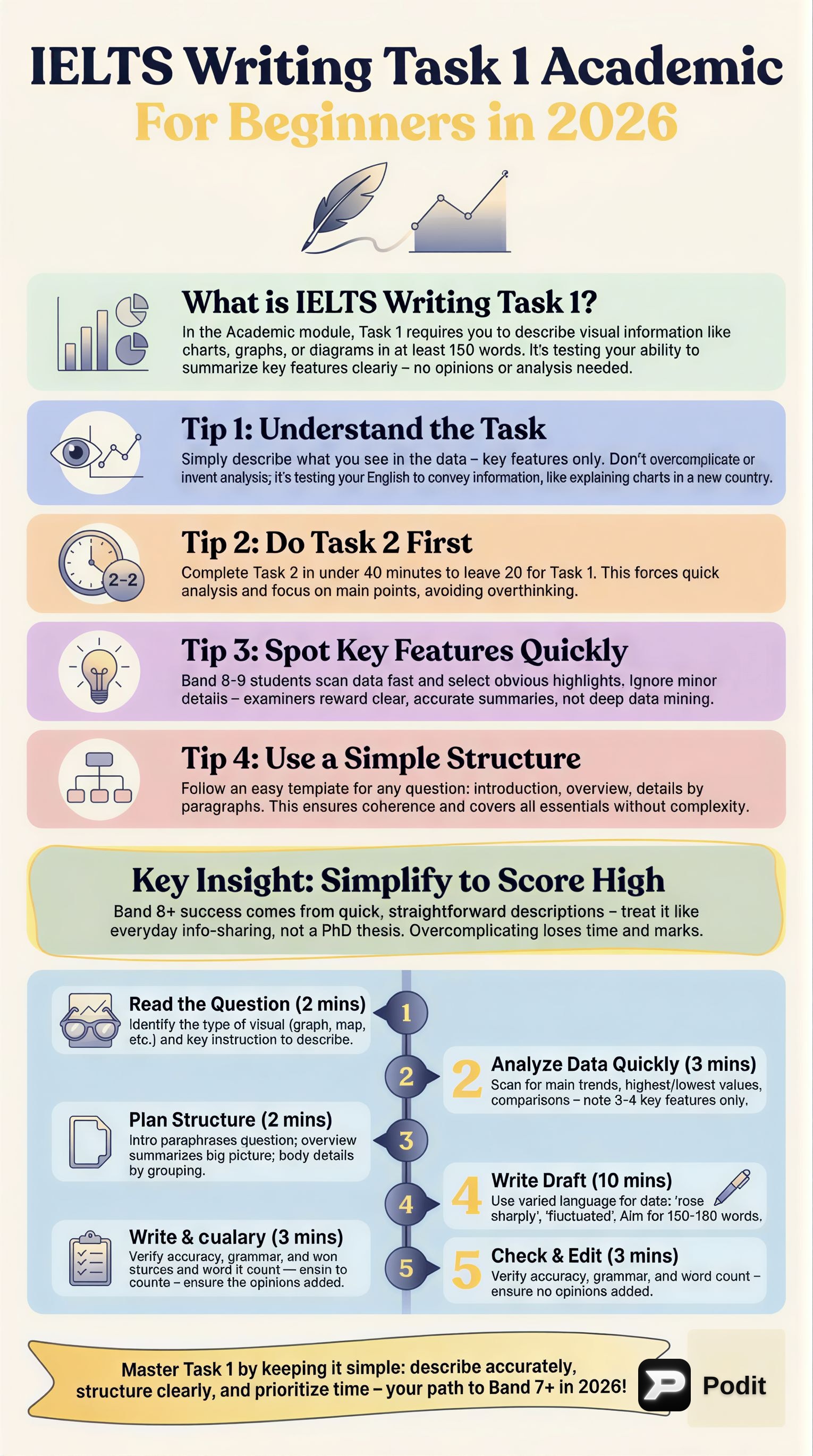
IELTS Academic Writing Task 1: A Beginner's Guide for 2026 - görsel özet infografik
Tam boyutta görüntüle →
03

Flash Kartlar

25 kart

Karta tıklayarak çevir. ← → ile gez, ⎵ ile çevir.

1 / 25
Tüm kartları metin olarak gör
  1. 1. What is the primary purpose of IELTS Academic Writing Task 1?

    IELTS Academic Writing Task 1 is designed to evaluate a candidate's ability to describe, summarize, or explain visual information. It assesses the capacity to communicate complex data objectively and formally, which is crucial for individuals pursuing higher education or professional registration in English-speaking environments.

  2. 2. For whom is IELTS Academic Writing Task 1 particularly crucial?

    IELTS Academic Writing Task 1 is particularly crucial for individuals intending to pursue higher education or professional registration in English-speaking environments. It assesses their ability to communicate complex data objectively and formally, a skill essential for academic and professional success in such settings.

  3. 3. What types of visual representations might a candidate encounter in IELTS Academic Writing Task 1?

    Candidates in IELTS Academic Writing Task 1 may encounter various visual representations. These commonly include line graphs, bar charts, pie charts, tables, maps, or process diagrams. Each type requires a specific approach to description and analysis.

  4. 4. What is the primary objective when describing information in Task 1?

    The primary objective in Task 1 is to describe the information, summarize the main trends, or explain how something operates. It is crucial to do this without introducing personal opinions or external knowledge, maintaining an objective and formal tone throughout the report.

  5. 5. What are the minimum word count and recommended time frame for IELTS Academic Writing Task 1?

    For IELTS Academic Writing Task 1, candidates are required to write a minimum of 150 words. The recommended time frame allocated for completing this task is 20 minutes. Adhering to these limits is important for managing time effectively during the exam.

  6. 6. What kind of language is expected in an IELTS Academic Writing Task 1 response?

    The language used in an IELTS Academic Writing Task 1 response must be formal and objective. Candidates should avoid contractions, informal language, and personal pronouns. The aim is to present information in an academic tone suitable for a formal report.

  7. 7. How are line graphs typically used in IELTS Academic Writing Task 1?

    Line graphs in IELTS Academic Writing Task 1 are typically used to illustrate trends over time. They show how one or more variables change across a specific period, allowing candidates to identify and describe patterns of increase, decrease, or stability.

  8. 8. What is the main function of bar charts in Task 1?

    Bar charts in Task 1 are primarily used for comparing quantities across different categories. They allow candidates to highlight differences and similarities between various data points, making it easy to identify the highest, lowest, or most significant values.

  9. 9. How do pie charts function in IELTS Academic Writing Task 1?

    Pie charts in IELTS Academic Writing Task 1 represent proportions of a whole. They show how different segments contribute to a total, often expressed as percentages. Candidates use them to describe the distribution or share of various categories within a given context.

  10. 10. What information do tables typically provide in Task 1?

    Tables in Task 1 typically provide detailed numerical data. They present information in rows and columns, offering precise figures for various categories or time points. Candidates need to select and report the most relevant data, rather than listing every single number.

  11. 11. What do process diagrams depict in IELTS Academic Writing Task 1?

    Process diagrams in IELTS Academic Writing Task 1 depict the stages of a procedure or how something operates. They illustrate a sequence of events or steps, requiring candidates to describe the process logically and clearly, often using sequential linking words.

  12. 12. What do maps typically show in Task 1?

    Maps in Task 1 typically show changes in a location over time. They present geographical information, often comparing two different periods to highlight developments, alterations, or transformations in an area. Candidates describe these spatial changes.

  13. 13. What are the four equally weighted assessment criteria for IELTS Academic Writing Task 1?

    The four equally weighted assessment criteria for IELTS Academic Writing Task 1 are Task Achievement, Coherence and Cohesion, Lexical Resource, and Grammatical Range and Accuracy. Each criterion contributes 25% to the overall score, making a balanced performance across all four essential for success.

  14. 14. Explain the Task Achievement criterion in Task 1.

    Task Achievement evaluates how well the task is addressed. This includes whether key features are identified and adequately described, if the overview is present and accurate, and if data supports the description without misrepresenting the information. It also checks if the word count is met and if the response is objective.

  15. 15. Explain the Coherence and Cohesion criterion in Task 1.

    Coherence and Cohesion focuses on the organization of ideas, appropriate paragraphing, and effective use of linking devices. It assesses how logically the report flows, how well paragraphs are structured, and if linking words and phrases are used correctly to connect sentences and ideas smoothly.

  16. 16. Explain the Lexical Resource criterion in Task 1.

    Lexical Resource assesses the range and accuracy of vocabulary used in the response. This includes appropriate word choice, the use of collocations, and the ability to paraphrase effectively. A wide and accurate vocabulary, relevant to describing data and trends, is key to a good score in this criterion.

  17. 17. Explain the Grammatical Range and Accuracy criterion in Task 1.

    Grammatical Range and Accuracy examines the variety and correctness of grammatical structures employed. It assesses the candidate's ability to use complex sentences accurately, minimize grammatical errors, and demonstrate control over sentence construction. Both range and accuracy are important for a high score.

  18. 18. What is the first stage of strategic preparation for Task 1, and how long should it take?

    The first stage of strategic preparation for Task 1 is analyzing the visual, which should take approximately five minutes. This involves identifying the visual type, understanding its representation, noting units, timeframes, and key categories. Crucially, candidates must identify the most significant features and overarching trends.

  19. 19. What key elements should candidates identify during the visual analysis stage?

    During the visual analysis stage, candidates should identify the type of visual, what it represents, units of measurement, timeframes, and key categories. Most importantly, they must pinpoint the most significant features, overarching trends, or salient comparisons that will form the core of their report.

  20. 20. What is the second stage of strategic preparation for Task 1, and how long should it take?

    The second stage of strategic preparation for Task 1 is planning the structure of the response, which should take about five minutes. This involves outlining the introduction, overview, and two to three body paragraphs. A clear plan ensures a logical and well-organized report.

  21. 21. Describe the standard structure of an IELTS Academic Writing Task 1 response.

    A standard Task 1 response structure includes an introduction, an overview, and two to three body paragraphs. The introduction paraphrases the prompt, the overview summarizes main trends without specific data, and the body paragraphs group related information with supporting data.

  22. 22. What is the purpose of the introduction in a Task 1 report?

    The purpose of the introduction in a Task 1 report is to paraphrase the prompt and state what the visual illustrates. It typically consists of one to two sentences and sets the context for the report, informing the reader about the content of the visual representation.

  23. 23. What is the purpose of the overview in a Task 1 report, and why is it vital for Task Achievement?

    The overview in a Task 1 report summarizes the main trends or most striking features without providing specific data points. It is vital for Task Achievement because it demonstrates the candidate's ability to identify and report the overall patterns, which is a key requirement of the task.

  24. 24. What kind of information should be included in the body paragraphs of a Task 1 report?

    The body paragraphs of a Task 1 report should group related information logically, providing specific data to support the overview and main points. It is crucial to select and report only the most relevant figures, employing comparative language where appropriate, rather than listing every data point.

  25. 25. What is the third stage of strategic preparation for Task 1, and how long should it take?

    The third stage of strategic preparation for Task 1 is writing the report, which should take approximately fifteen minutes. During this stage, candidates focus on maintaining a formal, academic tone, utilizing varied sentence structures, and employing a broad range of vocabulary relevant to describing data and trends.

04

Bilgini Test Et

15 soru

Çoktan seçmeli sorularla öğrendiklerini ölç. Cevap + açıklama.

Soru 1 / 15Skor: 0

What is the primary purpose of IELTS Academic Writing Task 1?

05

Detaylı Özet

4 dk okuma

Tüm konuyu derinlemesine, başlık başlık.

This content is based on a YouTube video.

📚 IELTS Academic Writing Task 1: A Beginner's Guide for 2026

Introduction to IELTS Academic Writing Task 1 📝

The International English Language Testing System (IELTS) is a globally recognized assessment of English language proficiency. For individuals aiming for higher education or professional registration in English-speaking countries, the Academic Writing module is crucial. Specifically, Task 1 evaluates your ability to describe, summarize, or explain visual information objectively and formally. This guide is designed for beginners preparing for IELTS Academic Writing Task 1 in 2026, providing a structured approach to understanding and mastering this essential component.

Understanding Task 1 Requirements and Assessment Criteria ✅

IELTS Academic Writing Task 1 presents candidates with a visual representation that needs to be described, summarized, or explained. The core objective is to report on the information without introducing personal opinions or external knowledge.

📊 Common Visual Types:

You will encounter one of the following:

  • Line Graphs: Illustrate trends and changes over time.
  • Bar Charts: Used for comparing quantities across different categories.
  • Pie Charts: Represent proportions or percentages of a whole.
  • Tables: Provide detailed numerical data.
  • Process Diagrams: Depict stages of a procedure or how something works.
  • Maps: Show changes in a location over time.

⏱️ Key Requirements:

  • Word Count: Minimum of 150 words.
  • Time Limit: Recommended 20 minutes (out of 60 minutes for both writing tasks).
  • Language: Must be formal and objective.

📈 Assessment Criteria (Each 25% of your score):

Understanding these four criteria is fundamental for effective preparation:

  1. Task Achievement:

    • Evaluates how well you address the task.
    • Checks if you identify and describe the key features of the visual.
    • Ensures data supports your description accurately.
    • Confirms you meet the minimum word count.
  2. Coherence and Cohesion:

    • Focuses on the logical organization of your ideas.
    • Assesses appropriate paragraphing.
    • Examines the effective use of linking devices (e.g., 'however,' 'therefore,' 'in contrast').
  3. Lexical Resource:

    • Measures the range and accuracy of your vocabulary.
    • Looks for appropriate word choice, collocations (words that naturally go together), and the ability to paraphrase.
    • Assesses your ability to avoid repetition.
  4. Grammatical Range and Accuracy:

    • Examines the variety and correctness of grammatical structures you employ.
    • Checks for sentence complexity (simple, compound, complex sentences).
    • Evaluates accuracy in grammar, punctuation, and spelling.

Strategic Preparation and Execution for Beginners 💡

A systematic approach is crucial for success in Task 1. Break down the process into distinct stages:

1️⃣ Stage 1: Analyze the Visual (Approx. 5 minutes)

  • Identify: What type of visual is it? (e.g., line graph, bar chart).
  • Understand: What does it represent? What are the labels, units of measurement, and timeframes?
  • Note: Identify key categories or variables.
  • Crucially, identify: The most significant features, overarching trends, or salient comparisons. These are the main points you will report.
    • Example: For a line graph, identify the highest/lowest points, periods of significant increase/decrease, or points where lines cross.

2️⃣ Stage 2: Plan the Structure (Approx. 5 minutes)

A standard structure ensures clarity and logical flow:

  • Introduction (1-2 sentences):

    • Paraphrase the prompt to state what the visual illustrates. Do not copy the prompt directly.
    • Example: "The provided bar chart illustrates the percentage of male and female students enrolled in various university courses from 2000 to 2010."
  • Overview (1-2 sentences):

    • Summarize the main trends or most striking features without providing specific data points. This is vital for Task Achievement.
    • Example: "Overall, it is evident that while female enrollment generally increased across most courses, male enrollment showed a more varied pattern, with a notable decline in arts subjects."
  • Body Paragraphs (2-3 paragraphs):

    • Group related information logically.
    • Provide specific data to support the overview and main points identified in Stage 1.
    • Do not list every data point. Select and report only the most relevant figures.
    • Employ comparative language where appropriate (e.g., 'significantly higher than,' 'in contrast to,' 'whereas').
    • Example (Body Paragraph 1): "Looking at engineering, male student numbers consistently remained higher than female students throughout the period, peaking at 60% in 2005. Conversely, female enrollment in engineering, though lower, saw a steady rise from 10% to 25%."

3️⃣ Stage 3: Write the Report (Approx. 15 minutes)

  • Tone: Maintain a formal, academic tone.
  • Vocabulary: Utilize a variety of sentence structures and a broad range of vocabulary relevant to describing data and trends (e.g., 'fluctuated,' 'plummeted,' 'soared,' 'remained stable').
  • Linking Words: Employ appropriate linking words and phrases for smooth transitions (e.g., 'in contrast,' 'subsequently,' 'furthermore,' 'however,' 'meanwhile').
  • Grammar: Ensure grammatical accuracy. Avoid contractions (e.g., 'don't'), informal language, and personal pronouns (e.g., 'I think').

4️⃣ Stage 4: Review and Edit (Approx. 5 minutes)

This final stage is critical for polishing your response:

  • Check for: Grammatical errors, spelling mistakes, and punctuation inaccuracies.
  • Verify: That the word count meets the minimum 150 words.
  • Ensure: All key features identified during planning have been adequately addressed.
  • Confirm: The report is clear, coherent, and easy to understand.

Key Takeaways for Success in 2026 🎯

Success in IELTS Academic Writing Task 1 for beginners hinges on a structured and disciplined approach.

  • Understand Requirements: Master the specific requirements, visual types, and the four assessment criteria.
  • Strategic Preparation: Meticulously analyze visuals, plan your report's structure, and execute your writing precisely.
  • Objective Reporting: Emphasize formal language, objective reporting, and accurate data interpretation.
  • Consistent Practice: Regularly practice with diverse visual representations.
  • Vocabulary Enhancement: Focus on expanding your vocabulary for describing trends and making comparisons.

By adhering to these principles, beginners can systematically develop the necessary skills to excel in this critical component of the IELTS examination and achieve a high band score.
Kendi çalışma materyalini oluştur

PDF, YouTube videosu veya herhangi bir konuyu dakikalar içinde podcast, özet, flash kart ve quiz'e dönüştür. 1.000.000+ kullanıcı tercih ediyor.

Sıradaki Konular

Tümünü keşfet
Introduction to Geography for KPSS Examination

Introduction to Geography for KPSS Examination

This summary provides a formal academic overview of introductory geography, covering its fundamental concepts, branches, and key principles relevant for the KPSS examination.

5 dk Özet 25 15 Görsel
KPSS & AGS Mathematics: Basic Operations 1

KPSS & AGS Mathematics: Basic Operations 1

An academic overview of foundational mathematical operations, specifically 'Temel İşlemler 1,' within the context of the Turkish KPSS and AGS national examinations.

7 dk Özet 25 15
Key Algebraic Concepts for Examination

Key Algebraic Concepts for Examination

This summary outlines essential algebraic concepts for an examination, including operations with radicals, algebraic identities, various equation types, and methods for solving and representing inequalities.

5 dk Özet 25
KPSS & AGS Mathematics: Basic Operations Fundamentals

KPSS & AGS Mathematics: Basic Operations Fundamentals

An academic summary of foundational mathematical operations crucial for the KPSS and AGS examinations, focusing on core concepts and their application in competitive exam settings.

6 dk Özet 25 15
Master Your A2 English Exit Exam

Master Your A2 English Exit Exam

Prepare for your A2 English exit exam with this comprehensive guide. Learn about the A2 level, exam structure, key grammar, vocabulary, and practical tips for success in reading, writing, listening, and speaking.

5 dk Özet 25 15
Enhancing Success with Evolve Student Resources for NGN

Enhancing Success with Evolve Student Resources for NGN

Discover how Evolve Student Resources can deepen your understanding, prepare you for the Next Generation NCLEX (NGN), and boost your overall academic success.

4 dk Özet 25 15
Mastering Data Description: Analyzing Trends in Charts and Graphs

Mastering Data Description: Analyzing Trends in Charts and Graphs

Learn to effectively describe trends and changes in data using precise vocabulary, comparatives, superlatives, and linking words, with examples from consumption and population growth data.

6 dk Özet 25 15
Mastering C2 English: 10 Advanced Words for You

Mastering C2 English: 10 Advanced Words for You

Ready to elevate your English? Join me as we explore 10 powerful C2-level words, complete with clear definitions and practical examples to boost your vocabulary and communication skills.

5 dk Özet 25