 Podit
Podit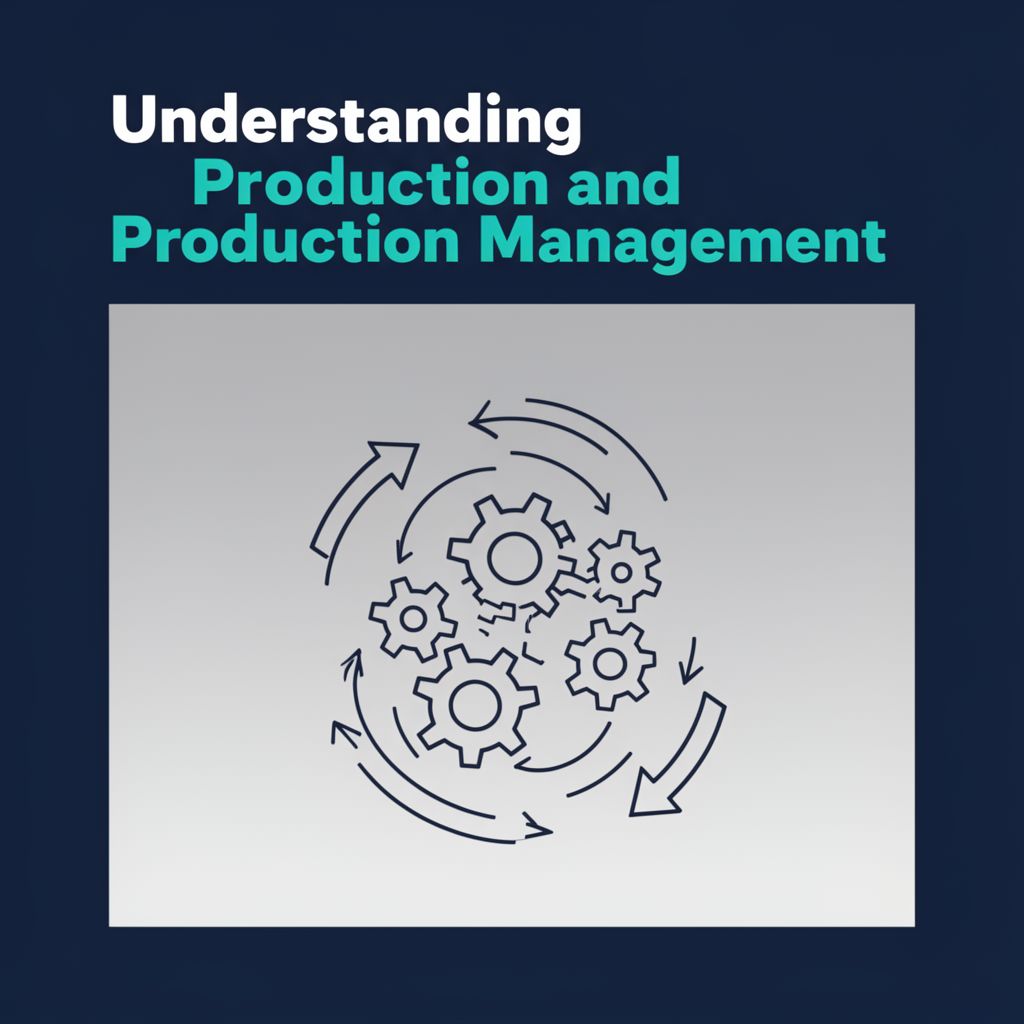
📚 Production and Production Management Study Guide
Source Information: This study material has been compiled from a lecture audio transcript and copy-pasted text provided by the user.
🎯 Introduction to Production and Production Management
Production is a fundamental economic activity that transforms inputs into outputs (goods and services). Production management focuses on effectively planning, organizing, and controlling these processes to achieve organizational goals. This guide will cover key concepts, relationships with other business functions, production types, cost analysis, capacity planning, and other essential operations within a production system.
1. 📚 The Production Function
The production function is a mathematical model that describes the technical relationship between the inputs (production factors) used and the outputs (goods and services) produced over a specific period.
- Inputs (Production Factors) include:
- Labor (Emek)
- Capital (Sermaye)
- Land (Toprak)
- Technology (Teknoloji)
- Entrepreneurship (Girişimcilik)
- Economic Perspective:
- Measures the efficiency and productivity of the production process.
- Optimizes resource allocation.
- Examines returns to scale.
- Indicates the optimal combination of inputs for maximum output.
- Importance: The production department is often the most critical section of an enterprise structured for producing goods or services.
2. 💡 Production and Production Management Concepts
Production is the process of transforming production factors through a series of physical, chemical, technological, and economic changes to obtain finished products or services.
- Scope of Production:
- Traditionally associated with manufacturing physical goods.
- Modern View: Encompasses both the manufacturing of goods and the provision of services.
- Transformation Process:
- Inputs (Girdiler): Raw materials, labor, machinery, tools, buildings, capital, management.
- Production Process (Üretim Süreci): Transformation, value addition.
- Outputs (Çıktılar): Finished products (Mamul Maddeler).
3. ✅ Relationship with Other Business Functions
Production does not operate in isolation; it has critical interdependencies with other core business functions.
-
Marketing and Production Relationship:
- Marketing's Role: Identifies customer needs and expectations, guiding production.
- Production's Role: Uses marketing insights for product planning, design, features, and pricing.
- Coordination Benefits: Reduces inventory costs, shortens delivery times, increases customer satisfaction.
-
Finance and Production Relationship:
- Finance's Role: Provides necessary resources and controls costs for production.
- Capital Intensity: Production often requires significant capital investment. Finance plans investments and working capital.
- Cost Analysis: Production cost analysis is crucial for profitability and expense reduction.
-
Human Resources (HR) and Production Relationship:
- HR's Role: Responsible for recruitment, training, and management of production employees.
- Workforce Quality: Ensures a skilled and motivated workforce, vital for production efficiency and quality.
- Collaboration Benefits: Important for employee safety, working conditions, and performance evaluations.
-
Research and Development (R&D) and Production Relationship:
- R&D's Role: Designs new products and improves existing ones.
- Integration: Ensures innovative products are manufactured with high quality and low cost.
- Competitive Advantage: Integrating technological innovations enhances the enterprise's competitive edge.
4. 🏭 Production Types
Production types classify processes based on customer demand, production volume, and methods to optimize resource management.
4.1. Classification by Production Quantity or Flow
-
Job Order Production (Siparişe Dayalı Üretim):
- Description: Produces goods with specific characteristics (time, quantity, quality) determined by individual customer orders.
- Example: Custom-made furniture, specialized machinery.
-
Continuous Production (Sürekli Üretim):
- Description: Tools, machinery, and facilities are dedicated to producing one or a few specific products continuously.
- Characteristics: High volume, low variety, standardized products.
- Example: Oil refining, electricity generation.
-
Batch Production (Parti Üretimi):
- Description: Produces a product in larger, yet specific, quantities (batches) to meet special orders or continuous demand.
- Characteristics: Medium volume, moderate variety.
- Example: Bakery products, pharmaceuticals.
4.2. Classification by Intermittency
| Feature | Intermittent Production (Kesikli Üretim) | Continuous Production (Kesiksiz Üretim) | | :---------------------- | :--------------------------------------------------------------------- | :--------------------------------------------------------------------- | | Production Quantity | Low quantity, high product variety. | High quantity, low product variety. | | Stock Levels | Requires more stock of raw materials, semi-finished goods. | Generally requires less stock. | | Labor Skill | Requires a higher proportion of skilled labor. | Requires adequate and fewer highly skilled personnel. | | Tools & Machinery | Multi-purpose. | Generally designed for specific purposes. | | Production Capacity | Flexible; capacity can be increased through various means. | Less flexible; increasing capacity often requires changing the entire system. | | Job Order/Workload | Higher intensity, but simpler preparation activities. | Lower intensity, but more complex preparation activities. |
5. 📊 Production Planning and Control
5.1. Production Planning
📚 Definition: The activity of pre-determining and organizing production processes, including what, how much, with what resources, and when products will be produced.
🎯 Objectives:
- Produce demanded products on time and in correct quantities.
- Ensure efficient use of resources (labor, material, machinery).
- Reduce costs and increase profitability.
- Optimize inventory levels.
📈 Types of Production Planning:
- Long-Term Planning: Strategic goals, capacity expansion, facility investments.
- Medium-Term Planning: Annual/monthly production targets, material supply plans.
- Short-Term Planning: Daily/weekly work plans and scheduling.
5.2. Production Control
📚 Definition: A process that monitors the implementation of production plans, identifies deviations, and takes necessary corrective measures.
🎯 Objectives:
- Ensure timely completion of planned production.
- Confirm effective resource utilization.
- Prevent errors and delays.
- Maintain quality standards.
1️⃣ Stages of Production Control:
- Monitoring: Continuous tracking of production activities and identifying differences between actual and planned production.
- Comparison: Comparing actual production data with plans and standards.
- Deviation Detection: Identifying problems (e.g., delays, quality issues) in production processes.
- Corrective Activities: Implementing necessary changes to eliminate the causes of deviations.
6. 💰 Production Costs and Capacity Planning
6.1. Production Costs
Enterprise managers face decisions regarding location, layout, product types, technology, capacity, personnel, equipment, quality standards, and investments, all of which impact costs.
Elements Constituting Production Costs:
- Material cost
- Direct cost
- Factory cost
- Total cost
- Sales revenues
Cost Classification:
-
Fixed Costs (Sabit Maliyetler):
- Definition: Costs that do not change with the level of production.
- Examples: Depreciation, long-term labor, fixed portion of general manufacturing expenses, fixed management/marketing expenses, financial expenses, property taxes, insurance, rent.
- Formula Component: FC in TC = FC + VC(Q).
-
Variable Costs (Değişken Maliyetler):
- Definition: Expenses that increase or decrease depending on the production volume. Not incurred if there is no production.
- Examples: Raw materials, energy, direct labor per unit, variable portions of management/marketing/other expenses.
- Formula Component: VC(Q) in TC = FC + VC(Q).
-
Total Costs (Toplam Maliyetler):
- Definition: The sum of fixed and variable costs. Increases with production volume.
- Formula: TM = F + VX (where TM = Total Cost, F = Fixed Cost, V = Variable Cost per unit, X = Quantity).
-
Average Cost (Ortalama Maliyet):
- Definition: Total expenses divided by the quantity of goods/services produced.
- Formula: OM = TM / X (where OM = Average Cost).
- Behavior: Unit costs generally decrease as production quantity increases up to a certain point, then may rise.
-
Marginal Cost (Marjinal Maliyet):
- Definition: The cost of producing the last unit (or batch) of output.
- Formula: MM = ΔS + ΔD (Marginal Fixed Cost + Marginal Variable Cost).
-
Sales Revenue (Satış Hasılatı):
- Definition: Income generated from sales, firms aim to maximize it.
- Formula: SH = P × X (where SH = Sales Revenue, P = Price per unit, X = Quantity Sold).
💡 Example: Olive Oil Production Cost Calculation
-
Scenario: Producing 100,000 units, selling at 50 TL/unit.
- Fixed Costs (F): 1,400,000 TL
- Variable Costs (VC): 2,600,000 TL
- Total Revenue (SH): 50 TL * 100,000 = 5,000,000 TL
- Total Costs (TM): 1,400,000 + 2,600,000 = 4,000,000 TL
- Sales Profit (SK): 5,000,000 - 4,000,000 = 1,000,000 TL
-
Scenario: Additional 10,000 units produced
- Fixed costs are already incurred, so marginal fixed cost for additional units is 0.
- Variable cost per unit: 2,600,000 TL / 100,000 units = 26 TL/unit
- Marginal Cost (MM) for 10,000 units: 0 + (26 TL/unit * 10,000 units) = 260,000 TL
- New Total Costs: 4,000,000 + 260,000 = 4,260,000 TL
- New Total Quantity: 100,000 + 10,000 = 110,000 units
- New Unit Cost (BM): 4,260,000 / 110,000 = 38.73 TL/unit (approx.)
💡 Example: Drying Machine Operating Costs This example illustrates calculating machine operating costs, considering factors like labor, maintenance, and energy, and how they contribute to unit costs. (Detailed calculations are provided in the source material for specific machine capacities).
General and Administrative Costs: These are indirect costs not directly related to production but essential for business operations.
- Factory: Maintenance, depreciation (machinery/building), insurance, property taxes, indirect labor, auxiliary facilities.
- Administrative Offices: Depreciation (management/office buildings/equipment), fees, corporate tax, office insurance, transportation, communication.
- Sales Department: Salaries (managers/personnel), rent, insurance, depreciation, maintenance (office/equipment), transportation, travel, advertising, promotion, communication, fair/exhibition expenses.
6.2. Capacity Planning
📚 Definition: The production rate or quantity over a specific period. Capacity and its utilization are influenced by various factors.
Factors Influencing Capacity: Location, factory design, costs, market demand, capital, machinery, technology, raw materials, management, labor, environmental conditions.
Key Capacity Concepts:
-
Planned (Theoretical) or Maximum Capacity:
- Description: The highest production volume desired based on technical calculations, often unattainable in practice. Represents maximum output under ideal conditions.
-
Actual (Practical) Capacity:
- Description: The production quantity achievable under normal circumstances, accounting for acceptable delays without undue strain. Considers internal (e.g., financial difficulties, maintenance) and external (e.g., macroeconomic, social) disruptions.
-
Marketing Capacity:
- Description: Evaluates the extent to which produced goods are sold.
- Calculation: (Marketed Production / Actual Capacity) × 100.
- Example: If actual capacity is 50,000 units and 40,000 units are sold, marketing capacity is (40,000 / 50,000) × 100 = 80%.
-
Idle (Slack) Capacity:
- Description: The unused portion of planned or practical capacity. The ideal scenario for a firm is zero or minimal idle capacity.
-
Optimal Capacity:
- Description: The most realistic and valid capacity type; the production quantity best suited to the enterprise's structure, size, and objectives.
7. 📈 Cost-Volume-Profit (CVP) Analysis (Break-Even Analysis)
📚 Definition: Determines the activity level where a firm's total expenses equal its total revenues (the break-even point). Above this point, the firm makes a profit; below it, a loss.
Assumptions for Simplified Analysis:
- Total annual expenses are a linear function of production quantity.
Formulas:
- Total Expenses (TM): TM = VX + F
- V: Variable cost per unit
- X: Production quantity
- F: Fixed costs
- Sales Revenue (SH): SH = PX
- P: Unit price
- Break-Even Point (BEP) - Quantity (X): At BEP, Total Expenses = Sales Revenue (F + VX = PX)
- X = F / (P - V) (Quantity to be sold to reach BEP)
- Break-Even Point - Price (P):
- P = F/X + V (Unit sales price at BEP)
💡 Example: Canned Vegetable Production Break-Even Point
- Variable costs (V): 60 units/ton
- Sales price (P): 130 units/ton
- Total Fixed Costs (F): 250,000 units
- Break-Even Quantity (X): X = 250,000 / (130 - 60) = 250,000 / 70 = 3571.4 tons/year
- This facility needs to produce and sell at least 3571.4 tons annually to cover all costs.
Profit Calculation using Contribution Margin:
- Profit (P) = C - F
- C: Total Sales × Contribution Margin (%)
- Example: Total sales = 800,000 TL, Contribution Margin = 40%, Fixed Costs = 300,000 TL
- C = 800,000 × 0.40 = 320,000 TL
- P = 320,000 - 300,000 = 20,000 TL
Multiple Products Break-Even Analysis:
- When firms produce multiple products, a single product BEP analysis is insufficient.
- It requires calculating a "weighted average contribution margin" based on the prices and variable costs of all products.
8. ⚙️ Other Main Operations in a Production System
8.1. Project Management and Control
- Definition: Involves planning, executing, controlling, and closing processes to achieve specific goals, ensuring effective management of time, cost, and resources.
- Project Management Phases: Project definition, planning, organization, execution, and closure.
- Project managers assign tasks, analyze risks, and manage communication.
- Project Control: Monitoring and evaluating the project process, detecting deviations, and taking corrective actions.
8.2. Factory Layout (Tesis Yerleşim Düzeni)
- Definition: Determining the placement of all activities within production facilities and arranging tools, machinery, and equipment within the existing area.
- Primary Goal: Efficiently organize labor, materials, and equipment to optimize workflow.
- Benefits: Reduces material movement, optimizes production flow, lowers costs, reduces waste, increases worker productivity, improves product quality, enhances occupational safety and ergonomics.
8.3. Quality Control (Kalite Kontrolü)
- Definition: A set of activities and processes to ensure products and processes comply with specific quality standards throughout the production system.
- Purpose: Monitor, evaluate, and improve product/service quality at every stage.
- Objectives: Assure product quality, increase customer satisfaction, prevent costly errors.
- Process: Involves sampling and testing products at various stages to evaluate characteristics, durability, safety, and compliance.
8.4. Maintenance (Bakım)
- Definition: Activities performed to sustain the functionality of machines, equipment, and facilities within production systems.
- Critical Importance: Ensures uninterrupted and efficient production processes.
- Benefits:
- Efficiency: Ensures machines operate effectively, preventing disruptions.
- Cost Control: Prevents breakdowns, reduces costly downtime and maintenance expenses.
- Safety: Reduces risk of accidents caused by faulty equipment, increasing worker safety.
Types of Maintenance:
-
Periodic (Planned) Maintenance:
- Description: Regular maintenance performed at fixed intervals (e.g., based on usage or age).
- Purpose: Extends equipment life, prevents breakdowns.
- Activities: Lubrication, cleaning, part replacement.
-
Predictive (Condition-Based) Maintenance:
- Description: Uses sensors, data analytics, and technology to predict equipment failure in advance.
- Purpose: Proactive intervention before failure occurs.
-
Breakdown (Corrective) Maintenance:
- Description: Unplanned maintenance performed after equipment failure.
- Nature: Urgent intervention to repair faults or replace damaged parts.