Podit
Podit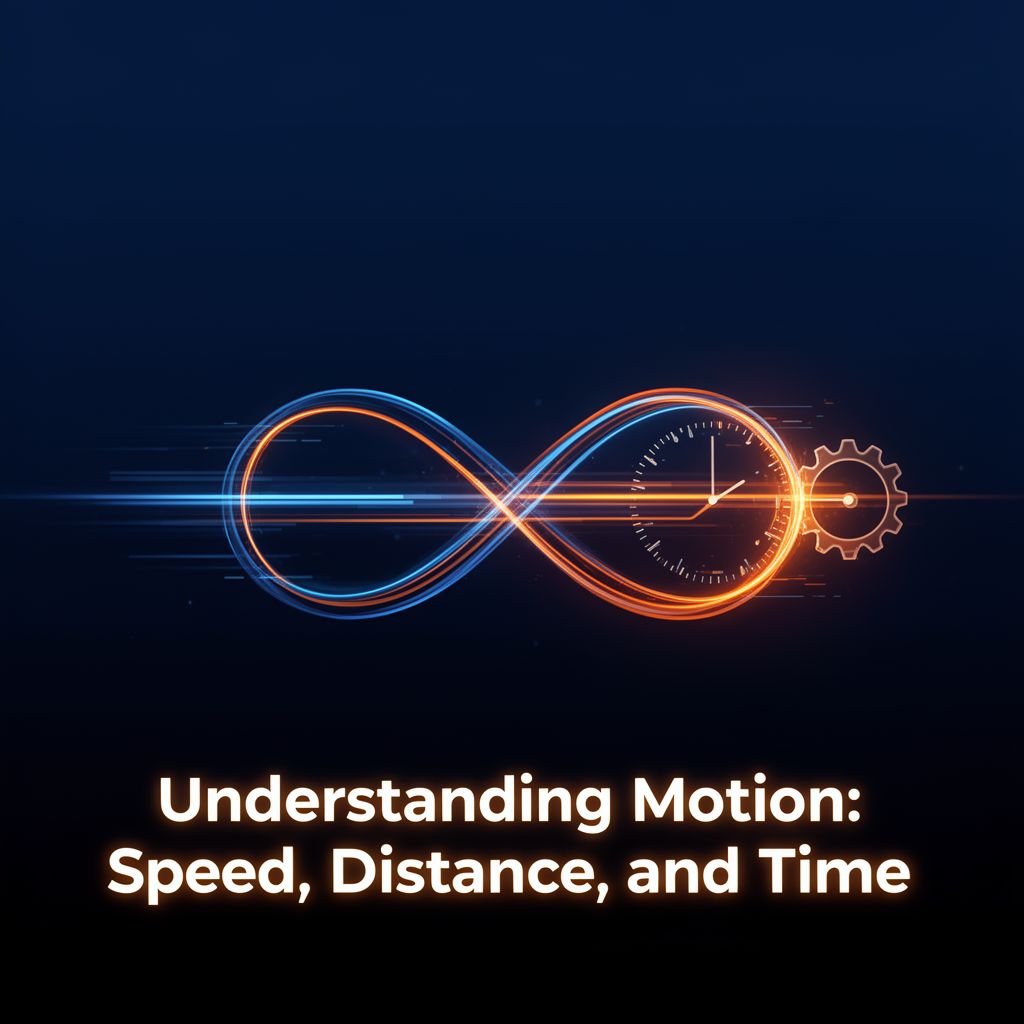
📚 Motion: Speed, Distance, and Time
Source Information: This study material has been compiled from a lecture audio transcript focusing on the fundamental concepts of motion.
🚀 Introduction to the Fundamentals of Motion
Understanding how objects move is a foundational concept in physics, crucial for comprehending the world around us. Every form of movement, from microscopic vibrations to planetary orbits, involves motion. To accurately describe and predict these movements, we rely on three interconnected concepts: distance, time, and speed. This guide will provide a clear and comprehensive understanding of these basic principles, explaining their individual significance and their intrinsic links, which form the bedrock of kinematics.
1️⃣ Defining Motion and Distance
📚 What is Motion?
Motion is fundamentally defined as a change in an object's position over a period of time. ✅ For an object to be considered in motion, its location must shift relative to a reference point. Without a reference point, motion cannot be definitively determined.
- Example: If you are sitting on a train, you are stationary relative to the train car, but you are in motion relative to the ground outside.
📏 Understanding Distance
Distance quantifies how much an object has moved.
- Definition: Distance is a scalar quantity, meaning it only has magnitude (a numerical value) and no direction.
- Concept: It represents the total length of the path covered by an object during its movement, regardless of the starting or ending points.
- Example: If you walk 5 meters forward and then 3 meters backward, the total distance covered is 8 meters.
- ⚠️ Important Note: Distance should not be confused with displacement, which is the straight-line distance from the starting point to the ending point, including direction. For this study, we focus solely on total path length.
- Common Units: Meters (m), kilometers (km), miles (mi).
2️⃣ Understanding Time
⏳ What is Time?
Time is a fundamental physical quantity that measures the duration of events and the intervals between them.
- Definition: Like distance, time is a scalar quantity, possessing only magnitude.
- Role in Motion: Time provides the essential framework within which motion occurs; without a duration, there can be no change in position.
- Standard Units: The standard unit in the International System of Units (SI) is the second (s). Minutes (min) and hours (h) are also commonly used.
3️⃣ Understanding Speed
⚡ What is Speed?
Speed is one of the most intuitive ways we describe motion, telling us how quickly an object is moving.
- Definition: Speed is the rate at which an object covers distance.
- Formula: Speed is calculated by dividing the total distance traveled by the total time taken.
Speed = Distance / Time - Quantity Type: Speed is also a scalar quantity, meaning it describes only how fast an object is moving, not the direction of its movement.
- Example: A car traveling at 60 kilometers per hour (km/h) has a speed of 60 km/h, regardless of whether it's heading north or south.
- Types of Speed:
- Average Speed: The total distance divided by the total time for an entire journey.
- Instantaneous Speed: The speed of an object at a particular moment in time.
- Common Units: Meters per second (m/s), kilometers per hour (km/h), miles per hour (mph).
4️⃣ The Interconnected Relationship: Distance, Speed, and Time
These three quantities are inextricably linked, forming the bedrock of kinematics. The relationship is elegantly expressed by the formula:
Speed (S) = Distance (D) / Time (T)
This fundamental equation can be rearranged to solve for any of the three variables if the other two are known:
- ✅ To find Distance:
Distance (D) = Speed (S) × Time (T) - ✅ To find Time:
Time (T) = Distance (D) / Speed (S)
💡 This versatility makes these concepts incredibly powerful for analyzing various scenarios of motion.
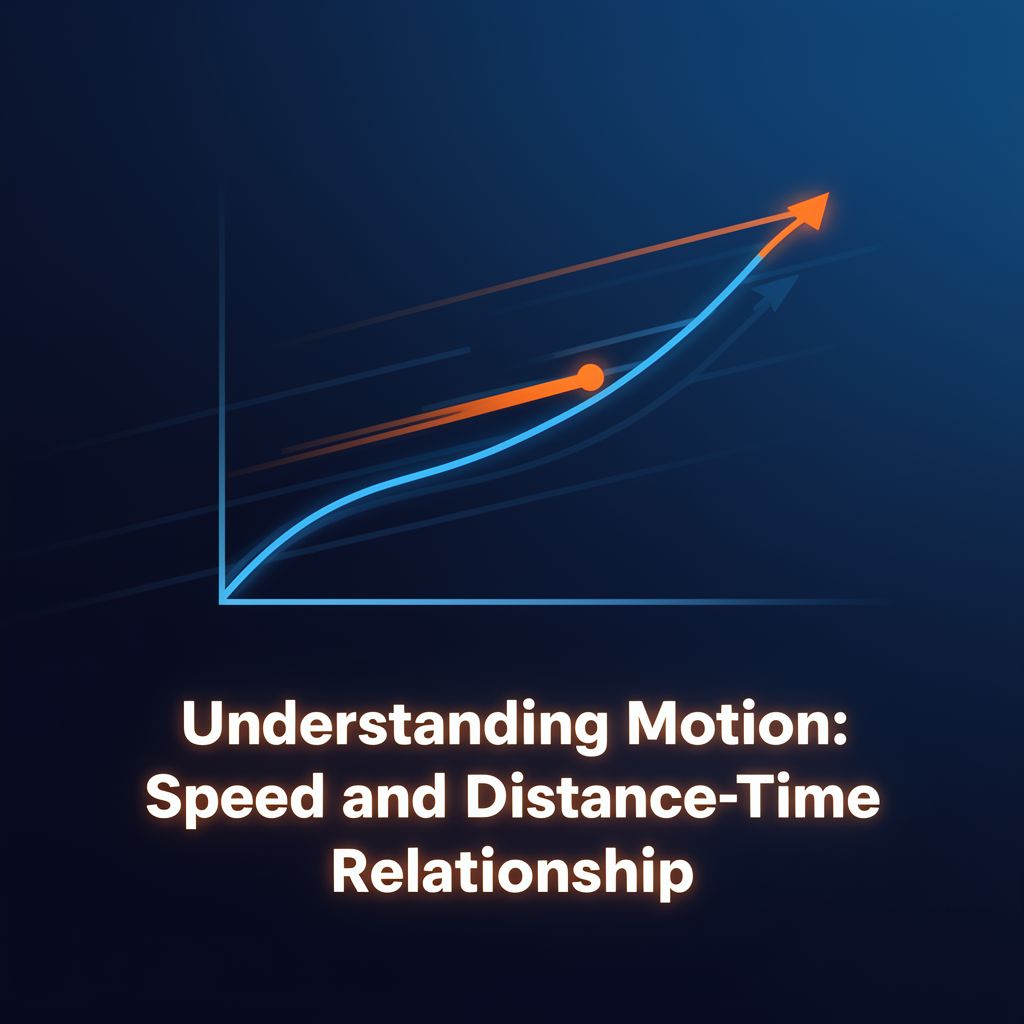
5️⃣ Visualizing Motion: Distance-Time Graphs
A particularly insightful way to visualize the relationship between distance, speed, and time is through a distance-time graph.
- Axes:
- Horizontal (x-axis): Represents Time (T)
- Vertical (y-axis): Represents Distance (D)
- Slope Interpretation 📊:
- The slope of the line on a distance-time graph directly represents the object's speed.
- Steeper Slope: Indicates a higher speed (more distance covered in less time).
- Horizontal Line (Slope = 0): Signifies that the object is stationary (its distance from the reference point is not changing over time, implying zero speed).
- Straight, Upward-Sloping Line: Indicates constant speed.
- Curved Line: Suggests that the speed is changing, indicating acceleration (speeding up) or deceleration (slowing down).
Understanding how to interpret these graphs provides a powerful visual tool for comprehending the dynamics of motion and the interplay between distance, speed, and time.
6️⃣ Conclusion: The Pillars of Motion Analysis
In summary, motion is a change in position relative to a reference point. Distance quantifies the total path length covered, time provides the duration, and speed measures the rate at which distance is covered per unit of time. The fundamental relationship, Speed = Distance / Time, allows us to calculate any of these variables given the other two, making them indispensable tools in physics. Furthermore, distance-time graphs offer a visual representation where the slope indicates speed. These concepts are not just academic exercises; they are the fundamental pillars upon which our understanding of movement in the physical world is built, from everyday travel to complex astrophysical phenomena. Mastering these basics is the first step towards unlocking deeper insights into the mechanics of our universe.