Podit
Podit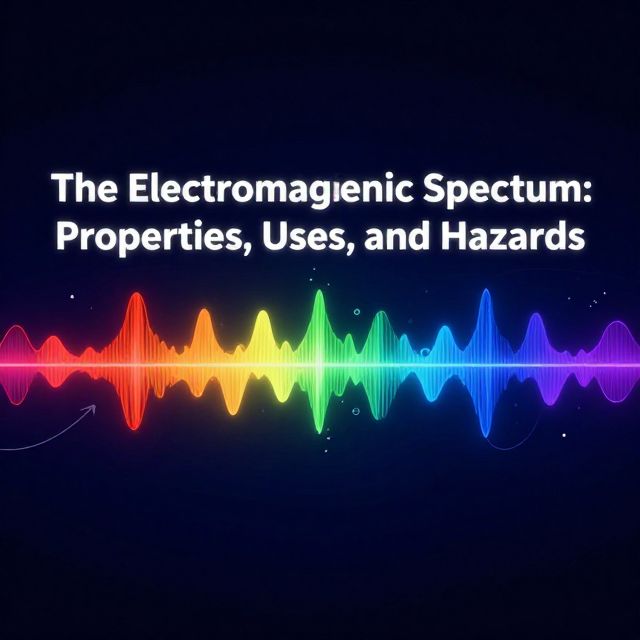
📚 Electromagnetic Spectrum: A Comprehensive Study Guide
This study material has been compiled and organized from various sources, including copy-pasted text and a lecture audio transcript, to provide a clear and structured overview of the Electromagnetic Spectrum.
1. Introduction to the Electromagnetic Spectrum 💡
The Electromagnetic (EM) Spectrum encompasses a continuous range of electromagnetic waves, which are a form of energy that travels through space. These waves are fundamental to our understanding of the universe and underpin much of modern technology. This guide will explore their discovery, properties, diverse applications, and associated hazards.
2. Discovery of Electromagnetic Waves 🔭
The existence of invisible electromagnetic radiation was first hinted at through experiments with light and heat.
-
Infrared Radiation (Thermal Radiation):
- Discoverer: William Herschel, an astronomer.
- Method: Herschel used a prism to split sunlight into its spectrum. He then placed thermometers at different points across the spectrum.
- Observation: He noticed that the thermometer reading increased when light fell on it, indicating energy absorption and a heating effect. Crucially, this effect was greatest beyond the red end of the visible spectrum and smallest for violet light.
- Conclusion: Herschel deduced the presence of an invisible form of radiation, which he named infrared radiation, responsible for this thermal effect. It's the heat we feel radiating from hot objects.
-
Ultraviolet Radiation:
- Discoverer: German scientist Johan Ritter.
- Method: Inspired by Herschel's discovery, Ritter investigated beyond the violet end of the spectrum.
- Observation: He found another invisible form of radiation, which he called ultraviolet (meaning "beyond violet").
- Connection: Experiments later suggested a link between infrared, visible, and ultraviolet radiation. Hotter objects emit more radiation from the higher-frequency (hotter) end of the spectrum, while cooler objects emit more from the lower-frequency (cooler) end.
3. Fundamental Properties of Electromagnetic Waves ✅
Electromagnetic waves are a family of transverse waves that share several key characteristics:
- Transverse Nature: All EM waves are transverse, meaning their oscillations are perpendicular to the direction of wave propagation.
- Travel Through Vacuum: They can all travel through a vacuum, unlike sound waves which require a medium.
- Constant Speed in Vacuum: All EM waves travel at the same speed in a vacuum, known as the speed of light (c), which is approximately 3 x 10⁸ m/s. This speed also applies to air.
- Medium Dependence: The speed of electromagnetic waves depends on the material through which they are traveling.
- Wave Phenomena: Like all waves, they can be:
- Reflected: Bouncing off a surface.
- Refracted: Bending as they pass from one medium to another.
- Diffracted: Spreading out as they pass through an opening or around an obstacle.
- Frequency and Wavelength: They have different frequencies and wavelengths, which determine their energy and how they interact with materials.
4. Wavelength and Frequency Relationship 📊
Wavelength (λ) and frequency (f) are inversely related for EM waves traveling at a constant speed (c): c = λf.
- Red Light vs. Violet Light Example:
- Red light has a greater wavelength than violet light.
- Violet light has a greater frequency than red light.
- Both travel at the same speed in a given medium. This means higher frequency corresponds to shorter wavelength, and vice-versa.
5. Components of the Electromagnetic Spectrum 🌈
The continuous electromagnetic spectrum is arranged in a specific order based on wavelength (decreasing) or frequency (increasing). The main groupings are:
- Radio waves
- Microwaves
- Infrared
- Visible Light (Red, Orange, Yellow, Green, Blue, Indigo, Violet)
- Ultraviolet
- X-rays
- Gamma rays
6. Uses of Electromagnetic Waves 📡
Each part of the EM spectrum has unique properties that make it suitable for specific applications:
-
Radio Waves:
- Broadcasting: Used for radio and television signals.
- Radio Astronomy: Detects radio waves from celestial objects like stars, galaxies, and black holes.
- RFID: Radio Frequency Identification chips (microchips under the skin) store medical information.
-
Microwaves:
- Satellite Communication: Used for satellite television broadcasting as they pass easily through Earth's atmosphere.
- Cell Phone Signals: Transmit mobile phone communications.
- Microwave Ovens: Heat food by causing water molecules to absorb microwave energy.
-
Infrared Radiation:
- Remote Controls: Used in devices like televisions to change channels or volume.
- Medical Applications: Detects heat (indicating infection), speeds up healing, and reduces pain.
- Optical Fibers: Used in high-speed internet and cable television.
-
Visible Light:
- Vision: Provides information about the world through our eyes.
- Optical Instruments: Used in cameras, telescopes, and microscopes.
- Photosynthesis: Vital for plant life.
- Optical Fibers: Used in high-speed internet and cable television.
-
Ultraviolet (UV) Light:
- Forensics: Causes some chemicals (e.g., body fluids like sweat and saliva) to emit visible light.
- Sterilization: Destroys DNA in bacteria and viruses, used to sterilize water.
-
X-rays:
- Security Scanners: Penetrate solid materials, used in airport security.
- Medical Imaging: Used in hospitals to see inside patients without surgery.
-
Gamma Rays:
- Cancer Treatment: Targeted beams can kill cancerous cells.
- Sterilization: Sterilize surgical instruments by killing bacteria.
- Cancer Detection: Used in certain diagnostic procedures.
7. Electromagnetic Hazards ⚠️
While useful, all forms of electromagnetic radiation can be hazardous, with the potential for harm generally increasing with frequency.
- Infrared Radiation: Can cause burns due to its heating effect.
- Ultraviolet (UV) Radiation:
- From the Sun, it can damage skin cells, leading to sunburn and skin cancer.
- Can damage eye cells, necessitating eye protection (sunglasses, hats) in bright sunlight.
- X-rays and Gamma Rays:
- These are the most dangerous parts of the spectrum due to their high frequency and energy.
- They can cause mutations in DNA, which may lead to cancer.
- Longer Waves (Microwaves, Radio Waves):
- Generally much less harmful than high-frequency waves.
- However, widespread use (e.g., mobile phones) leads to greater exposure.
- Research on mobile phone use has primarily found only a slight heating effect, not currently believed to be harmful, though prolonged use could increase any potential effects.
8. Communicating Using EM Waves 📞
Electromagnetic waves are the backbone of modern communication systems.
8.1 Satellites 🛰️
Artificial satellites orbit Earth and primarily use microwaves for transmitting information.
-
Geostationary Satellites:
- Orbit: Above the Earth’s equator.
- Height: Approximately 36,000 km above the surface.
- Orbital Period: 24 hours, matching Earth's rotation, making them appear stationary from the ground.
- Use: Ideal for continuous radio and telecommunication broadcasting globally due to their high, fixed position.
-
Low Earth Orbit (LEO) Satellites:
- Orbit: Much closer to Earth, as low as 2,000 km above the surface.
- Orbital Period: Around 2 hours.
- Coverage: Cover a smaller area of Earth's surface at any given time.
- Advantage: Minimal delay in conversation due to closer proximity.
- Limitation: Cannot transmit data as fast as geostationary satellites and are less suitable for continuous television broadcasting.
8.2 The Right Wave for the Job 💡
Different EM waves are chosen for specific communication needs:
- Microwaves: Used for mobile phones and wireless internet.
- Radio Waves: Used for short-range communication like Bluetooth.
- Infrared Radiation & Visible Light: Used in optical fibers for cable television and high-speed internet. These waves have higher frequencies and can carry more data.
8.3 Analogue and Digital Signals 🔢
Communication relies on two types of signals:
-
Analogue Signals:
- Vary continuously.
- Can take any value within a range.
-
Digital Signals:
- Can only take one of two discrete states.
- Typically represented as 1s and 0s, highs and lows, or ons and offs.
8.4 Making a Digital Phone Call 📞
- Encoding: An analogue sound wave from the caller is converted into a series of digital pulses by a converter.
- Transmission: The digital signal travels along optical fibers using visible light pulses or infrared waves.
- Regeneration: The signal passes through regenerators that clean up any distortion, ensuring signal integrity.
- Decoding: A second converter switches the digital signal back into an analogue signal.
- Output: The analogue signal is then converted back into a sound wave for the receiver.
Advantages of Digital Signals:
- Transmit data much more rapidly and accurately than analogue signals.
- Communicate directly with computers, which inherently use digital data.
Conclusion ✅
The electromagnetic spectrum is a vast and vital component of our physical world and technological landscape. From the initial discoveries of invisible radiation to the complex communication networks of today, understanding the properties, uses, and hazards of each part of the spectrum is crucial for scientific advancement and responsible technological development.