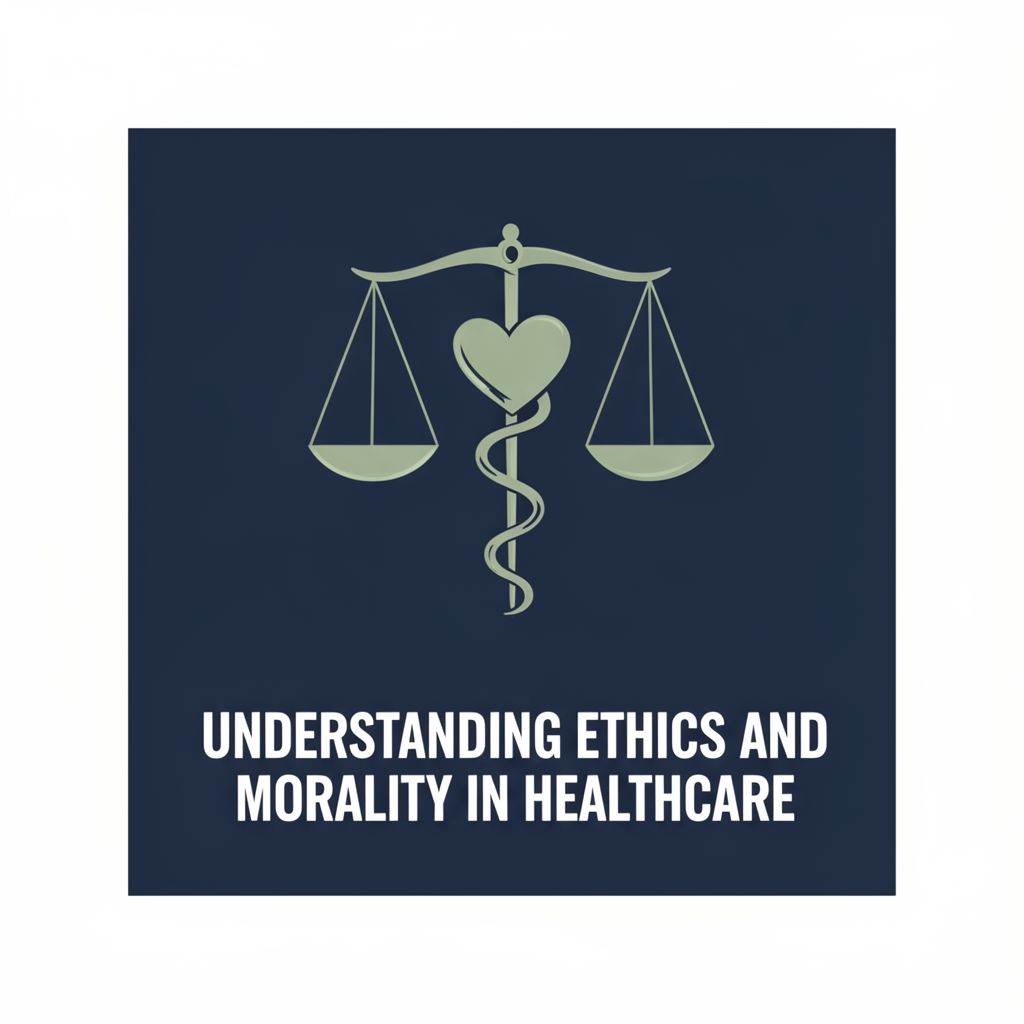
Understanding Ethics and Morality in Healthcare - kapak
Eğitim#ethics#morality#healthcare#medical ethics

Understanding Ethics and Morality in Healthcare

Explore the core concepts of ethics, morality, and their application in healthcare, including key theories, principles, and dilemmas.

January 16, 2026 ~20 dk toplam
01

Sesli Özet

5 dakika

Konuyu otobüste, koşarken, yolda dinleyerek öğren.

Sesli Özet

Understanding Ethics and Morality in Healthcare

0:004:55
02

Flash Kartlar

25 kart

Karta tıklayarak çevir. ← → ile gez, ⎵ ile çevir.

1 / 25
Tüm kartları metin olarak gör
  1. 1. What is morality?

    Morality refers to the norms, rules, and standards that dictate how people should act, focusing on prescriptive behavior.

  2. 2. Define descriptive ethics.

    Descriptive ethics, or unexamined morality, simply observes and describes how people actually act in various situations.

  3. 3. What is the philosophical study of ethics?

    Ethics is the philosophical study of morality itself, involving the analysis and guidance of moral conduct and establishing standards.

  4. 4. Explain the relationship between morality and law.

    Morality and law often overlap but are not always identical; an action can be moral but illegal, or immoral but legal.

  5. 5. What is the core principle of Consequentialism?

    Consequentialism judges the morality of an action based solely on its outcome or consequences.

  6. 6. Describe Utilitarianism.

    Utilitarianism is a form of consequentialism that aims to achieve the greatest happiness for the greatest number of people.

  7. 7. What does Deontology emphasize?

    Deontology, or non-consequentialism, emphasizes duties, rules, and intentions, asserting certain actions are inherently right or wrong.

  8. 8. What is the primary focus of Virtue Ethics?

    Virtue Ethics focuses on the moral character of the agent, emphasizing the development of virtues like compassion and integrity.

  9. 9. Name the four main Beauchamp and Childress principles in healthcare ethics.

    The four main principles are Autonomy, Non-maleficence, Beneficence, and Justice.

  10. 10. Define Autonomy in healthcare.

    Autonomy respects a patient's choices and their capacity for self-governance in medical decisions.

  11. 11. What is the principle of Non-maleficence?

    Non-maleficence is the ethical duty to do no harm to patients.

  12. 12. Explain the principle of Beneficence.

    Beneficence is the ethical obligation to do good and act in the best interests of the patient.

  13. 13. What does the principle of Justice ensure in healthcare?

    Justice ensures fairness in the distribution of healthcare resources and equitable access to care.

  14. 14. What is professional morality in medicine?

    It is a special set of intrinsic moral obligations in medicine that go beyond common morality, integrating legal and personal ethics.

  15. 15. What is the basis of confidentiality in healthcare, and when can it be overridden?

    Confidentiality is built on trust and loyalty, but it may be overridden in rare cases to prevent serious harm.

  16. 16. What is informed consent?

    Informed consent is a patient's authorization for a medical intervention, deeply rooted in the principle of autonomy.

  17. 17. What three conditions are necessary for consent to be valid?

    For consent to be valid, patients must receive adequate disclosure, understand the information, and have the capacity for self-governance.

  18. 18. How is competence for consent assessed?

    Competence is assessed by evaluating a patient's ability to make a reasonable decision, free from mental illness, and to apply rational values.

  19. 19. In what situations might informed consent not always be required?

    Consent may not be needed in mandatory public health treatments, emergencies, or when a patient is incompetent and a surrogate is required.

  20. 20. What are key aspects of the moral problem surrounding abortion?

    Abortion presents an unresolved moral problem, with discussions revolving around fetal viability and the concept of personhood.

  21. 21. Define Medically Assisted Dying (MAID).

    MAID involves a doctor providing the means for a patient to end their life, with the patient performing the final act.

  22. 22. What is active euthanasia?

    Active euthanasia is a direct intervention that intentionally causes the death of a patient.

  23. 23. How is passive euthanasia defined?

    Passive euthanasia involves the withholding or withdrawing of life-sustaining medical treatment.

  24. 24. What is the first step in the Clinical Moral Reasoning Model?

    The first step is collecting all relevant facts pertaining to the ethical dilemma.

  25. 25. What was Berengario da Carpi's historical contribution to medicine?

    Berengario da Carpi made crucial contributions to anatomy by correcting early texts and performing some of the first personal dissections.

03

Bilgini Test Et

15 soru

Çoktan seçmeli sorularla öğrendiklerini ölç. Cevap + açıklama.

Soru 1 / 15Skor: 0

According to the podcast, what is the primary focus of 'morality'?

04

Detaylı Özet

5 dk okuma

Tüm konuyu derinlemesine, başlık başlık.

📚 Ethics and Morality in Healthcare: A Comprehensive Study Guide

Source Information: This study material has been compiled from a lecture audio transcript and a collection of personal notes/PDF texts. All content has been consolidated and organized for clarity and ease of study.


1. Introduction to Ethics and Morality 🌍

This guide provides an in-depth look at the fundamental principles of ethics and morality, particularly within the context of healthcare. Understanding these concepts is crucial for navigating complex decision-making processes.

1.1. Core Definitions 📚

  • Morality: Norms, rules, and standards that dictate how people should act. It's about prescriptive behavior.
  • Descriptive Ethics (Unexamined Morality): Observes how people actually act.
  • Ethics: The philosophical study of morality itself. It involves analyzing and guiding moral conduct, establishing standards, moral rules, and criteria for acceptable ethical behavior.

1.2. Morality and Law ⚖️

While morality and law often overlap, they are not always identical.

  • An action can be moral but illegal.
  • An action can be immoral but legal.
  • 💡 Key Insight: Understanding this distinction is crucial for ethical decision-making.

2. Foundational Ethical Theories and Principles ✅

These theories provide frameworks for understanding and evaluating moral actions.

2.1. Ethical Theories 🧠

  1. Consequentialism:
    • Judges the morality of an action based on its outcome or consequences.
    • Focuses on responsibility for the results, including negative responsibility.
    • Utilitarianism: A prominent form of consequentialism.
      • Aims for the greatest happiness for the greatest number.
  2. Deontology (Non-Consequentialism):
    • Emphasizes duties, rules, and intentions.
    • Asserts that certain actions are inherently right or wrong, regardless of their consequences.
  3. Virtue Ethics:
    • Focuses on the moral character of the agent (the person acting).
    • Emphasizes virtues like compassion, integrity, and conscientiousness.

2.2. Key Ethical Principles in Healthcare (Beauchamp & Childress) 🏥

These principles are paramount in medical ethics:

  • Autonomy: Respecting a patient's choices and their capacity for self-governance.
  • Non-maleficence: The duty to do no harm.
  • Beneficence: The obligation to do good.
  • Justice: Ensuring fairness in the distribution of resources and care.

2.3. Principles of Double Effect ⚖️

This principle applies when an action has both good and bad moral effects:

  • The bad effect is not the means to achieve the good effect.
  • The action itself must be morally good or neutral.
  • The agent's intention must be for the good effect, with the bad effect being an unintended, though foreseen, side effect.
  • The good effect must outweigh the bad effect.

3. Professional Morality in Healthcare 🧑‍⚕️

Professional morality in medicine extends beyond common morality, integrating legal and personal ethical considerations.

3.1. Special Moral Duties 💼

  • Healthcare professionals have intrinsic moral obligations specific to their roles.
  • A healthcare provider is not merely a technical actor but a potential ethical service provider.
  • Fundamental Values: Autonomy, health, well-being, social justice.
  • Ethical Standards: Codes of medical and nursing ethics provide guidelines.

3.2. Confidentiality 🔒

  • A critical aspect built on trust and loyalty.
  • Types of Confidentiality:
    • Absolute: No disclosure under any circumstances.
    • Qualified: Disclosure allowed under specific, limited conditions.
    • Limited: Disclosure allowed for specific purposes (e.g., treatment team).
  • Arguments for Absolute Confidentiality: Fosters trust and loyalty.
  • Arguments Against Absolute Confidentiality: May need to be overridden to prevent serious harm to the patient or others.

4. Clinical Moral Reasoning Model 📊

A structured approach to navigate complex ethical situations in healthcare.

  1. Collect all relevant facts.
  2. Identify relevant ethical principles (e.g., autonomy, beneficence, non-maleficence, justice).
  3. Formulate the ethical question.
  4. Plan a course of action that considers:
    • Patient autonomy.
    • Professional conscience.
    • Beneficence.
    • Truth-telling.
    • Patient interests and rights.

5. Applying Ethics in Healthcare: Key Dilemmas ⚠️

5.1. Informed Consent 📝

A patient's authorization for a medical intervention, deeply rooted in the principle of autonomy.

  • Requirements for Valid Consent:
    1. Disclosure: Patient receives adequate information about the procedure, risks, benefits, and alternatives.
    2. Understanding: Patient comprehends the information provided.
    3. Voluntariness: Patient's decision is free from coercion or undue influence.
    4. Capacity (Competence): Patient has the ability for self-governance, meaning they can act on their values and plans.
      • Assessment of Competence: Evaluates a patient's ability to make a reasonable decision, free from mental illness, and to apply rational values.
      • Presumption of Competence: Patients are presumed competent until proven otherwise.
  • Types of Consent:
    • Implicit: Inferred from behavior (e.g., extending arm for blood draw).
    • Explicit: Clearly stated, either orally or in writing.
  • When Consent is NOT Always Needed:
    • Emergencies: When immediate treatment is necessary to save a life or prevent serious harm, and the patient is unable to consent.
    • Mandatory Public Health Treatments: (e.g., vaccinations, quarantine) to protect the community.
    • When Patient is Incompetent: A surrogate decision-maker (proxy) is required, acting in the patient's best interest.

5.2. Beginning of Life: Abortion and Personhood 👶

  • Unresolved Moral Problem: Discussions revolve around fetal viability and the concept of personhood.
  • Key Concepts:
    • Fetal Viability: The point at which a fetus can survive outside the womb.
    • Personhood: The status of being a person, often linked to moral rights. Definitions vary:
      • Consciousness, self-awareness, rationality, ability to feel pain, potential for a "future-like-ours."
  • Diverse Moral Positions:
    • Pro-Life: Often argues that life begins at conception and a fetus has a right to life.
    • Pro-Choice: Emphasizes a woman's bodily autonomy and the idea that a fetus may not meet all criteria for personhood.
  • 💡 Insight: There is no universally accepted solution to the moral problem of abortion.

5.3. End of Life: Euthanasia and Medically Assisted Dying (MAID) 🕊️

These topics involve complex ethical considerations, often raising concerns about a "slippery slope" where allowing one practice might lead to less ethical ones.

  • Medically Assisted Dying (MAID):
    • A doctor provides the means (e.g., medication) for a patient to end their own life.
    • The patient performs the final act.
  • Euthanasia:
    • Active Euthanasia: A direct intervention by a medical professional to cause a patient's death (e.g., administering a lethal dose).
    • Passive Euthanasia: Involves the withholding or withdrawing of life-sustaining treatment, allowing the patient to die naturally.
  • Key Considerations:
    • Patient autonomy and the right to self-determination.
    • The duty to alleviate suffering (beneficence).
    • The duty to do no harm (non-maleficence).
    • The distinction between "killing" and "letting die."
    • Identifying patient needs versus professional duties.

6. Historical Context: Anatomy and Ethics 📜

Our understanding of medicine and ethics has evolved significantly over time.

  • Berengario da Carpi (15th-16th Century):
    • Though not a physician, he made crucial contributions to anatomy.
    • Corrected early anatomical texts.
    • Performed some of the first personal dissections.
    • Distinguished structures like the atrium and ventricle of the heart.
  • 💡 Significance: This historical progression underscores how medical practice, and the ethical frameworks guiding it, are continually refined through scientific advancement and critical inquiry.
Kendi çalışma materyalini oluştur

PDF, YouTube videosu veya herhangi bir konuyu dakikalar içinde podcast, özet, flash kart ve quiz'e dönüştür. 1.000.000+ kullanıcı tercih ediyor.

Sıradaki Konular

Tümünü keşfet
Ethical Decision-Making in Healthcare: Utilitarianism and Bioethics

Ethical Decision-Making in Healthcare: Utilitarianism and Bioethics

Explore ethical theories like utilitarianism and fundamental bioethical principles, applying them to complex medical dilemmas, including resource allocation during pandemics and patient autonomy.

Özet 23
Philosophical Foundations of Welfare Economics

Philosophical Foundations of Welfare Economics

An overview of key concepts in welfare economics, including utilitarianism, social welfare functions, justice theories, and philosophical methods.

Özet 25
Ethics and Biotechnology: Navigating Moral Dilemmas

Ethics and Biotechnology: Navigating Moral Dilemmas

Explore the critical ethical considerations in biotechnology, from foundational principles like utilitarianism and deontology to complex issues in genetic modification, human trials, cloning, and genetic privacy.

Özet 24 15
Earth Systems and Resources Overview

Earth Systems and Resources Overview

An academic summary of Earth's physical systems, including plate tectonics, soil dynamics, atmospheric composition, global climate drivers, and oceanic phenomena like ENSO.

8 dk 15 Görsel
Introduction to Geography for KPSS Examination

Introduction to Geography for KPSS Examination

This summary provides a formal academic overview of introductory geography, covering its fundamental concepts, branches, and key principles relevant for the KPSS examination.

5 dk Özet 25 15 Görsel
Introduction to Geography for KPSS-MEB AGS 2026

Introduction to Geography for KPSS-MEB AGS 2026

This audio summary provides an academic overview of foundational geographical concepts relevant to the KPSS-MEB Field Knowledge Examination, specifically focusing on introductory geography principles.

5 dk Özet 25 15 Görsel
Introduction to Geography for KPSS-AGS Examination

Introduction to Geography for KPSS-AGS Examination

This summary provides an academic overview of foundational geographical concepts relevant to the KPSS-AGS examination for prospective geography teachers in Turkey, emphasizing key principles and their educational significance.

6 dk Özet 25 15
IELTS Academic Writing Task 1: A Beginner's Guide for 2026

IELTS Academic Writing Task 1: A Beginner's Guide for 2026

This summary provides a comprehensive guide for beginners approaching IELTS Academic Writing Task 1 in 2026, covering requirements, assessment criteria, and strategic preparation methods.

5 dk Özet 25 15 Görsel