Podit
Podit
📚 Study Guide: Voice, Identity, and Cultural Multiplicity
Source Information: This study material is compiled from an excerpt of Zadie Smith's lecture "Speaking in Tongues" (December 2008, New York Public Library) and a corresponding lecture audio transcript.
🌍 Introduction: The Shifting Landscape of Voice and Identity
Zadie Smith's "Speaking in Tongues" explores the intricate relationship between an individual's voice, their identity, and the broader cultural landscape. The essay delves into how linguistic adaptation shapes personal identity, societal perceptions, and the tension between individual multiplicity and cultural expectations of singularity. Smith uses her own experiences, literary examples like George Bernard Shaw's Pygmalion, and the public persona of Barack Obama to illustrate these complex dynamics.
1️⃣ The Personal Experience of Voice Adaptation
Smith begins by reflecting on her own journey of linguistic transformation.
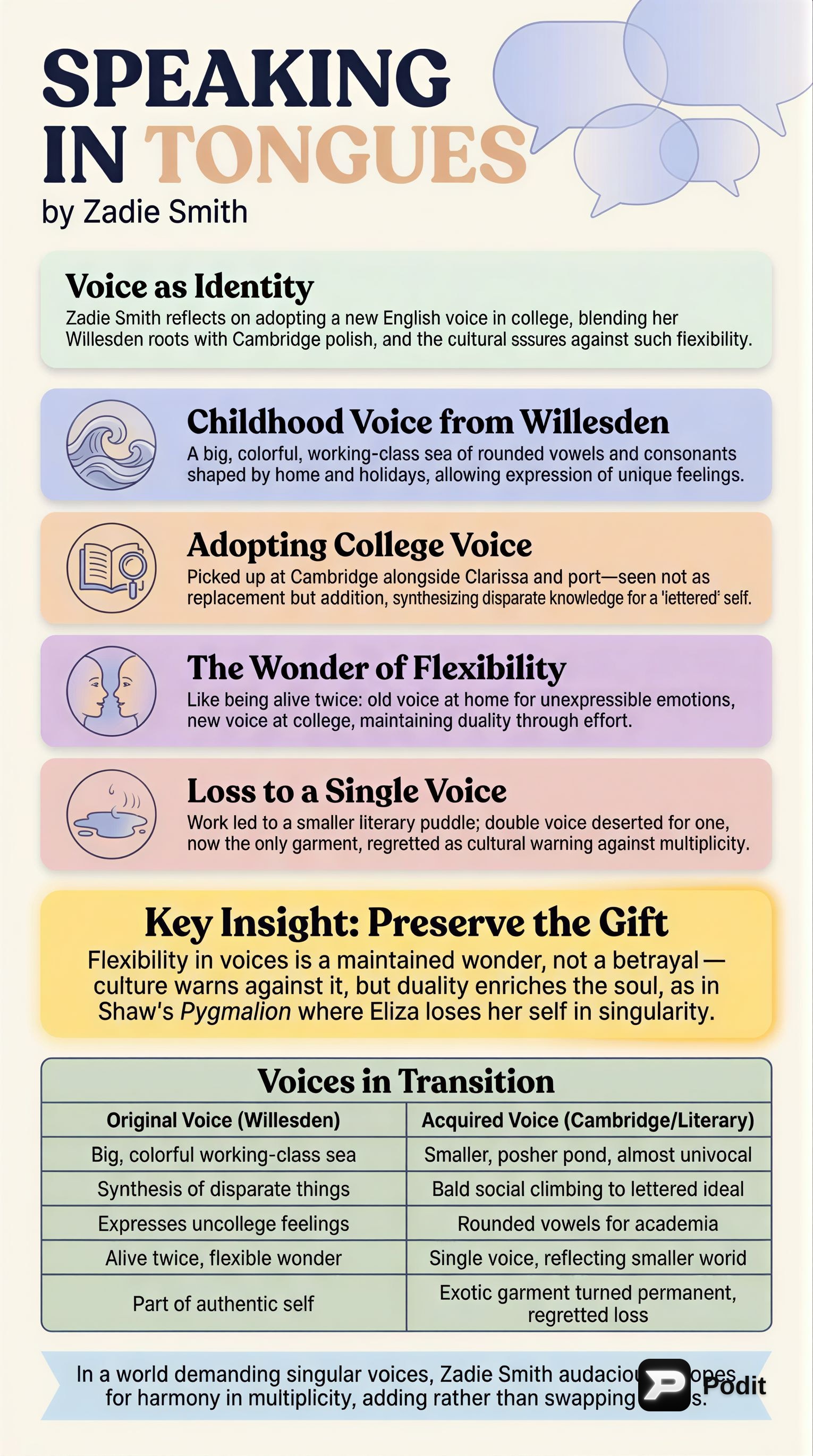
- Childhood Voice vs. Acquired Voice: She recounts acquiring a distinct "English voice" with "rounded vowels and consonants in more or less the right place" during her college years, differing significantly from her childhood speech patterns.
- Initial Perception: Initially, Smith viewed this as an additive process ➕, believing she was "adding Cambridge to Willesden," integrating new linguistic and intellectual facets into her existing identity. She felt a "sort of wonder at the flexibility of the thing. Like being alive twice."
- Loss of Flexibility: Over time, this dual linguistic capacity diminished, yielding to a singular voice that reflected the "smaller world" of her professional life. She expresses regret over this loss, noting that "flexibility is something that requires work if it is to be maintained."
- Societal Scrutiny: This personal experience highlights a broader societal phenomenon where voice adaptation is often viewed critically, particularly within British culture.
2️⃣ The British Context: Voice, Class, and Societal Scrutiny
In Britain, altering one's voice carries significant social implications, often interpreted as a betrayal of authenticity.
- "Original British Sin": Smith references George Bernard Shaw's Pygmalion, where voice adaptation is depicted as an "original British sin." Shaw noted that "many thousands of [British] men and women…have sloughed off their native dialects and acquired a new tongue," yet few admit it.
- Cultural Expectation of Singularity: The prevailing cultural sentiment dictates that voices should remain unchanging and singular. Deviation is often perceived as:
- Duplicity: "Janus-faced duplicity."
- Loss of Self: "The loss of our very souls."
- Class Betrayal: Moving up or down the class scale linguistically is seen as "an unforgivable act of class betrayal."
- Eliza Doolittle: A Tragic Case Study 🎭
- The Dilemma: Eliza, the protagonist of Pygmalion, transforms from a Cockney flower girl to a refined lady through Professor Higgins's experiment. This transformation leaves her in an "awkward, in-between" existence.
- Shaw's Didactic Intent: Shaw intended Pygmalion to be didactic, demonstrating that changing one's voice could lead to a loss of self. Eliza's lament, "I have forgotten my own language, and I can speak nothing but yours," encapsulates this tragedy.
- The "Middling Spot": Both Eliza and her father, Alfred Doolittle, find themselves trapped in a "comi-tragic" "middling spot"—neither fully belonging to their original class nor fully integrated into the new one.
- Broader Anxieties: Smith extends this concept to broader societal anxieties concerning individuals perceived as existing "between worlds," such as:
- The "tragic mulatto."
- Transsexual individuals.
- Contemporary immigrants.
- These groups often face pressure to sacrifice one aspect of their identity for another to conform to a singular, culturally prescribed self.
3️⃣ Barack Obama: Embracing Multiplicity and "Dream City"
In contrast to the tragic narrative of Pygmalion, Smith presents Barack Obama as an embodiment of a more hopeful and additive approach to identity and voice.
- Additive Identity: Obama's autobiography, Dreams from My Father, portrays a personal narrative of genuine multiplicity, where identity is an accumulation of selves.
- "Speaking Them": Smith highlights Obama's exceptional facility for dialogue, enabling him to authentically represent a wide array of voices and perspectives from diverse racial, social, and regional backgrounds. He can "speak them" – embody the experiences of diverse individuals – rather than merely speaking for them.
- The Gift of Multiple Voices: For Obama, having multiple voices is perceived as a gift 🎁 rather than a burden, leading to a conclusion that "each man must be true to his selves, plural."
- "Dream City" Concept 🏙️
- Definition: "Dream City" is a metaphorical space where the unified, singular self is an illusion, and multiplicity is inherent.
- Inhabitants: Obama, with his mixed heritage (Hawaiian, Kenyan, Kansan, Indonesian influences) and diverse background, is presented as a natural inhabitant. Smith suggests that many people, despite not overtly displaying it, also originate from this "Dream City" of complex backstories and multiple narratives.
- Necessity of Multiplicity: In Dream City, "everything is doubled, everything is various. You have no choice but to cross borders and speak in tongues."
- Obama's Campaign Strategy: His political campaign, characterized by the inclusive use of "we" rather than "I," implicitly suggested that many individuals seek synthesis between disparate elements of their identity. This "invocation of our collective human messiness" was a "high-wire strategy" that resonated with many.
- Cary Grant as an Example: Smith also cites Cary Grant (born Archibald Leach) as another example of a "self-created man" from "Dream City," whose "heavenly sui generis accent" was a product of collective imagination, transcending singular origins.
4️⃣ Conclusion: The Harmony of Plurality
Smith concludes by emphasizing that living a life of varied identities is not merely an accidental gift but a continuous, conscious effort.
- Flexibility as a Choice: She illustrates this with a personal anecdote from election night, underscoring that flexibility and the embrace of multiplicity are choices available to all, irrespective of background. "Flexibility is a choice, always open to all of us." ✅
- Audacious Hope for Obama: Smith expresses an "audacious hope" that Obama, as a figure born and raised amidst diverse cultures and opposing dogmas, would recognize the contingent nature of culture.
- Avoiding Universal Laws: She hopes he would not mistake his personal cultural sensibilities for universal natural laws.
- Reconciling Patriotism: She hopes he would align with George Bernard Shaw's perspective on patriotism as a conviction rooted in birth rather than objective superiority.
- Human Harmony: Ultimately, Smith envisions Obama as a figure capable of demonstrating that holding multiple voices—such as expressing love for one's country while simultaneously acknowledging its shared humanity with other nations—does not imply contradiction or equivocation. Instead, it represents a "proper and decent human harmony" 🤝, where plurality enriches identity rather than diminishing it.