 Podit
Podit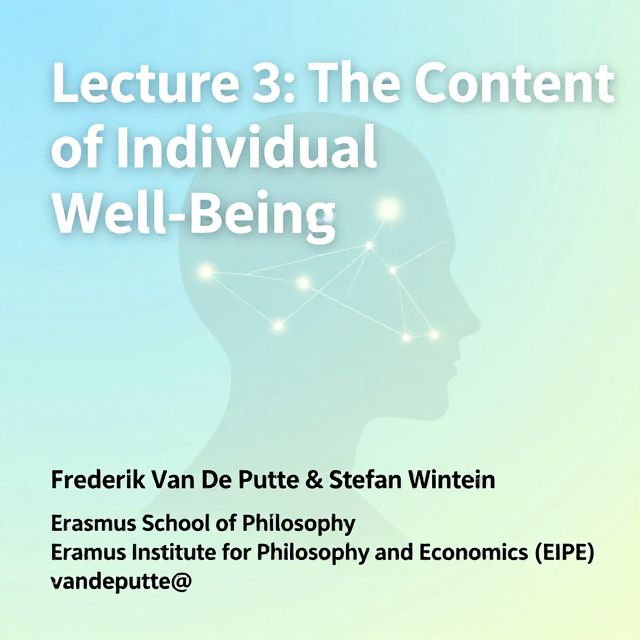
Understanding Individual Well-Being: Content and Theories
Source Information: This study material is compiled from a lecture transcript and accompanying presentation slides (copy-pasted text) on "The Content of Individual Well-Being" by Frederik Van De Putte & Stefan Wintein from Erasmus School of Philosophy, Erasmus Institute for Philosophy and Economics (EIPE), ©2026 Erasmus University Rotterdam.
📚 Introduction to Well-Being
Well-being is a fundamental concept in moral philosophy, particularly for ethical frameworks like utilitarianism, which aims to maximize overall well-being. As defined by Roger Crisp, well-being in philosophy refers to what is non-instrumentally or ultimately good for a person. Understanding its content is crucial for evaluating outcomes and making informed ethical decisions.
This lecture primarily focuses on the content of well-being: what it ultimately is, and what it means for one outcome to provide a person with greater well-being than another.
Key Distinctions: Content, Structure, and Subject
Conceptually, questions about well-being can be grouped into three categories:
- Content: What constitutes well-being ultimately? What makes something intrinsically good for an individual? (Focus of this lecture)
- Structure: How can well-being be quantified, measured, or represented in terms of degrees or rankings? (Covered in subsequent lectures)
- Subject: Whose well-being should be considered (e.g., all living beings, future generations)? (Beyond the scope of this course)
Intra-personal vs. Inter-personal Comparisons
This material primarily focuses on intra-personal comparisons of well-being, examining how a single person's well-being changes between different states or outcomes (e.g., "Person A is better off in state X than in state Y").
Intrinsic vs. Instrumental Good
- Instrumental Good: Something that is good because it leads to something else that is good (e.g., money is instrumentally good for purchasing goods and services).
- Intrinsic Good: Something that is good in its own right, not merely as a means to an end (e.g., having more lifestyle options might be considered intrinsically good). Theories of well-being aim to identify what is intrinsically good for an individual.
💡 Core Theories of Individual Well-Being
Various philosophical theories attempt to define the content of well-being. These can broadly be categorized as subjective or objective.
1️⃣ Subjective Theories
These theories define well-being solely in terms of a person's subjective attitudes, such as their preferences or feelings. To assess well-being, one would typically ask the individual.
-
Hedonist Theories of Well-Being:
- Core Idea: An outcome 'x' is better for a person than 'y' if 'x' provides that person with more pleasure than 'y'.
- Key Figure: Jeremy Bentham.
- Example: If Judith enjoys playing chess, then playing chess is instrumentally good because the enjoyment (pleasure) is intrinsically good.
- Monist: Pleasure is the sole intrinsic good.
-
Preference-Based (PB) Theories of Well-Being:
- Core Idea: An outcome 'x' is better for a person than 'y' if their preferences are satisfied to a greater extent in 'x' than in 'y'.
- Example: "The Calvinist" prefers saving money over spending it on enjoyable things due to conviction. A hedonist would say spending is better, but a PB theorist would say saving is better because it satisfies the Calvinist's preference.
- Monist: Preference satisfaction is the sole intrinsic good.
2️⃣ Objective Theories
These theories propose that well-being depends on factors beyond an individual's subjective attitudes. A person might be mistaken about what truly contributes to their well-being.
-
Eudaimonist Theories of Well-Being:
- Core Idea: A person's well-being is greater if they develop their full potential as a human being to a greater extent. This involves flourishing physically, mentally, and socially, functioning well, and perfecting one's talents.
- Key Figure: Aristotle, with his concept of "virtuous activity in accordance with reason."
- Example: Playing chess is good for Judith because it allows her to exercise her powers of reasoning, which is intrinsically good for human flourishing.
- Challenge: Defining "human nature" or "the perfect human being" can be problematic.
-
Capability Theories:
- Core Idea: Well-being is enhanced when a person's functionings (what they actually do) and capabilities (what they could do, what they are free and able to do) are greater.
- Key Figures: Amartya Sen and Martha Nussbaum.
- Nussbaum's Objective List: Proposes a pluralistic list of intrinsically good capabilities:
- ✅ Bodily health
- ✅ Bodily integrity
- ✅ Imagination and Thought
- ✅ Love and Emotions
- ✅ Pleasure and Pain
- ✅ Practical reason
- ✅ Respect
- ✅ Other species (connection to nature)
- ✅ Play
- Pluralist: Multiple things are intrinsically good for a person.
Overlap and Utilitarianism's Stance
While distinct, these theories often overlap (e.g., people typically prefer enjoyable outcomes, enjoy satisfying preferences, and enjoy flourishing). The key difference lies in what is considered the ultimate explanation of goodness. Utilitarianism (UP) does not specify the content of well-being but has historically been combined with hedonist theories (Bentham, Mill) and, more recently, with refined PB theories, especially in welfare economics.
⚠️ Critiques and Challenges to Well-Being Theories
Each theory faces significant philosophical challenges and counterarguments.
1️⃣ The Charge of Paternalism (Against Objective Theories)
- Definition: Paternalism occurs when an external "judge" determines what is good for someone, rather than the individual's own attitudes or choices.
- Argument: Objective theories are often criticized as paternalistic because they imply that an individual might be wrong about their own well-being.
- J.S. Mill's View: Argued against paternalism, stating that "His own good, either physical or moral, is not a sufficient warrant" for exercising power over an individual against their will.
- Example (Smoking):
- Person A prefers to smoke and live 60 years in poor health (x) over not smoking and living 80 years in good health (y).
- PB Theory: x is better for A (satisfies preference). Banning smoking decreases A's well-being.
- Nussbaum's Objective Theory: y is better for A (promotes bodily health). Banning smoking increases A's well-being.
- Nuance: Objective theories can include subjective components (e.g., pleasure). Some argue paternalism isn't always negative, especially for those lacking capacity or being misinformed. Capability theories are generally less paternalistic than strict eudaimonism as they focus on opportunities rather than prescribed outcomes.
2️⃣ Charges Against Subjective Theories
A. Challenges to Hedonism
- Mental Adaptation (Amartya Sen):
- Scenario: Nelson is imprisoned in harsh conditions but adapts and finds pleasure in small things (x). Another Nelson lives luxuriously but constantly desires more and finds little pleasure (y).
- Hedonist Implication: Nelson is better off in (x) because he experiences more pleasure.
- Intuitive Counter-argument: Intuitively, Nelson's life is not better in (x). This suggests well-being is more than just pleasure.
- Experience Machine (Robert Nozick):
- Scenario: A machine can simulate a life of perfect pleasure and enjoyment, making you believe you are achieving great things and having meaningful relationships, without you ever knowing you're in the machine.
- Question: Would you plug into this machine for life?
- Hedonist Implication: If hedonism is correct, it is better to plug into the machine.
- Intuitive Counter-argument: Most people would decline, suggesting that actual achievement, genuine relationships, and living in reality contribute to well-being beyond mere pleasurable experiences. This serves as a strong argument against hedonism (Modus Tollens).
B. Challenges to Preference-Based Theories
-
Adapted Preferences:
- Scenario: Nelson, imprisoned for years, adapts and prefers staying in prison (x) over being freed and building a new life (y).
- PB Implication: x is better for Nelson.
- Intuitive Counter-argument: This seems incorrect; his preferences are "adapted" to his constrained circumstances and may not reflect his true well-being.
-
False Beliefs:
- Scenario: Alma prefers living in Kralingen (x) over Noord (y) because she falsely believes Noord lacks green spaces and shops, and cycling is dangerous. If informed, she would prefer Noord.
- PB Implication: x is better for Alma because she prefers it.
- Intuitive Counter-argument: Alma's preference is based on ignorance, suggesting that well-being shouldn't be based on uninformed preferences.
- Revised PB Theories: Propose that 'x' is better for Alma than 'y' if she would prefer 'x' to 'y' if she were informed of all relevant facts. This addresses the false beliefs problem.
-
Challenges to Revised PB Theories:
- Compulsions (John Rawls):
- Scenario: Alma, due to compulsion, prefers staying in a park to count grass blades (y) over meeting friends (x), even when fully informed.
- Revised PB Implication: y is better for Alma.
- Intuitive Counter-argument: Most would argue x (meeting friends) is better, suggesting compulsions don't reflect true well-being.
- Preferences about Remote Futures (Self-Sacrifice):
- Scenario: A rich chef, Alma, sacrifices all her money to a trust fund to ensure her great-grandchildren (whom she'll never meet) eat well, starving herself. She is fully informed.
- Revised PB Implication: Alma's well-being depends on what happens to her great-grandchildren after her death.
- Intuitive Counter-argument: Most would argue Alma's well-being should not depend on events beyond her life or direct experience.
- Time-Sensitivity of Preferences (Angry Teenager):
- Scenario: An angry teenager, Alma, attempts suicide to punish her parents. Later, when calm, she no longer wants to die.
- Problem: Revised PB theories are ambiguous. Based on "angry preferences," dying is better. Based on "calm preferences," living is better. Which preference set should count?
- Compulsions (John Rawls):
🔄 Hybrid Theories and Preference Laundering
To address the issues with subjective theories, some propose hybrid theories or preference laundering.
- Restricted Hedonism: Suggests not all forms of pleasure count towards well-being (e.g., pleasure from torturing). However, this risks paternalism and may still face original counterexamples.
- Preference Laundering: Involves restricting, modifying, or affecting preferences used for well-being judgments.
- For "Angry Teenager," this might mean using preferences "stable over time."
- For "Self-Sacrifice," using preferences that can be satisfied during one's life.
- For "Grass Counting," using preferences of a "mentally healthy version" of the person.
- Risk: While aiming to refine PB theories, preference laundering can reintroduce the charge of paternalism by imposing external criteria on what constitutes a "valid" preference.
📊 Summary of Challenges
| Theory Class | Key Idea | Main Challenges …