 Podit
Podit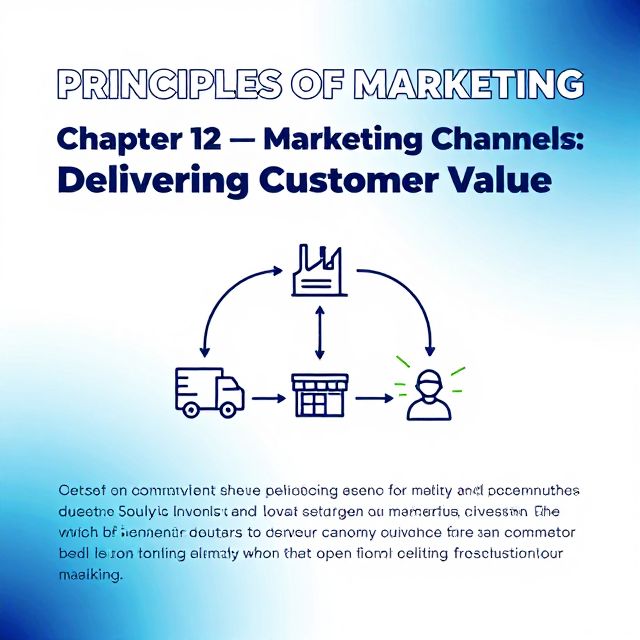
Flash Kartlar
25 kartKarta tıklayarak çevir. ← → ile gez, ⎵ ile çevir.
Tüm kartları metin olarak gör
1. What is a marketing channel, also known as a distribution channel?
A marketing channel is a network of interdependent organizations that work together to make a product or service available for use or consumption by the final buyer. These organizations bridge the gap between producers and consumers, facilitating the flow of goods and services. Channel decisions are fundamental as they significantly influence other marketing strategies like pricing, product development, and promotion.
2. How did Airbnb exemplify disruption in traditional marketing channels?
Airbnb disrupted the traditional hotel industry by creating an online marketplace that connected individuals needing accommodation with those offering spare space. This innovative model bypassed conventional hotel chains, providing a unique 'live-like-the-locals' experience. It demonstrated that companies must continuously innovate their distribution models to remain competitive and thrive amidst market disruption.
3. Why is understanding marketing channels crucial for companies in today's market?
Understanding marketing channels is crucial because they are fundamental to effective value delivery to customers. In a dynamic market, companies must constantly innovate their distribution models to adapt to changes and disruption. Proper channel management ensures that products and services reach the target audience efficiently, impacting overall business success and competitive advantage.
4. Define 'upstream partners' within a value delivery network.
Upstream partners are firms that supply the raw materials, components, information, finances, and expertise necessary to create a product or service. They are involved in the initial stages of the production process, providing the essential inputs. These partners are critical for the company's ability to produce its offerings before they move through the distribution channels.
5. Define 'downstream partners' within a value delivery network.
Downstream partners are the marketing and distribution channels that connect the company with its customers. These typically include intermediaries such as wholesalers and retailers. Their role is to facilitate the flow of products from the producer to the final consumer, making the goods available and accessible in the market.
6. What is the primary focus of a 'supply chain' in the context of value delivery?
A supply chain, often referred to as a 'make and sell' approach, primarily focuses on a firm's inputs and its production capacity. It emphasizes the process of sourcing raw materials, manufacturing products, and then pushing them out to the market. This traditional view centers on the company's internal operations and its ability to produce goods efficiently.
7. How does a 'demand chain' differ from a 'supply chain'?
A demand chain, also known as a 'sense and respond' approach, differs from a supply chain by starting its planning with the target customer's needs. Instead of focusing solely on production, it first identifies what customers want and then organizes the supply chain to meet those demands. This customer-centric approach ensures that products and services are tailored to market requirements, enhancing customer value.
8. Explain the concept of a 'value delivery network'.
A value delivery network is a comprehensive partnership that includes the company, its suppliers, distributors, and ultimately, its customers. All these entities collaborate to enhance the performance of the entire system in delivering customer value. It's a holistic view that recognizes the interconnectedness of all parties involved in creating and delivering a product or service, aiming for collective efficiency and effectiveness.
9. How do marketing channel decisions impact other marketing strategies?
Marketing channel decisions profoundly impact other marketing strategies because they dictate how and where products are made available to customers. For instance, channel choices influence pricing strategies, as different channels may have varying cost structures. They also affect product development by signaling market needs and promotion strategies by determining how messages reach the target audience. An integrated approach is essential for consistency and effectiveness.
10. How do channel members add value by transforming product assortments?
Channel members add value by transforming the assortments of products available from producers into the assortments desired by consumers. Producers typically make large quantities of a limited variety of products, while consumers usually want small quantities of a wide variety. Intermediaries break down bulk, sort, and combine products from various sources to create convenient and desirable assortments for buyers, simplifying the shopping process.
11. What significant 'gaps' do marketing channels bridge between producers and users?
Marketing channels bridge significant time, place, and possession gaps between producers and users. The 'time gap' refers to the difference between when a product is produced and when it is consumed. The 'place gap' addresses the geographical distance between production and consumption. The 'possession gap' relates to the transfer of ownership from the producer to the consumer, making the product accessible and usable.
12. Why do producers often use intermediaries in their marketing channels?
Producers often use intermediaries for greater efficiency in making goods available to target markets. Intermediaries offer specialized contacts, experience, and scale that individual producers might lack. They can perform functions more effectively and at a lower cost than producers could on their own, ultimately benefiting from their expertise in distribution and market reach.
13. Name three key value-adding functions performed by marketing channel intermediaries.
Three key value-adding functions performed by marketing channel intermediaries include information gathering, promotion, and customer contact. Information gathering involves collecting and distributing market research. Promotion entails developing and spreading persuasive communications. Customer contact means finding and communicating with prospective buyers. Other functions include matching, negotiation, physical distribution, financing, and risk-taking.
14. Describe the 'information gathering' function of a marketing intermediary.
The 'information gathering' function of a marketing intermediary involves collecting and distributing marketing research and intelligence about the marketing environment. This includes data on potential customers, competitors, and other forces that might affect exchange. By providing valuable insights, intermediaries help producers make informed decisions about product development, pricing, and promotional strategies.
15. How does 'promotion' function as an activity performed by a marketing intermediary?
As an intermediary activity, 'promotion' involves developing and spreading persuasive communications about an offer. Intermediaries often engage in advertising, personal selling, and sales promotions to attract customers and inform them about products. This function helps to stimulate demand and move products through the channel, effectively reaching the target audience on behalf of the producer.
16. What is the 'matching' function performed by a marketing intermediary?
The 'matching' function involves shaping offers to meet the buyer's needs. This can include activities such as manufacturing, grading, assembling, and packaging products to suit specific customer requirements. Intermediaries ensure that the products available are in the right form, quantity, and assortment that consumers desire, thereby facilitating the exchange process.
17. Explain the 'negotiation' function of a marketing intermediary.
The 'negotiation' function of a marketing intermediary involves reaching an agreement on price and other terms of the offer. Intermediaries act as a go-between for producers and consumers, facilitating discussions and agreements that lead to a successful transaction. This function helps to resolve potential conflicts and establish mutually beneficial terms for both parties in the exchange.
18. What does the 'physical distribution' function entail for marketing intermediaries?
The 'physical distribution' function for marketing intermediaries involves transporting and storing goods. This includes all the activities required to move products from their point of origin to the point of consumption. Efficient physical distribution ensures that products are available at the right place and time, minimizing costs and maximizing customer satisfaction.
19. How do marketing intermediaries perform a 'financing' function?
Marketing intermediaries perform a 'financing' function by acquiring and using funds to cover the costs of carrying out channel work. This might involve extending credit to customers, holding inventory, or making early payments to producers. By providing financial support, intermediaries help to smooth the flow of goods and reduce the financial burden on other channel members.
20. What does the 'risk-taking' function involve for marketing intermediaries?
The 'risk-taking' function for marketing intermediaries involves assuming the risks associated with carrying out channel work. This can include risks related to holding inventory (e.g., obsolescence, damage, theft), extending credit, or investing in marketing activities that may not yield immediate returns. By taking on these risks, intermediaries help to reduce the exposure of producers and facilitate the overall distribution process.
21. Illustrate the 'Distributor Effect' and its benefit to efficiency.
The 'Distributor Effect' illustrates how intermediaries drastically reduce the total number of contacts needed in a marketing channel, significantly improving system efficiency. For example, without a distributor, three manufacturers serving three customers would require nine direct transactions. With a single distributor, this reduces to three transactions from manufacturers to the distributor, plus three from the distributor to customers, totaling only six transactions. This reduction in contacts streamlines the process and lowers overall costs.
22. What is a 'channel level' in the context of marketing channels?
A channel level refers to a layer of intermediaries that performs some work in bringing the product and its ownership closer to the final buyer. Each intermediary that performs a function in moving the product to the final consumer constitutes a channel level. The number of intermediary levels defines the length and complexity of a marketing channel.
23. Define a 'direct marketing channel' (Channel 1).
A direct marketing channel, also known as Channel 1, is a distribution channel that involves no intermediary levels. In this setup, the producer sells directly to the consumer. Examples include selling through a company's own website, direct mail, or a company-owned retail store. This approach allows for direct control over the customer experience and often closer customer relationships.
24. Provide an example of a 'Channel 2 indirect marketing channel'.
A Channel 2 indirect marketing channel involves one intermediary level. A common example is a producer selling to a retailer, who then sells the product to the final consumer. For instance, a clothing manufacturer might sell its apparel to a department store, and the department store then sells it to individual shoppers. This structure allows producers to reach a wider customer base through established retail networks.
25. Describe a 'Channel 3 indirect marketing channel'.
A Channel 3 indirect marketing channel involves two intermediary levels. In this structure, the producer sells to a wholesaler, the wholesaler then sells to a retailer, and finally, the retailer sells to the consumer. This channel is often used for products that require broad distribution, especially in fragmented markets, where wholesalers can efficiently reach many small retailers.
Bilgini Test Et
15 soruÇoktan seçmeli sorularla öğrendiklerini ölç. Cevap + açıklama.
Which company is used as an example to illustrate the transformative power of marketing channels and market disruption in the introduction?