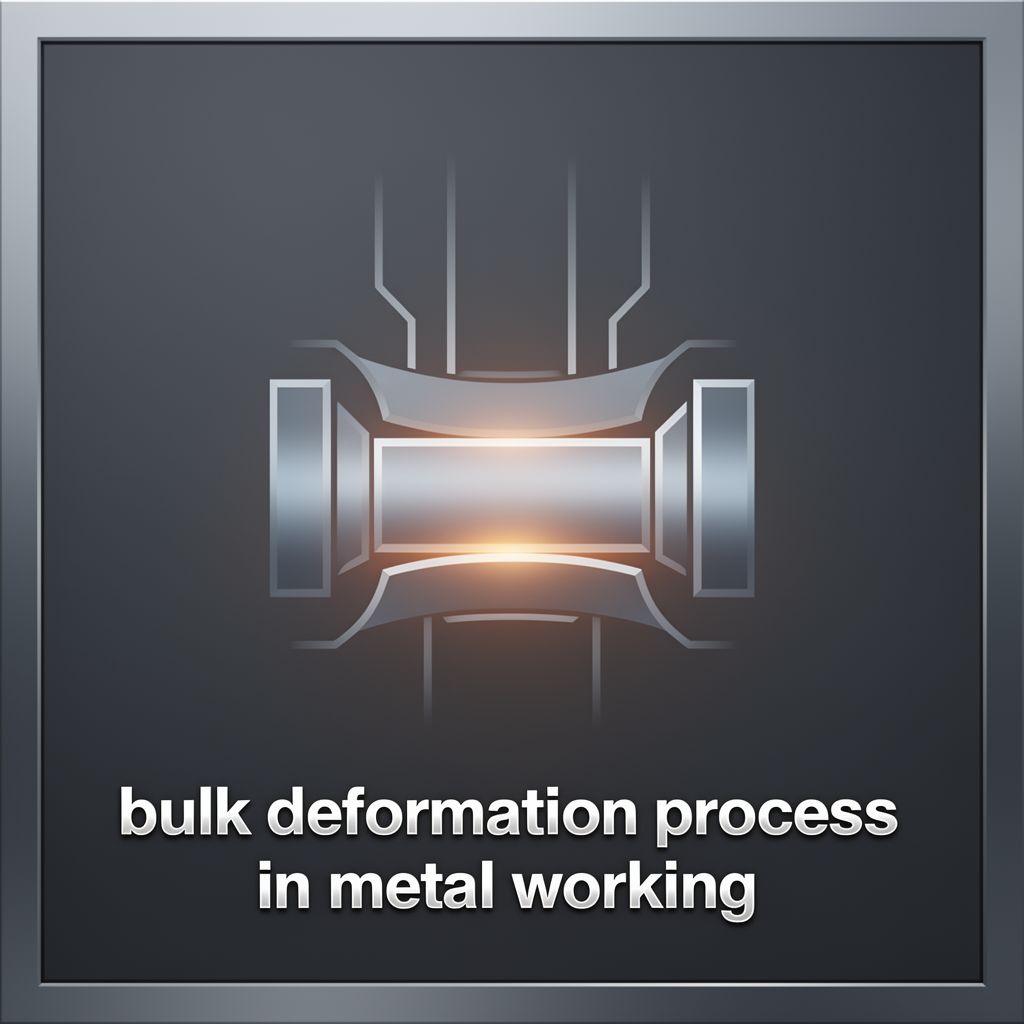
Mastering Bulk Deformation in Metalworking - kapak
Teknoloji#metalworking#bulk deformation#forging#rolling

Mastering Bulk Deformation in Metalworking

Discover the fascinating world of bulk deformation processes in metalworking. Learn how metals are shaped without material loss, exploring forging, rolling, extrusion, and drawing.

NHLsSnQ5January 16, 2026 ~14 dk toplam
01

Flash Kartlar

25 kart

Karta tıklayarak çevir. ← → ile gez, ⎵ ile çevir.

1 / 25
Tüm kartları metin olarak gör
  1. 1. What is the main topic discussed in this session?

    The main topic discussed is 'bulk deformation processes' in metalworking, focusing on how metals are shaped by applying force.

  2. 2. What is the primary goal of bulk deformation processes?

    The primary goal is to change the shape of metals dramatically by applying force, not by cutting or melting.

  3. 3. What does the term 'bulk' refer to in bulk deformation?

    'Bulk' refers to a significant change in the overall shape of the metal, where the surface area to volume ratio changes considerably.

  4. 4. What kind of deformation is specifically aimed for in bulk deformation?

    In bulk deformation, the aim is for plastic deformation, meaning the metal changes shape permanently.

  5. 5. How is plastic deformation different from elastic deformation?

    Plastic deformation means the material stays bent after force removal, while elastic deformation means it springs back to its original form.

  6. 6. How is plastic deformation achieved in bulk deformation processes?

    Plastic deformation is achieved by applying stresses that exceed the material's yield strength.

  7. 7. What is a common benefit of bulk deformation processes for metals?

    These processes often improve the metal's mechanical properties, such as its strength and toughness, by refining its internal grain structure.

  8. 8. Name the four key bulk deformation processes mentioned.

    The four key bulk deformation processes mentioned are forging, rolling, extrusion, and drawing.

  9. 9. Describe the process of forging.

    Forging involves applying compressive forces, often with hammers or presses, to shape metal, similar to a blacksmith's work.

  10. 10. Give an example of a product typically made by forging.

    Products like engine components or hand tools are often made by forging due to its ability to create strong, tough parts.

  11. 11. What is the mechanism behind the rolling process?

    Rolling involves passing metal, either hot or cold, between two rotating rolls that squeeze and reduce its thickness, making it longer.

  12. 12. What kind of products are commonly produced using rolling?

    Rolling is used to produce items like sheet metal for car bodies or structural beams for buildings.

  13. 13. Explain the extrusion process.

    Extrusion involves pushing a metal billet through a die opening, forcing it to take the shape of the die, similar to squeezing toothpaste.

  14. 14. What types of products are ideal for manufacturing via extrusion?

    Extrusion is perfect for creating long products with a uniform cross-section, such as aluminum window frames, pipes, or electrical wires.

  15. 15. How does the drawing process differ from extrusion?

    In drawing, the metal is pulled through a die, whereas in extrusion, it is pushed through a die.

  16. 16. What is the primary application of the drawing process?

    Drawing is primarily used to make long, thin wires and rods by pulling a larger diameter rod through progressively smaller dies.

  17. 17. What is a fundamental principle shared by all bulk deformation processes?

    They all share the fundamental principle of plastically deforming the bulk of the metal.

  18. 18. Do bulk deformation processes remove material from the workpiece?

    No, bulk deformation processes change the shape of the metal permanently without removing any material.

  19. 19. What happens to the surface area to volume ratio during bulk deformation?

    The surface area to volume ratio changes considerably during bulk deformation as the overall shape of the metal is significantly altered.

  20. 20. Why is understanding bulk deformation important in engineering?

    It's important because it allows engineers to manipulate materials to create incredibly strong and useful products without material loss, often improving properties.

  21. 21. What is the role of a die in extrusion and drawing processes?

    A die is a tool with an opening that shapes the metal as it is pushed (extrusion) or pulled (drawing) through it.

  22. 22. Can bulk deformation be applied to both hot and cold metals?

    Yes, processes like rolling can be applied to both hot or cold metal, depending on the specific application and desired properties.

  23. 23. What is the effect of refining internal grain structure in metals?

    Refining the internal grain structure often improves the metal's mechanical properties, such as its strength and toughness.

  24. 24. What kind of forces are typically involved in forging?

    Forging primarily involves the application of compressive forces to shape the metal.

  25. 25. What is the common characteristic of products made by extrusion?

    Products made by extrusion typically have a long length and a uniform cross-section.

02

Bilgini Test Et

15 soru

Çoktan seçmeli sorularla öğrendiklerini ölç. Cevap + açıklama.

Soru 1 / 15Skor: 0

What is the primary method used to change the shape of metals in bulk deformation processes?

03

Detaylı Özet

4 dk okuma

Tüm konuyu derinlemesine, başlık başlık.

Study Material: Bulk Deformation Processes in Metalworking


📌 Content Source Information:

  • MANUALLY SELECTED TOPIC: Comprehensive content generated from general knowledge.
  • LECTURE AUDIO TRANSCRIPT: Provides an introductory overview and highlights key concepts and processes.

📚 1. Introduction to Bulk Deformation Processes

When observing metal objects like car parts, tools, or structural components, one might wonder how they acquire their specific shapes. Beyond cutting or melting, a fundamental set of manufacturing techniques known as bulk deformation processes are employed to dramatically reshape metals. These processes involve applying significant forces to permanently alter the material's form, often enhancing its mechanical properties in the process. This study guide will delve into the core principles and major types of bulk deformation.


2. Understanding Bulk Deformation

The term "bulk deformation" can be broken down to understand its meaning:

  • 📚 Bulk: Refers to a significant change in the overall shape of the metal, where the ratio of surface area to volume changes considerably. Unlike sheet metal forming, which primarily deforms thin sheets, bulk deformation reshapes substantial pieces of material.
  • 📚 Deformation: Implies a change in shape. In the context of bulk deformation, the goal is plastic deformation.

2.1 Plastic vs. Elastic Deformation

  • ✅ Plastic Deformation: This is a permanent change in the material's shape. Once the applied force is removed, the material does not return to its original form. This occurs when stresses applied to the material exceed its yield strength.
  • ⚠️ Elastic Deformation: This is a temporary change in shape. The material returns to its original form once the applied force is removed. This occurs when stresses are below the material's yield strength.

2.2 Property Enhancement

A significant advantage of bulk deformation processes is their ability to improve the metal's mechanical properties. By plastically deforming the material, its internal grain structure is refined and elongated in the direction of flow, leading to:

  • 📈 Increased strength
  • 📈 Enhanced toughness
  • 📈 Improved fatigue resistance

3. Key Bulk Deformation Processes

There are four primary bulk deformation processes widely used in manufacturing: Forging, Rolling, Extrusion, and Drawing. Each process utilizes compressive forces to achieve permanent shape change.

3.1 Forging

  • 📚 Definition: A process where compressive forces are applied to a metal workpiece, typically using a hammer or press, to shape it into a desired geometry.
  • 💡 Mechanism: The metal is often heated (hot forging) to reduce its strength and increase ductility, making it easier to deform. Cold forging is also possible for smaller parts and specific materials.
  • ✅ Applications:
    • Engine components (e.g., crankshafts, connecting rods)
    • Hand tools (e.g., wrenches, hammers)
    • Gears, bolts, and other high-strength parts.
  • Benefits: Produces parts with excellent strength, toughness, and favorable grain flow.

3.2 Rolling

  • 📚 Definition: A process in which metal stock is passed between a pair of rotating rolls that exert compressive forces, reducing its thickness and increasing its length.
  • 💡 Mechanism: The gap between the rolls is smaller than the thickness of the incoming metal, causing plastic deformation. Rolling can be performed hot (hot rolling) or cold (cold rolling).
  • ✅ Applications:
    • Production of sheets, plates, and foils for various industries (e.g., automotive, construction).
    • Structural shapes (e.g., I-beams, channels).
    • Rails.
  • Benefits: Efficient for producing long products with uniform cross-sections and good surface finish (especially cold rolling).

3.3 Extrusion

  • 📚 Definition: A process where a metal billet is forced by a ram through a die opening, causing it to take on the cross-sectional shape of the die.
  • 💡 Mechanism: The metal is subjected to intense compressive stress. It can be direct (forward) or indirect (backward) extrusion, and is often performed hot.
  • ✅ Applications:
    • Long products with uniform cross-sections (e.g., aluminum window frames, pipes, tubes).
    • Electrical wires (as an intermediate step).
    • Structural components.
  • Benefits: Capable of producing complex cross-sections, good surface finish, and improved mechanical properties.

3.4 Drawing

  • 📚 Definition: A process in which a metal workpiece (typically a rod or wire) is pulled through a die opening to reduce its cross-section and increase its length.
  • 💡 Mechanism: Tensile forces are applied to pull the material through the die. Often, a series of progressively smaller dies are used to achieve significant reductions.
  • ✅ Applications:
    • Production of wires for electrical cables, fences, and springs.
    • Rods for fasteners and other components.
    • Tubes with reduced wall thickness.
  • Benefits: Produces products with excellent surface finish, dimensional accuracy, and enhanced strength due to strain hardening.

4. General Principles and Advantages

Bulk deformation processes are fundamental to modern manufacturing due to several key advantages:

  • 1️⃣ Material Conservation: These processes reshape material without removing chips or generating significant scrap, making them highly efficient in terms of material usage.
  • 2️⃣ Property Enhancement: As discussed, the plastic deformation refines the grain structure, leading to improved strength, toughness, and fatigue life.
  • 3️⃣ Versatility: A wide range of shapes, sizes, and materials can be processed, from small wires to large structural beams.
  • 4️⃣ High Production Rates: Many bulk deformation processes are highly automated and can achieve high production volumes.

5. Conclusion

Bulk deformation processes are indispensable in metalworking, enabling the creation of countless products that form the backbone of our infrastructure and technology. By understanding the principles of plastic deformation and the specific mechanisms of forging, rolling, extrusion, and drawing, one gains insight into how raw metal is transformed into strong, functional, and precisely shaped components. These processes not only shape the world around us but also enhance the very properties of the materials they manipulate.
Kendi çalışma materyalini oluştur

PDF, YouTube videosu veya herhangi bir konuyu dakikalar içinde podcast, özet, flash kart ve quiz'e dönüştür. 1.000.000+ kullanıcı tercih ediyor.

Sıradaki Konular

Tümünü keşfet
Shaping Metals: Your Guide to Metal Forming Basics

Shaping Metals: Your Guide to Metal Forming Basics

Ever wondered how metal objects get their shape? Join me as we explore the fascinating fundamentals of metal forming, from bending to stretching, and discover how materials are transformed.

Özet 22 15
Sheet Metalworking: Shaping Our World

Sheet Metalworking: Shaping Our World

Discover the fascinating world of sheet metalworking! Learn how flat metal sheets are transformed into everyday objects, from cars to appliances, through cutting, bending, and advanced forming techniques. You'll understand the 'why' and 'how' behind this essential industrial process.

5 dk Özet 23 10
Nondestructive Testing: Replica Technique for Thermal Power Engineering Facilities

Nondestructive Testing: Replica Technique for Thermal Power Engineering Facilities

Explore the replica technique as a nondestructive testing method for assessing in-service degradation, creep damage, and remaining life of superheater pipes and welded joints in thermal power plants.

11 dk 15
Surface Integrity in Advanced Manufacturing Processes

Surface Integrity in Advanced Manufacturing Processes

This summary explores surface integrity, its impact on component performance, various measurement techniques, and methods for enhancing surface properties in advanced manufacturing.

8 dk Özet 25 15
Abrasive Processes: Grinding, Honing, Lapping, and Polishing

Abrasive Processes: Grinding, Honing, Lapping, and Polishing

An academic overview of abrasive machining, covering abrasive materials, grit interactions, grinding wheel characteristics, operational parameters, thermal effects, and various finishing processes.

6 dk Özet 25 15
Engineering Through the Ages: Military, Materials, and Mechanisms

Engineering Through the Ages: Military, Materials, and Mechanisms

Explore the historical evolution of military engineering, the mastery of materials science, and the groundbreaking development of mechanical devices and automata, from ancient defenses to precision clockwork.

Özet 15
The Synergy of Explicit and Tacit Knowledge in Engineering

The Synergy of Explicit and Tacit Knowledge in Engineering

Explore the critical interplay between explicit and tacit knowledge, the roles of engineers and artisans, and how their combined expertise drives innovation and excellence in design and construction.

Özet 15
Nondestructive Testing: The Replica Technique for Thermal Power Facilities

Nondestructive Testing: The Replica Technique for Thermal Power Facilities

Explore the replica technique, a crucial nondestructive testing method for assessing in-service degradation and remaining life of superheater pipes and welded joints in thermal power engineering facilities.

9 dk 15