 Podit
Podit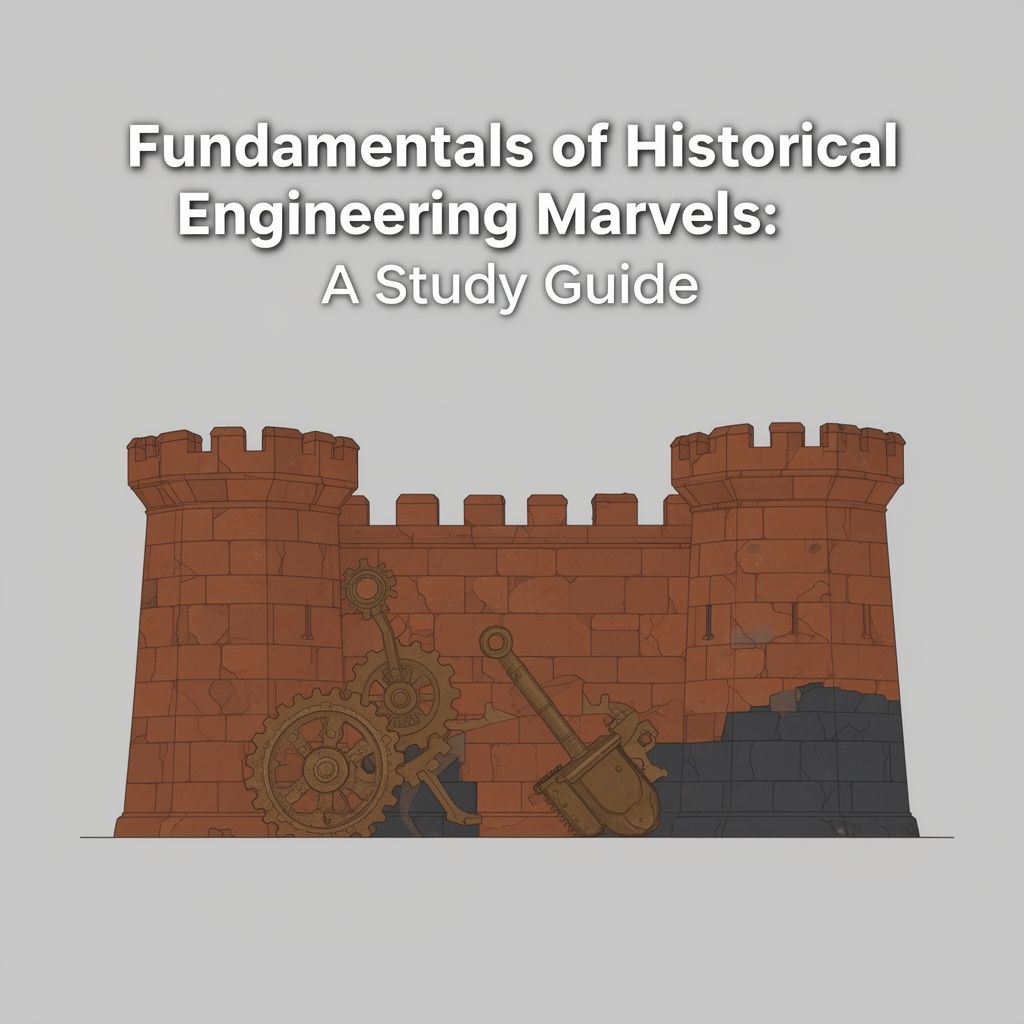
📚 Fundamentals of Historical Engineering Marvels: A Study Guide
Source Information: This study material has been compiled from a combination of copy-pasted text (pages 49-83) and a lecture audio transcript, both provided by the user.
Introduction: Journey Through Engineering Ingenuity
This study guide explores the foundational advancements and continuous innovation in engineering throughout history. We will delve into three pivotal domains: the strategic evolution of military engineering, the foundational advancements in materials science, and the intricate development of mechanical devices and automata. From ancient fortifications to sophisticated timekeeping mechanisms, we will uncover how humanity's relentless pursuit of practical solutions led to remarkable technological breakthroughs, demonstrating the interconnectedness of human inventiveness and problem-solving.
1. ⚔️ The Evolution of Military Engineering
Military engineering is driven by the eternal struggle between offense and defense. Defenses aim to slow, steer, and tire attackers, while attackers develop increasingly sophisticated methods to overcome these obstacles.
1.1. Core Principles of Defense and Attack
- Defenses:
- ✅ High and thick walls
- ✅ Ditches
- ✅ Overlapping fields of fire
- 💡 Goal: Slow, steer, and exhaust attackers.
- Attackers' Response:
- ✅ Siege towers and engines
- ✅ Approach trenches and saps
- ✅ Logistical support to sustain efforts for weeks/months
- Materials:
- Rammed earth/mudbrick: Fast to build, but vulnerable to rain and battering rams.
- Cut stone with lime mortar: Resists blows, but requires time and skilled labor.
1.2. Ancient Near East & Egypt (c. 3000–500 BCE)
- Early Cities: Built with mudbrick walls, timber ties, and ditches, creating layered defenses to absorb shocks.
- Egyptian Engineering: Evidence of systematic field engineering, including planned siege ramps and battering rams.
- Frontier Forts: Along the Nile and in Nubia, these forts integrated walls, sloped glacis (an artificial slope), and water barriers, utilizing the river as a natural defense.
1.3. Classical Greek World (6th–4th C. BCE)
- Polis (City-State): The community structure with an urban center and surrounding countryside.
- Fortifications:
- ✅ Stone curtain walls
- ✅ Towers at intervals
- ✅ Small, hidden sally ports (side gates) for surprise counterattacks, turning the city edge into a controlled fighting platform.
- Naval Engineering: As crucial as land defenses.
- 📚 Triremes: Precision machines optimized for ramming and maneuver.
- Siegecraft: Still basic but more organized.
- ✅ Battering rams
- ✅ Ladders
- ✅ Simple torsion engines (early ballistae)
1.4. Hellenistic Siegecraft (4th–2nd C. BCE)
- Advanced Artillery:
- ✅ Torsion catapults and ballistae with sinew bundles storing more energy than simple bows.
- Siege Towers:
- 📚 Helepolis: Huge siege towers (meaning 'taker of cities').
- ✅ Roofed battering rams moved behind mobile shields (mantlets).
- Sappers: Tunneled to collapse walls from below.
1.5. Roman Military Engineering (3rd C. BCE–5th C. CE)
- Camps:
- 📚 Castra: Meticulously surveyed and entrenched daily camps, ensuring security and order.
- Infrastructure:
- ✅ Strategic roads and bridges for rapid troop concentration.
- ✅ Field pontoon bridges and timber works for swift water crossings.
- Integrated Siegecraft:
- ✅ Circumvallation: Lines of fortifications facing outwards to protect besiegers from relief forces.
- ✅ Contravallation: Lines of fortifications facing inwards to prevent besieged forces from escaping.
- ✅ Artillery and mining operations.
1.6. Theodosian Walls (7th–14th C.)
- Layered Defense: Fused tall curtain walls, towers, a berm, and a moat, resisting siege engines for centuries.
- Greek Fire: A chemical weapon used in naval warfare, making ships and siege platforms high-risk targets.
- Maintenance: Fortified towns remained viable due to robust institutions:
- ✅ Corvée labor: Unpaid labor for public works.
- ✅ Annuities and imperial oversight to maintain walls, gates, and stores.
1.7. Gunpowder Arrives (14th–16th C.)
- Impact of Gunpowder:
- ✅ Early pieces (bombards, cast-bronze guns) cracked high walls and broke towers.
- Defensive Adaptation:
- ✅ Lower, thicker, earth-backed walls.
- ✅ Angled bastions and wide ditches to absorb fire and expose attackers.
- Siege Adaptation:
- ✅ Approach trenches and zig-zag saps.
- ✅ Gun batteries for enfilade (side-on) fire and counter-battery engagements.
- Logistics: Manufacturing and logistics became central due to powder supply, casting quality, and heavy transport.
1.8. Early Modern Fortification: The Trace Italienne (16th–17th C.)
- Response to Gunpowder: Developed as earlier medieval fortifications became obsolete.
- Design:
- ✅ Star-shaped forts with angular bastions.
- ✅ Every wall covered by flanking fire, eliminating "dead ground."
- Standardized Siege Method:
- 1️⃣ Mark a siege line.
- 2️⃣ Dig parallels and zig-zag saps.
- 3️⃣ Set ricochet/breach batteries.
- 4️⃣ Reduce outworks step by step.
1.9. Vauban’s System (Late 17th C.)
- Scientific Approach: Standardized design elements and siege phases, turning fortress war into a reproducible science.
- Optimized Logistics: Roads, depots, bridge trains.
- Enforced Maintenance: Cycles to keep ramparts dry and serviceable.
- 💡 Key Insight: Engineering plus administration became inseparable; geometry on paper required institutions to align men, money, and materials.
2. 🔬 Mastering Materials: From Earth to Steel and Beyond
Ancient and pre-industrial societies developed sophisticated processes to harness natural resources and create the building blocks of their civilizations.
2.1. Controlling Heat and Atmosphere
- Pre-industrial Processing: Depended on controlling heat and airflow in pits, kilns, hearths, and furnaces.
- Charcoal: Provided high, steady heat.
- Bellows and Chimneys: Controlled oxygen for oxidation or reduction processes.
- Temperature Gauges: Workers read color, sound, and spark as practical indicators, lacking thermometers.
2.2. Stone, Brick, and Lime Mortars
- Quarries: Produced blocks shaped with chisels, points, and abrasion.
- Lime Mortar: Used to set shaped stones.
- Bricks: Molded and fired to a ceramic, making walls lighter and faster to build than cut stone.
- Lime Production: From calcining limestone. Mixed with sand and water, it set slowly, bonding masonry.
- Hydraulic Mortars: In some regions, volcanic ash created mortars that could harden underwater.
- Example: Pyramids of Khufu used gypsum/lime mortars for enduring precision stonework.
2.3. Ceramics and Glazes
- Pottery Process:
- 1️⃣ Refine clay, remove stones.
- 2️⃣ Throw or mold vessels.
- 3️⃣ Bisque firing (first firing).
- 4️⃣ Second firing with glaze to form a glassy, sealed, and colored skin.
- Kiln Design: Evolved for efficient hot gas movement and stable high temperatures without collapsing ware.
2.4. Glassmaking and Glassworking
- Glass Composition: Fusion of sand (silica), ash (alkali), and lime baked into a plastic melt.
- Glassblowing: Revolutionary invention allowing fast shaping of hollow forms from a gather on a blowpipe.
- Refinement: Specialized workshops refined clarity, colorants, and annealing (preventing cracking/distortion).
- Example: The Lycurgus Cup (dichroic glass cage-cup) shows advanced glass technique.
2.5. Copper, Bronze, and Early Alloying
- Copper Smelting: Required roasting and reduction in a low-oxygen furnace to free the metal.
- Bronze: Adding tin to copper produced bronze, which cast well and held an edge better than pure copper.
- Casting: Used stone or clay molds.
- Finishing: Grinding and hammering to harden surfaces.
- Example: Riace bronzes (Greek bronze statues) demonstrate early bronze casting.
2.6. From Bloomery Iron to Cast Iron
- Bloomery Iron:
- ✅ Ore reduced to a spongy bloom in bloomeries.
- ✅ Hammered to expel slag, producing wrought iron.
- ✅ Wrought iron could be forged and riveted but not easily cast.
- Cast Iron:
- ✅ Higher-temperature furnaces later produced liquid cast iron.
- ✅ Hard and brittle, but very moldable.
2.7. Making Steel: Carburizing, Quenching, and Crucibles
- Carburizing: Infused carbon into hot iron to create a hardened steel surface.
- Quenching and Tempering: Tuned hardness and toughness by cycling heat and cooling.
- Crucible Steels: In some regions, iron was melted with carbon and fluxes to form uniform, high-quality ingots.
- Example: Damascus steel (wootz process) known for distinctive patterns and high quality.
2.8. Wood, Seasoning, and Joinery (with Shipbuilding)
- Timber Processing: Felled, seasoned (to remove moisture), and cut with saws and adzes.
- Joinery: Mortise-and-tenon or treenails (wooden pegs) for strong joints.
- Shipbuilding:
- ✅ Steam or hot water used to bend planks.
- ✅ Tar, pitch, and caulking to seal seams.
- ✅ Workshop jigs and templates for repeatable shapes (e.g., ribs and frames), showing early standardization.
- Example: Vasa warship (1628) with complex oak hull joinery.
2.9. Powering Processes: Hammers, Mills, and Mechanization
- Waterwheels: Drove trip hammers, bellows, grinding stones, saws, and fulling stocks, increasing speed and consistency.
- Standardized Tools: Tools and gauges allowed workshops to copy parts and maintain quality.
- Early Continuous Processing (17th C.): Rolling, wire-drawing, and slitting mills.
2.10. Textiles, Paper, and Early Composites
- Textiles: Spinning and weaving turned plant/animal fibers into yarn and cloth with controlled twist and tension.
- Example: Bayeux Tapestry (c. 1070s) shows controlled spinning/weaving.
- Papermaking: Beat plant fibers into pulp, formed sheets on a screen, then pressed and dried.
- Laminated Materials: Plywood-like layers, rawhide, or paper with glue acted as early composites.
3. ⚙️ The Dawn of Automation: Mechanical Devices & Automata
This section explores the origins of self-acting machines that laid the groundwork for modern automation and control systems.
3.1. Definition and Purpose of Automata
- 📚 Automaton: A self-acting mechanism powered by weights, springs, water, steam, or air.
- Purposes:
- ✅ Ritualistic/theatrical displays
- ✅ Timekeeping
- ✅ Regulating water flow
- 💡 Introduced early control and programming ideas.
3.2. Four Engineering Building Blocks
Automata relied on these fundamental components:
- 1️⃣ Gear trains: Scale speed/torque, reverse/route motion.
- 2️⃣ Cams & pinned cylinders: Generate repeatable sequences (early programming).
- 3️⃣ Escapements: Release energy in controlled pulses (regulating motion).
- 4️⃣ Feedback: Floats/valves regulate flow automatically (proto-control systems).
3.3. Everyday Roots: Water Lifting & Water Clocks
- Shaduf: Counterbalanced pole for lifting water for irrigation.
- Clepsydra (Water Clock): Measured time by regulated water flow.
- 💡 These pragmatic devices formed the base for more complex automata.
3.4. Hellenistic Ingenuity: Heron of Alexandria
- Pneumatic and Hydraulic Mechanisms: Powered temple theatrics (e.g., self-opening doors).
- Aeolipile: A steam-driven rotor, one of the earliest known steam engines.
- 💡 Blended spectacle with clear demonstrations of mechanical principles.
3.5. A Mechanical "Computer": The Antikythera Mechanism
- Multi-stage Gear Trains: Modeled celestial movements and predicted eclipses.
- Advanced Bronze Gear Design: A benchmark for analog computation in antiquity.
- 💡 Demonstrated advanced understanding of mechanical calculations.
3.6. Islamic Golden Age Contributions
- Banū Mūsā brothers (Kitab al-Hiyal al-Naficah):
- ✅ Cataloged ~100 ingenious mechanisms.
- ✅ Included automatic fountains, self-trimming lamps.
- 💡 Built on Hellenistic sources, extending ideas of programmability.
- Al-Jazari's Machines:
- ✅ Showpiece automata like the Elephant Clock and mechanical musicians.
- ✅ Used pinned cylinders and cams for timed sequences (early programming).
- 💡 His illustrated treatise enables modern reconstructions.
3.7. China’s Clockwork Leap: Su Song
- Astronomical Clock-Tower (11th C.):
- ✅ United hydraulic power, an escapement action, and an endless chain transmission.
- ✅ Synchronized celestial displays with timekeeping.
- 💡 Achieved decades before similar European combinations, highlighting independent development.
3.8. European Clocktowers & Automata
- Civic Timekeeping: Integrated automata (apostles, roosters, skeletons striking the hour).
- Mechanisms: Driven by gears, cams, and levers.
- 💡 Transformed civic timekeeping into shared public theater.
- Example: The Prague Orloj (astronomical clock).
3.9. Escapements & the Rise of Precision
- Huygens (1656): Invented the pendulum clock, with mathematical analysis of oscillation.
- Anchor Escapement:
- ✅ Smaller pendulum swing.
- ✅ Better isochronism (constant period of oscillation regardless of amplitude).
- 💡 Precision timing enabled more reliable and sophisticated automata.