 Podit
Podit
This study material has been compiled from a copy-pasted text document and a lecture audio transcript.
📚 THM103.01 Business Administration Final Study Guide
Introduction to Business Administration Fundamentals
Welcome to this comprehensive study guide for Business Administration. This material provides a structured overview of essential concepts, from strategic planning and organizational design to operations management and human capital. The goal is to equip you with a clear understanding of the core elements that drive business effectiveness and efficiency, helping you prepare for your final examination.
1. Types of Strategy
Strategy defines the direction and scope of an organization over the long term. There are three primary types:
1.1. Corporate Strategy
📚 Definition: Strategy that determines the firm’s overall growth and how it manages its different businesses or product lines. It defines the firm's overall growth trajectory. ✅ Example: A company decides to expand into international markets.
1.2. Business (Competitive) Strategy
📚 Definition: Strategy at the business or product level to improve competitive position within its specific market. ✅ Example: A restaurant lowers prices to compete with nearby restaurants.
1.3. Functional Strategy
📚 Definition: Strategy used by departments (e.g., marketing, production, human resources) to achieve corporate goals through productivity. ✅ Example: The marketing department increases social media advertising efforts.
2. Hierarchy of Strategy
Strategies exist in a clear hierarchy, ensuring coherent organizational direction: 1️⃣ Corporate Strategy → 2️⃣ Business Strategy → 3️⃣ Functional Strategy
✅ Example:
- Corporate: Grow the company
- Business: Beat competitors
- Functional: Improve marketing
3. Formulating Strategy
The process of creating a strategy involves several key steps:
3.1. Step 1: Setting Strategic Goals
📚 Definition: Deciding what the organization wants to achieve. ✅ Example: Increase sales by 20%.
3.2. Step 2: Analyzing Organization and Environment (SWOT)
📚 Definition: Analyzing strengths, weaknesses, opportunities, and threats. ✅ Example: Strong brand, high costs, new market opportunity, strong competitors.
3.3. Step 3: Matching Organization and Environment
📚 Definition: Using strengths to take advantage of opportunities. ✅ Example: Using a strong brand image to enter a new market.
4. SWOT Analysis
SWOT analysis is a strategic planning tool used to identify internal and external factors that are favorable and unfavorable to achieving a goal.
- Strengths (S)
- 📚 Definition: Internal advantages of the business.
- ✅ Example: Good reputation.
- Weaknesses (W)
- 📚 Definition: Internal disadvantages of the business.
- ✅ Example: High costs.
- Opportunities (O)
- 📚 Definition: External opportunities in the environment.
- ✅ Example: Growing market.
- Threats (T)
- 📚 Definition: External threats from the environment.
- ✅ Example: New competitors.
5. Hierarchy of Plans
Strategic vision is translated into actionable steps through a hierarchy of plans:
5.1. Strategic Plan
📚 Definition: A long-term plan about company goals, typically spanning several years. ✅ Example: Open 10 new branches in 5 years.
5.2. Tactical Plan
📚 Definition: A short-term plan to support strategic plans, usually for 1-3 years. ✅ Example: Hire new staff for new branches.
5.3. Operational Plan
📚 Definition: Daily, weekly, or monthly plans that cover specific activities. ✅ Example: Daily work schedule.
6. Contingency Planning & Crisis Management
6.1. Contingency Planning
📚 Definition: Planning for possible future problems or unexpected events. ✅ Example: Identifying a backup supplier in case the main supplier fails.
6.2. Crisis Management
📚 Definition: How organizations deal with emergencies and critical situations. ✅ Example: Actions taken during a pandemic.
7. Corporate Culture
7.1. Definition
📚 Definition: Shared values, beliefs, and norms within an organization. ✅ Example: Teamwork and respect in the workplace.
7.2. Communicating Culture & Managing Change
💡 Key Points:
- Managers must understand the existing culture.
- Share the culture with employees.
- Reward employees who support the culture. ✅ Example: Promoting employees who follow company values.
8. Organizing the Business
8.1. Organizational Structure
📚 Definition: The specification of jobs and how they relate to each other, essentially defining who reports to whom within a company. ✅ Example: Determining reporting lines in a company.
8.2. Organization Chart
📚 Definition: A diagram that shows the structure of a company and how employees are related to each other. It visually represents the company's hierarchy.
What Does an Organization Chart Show?
- ✅ Positions (jobs)
- ✅ Levels of management
- ✅ Chain of command
- ✅ Reporting relationships
Detailed Example: Restaurant Organization Chart (Text Form)
- General Manager
- Operations Manager
- Restaurant Manager
- Head Chef
- Line Cooks
- Service Supervisor
- Waiters / Waitresses
- Head Chef
- Finance Manager
- Accountant
- Human Resources Manager
- HR Assistant
- Restaurant Manager
- Operations Manager
Chain of Command in This Chart
Waiter → Service Supervisor → Restaurant Manager → Operations Manager → General Manager
Why an Organization Chart Is Important?
- ✅ Shows authority clearly
- ✅ Avoids confusion
- ✅ Improves communication
Short Exam Answer Tip
💡 An organization chart shows the structure of a company and reporting relationships. For example, in a restaurant, waiters report to the service supervisor, who reports to the restaurant manager.
8.3. Chain of Command
📚 Definition: The reporting relationships in a company, illustrating the line of authority. ✅ Example: Employee → Supervisor → Manager.
9. Departmentalization
📚 Definition: Grouping jobs into logical units to streamline operations and focus resources effectively.
9.1. Types of Departmentalization
- Functional Departmentalization
- 📚 Definition: Grouping by functions.
- ✅ Example: Marketing, Finance, Production departments.
- Product Departmentalization
- 📚 Definition: Grouping by products.
- ✅ Example: Separate departments for food and beverages.
- Process Departmentalization
- 📚 Definition: Grouping by production process stages.
- ✅ Example: Cooking, packaging, delivery stages.
- Customer Departmentalization
- 📚 Definition: Grouping by customer type.
- ✅ Example: Individual customers vs. corporate customers.
- Geographic Departmentalization
- 📚 Definition: Grouping by location.
- ✅ Example: Europe, Asia, America offices.
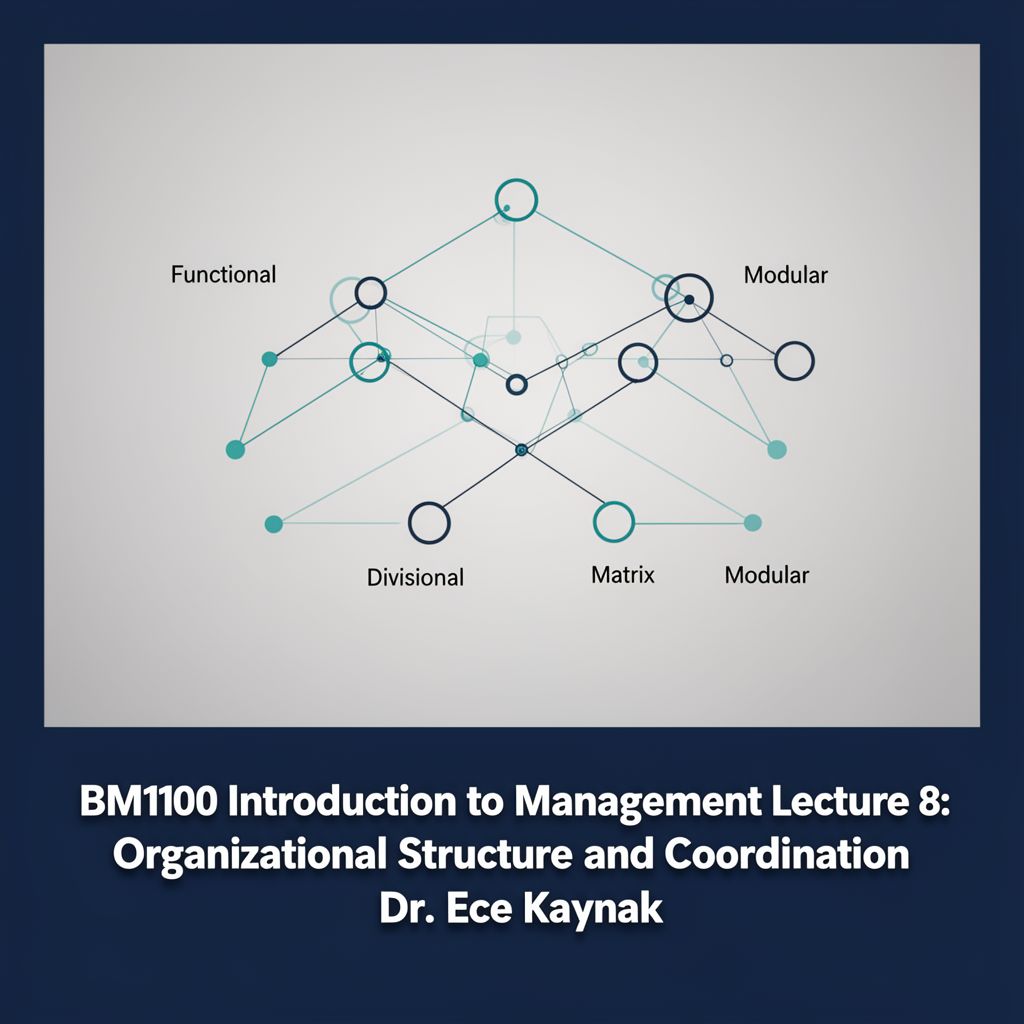
10. Basic Forms of Organizational Structure
10.1. Functional Structure
📚 Definition: Structure based on functions; common in small and medium firms. ✅ Example: Marketing, operations, finance departments.
10.2. Divisional Structure
📚 Definition: Structure based on products or divisions. ✅ Example: Separate divisions for each product line.
10.3. Matrix Structure
📚 Definition: A combination of functional and divisional structures, where employees report to multiple managers. ✅ Example: An employee reports to both a product manager and a functional manager.
11. Centralization & Decentralization
These terms describe where decision-making authority lies within an organization.
11.1. Centralized Organization
📚 Definition: Decision-making authority is concentrated at the top management level. ✅ Example: Only top managers make decisions.
11.2. Decentralized Organization
📚 Definition: Decision-making authority is delegated to lower levels of the organization. ✅ Example: Store managers can make decisions.
12. Tall & Flat Organizations
These describe the number of management layers in an organization.
12.1. Flat Organization
📚 Definition: Characterized by few management levels, allowing a manager to supervise many employees directly. ✅ Example: One manager supervises 10 employees.
12.2. Tall Organization
📚 Definition: Characterized by many management levels, with numerous supervisors between workers and top management. ✅ Example: Many supervisors between a worker and the top manager.
13. Span of Control
📚 Definition: The number of people supervised by one manager. This is a key concept influencing the flatness or tallness of an organization. ✅ Example: One manager supervises 10 employees.
14. Delegation
📚 Definition: Assigning work and authority to subordinates.
Steps in Delegation:
- Responsibility: Assigning the task duty.
- Authority: Granting the power to make decisions necessary to complete the task.
- Accountability: Holding the subordinate responsible for the results. ✅ Example: A manager gives a task and the necessary authority to an employee.
15. Communication in Organization
15.1. Formal Communication
📚 Definition: Official communication channels within the organizational hierarchy.
- Upward: Employee → Manager
- Downward: Manager → Employee
- Horizontal: Between employees at the same level
15.2. Informal Communication
📚 Definition: Unofficial communication that occurs outside formal channels. ✅ Examples: Grapevine (rumors), social media interactions among colleagues.
16. Operations Management
16.1. What Does Operations Mean?
📚 Definition: All activities involved in making goods and services for customers. ✅ Example: Producing food in a restaurant.
16.2. Goods vs. Service Operations
- Goods Production
- 📚 Definition: Producing tangible products.
- ✅ Example: Making bread, books, cars.
- Service Production
- 📚 Definition: Producing intangible services.
- ✅ Example: Education, transportation, hotel service.
16.3. Operations Management
📚 Definition: Managing activities that transform resources (inputs) into products or services (outputs). ✅ Example: Turning raw food into meals.
16.4. Resource Transformation Process
1️⃣ Inputs (e.g., ingredients) → 2️⃣ Transformation (e.g., cooking) → 3️⃣ Outputs (e.g., meal)
16.5. Operations Capability
📚 Definition: A special ability to outperform competitors in production or service delivery. ✅ Example: Fast delivery.
17. Goods Production Processes
17.1. Make-to-Order
📚 Definition: Custom-made products produced only after an order is received. ✅ Example: A tailor-made dress.
17.2. Make-to-Stock
📚 Definition: Standard products produced in large quantities and held in inventory for immediate sale. ✅ Example: Packaged food in markets.
18. Service Production & Customer Contact
18.1. Low-Contact System
📚 Definition: A service system where the customer is not directly involved in the service process. The service is performed without the customer's direct presence. 💡 Key Idea: Service is performed without the customer present. ✅ Examples: Postal service, laundry service (clothes washed in back area), online banking transaction. 📝 Exam Sentence: In a low-contact system, the customer is not part of the service process.
18.2. High-Contact System
📚 Definition: A service system where the customer is directly involved in the service process. The customer is an integral part of the service delivery. 💡 Key Idea: Service is delivered with the customer present. ✅ Examples: Restaurant service, bus transportation, hotel stay, hair salon. 📝 Exam Sentence: In a high-contact system, the customer is part of the service process.
18.3. Super Easy Comparison (For Exams)
| Feature | Low Contact | High Contact | | :---------------- | :-------------------- | :-------------------- | | Customer Presence | Not present | Present | | Service Location | Back-office service | Front-office service | | Interaction | Less interaction | More interaction | | Example | Cargo/Postal Service | Restaurant |
18.4. Final Exam Tip
💡 Low-contact systems do not require customer presence, such as postal services. High-contact systems require customer participation, such as restaurants.
19. Operations Planning
19.1. Capacity Planning
📚 Definition: Determining how much a company can produce. ✅ Example: A restaurant serves 200 meals per day.
19.2. Location Planning
📚 Definition: Deciding where to produce goods or offer services. ✅ Example: Opening a factory near raw materials.
19.3. Layout Planning
📚 Definition: Arrangement of machines, equipment, and workspaces. ✅ Example: Kitchen layout in a restaurant.
19.4. Quality Planning
📚 Definition: Ensuring products or services meet customer needs and expectations.
- Performance: How well it works.
- Consistency: Same quality every time. ✅ Example: Ensuring the same taste in every meal.
19.5. Methods Planning
📚 Definition: Improving processes to reduce waste and increase efficiency. ✅ Example: Implementing a faster checkout process.
20. Operations Scheduling
20.1. Master Schedule
📚 Definition: A high-level plan indicating what will be produced and when. ✅ Example: Weekly production plan.
20.2. Detailed Schedule
📚 Definition: Specific daily work plans.
20.3. Staff Schedule
📚 Definition: Determining who will work and when.
20.4. Project Schedule
📚 Definition: Planning for large, complex projects.
- Gantt Chart: Shows tasks and their timelines.
- PERT Chart: Shows the sequence of tasks and the critical path (longest sequence of tasks that must be completed on time for the project to finish on schedule).
21. Operations Control
21.1. Operations Control
📚 Definition: Monitoring performance and correcting problems in the production process.
21.2. Materials Management
📚 Definition: Managing the flow of materials from acquisition to delivery. ✅ Includes: Supplier selection, purchasing, transportation, warehousing, inventory control.
21.3. Quality Control
📚 Definition: Ensuring products meet established quality standards.
21.4. Total Quality Management (TQM)
📚 Definition: A continuous quality improvement approach involving all employees. ✅ Example: Employees working together to solve quality problems.
21.5. ISO Standards
- ISO 9000: International standards for quality management systems.
- ISO 14000: International standards for environmental management systems.
21.6. Lean Production & Just-in-Time (JIT)
- Lean Production:
- 📚 Definition: A production approach that eliminates waste in all forms.
- Just-in-Time (JIT):
- 📚 Definition: A system where materials arrive exactly when needed for production, minimizing inventory.
21.7. Supply Chain
📚 Definition: The entire flow of materials, information, and finances from suppliers to customers. ✅ Example: Farmer → Factory → Market → Customer.
22. Employee Behavior
22.1. Definition
📚 Definition: The pattern of actions of employees that affects organizational performance. ✅ Example: Working hard, helping others.
22.2. Forms of Employee Behavior
22.2.1. Performance Behaviors
📚 Definition: Behaviors that directly improve productivity and contribute to job performance. ✅ Example: Completing tasks on time.
22.2.2. Organizational Citizenship
📚 Definition: Voluntary behaviors that indirectly benefit the organization, going beyond formal job requirements.
- Altruism: Helping others without expecting a reward.
- ✅ Example: Helping a coworker.
- Courtesy: Being polite and respectful to others.
- ✅ Example: Informing coworkers in advance about changes.
- Conscientiousness: Being disciplined and performing beyond minimum requirements.
- ✅ Example: Always coming to work early.
- Civic Virtue: Representing and supporting the organization positively.
- ✅ Example: Defending the company outside of work.
22.2.3. Counterproductive Behaviors
📚 Definition: Behaviors that harm organizational performance.
- Absenteeism: Not coming to work.
- Turnover: Employees leaving the company (high turnover rate indicates problems).
23. Personality at Work
23.1. Personality
📚 Definition: Stable psychological traits that make people different from one another.
23.2. The Big Five Personality Traits
📊 These five broad dimensions describe human personality:
- Agreeableness:
- 📚 Definition: The ability to get along with others.
- ✅ Example: A friendly employee.
- Conscientiousness:
- 📚 Definition: Being organized, responsible, and dependable.
- ✅ Example: An always-prepared worker.
- Emotionality (Neuroticism):
- 📚 Definition: Refers to an individual's emotional stability or instability, often described as a positive or negative emotional outlook.
- ✅ Example: A calm vs. a nervous employee.
- Extraversion:
- 📚 Definition: Comfort with social interaction and assertiveness.
- ✅ Example: A talkative employee.
- Openness (to Experience):
- 📚 Definition: Openness to new ideas, experiences, and creativity.
- ✅ Example: An employee accepting new methods.
24. Matching People and Jobs
24.1. Psychological Contract
📚 Definition: The mutual expectations between an employee and the organization, often unwritten. ✅ Example: Employee expects salary; company expects performance.
24.2. Person–Job Fit
📚 Definition: The match between an employee's abilities, skills, and personality, and the requirements of the job. ✅ Example: A chef working in a kitchen.
25. Motivation
25.1. Motivation
📚 Definition: The forces that cause people to act, driving them towards goals.
25.2. Classical Theory of Motivation
📚 Definition: Suggests that people are primarily motivated only by money.
25.3. Theory X and Theory Y
- Theory X:
- 📚 Definition: Assumes people are lazy, dislike work, and avoid responsibility.
- Theory Y:
- 📚 Definition: Assumes people are motivated, enjoy work, and seek responsibility.
25.4. Maslow’s Hierarchy of Needs
📚 Definition: A theory stating that human needs must be satisfied step by step, from basic physiological needs to self-actualization. 1️⃣ Physiological → 2️⃣ Safety → 3️⃣ Social → 4️⃣ Esteem → 5️⃣ Self-actualization
25.5. Two-Factor Theory (Herzberg)
📚 Definition: Proposes that job satisfaction depends on two separate factors: hygiene factors (prevent dissatisfaction, e.g., salary) and motivators (create satisfaction, e.g., achievement). ✅ Example: Hygiene: Salary; Motivator: Achievement.
25.6. Expectancy Theory
📚 Definition: States that people work harder if they believe their effort will lead to good performance, which will then lead to desired rewards. ✅ Example: Employees are motivated if they believe effort leads to reward.
25.7. Equity Theory
📚 Definition: Suggests that people compare their inputs (effort, skills) and outputs (pay, recognition) with those of others, seeking fairness. ✅ Example: Expectation of same pay for the same work.
26. Leadership and Decision Making
26.1. Leadership
📚 Definition: The process of motivating, inspiring, and influencing others to achieve organizational goals. ✅ Example: A manager motivates employees to reach goals.
26.2. Management vs. Leadership
- Management:
- 📚 Focuses on: Planning, organizing, and controlling resources and processes.
- Leadership:
- 📚 Focuses on: Inspiring, guiding, and influencing people. ✅ Example: A manager plans work, while a leader inspires people.
27. Early Approaches to Leadership
27.1. Trait Approach
📚 Definition: Suggests that leaders are born with special traits or characteristics that make them effective. ✅ Traits: Intelligence, self-confidence, energy. ✅ Example: A confident and intelligent leader.
27.2. Behavioral Approach
📚 Definition: Proposes that leadership can be learned through specific behaviors, focusing on what leaders do.
- Task-Focused Behavior:
- 📚 Definition: Leaders focus on tasks, efficiency, and performance.
- ✅ Example: Giving clear instructions.
- Employee-Focused Behavior:
- 📚 Definition: Leaders focus on employee satisfaction, well-being, and development.
- ✅ Example: Supporting employees.
28. Modern Leadership Approaches
28.1. Situational Leadership
📚 Definition: Argues that the most effective leadership style depends on the specific situation, including the readiness of followers and the context. ✅ Example: Different leadership styles are effective in a crisis versus normal times.
Conclusion
This study guide has provided a foundational understanding of key business administration concepts, from strategic planning and organizational structures to operations management and human capital dynamics. Mastering these topics is crucial for understanding how organizations operate, grow, and succeed. Reviewing these concepts, definitions, and examples will prepare you for your final examination.