 Podit
Podit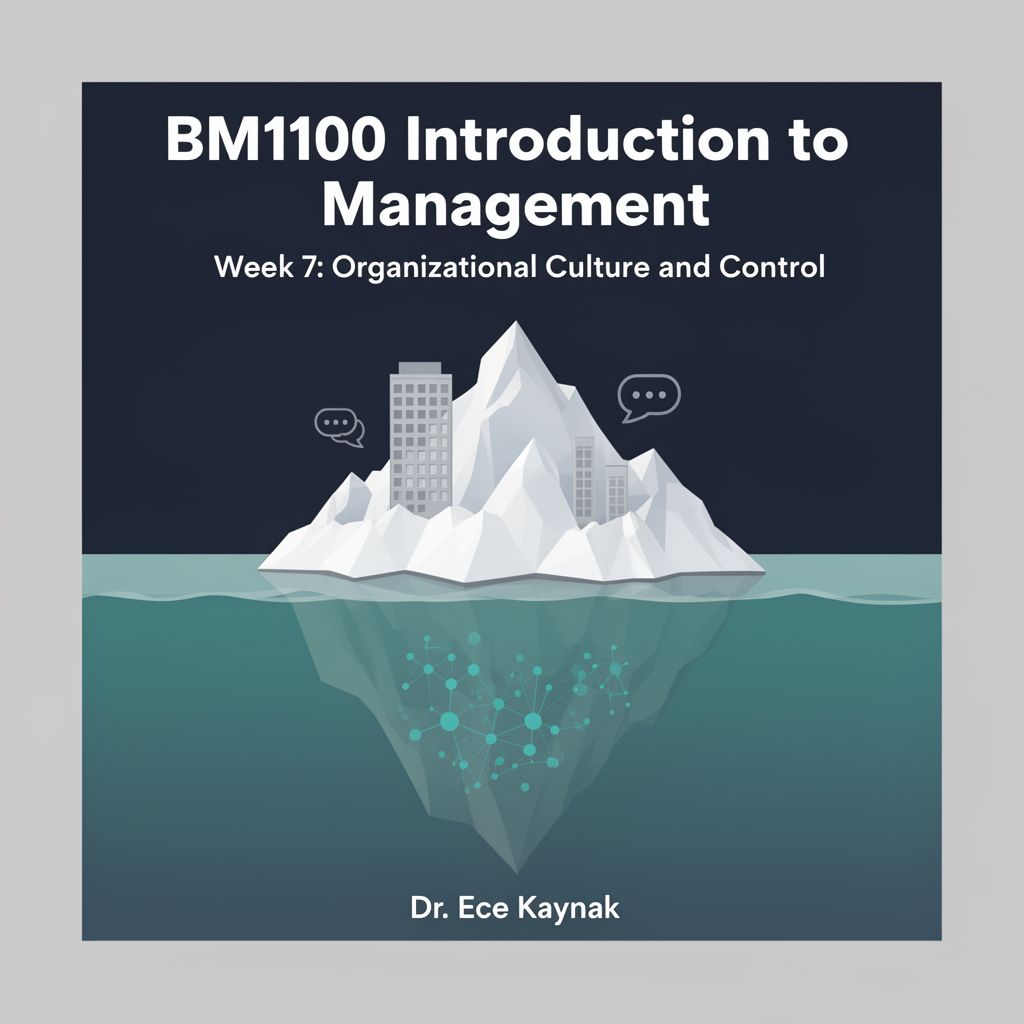
📚 BM1100 Introduction to Management: Organizational Culture and Control
Source Information: This study material is compiled from a lecture audio transcript and copy-pasted text (likely lecture slides) provided for Week 7 of the BM1100 Introduction to Management course, delivered by Dr. Ece Kaynak.
🎯 Learning Objectives
By the end of this study material, you should be able to:
- ✅ Define organizational culture and identify its various levels.
- ✅ Understand how to identify the underlying assumptions of an organization's culture.
- ✅ Explain why organizational culture is crucial for control and coordination.
- ✅ Differentiate between various control mechanisms in organizations.
- ✅ Analyze the relationship between organizational culture and firm performance.
- ✅ Describe how leaders create, maintain, and change organizational culture through attraction, selection, attrition, and socialization.
1. 📚 What is Organizational Culture?
Organizational culture is a fundamental concept that shapes how individuals within an organization perceive, think, feel, and behave.
- Definition: Organizational culture is a system of assumptions and beliefs shared by a group of people that profoundly shapes their perceptions, thoughts, feelings, and behaviors (Schein, 1992; 1996).
- Core Idea: It's often summarized as "how we do things around here."
- Learning & Reproduction:
- Culture is taught to new members, guiding them on correct ways to perceive, think, and feel regarding issues like decision-making or collaboration.
- It naturally reproduces itself over time.
- If not consciously and strategically shaped by leaders, culture will develop organically in any social group.
2. 📊 Levels of Organizational Culture
Organizational culture exists on three distinct levels, ranging from easily observable to deeply ingrained and invisible.
2.1. 1️⃣ Artifacts (Visible but Hard to Interpret)
- Description: These are the visible and audible products of culture. They are easy to see but often hard to interpret without understanding the deeper levels.
- Examples:
- Technology and art within the workplace.
- Office layout and design.
- Dress codes (formal vs. casual).
- Visible behavioral patterns (e.g., how meetings are conducted).
- Symbols, stories, and texts (e.g., company slogans, historical anecdotes).
2.2. 2️⃣ Espoused Values (Greater Awareness)
- Description: These are the stated values and norms that people say are the reasons for their behavior. They represent what is considered right or wrong, important or unimportant. Insiders can verbalize these values.
- Example: A company proudly stating, "We are an innovative firm."
2.3. 3️⃣ Underlying Beliefs and Assumptions (Taken-for-Granted, Invisible)
- Description: These are the deepest level – unconscious, taken-for-granted, shared beliefs and schemas that determine how group members perceive, think, and feel about situations. They are invisible and must be inferred.
- Examples:
- "Schools should educate."
- "Businesses should be profitable."
- "Innovation requires the input of everyone."
- 💡 Insight: These assumptions are the most difficult to decipher but are fundamental to the organization's core identity and operations.
3. 🔍 Identifying Underlying Assumptions
To understand an organization's deepest cultural layers, one must infer its underlying assumptions by asking critical questions across several dimensions:
- 1. The organization’s relationship to its environment:
- Who are considered main stakeholders? Who receives the most attention?
- How should the organization relate to its stakeholders (e.g., collaboration, competition)?
- 2. The nature of reality and truth:
- Who has the authority to decide what is true vs. false, good vs. bad?
- How are "good decisions" made (e.g., data-driven, consensus, hierarchical)?
- How important are history and tradition versus change and innovation?
- 3. The nature of human nature:
- Should people be trusted? Are they naturally inclined to behave reliably?
- Can people develop and grow? How much can they learn, change, and adapt?
- 4. The nature of human activity:
- What is expected from people? How should they spend their time and efforts?
- What is the acceptable/desirable overlap between work, family, and fun?
- 5. The nature of human relationships:
- How should people relate to their peers, superiors, and subordinates (e.g., collegial, paternalistic, formal)?
- How should power and resources be distributed internally?
- How important is individual work versus collective, team work?
4. 💡 Why Does Culture Matter?
Culture is a powerful mechanism for controlling and coordinating behavior within organizations.
4.1. Mechanisms to Control and Coordinate Work
Organizations employ various control mechanisms:
- 1️⃣ Simple Control (Coercive Control):
- Description: Direct, personal control exercised by one person over another.
- Example: A manager directly supervising and instructing an employee.
- 2️⃣ Technical Control:
- Description: Control embedded in technical systems or processes.
- Example: An assembly line dictating the pace and sequence of work.
- 3️⃣ Bureaucratic Control:
- Description: Control embedded in formal rules, policies, and a hierarchical structure. Decisions are often centralized.
- Characteristics: Efficient for routine operations but can be less adaptive.
- 4️⃣ Normative Control through Culture:
- Description: Shared values, norms, and expectations guide and control behavior.
- Examples:
- Google: "Do the right thing."
- Amazon: "Obsess over the customer."
- Netflix: Expense policy states, "Act in Netflix’s best interest."
- Benefits:
- Strong norms provide clear guidelines, increasing clarity about priorities.
- Frees leaders from constant monitoring as employees internalize culture and self-monitor (and even peer-monitor).
- Feels less obtrusive and more natural than other controls due to fewer explicit rules, despite being pervasive.
- When it's especially important:
- When employees face unique problems and actions cannot be easily specified by supervisors (common for knowledge workers).
- When behaviors cannot be directly observed.
5. 📈 Culture and Firm Performance
A strong and strategically relevant culture can significantly impact an organization's success.
- Benefits of a Strong Culture:
- ✅ Guides behavior while often being experienced as autonomy, which is desirable for knowledge workers.
- ✅ Conserves management resources by reducing the need for direct oversight.
- ✅ Generates commitment among employees.
- ✅ Taps into employees' intrinsic motivations.
- ✅ Can improve organizational performance (e.g., sales volume, revenues, market share, stock prices).
- What makes a culture "strong"?
- Core values are intensely held and widely shared.
- Consensus across the organization on what is important and valued.
- Intensity of approval/disapproval attached to expectations.
- ⚠️ Risks of a Strong Culture:
- Incongruence: If the culture is misaligned with the external environment, it can hinder adaptation.
- Inertia: A strong culture can become a source of inflexibility, preventing necessary change.
- 💡 Key Principle: "You get the culture you reward and reinforce, not the one you hope for!" Culture is more than just a mission statement or vision.
- Toxic Culture: A negative or "toxic" culture can lead to demotivation, low morale, and significantly impair organizational health and performance.
6. 🛠️ How is Culture Cultivated and Maintained by Leaders?
Organizational culture is continuously shaped and reinforced through a cycle of attraction, selection, attrition, and socialization.
6.1. Attraction & Selection
- Description: Organizations attract and select individuals whose values and beliefs align with the existing culture.
- Tools for Cultural Fit:
- Job descriptions that reflect cultural values.
- Recruiting events and materials.
- Employee referrals.
- Peer interviews to assess fit.
- Explicit hiring criteria for cultural alignment.
- Importance: Wrong hires are costly.
- Balancing Act: It's crucial to balance the need for cultural cohesion with the need for diversity to foster innovation and varied perspectives.
6.2. Socialization
- Description: The process by which new members learn the values, norms, and expected behaviors of the organization. Culture is learned.
- Stages & Methods:
- Onboarding & Training: Initial formal processes where peers and supervisors transmit values, assumptions, and task-relevant information.
- Formal vs. Informal: Socialization can be structured (e.g., Google's "classes" for new hires) or unstructured. Formal enculturation can foster belonging.
- Ongoing Process: Socialization doesn't end after onboarding; it's continuous.
- Reinforcement Mechanisms:
- Stories and Symbols: Powerful ways to communicate and reinforce culture. Myths from history (e.g., HP garage) inspire and motivate. Narratives turn ordinary actions into symbols of excellence.
- Rituals: Routines with symbolic value that support underlying cultural assumptions (e.g., "all hands" meetings, celebrations of "wins").
- Language and Metaphor: Specialized language used by insiders signals shared assumptions (e.g., Amazon calling itself "peculiar"). Metaphors (e.g., "shoot for the moon") crystalize culture.
6.3. Attrition
- Description: Individuals who do not fit the culture, despite initial selection and socialization efforts, may eventually leave the organization, either voluntarily or involuntarily. This further reinforces the existing culture.
6.4. The Role of Leaders in Cultivating and Maintaining Culture
Leaders are pivotal in shaping and sustaining culture:
- Setting the Tone: Leader actions, behaviors, and attitudes set the standard for the entire organization.
- Reinforcement:
- Modeling desired behaviors and attitudes.
- Instituting systems that reward culturally aligned behaviors.
- Ensuring values drive recruitment decisions.
- Creating and promoting symbols, rituals, and language that continually reinforce the culture.
7. 🔄 Creating Culture Change in Organizations
Creating culture change is a complex and challenging endeavor. It requires sustained leadership commitment and strategic interventions across all the dimensions mentioned above (attraction, selection, socialization, and leader actions). It often involves a deliberate shift in underlying assumptions, espoused values, and observable artifacts.
8. 📝 Summary & Key Takeaways
- Strong Culture = Performance: A robust organizational culture significantly impacts organizational performance.
- Leader's Responsibility: Leaders are crucial for setting, maintaining, and continually aligning culture with environmental demands.
- Culture Cycle: Culture is cultivated and maintained through a continuous cycle of attraction, selection, socialization, and attrition.
- Control Mechanism: Culture serves as a powerful means of control and coordination, especially vital in modern, knowledge-based organizations where:
- Information processing needs are high.
- Employee behaviors cannot be easily observed and monitored.
- The competitive context demands agility and adaptability.
⚠️ REMINDER: Attend tutorials this week to get started on your team coursework!
NEXT WEEK: Organizational Structure