 Podit
Podit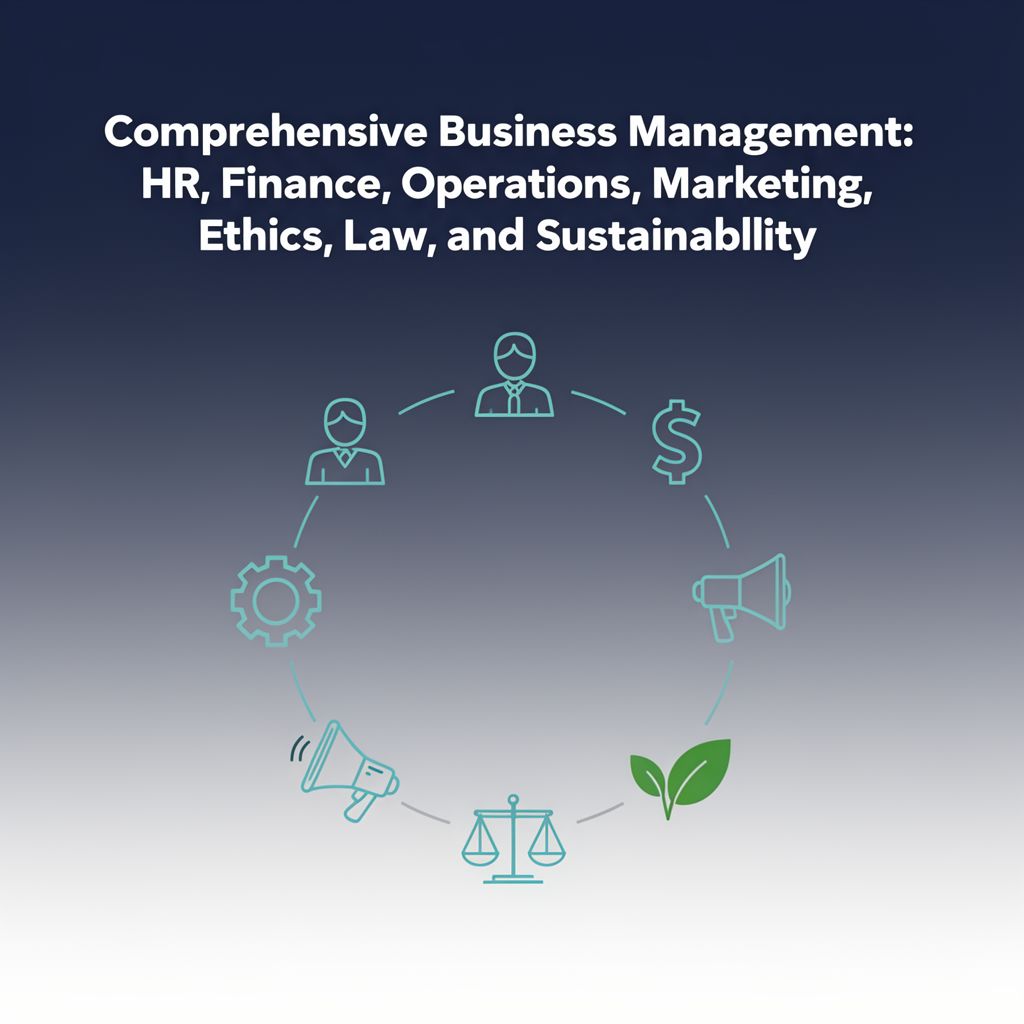
This study material has been compiled and organized from the provided lecture audio transcript and copy-pasted text (slides) to offer a comprehensive overview of key business management fundamentals.
📚 Introduction to Business Management Fundamentals
This study guide covers essential principles of business management, crucial for understanding and navigating the complexities of modern organizations. We will explore Human Resources Management, Accounting and Finance, Operations Management, Marketing Management, Social Responsibility, Ethics and Law, and Environmental Sustainability.
1. 🧑🤝👩 Human Resources Management (HRM)
📚 Definition and Importance
- Definition: HRM is the function of attracting, developing, and maintaining a sufficient number of skilled employees to perform activities that achieve organizational goals.
- Importance: It is critical for both top management and other managers within an organization.
🌍 Environmental Influences on HRM
Organizations operate within an environment, and many factors influence their human resources. Employees have diverse needs, wants, and expectations that change over time. Satisfied employees contribute to high performance.
✅ Internal Environmental Factors
- Personal Factors: Employee needs, wants, expectations, common values, perception of roles, motivation, and abilities.
- Job Characteristics: Influence of different jobs, workload, job security, and working conditions.
- Interpersonal Relations: Leadership styles, formal and informal groups.
- Organizational Factors: Top management, organizational size, industry characteristics, competitive strategy, mergers, and technology.
✅ External Environmental Factors
- Workforce Diversity: Demographic characteristics of the community's workforce (education level, gender, age groups).
- External Sources of HR: The pool from which organizations recruit (vocational schools, universities, unions, HR agencies).
- Competitors: Organizations often compete for similar qualified workforces.
- Regulators: Government regulations on labor issues (minimum wage, health and safety laws).
⚙️ Functions of HRM
The core functions of HRM are:
- HR Planning
- HR Recruitment and Selection
- HR Training and Development
- HR Performance Appraisal
- HR Compensation
1. HR Planning
- Definition: Determining the right amount of people with the right qualifications at the right time and place to achieve company goals.
- Strategic Link: HRM should be linked to the company's overall strategic mission and goals.
🔢 Determining the Right Number of People
- Past Experiences: Trend analysis and ratio analysis to predict future needs.
- Evaluating Workloads: Amount of production, number of customers.
- Production Technology: Type of technology utilized.
- Practices of Other Companies: Benchmarking similar goods/services producers.
🎓 Determining the Right Qualification of People
- Job Analysis: Detailed examination of all jobs to describe tasks, required knowledge, skills, physical activities, and abilities.
- Job Analysis Methods:
- Interview method (individual employees, groups, supervisors)
- Structured questionnaire method
- Observation method (noting physical activities)
- Diary method (workers log activities and time spent)
- Results of Job Analysis:
- Job Description: A written statement describing what the worker does, how, and working conditions (job identification, summary, responsibilities, authority, performance standards, working conditions, specifications).
- Job Specification: Lists the "human requirements" for a job (qualifications, skills, talents).
- Job Evaluation: Determines the relative value of jobs within the organization, crucial for compensation management.
- Job Analysis Methods:
2. HR Recruitment and Selection
- Importance: Selecting the right employee is vital to avoid low productivity from unqualified personnel.
- Recruiting: The "candidate search and find" process to develop a candidate pool for vacant positions.
- Internal Sources: Promotions, transfers, employee recommendations.
- External Sources: Advertising (want-ads), vocational schools, universities, unions, HR agencies.
- Selection: The process of choosing candidates from the pool.
- Systematic Way (Internal): Career planning.
- Steps (External):
- Application form (records interest, provides profile, basic record for hired, research selection effectiveness).
- Tests (Cognitive ability, personality, physical, achievement).
- Interviews (Face-to-face to probe areas not covered by forms/tests).
- Types of Interviews: Structured (standardized questions), Unstructured (no specific questions), Stress (creates anxiety), Situational (how to respond to specific job situations).
- Medical examination
- Reference checks
- Employment decision
3. HR Orientation and Training
- Orientation: Procedure for providing new employees with basic information about the firm.
- Training: Providing specific knowledge and skills necessary to perform specific job activities and tasks.
- Employee Groups: Managers (first-line, middle, top), Non-managerial staff (white-collar, blue-collar).
- Non-Managerial Level Training Programs:
- On-the-Job: Apprenticeship training, job instruction by monitoring.
- Off-the-Job: Conference, classroom groups, programmed instruction, audiovisual techniques, lectures, simulation, computer-based training.
- Managerial Level Training Programs:
- On-the-Job: Coaching, understudy assignments, job rotation.
- Off-the-Job: Case study, management game method, role-playing method.
4. HR Performance Appraisal
- Definition: Process by which organizations evaluate employees' job performance.
- Purpose: Identify past performance and potential improvements.
- Methods: Checklist method, critical incident method, rating scale method, essay method, forced choice method.
5. HR Compensation Management
- Definition: One of the most important HRM functions.
- Components:
- Direct Compensation: Wages, salaries, incentives (majority of compensation costs).
- Indirect Compensation: Fringe benefits (voluntarily offered, legal obligations) and services (non-cash items).
- Job Evaluation: Systematic procedures to compare jobs and determine their worth relative to others, based on job content (skills, effort, problem-solving, responsibility, work conditions, work pressure, know-how, creativity).
2. 📊 Accounting and Finance
💰 Financial Issues in Business
Financial issues are crucial for business success. Businesses need capital to achieve their goals, and a lack of capital can hinder target achievement. Decisions on how to raise money are called financing decisions.
📈 Money Management in Organizations
- Accounting Activities: Recording and analyzing monetary activities.
- Financing Activities: Fund (money) raising and investing decisions.
📚 Accounting Process
Accounting is an information system that provides necessary financial information, such as investment costs, material costs, revenues, wages, marketing, and sales costs.
- Collection: Gather receipts, invoices, statements as proof of business activities.
- Recording: Enter every business activity as debit and credit based on documents.
- Journal Entry: Record every transaction chronologically in a journal.
- Ledger Transfer: Transfer journal entries to relevant account pages in a ledger.
- Financial Statements: Prepare summarized charts (Balance Sheet, Cash Flow, Income Statement) showing performance results.
- Analysis: Analyze organizational performance based on financial statements.
📊 Financial Accounting
- Purpose: Provides financial information to external parties outside the organization.
- External Parties: Stockholders, creditors, labor unions, customers, suppliers, tax authorities, government institutions.
- Transactions: Deals handled when doing business, requiring documents (receipts, invoices) as proof.
- Recording Transactions: Every transaction is recorded with two equal entries: debit and credit.
- Journal: A book where transactions are recorded chronologically, including transaction number, date, debit/credit changes, and a short explanation.
- Ledger: A book where all separate accounts are recorded and kept, with journal entries transferred to individual account pages.
📄 Basic Financial Statements
1. Balance Sheet
- Purpose: Shows the financial status of the organization at a specified date.
- Content: Summarizes assets and liabilities at a specific point in time.
- Source: Ledger accounts.
2. Income Statement (Profit and Loss Statement)
- Purpose: Shows revenues, expenses, and net income over a period of time.
- Measures: Company's profitability based on revenues and expenses.
- Revenues (Sales): Inflows that increase owner's/stakeholder's interest.
- Expenses: Outflows that decrease owner's/stockholder's interest.
- Net Income (Profit): Revenues > Expenses.
- Loss: Expenses > Revenues.
3. Cash Flow Statement
- Purpose: States cash receipts and cash payments during a period of time.
- Basic Goal: Report generated cash.
💼 Managerial Accounting
- Purpose: Provides financial information to people inside an organization who manage its operations.
- Benefit: Offers important data for effective business administration.
💰 Financial Management
- Definition: Planning, obtaining, and managing an organization's use of funds to achieve preset goals effectively.
- Financial Managers: Responsible for developing and implementing plans for obtaining money to supply assets.
- Tasks: Managing capital budgeting and financing decisions.
- Working Capital: Focuses on current assets and liabilities.
- Cash Forecasts: Assess possible cash movements in the near future.
- Cash Budgets: Cash projections prepared on a rolling basis.
🏦 Sources of Funds
Organizations need funds to purchase assets.
1. Equity Capital
- Definition: Funds raised from the organization's owners and shareholders.
- Repayment: Not borrowed money, so not paid back to providers.
- Venture Capital: Capital owners investing in new, young, and untried businesses for profits.
2. Debt Capital
- Definition: Funds raised through borrowing from creditors.
- Repayment: Borrowed fund, usually paid back with interest by a specified date.
- Short-Term Debts:
- Definition: Debts to be paid back in less than one year, used for current cash needs.
- Bank Loans: Simplest and most common form.
- Factoring: Selling receivables to a financial institution at a discounted price before due time.
- Long-Term Debts:
- Definition: Loans issued by financial institutions, usually for large companies.
- Financial Leasing: Long-term rental agreement for assets (machinery, equipment) instead of buying.
3. 🏭 Operations Management
⚙️ Definition
- Concept: Operations are a transformation process, viewed as the technical core of an organization.
- Process: Inputs (raw materials, capital, labor) are transformed into outputs.
- Forms of Operations:
- Physical: Manufacturing operations.
- Locational: Transportation or warehouse operations.
- Exchange: Retail operations.
- Informational: Communication operations.
🎯 Primary Topics in Operations Management
- Deploying operations strategy
- Assuring quality
- Designing products and services
- Choosing a location
- Planning the production process
- Laying out the facility
- Designing jobs and work
- Supply chain management
- Production planning and scheduling
🔄 Process (Transformation) Strategies
- Definition: An organization's overall approach to physically produce goods and services.
- Key Aspects:
- Capital Intensity: Mix of capital and labor used in production.
- Vertical Integration: Extent to which firms produce inputs and control outputs.
- Customer Involvement: Role of the customer in the productive process.
🏭 Types of Processes
- Projects:
- Characteristics: One-of-a-kind production for individual customers, very high customer involvement.
- Examples: Airplanes, ships, bridges, planning concerts/conferences.
- Batch Production:
- Characteristics: Goods produced in small groups or batches, moderate quantities made to customer order, involves fabrication more than assembling.
- Examples: Bakeries, furniture making.
- Mass Production:
- Characteristics: Standardized products in larger quantities, high volumes due to stable demand, associated with flow lines or assembly lines.
- Examples: Televisions, cars, computers.
- Continuous Production:
- Characteristics: Highly automated process for very high volume, standardized commodities, operates 24 hours a day, continuous outputs.
- Examples: Paper, paints, chemicals, steel.
🔗 Supply Chain Management (SCM)
- Definition: Integration of activities that receive materials, transform them into final products, and deliver them to customers through an effective distribution system.
- Activities: Purchasing, activities with suppliers and marketing intermediaries, credits, cash transfers, accounts receivable/payables, warehousing, inventories, information flow.
- Importance: Increases competitiveness through high quality and cost reductions. Key is to make suppliers "partners."
- Flexibility: Supply chains must be flexible to react to immediate changes.
💡 Supply Chain Strategies
- Negotiating with Many Suppliers: Low prices due to competition, common for standardized products.
- Long-Term Partnering with Few Suppliers: Builds strong relationships, minimizes conflicts.
- Vertical Integration: Acquiring suppliers to produce goods previously purchased externally (backward integration).
- Developing Network/Virtual Supplying Companies: Partnering through improved communication systems for specialized vendor services.
📦 Inventory Management
- Definition: Stock of items a company maintains to meet demands.
- Forms of Inventory: Finished goods, raw materials, purchased parts, in-process products, component parts, tools, machinery, equipment.
- Goal: Maintain adequate inventory to meet customer demands efficiently.
- Inventory Costs:
- Inventory carrying costs
- Inventory ordering costs
- Inventory shortage costs
⏱️ Just-In-Time System (JIT)
- Definition: Purchase, production, or both, of small quantities of products just in time for use.
- Benefits: Smaller inventories, reduced storage space, less equipment (forklifts), lower material and handling costs.
- Principle: Eliminates waste by providing the right parts at the right place, at the right time, leading to less inventory, lower costs, and better quality.
- Trend: Suppliers and buyers collaborate to remove waste and drive down costs.
4. 🎯 Marketing Management
📚 Definition and Importance
- Definition: Dynamic, exciting, and most important function; defines customer needs and directs resources to meet them.
- Scope: Foreseeing, predicting, managing, and satisfying customer demand through exchange (environmental analysis, marketing research, buyer analysis, product planning, distribution, promotion, price planning).
- Core: "All activities directed toward identifying and satisfying customer needs and wants through a process of exchange."
- Alternative Definition: "Planning and executing the conception, pricing, promotion, and distribution of ideas, goods and services to create exchanges that satisfy individual and organizational objectives."
🆚 Marketing vs. Selling Concept
- Selling Concept: Starts with existing product in the factory, uses promotional efforts to achieve profitable sales.
- Marketing Concept: Starts with a clearly defined market, focuses on customer needs and wants, coordinates all marketing activities (product creation, distribution, promotion) to obtain profits.
🔍 Marketing Research
- Definition: Collecting and using information for making marketing decisions.
- Purpose: Define marketing problems/opportunities, systematically collect and analyze information, recommend actions to improve marketing activities. Reduces risks and uncertainty.
- Scope: Very broad, includes product development (idea generation to post-launch), identifying target markets, analyzing market conditions, evaluating distribution methods, assessing sales and promotion.
- Types of Research Design:
- Exploratory Research: Investigating the main purpose.
- Causal Research: Investigating relationships, cause, and effect.
- Descriptive Research: Identifying customer or product profiles.
🛒 Markets and Buyers
- Market Definition: A place where people or organizations with sufficient purchasing power, authority, and willingness to buy and sell meet.
- Key Elements: Buyer and seller willing to exchange, buyer's purchasing capacity, seller's authority to sell.
- Market Characteristics: Often consist of customers with different lifestyles, backgrounds, tastes, values, and income levels.
- Target Market/Market Segment: Specific market with potential customers sharing similar characteristics and product needs.
- Market Classifications:
- Seller's Market: Many buyers, few products.
- Buyer's Market: Few buyers, many products.
- Segmented Market: Customers with similar characteristics.
- Mass Market: Customers with different characteristics.
- Consumer Markets: Individuals and households buying for personal consumption.
- Business Markets: Organizations buying for manufacturing, resale, renting, or consumption.
🛍️ Consumer Markets
- Definition: Market made up of all individuals and households who purchase goods and services for personal consumption.
- Consumer Market Segmentation: Based on characteristics of individuals, groups, or organizations to identify segments with different response patterns to marketing mixes.
- Geographic Segmentation: Country, region.
- Demographic Segmentation: Age, gender, income.
- Psychographic Segmentation: Personality, motive, lifestyle.
- Geo-demographic Segmentation: Combination of geographic, demographic, and psychographic.
- Usage Rate Segmentation: Non-user, former user, potential user.
- Benefit Segmentation: Health, nutrition, good taste, economical, weight loss.
🧠 Consumer Behavior
- Definition: Actions an individual takes in purchasing and using products and services.
- Factors Affecting Consumer Behavior:
- Psychological Factors: Motivation, personality, perception, learning, values, beliefs, attitudes, lifestyle.
- Socio-Cultural Factors: Word-of-mouth, opinion leaders, family influences, social class, cultures, and sub-cultures.
🏢 Business Markets
- Definition: Markets for products and services purchased by organizations for use in manufacturing, resale, renting to others for profit, and consumption.
- Scope: Involved in all non-retail and non-consumer goods sales.
- Consumers: Business firms, governments, institutions.
🛒 Marketing Mix (4 P's: Product, Pricing, Promotion, Distribution/Place)
📦 Products and Services
- Products: Tangible objects with physical properties.
- Services: Intangible form of product, consisting of activities/benefits offered for sale; cannot be stored or processed.
- Classification by Tangibility:
- Durable Product: Used over time (household appliances, cars).
- Non-durable Product: Consumed in one or a few uses (packaged goods like detergents, foodstuff; non-packaged like gasoline).
- Classification by User:
- Consumer Products: Purchased by final end-user for personal consumption.
- Convenience Products: Bought frequently, immediately, with minimal effort (toothpastes, newspapers).
- Shopping Products: Customers spend more time/effort on selection, comparing prices, quality, style (furniture, clothing).
- Specialty Products: Unique characteristics, consumers make special efforts to search/purchase (luxury cars, jewels).
- Industrial Products: Sales result from derived demand from consumer goods sales (e.g., demand for raw materials for cars).
- Production Products
- Support Products
- Consumer Products: Purchased by final end-user for personal consumption.
🔄 Product Life Cycle (PLC)
- Concept: Products are born, age, and die over time, passing through stages.
- New Product Development Stages:
- Idea Generation
- Screening
- Product Development (Prototypes)
- Product Market Testing
- Business Analysis (Financial consequences)
- Commercialization
➕ Product Mix and Product Lines
- Product Lines: Group of closely related product items a company offers.
- Product Mix: All different product lines a company offers.
🏷️ Branding
- Brand: Name, sign, symbol, etc., identifying a product/service.
- Brand Equity: Value of a brand.
- Brand Loyalty: Consumers preferring a particular brand (recognition, preference, insistence).
- Trademarks: Brands under legal protection.
- Types of Brands:
- Manufacturer's Brand: Owned by manufacturer.
- Private Brand: Owned by wholesaler or retailer.
- Generic Products: Unbranded products.
- Packaging: Holds contents and protects products.
- Labeling: Promotional or informational logo/theme.
- Persuasive Labeling: Focuses on promotional logo/theme.
- Informational Labeling: Provides information.
🧑💻 Service Processing
- People Processing: Service directed at the customer.
- Possession Processing: Service directed at something the customer owns.
- Information Processing: Service involving brainpower or technology (e.g., accounting, financial, legal services).
🚚 Distribution (Place)
- Goal: Effectively and efficiently deliver products to end-users.
- Marketing Channels (Distribution Channels): Structures between product origin and end-user, facilitating communication, sales, shipping, storage, delivery, and service.
- Direct Marketing Channel: Mail orders, internet sales, door-to-door selling.
- Indirect Marketing Channel: Wholesalers, retailers, agents, brokers.
- Retailers: Sell products directly to end-users for personal use.
- Wholesalers: Sell products to other wholesalers and retailers for resale.
📢 Promotion
- Purpose: Develop programs to inform about products/organization and motivate potential customers to purchase. Achieved through effective marketing communications.
- Objectives: Providing information, increasing demand, differentiating product/service, enhancing product value, stabilizing sales.
- Promotional Strategies:
- Pulling Strategy: Communication directed to end-users.
- Pushing Strategy: Communication directed to intermediaries.
💲 Pricing
- Importance: Exchange value of a product/service, determines success or failure. Prices should be consistent with quality and valued by customers.
- Factors Affecting Prices:
- Internal Factors: Marketing objectives/strategy, raw material cost, organizational considerations.
- External Factors: Market demand, competitor's price, economic conditions, governments.
- Pricing Strategies:
- New Product / New Market Pricing Strategies:
- Market-Skimming Pricing
- Market-Penetration Pricing
- Parity Pricing: Competitive pricing.
- New Product / New Market Pricing Strategies:
5. ⚖️ Social Responsibility, Ethics, and Law
🤝 Social Responsibilities of Business
- Impact: Businesses affect community welfare through their conduct.
- Goals: High productivity and improving stakeholder welfare. Business failure impacts stakeholders.
- Definition: Management's consideration of social and economic effects of decisions. Managers should think about overall effects before acting.
- Obligation: Management is obliged to make choices that contribute to the interest and welfare of the community, as well as the organization and its stakeholders.
- Nature: Assumed to be self-control rather than external enforcement; voluntary and involves managers' discretion.
👥 Responsibility to Stakeholders
- Stakeholders: Individuals and groups with interests in the organization's performance.
- Primary Stakeholders: Shareholders, investors, employees, customers, suppliers, consumers, competitors, government bodies, and the public.
- Shareholders/Investors: Management is responsible for achieving objectives with minimal resources to satisfy their expectations.
- Employees: Management is responsible for fair treatment and compensation.
- Consumers: Demanding quality products/services, safety, fair prices, and information. Product safety is a major issue.
- Creditors: Businesses use funds generated from the public, so management is responsible to the financial community.
- Government: Organizations are principal taxpayers and must conform to regulations.
- Public: Issues like hiring handicapped/ex-convicts, fair employment, public health, corporate philanthropy are important.
- Natural Environment: Businesses use natural resources (some non-renewable). Environmental responsiveness (e.g., recycling) is crucial for sustainability and future generations. Pollution damages nature and public health.
📈 Responses of Business Toward Social Demands
- Social Obligation Stage: Reacts to social issues through obedience to laws. Driven by sanctions for incorrect actions.
- Social Responsibility Stage: More active responses, accepting responsibilities voluntarily, even without obligation.
- Social Responsiveness Stage: Highly proactive, pioneers in public affairs, seeks positive public assessments for a respectable image.
🛡️ Corporate Response Strategies
- Reaction Strategies: Obstructive, deny responsibility, defend against accusations (e.g., information disclosure, expert counseling).
- Defense Strategies: Do not deny responsibility, admit some faults, take no obstructive actions. Aim to resolve conflict with minimal loss.
- Accommodation Strategies: Admit responsibility, usually under public pressure. Meet economic and legal penalties through expert counseling.
- Proactive Strategies: Take the lead in social actions, identify public wants, take steps without external pressure.
📝 Social Audits in Organizations
- Purpose: Demonstrate accountability of social responsibility.
- Objective: Inform stakeholders by reviewing, reporting, and evaluating social responsibility activities.
- Scope: Audits on environment, employment, corporate social giving, providing information for new social programs.
🧐 Business Ethics
- Definition: Concerned with what is right or wrong, truth, and justice in business.
- Aspects: Societal expectations, fair competition, advertising, public relations, social responsibilities, consumer autonomy, corporate behavior (domestic and international).
- Ethical Behavior: Application of ethical understanding to business life.
- Approach: Based on norms and values of the society in which business people operate.
💡 Ethical Approaches
- Utilitarian Approach: Plans and actions evaluated by consequences; should produce the greatest good for the greatest number.
- Individual Rights Approach: All people have basic, unlimitable rights; ethical decisions maintain these rights.
- Justice Approach: Decision-makers guided by standards of fairness, equity, and impartiality.
🧑💼 Managing Ethics in Organizations
Managers should create an organizational environment that considers ethical decisions.
- Methods:
- Establishing a company policy or code of ethics.
- Establishing an ethics committee.
- Teaching ethics in development programs.
- Code of Ethics: Statement of policies, principles, or rules guiding business behavior.
- Suggestions to Prevent Unethical Actions:
- Provide clear guidelines for ethical behavior.
- Teach ethical guidelines and their importance.
- Refrain from actions in unclear ethical situations.
- Set up controls for illegal or unethical contracts/tasks.
- Conduct frequent and unpredictable audits.
- Punish unethical actions meaningfully and publicly.
- Emphasize that company loyalty does not excuse improper behavior.
⚖️ Factors Affecting Ethics and Ethical Standards
Ethical standards vary across countries.
- The Manager: Personality traits, personal needs, family influence, religious backgrounds, self-confidence…