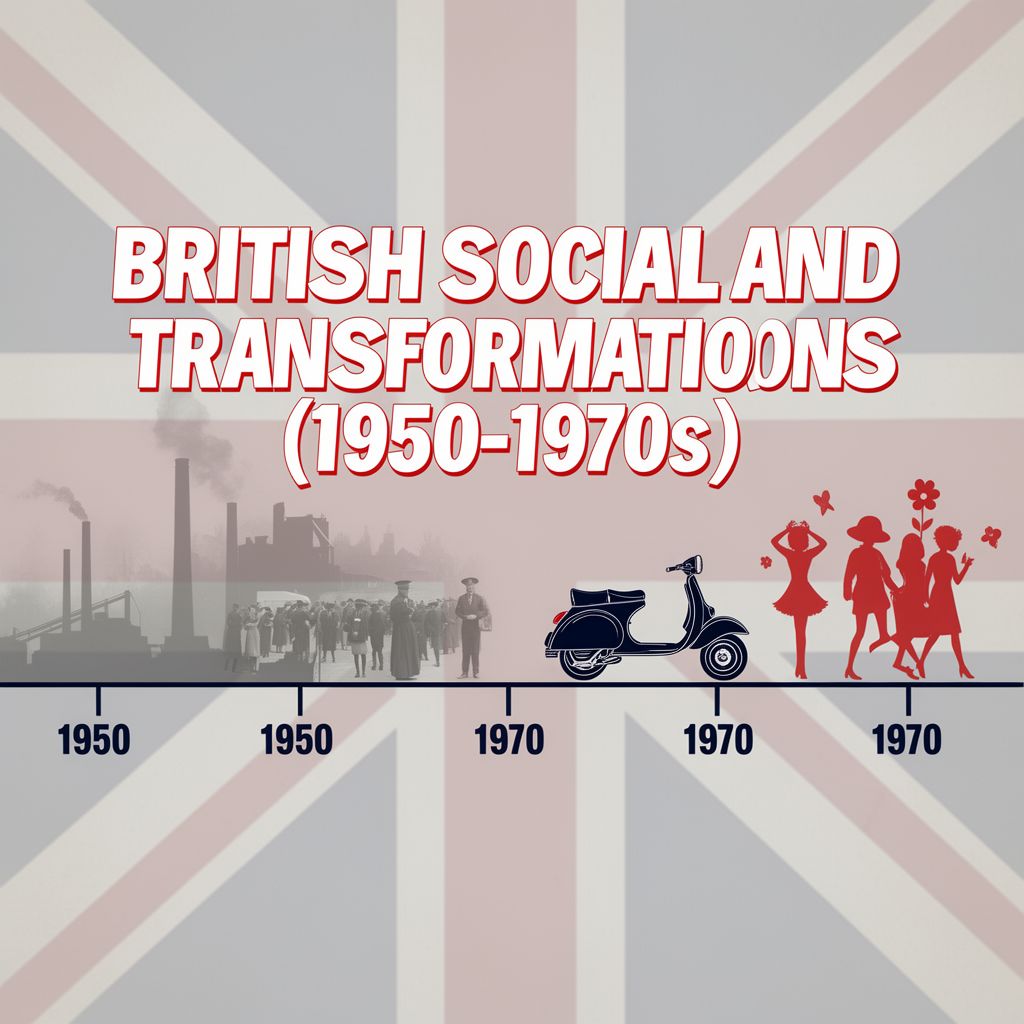
British Social and Political Transformations (1950-1970s) - kapak
Tarih#british history#post-war britain#welfare state#new jerusalem

British Social and Political Transformations (1950-1970s)

An academic summary of major social, cultural, and political changes in Britain from the post-war era through the 1970s, covering the Welfare State, youth culture, and economic challenges.

carpedi3mFebruary 11, 2026 ~24 dk toplam
01

Sesli Özet

8 dakika

Konuyu otobüste, koşarken, yolda dinleyerek öğren.

Sesli Özet

British Social and Political Transformations (1950-1970s)

0:007:49
02

Flash Kartlar

25 kart

Karta tıklayarak çevir. ← → ile gez, ⎵ ile çevir.

1 / 25
Tüm kartları metin olarak gör
  1. 1. What were some of the key transformations Britain experienced from the mid-20th century to the late 1970s?

    Britain underwent significant changes including the decline of its empire, increased immigration, the rise of the women's movement, and the emergence of youth culture. These factors collectively contributed to a more diverse society and a redefinition of British identity during this period, moving from post-war recovery to a fragmented society.

  2. 2. What was the 'New Jerusalem' vision in post-war Britain, and what were its main goals?

    The 'New Jerusalem' was an ambitious post-war vision aiming to rebuild Britain as a more peaceful and egalitarian society. Its main goals were to address poverty, inequality, inadequate housing, limited education, and lack of healthcare, recognizing these as state responsibilities rather than individual burdens. This vision sought to provide comprehensive security 'from cradle to grave'.

  3. 3. Which government was responsible for establishing the National Health Service (NHS) in 1948, and what was its broader political affiliation?

    The National Health Service (NHS) was established in 1948 under Clement Attlee's Labour government. This initiative was a cornerstone of the broader welfare state reforms, aiming to provide comprehensive healthcare security 'from cradle to grave' for all Britons. It represented a significant step towards an egalitarian society.

  4. 4. Describe the general living conditions for most Britons prior to the 1940s.

    Before the 1940s, life for most Britons was characterized by widespread poverty, significant inequality, and frequent food shortages. There was a general lack of basic amenities, and no comprehensive welfare state or social insurance system existed to provide a safety net for citizens. This period highlighted the urgent need for social reform.

  5. 5. What was the significance of the Beveridge Report of 1942 in post-war British reforms?

    The Beveridge Report of 1942 was instrumental in shaping post-war British reforms. It identified major social problems such as poverty, disease, ignorance, squalor, and idleness, and provided a blueprint for the creation of the welfare state. This report inspired the comprehensive social security system and the 'New Jerusalem' vision that followed.

  6. 6. How did the 1950s contribute to the emergence of a consumer society in Britain?

    The 1950s saw a period of economic growth and rising living standards in Britain, which led to increased accessibility of consumer goods. This prosperity, coupled with greater disposable income, fostered the development of a new youth and consumer culture, fundamentally reshaping societal norms and expectations. It marked a shift from wartime discipline to individual freedom.

  7. 7. What famous quote by Harold Macmillan encapsulated the economic sentiment of the 1950s in Britain?

    Harold Macmillan famously asserted, 'People have never had it so good,' which encapsulated the prevailing economic sentiment of the 1950s in Britain. This quote reflected the era's rising living standards, increased prosperity, and the growing availability of consumer goods after the post-war austerity. It symbolized a period of newfound security and affluence.

  8. 8. How did the economic recovery in the mid-1950s impact young people and popular culture?

    The economic recovery granted young people unprecedented financial independence, leading to increased leisure time and disposable income. This newfound economic freedom fueled the growth of popular culture, characterized by new music, fashion, and social spaces. This visible youth consumption, however, also intensified public anxiety among the 'austerity generation'.

  9. 9. What were 'moral panics' in the context of 1950s British society, and how did they relate to youth culture?

    'Moral panics' were periods of intense public anxiety, often fueled by the media, regarding perceived threats to societal values. In the 1950s, these panics frequently targeted youth culture, as older generations interpreted the visible youth consumption and new freedoms as a rejection of traditional values, leading to scapegoating of youth groups and popular culture.

  10. 10. Who were the Teddy Boys, and what was their significance as Britain's first youth subculture?

    The Teddy Boys emerged in the mid-1950s as Britain's first distinct youth subculture. They were working-class youth characterized by their distinctive Edwardian-style fashion. Their appearance and association with activities like gang violence, particularly during events like the Notting Hill riot, generated significant public fear and media attention, establishing a pattern of blaming youth for societal problems.

  11. 11. How did the media contribute to public fear surrounding youth culture in the 1950s?

    The media played a significant role in fueling public fear by often exaggerating portrayals of youth subcultures like the Teddy Boys. It established a pattern of blaming popular culture, including television and Rock 'n' Roll, for societal problems. This sensationalism intensified moral panics and anxieties among the older generations, creating a divide between youth and 'austerity generation' values.

  12. 12. What events led to a decline in public trust in the Conservative government before Harold Wilson's Labour Party came to power in 1964?

    Public trust in the Conservative government declined due to significant events such as the Suez Canal crisis and the Profumo Affair. These scandals and perceived mismanagements contributed to a loss of confidence in the ruling party. This paved the way for Harold Wilson's Labour government to come to power in 1964 with promises of a 'technological revolution'.

  13. 13. What were some of the key social and legal reforms introduced in Britain during the 1960s?

    The 1960s saw significant social and legal reforms, moving away from Victorian-era restrictions. Capital punishment was suspended, and activities such as gambling and homosexuality were decriminalized. Additionally, youth rights expanded with the voting age being lowered to eighteen, reflecting a more liberal and modern societal outlook.

  14. 14. Which landmark legislation in the 1960s significantly enhanced women's reproductive rights and independence?

    Landmark legislation in the 1960s that significantly enhanced women's reproductive rights and independence included the 1967 Abortion Act, the 1967 Family Planning Act, and the 1969 Divorce Reform Act. These acts provided women with greater control over their bodies and personal lives, marking a crucial period for the Women's Movement and individual freedoms.

  15. 15. What was the significance of Enoch Powell's 'Rivers of Blood' speech in 1968?

    Enoch Powell's 'Rivers of Blood' speech in 1968 was highly controversial and significantly fueled racial tensions and polarization in Britain. The speech, which warned against the dangers of immigration, became a symbol of growing divisions over race and immigration. It contributed to a more fragmented society and highlighted deep-seated anxieties.

  16. 16. What major conflict intensified in Northern Ireland towards the end of the 1960s, leading to the deployment of British troops?

    Towards the end of the 1960s, regional conflict intensified significantly in Northern Ireland, characterized by civil unrest and sectarian violence. This escalating situation led to the deployment of British troops in 1969, marking a difficult and prolonged period of conflict known as 'The Troubles.' This event highlighted the deep-seated divisions within the UK.

  17. 17. How did the optimism of the 1960s change as Britain entered the 1970s?

    The optimism that characterized the 1960s largely dissipated as Britain entered the 1970s. This decade was marked by a shift towards significant social division and economic turmoil, replacing the earlier sense of progress and liberation with widespread challenges and a growing sense of disillusionment. The 'Swinging Sixties' gave way to a more somber reality.

  18. 18. What role did immigration play in exacerbating racial tensions during Edward Heath's Conservative government in the 1970s?

    During Edward Heath's Conservative government in the 1970s, substantial immigration, particularly from Kenya and Uganda, combined with existing economic anxieties, exacerbated racial tensions. This environment provided fertile ground for extremist groups like the National Front to gain influence and further polarize society. It contributed to a sense of social fragmentation.

  19. 19. What were the primary economic challenges faced by Britain in the 1970s?

    The 1970s were defined by severe economic challenges for Britain, including widespread industrial decline in key sectors like mining and shipbuilding. The country also experienced rampant inflation, which peaked at an alarming 25% in 1974, leading to significant economic instability and hardship. Global oil prices and uncompetitive industries further compounded these issues.

  20. 20. What measures were implemented in the 1970s to conserve fuel amidst economic difficulties?

    Amidst the economic difficulties and fuel shortages of the 1970s, measures such as national power cuts and the implementation of a 'three-day week' were put in place to conserve fuel. These drastic steps highlighted the severity of the energy crisis and its impact on daily life and industrial output, reflecting a period of national emergency.

  21. 21. What was the 'economic malaise' that persisted in the 1970s, even after the return of Harold Wilson's Labour Party?

    The 'economic malaise' of the 1970s referred to a persistent state of economic stagnation and difficulty, characterized by high inflation, industrial decline, and unemployment. This malaise continued even after Harold Wilson's Labour Party returned to power, driven by factors such as global oil price shocks and uncompetitive domestic industries. It created a sense of national desperation.

  22. 22. Despite the economic turmoil, what were some paradoxical signs of progress or prosperity in the 1970s?

    Despite the widespread economic turmoil, the 1970s also saw some paradoxical signs of progress. There was an increase in home and car ownership for some segments of the population, indicating a degree of individual prosperity. Additionally, significant social advancements like the 1970 Equal Pay Act were enacted, aiming to address gender inequality in wages, even if full equality was not achieved.

  23. 23. What was the significance of the 1970 Equal Pay Act in Britain?

    The 1970 Equal Pay Act was a significant piece of legislation aimed at addressing gender inequality in the workplace. It made it illegal to pay men and women different rates for the same work or work of equal value. While a crucial step, women still earned considerably less than men and faced objectification, indicating ongoing challenges in achieving full gender equality.

  24. 24. How did the youth of the 1970s express their desperation and protest against a perceived bleak future?

    The youth of the 1970s, facing a perceived bleak future amidst economic instability and social unrest, expressed their desperation through the emergence of movements like Punk. This cultural phenomenon served as a visual and musical protest against the prevailing societal conditions and a lack of optimism. It reflected a deep-seated disillusionment with the status quo.

  25. 25. What cultural and social issues did the press amplify fears about in the 1970s, contributing to social fragmentation?

    In the 1970s, the press amplified fears surrounding various cultural and social issues, contributing to increased social fragmentation. Notable examples included the sensationalized coverage of football hooliganism, which further highlighted societal divisions and anxieties about public order. This media portrayal often exacerbated existing tensions and moral panics.

03

Bilgini Test Et

15 soru

Çoktan seçmeli sorularla öğrendiklerini ölç. Cevap + açıklama.

Soru 1 / 15Skor: 0

Which of the following was NOT identified as a contributing factor to the redefinition of British identity in the post-war period?

04

Detaylı Özet

6 dk okuma

Tüm konuyu derinlemesine, başlık başlık.

📚 Post-War British Transformations: Society, Culture, and Politics (1940s-1970s)

Source Information: This study material has been compiled from a combination of copy-pasted text and a lecture audio transcript.


🌍 Introduction: Reshaping British Identity

From the mid-20th century onwards, Britain underwent profound social, cultural, and political transformations. The decline of the British Empire, increased immigration, the women's movement, and the rise of youth culture collectively fostered a more diverse society and redefined British identity. These shifts significantly impacted the arts, particularly after the establishment of the Arts Council in 1948, which championed experimental and non-traditional works. This period, marked by both progress and profound challenges, laid the groundwork for modern Britain.


1️⃣ The Post-War Vision: The "New Jerusalem" (1940s-1950s)

Emerging from the devastation of World War II and the hardships of the early 20th century, Britain envisioned a "New Jerusalem" – a more peaceful and egalitarian society. This ambitious period of reform aimed to address systemic issues like poverty, inequality, poor housing, limited education, and inadequate healthcare, recognizing them as state responsibilities rather than unavoidable conditions.

  • Pre-1940s Context: Life for most Britons was characterized by widespread poverty, food shortages, and a lack of basic amenities. There was no welfare state, National Health Service (NHS), pensions, or social insurance.
  • Planning During WWII: During the war, a cross-party consensus emerged that centralized state planning, rather than private enterprise, was essential for rebuilding. The Beveridge Report (1942) was pivotal, identifying major social problems and inspiring reforms focused on education, health, housing, and employment.
  • Labour's Reforms (1945-1951):
    • Under Clement Attlee, the Labour government nationalized key industries.
    • Welfare State & NHS: The welfare state and the National Health Service were established in 1948, promising care "from cradle to grave."
    • Education Reforms: Significant educational changes were implemented.
  • Post-War Consensus: Despite initial divisions, the core principles of the welfare state and state responsibility gained broad political support, maintained even by Conservative governments until the late 1970s.
  • Recovery and Consumer Society (1950s):
    • The 1950s saw economic growth, rising living standards, and increased accessibility of consumer goods.
    • 💡 "People have never had it so good": Harold Macmillan's famous quote encapsulated the era's optimism.
    • A new youth and consumer culture began to emerge, fundamentally reshaping British society from hardship towards security and prosperity.

2️⃣ Social Upheaval, Moral Panics, and Youth Culture (1950s-1960s)

While economic recovery brought improvements, it also generated significant social change and public anxiety. The psychological impact of the war and persistent class inequalities meant the welfare state, though vital, didn't erase deeper societal scars.

  • The Welfare State's Limits: Despite providing basic education, healthcare, and financial support, the welfare state acted more as a "bandage" than a complete "cure," failing to fully address ingrained class inequality. Working-class youth, despite increased disposable income, still faced limited social mobility.
  • Rise of Youth Consumption: Economic recovery granted young people unprecedented financial independence, leading to increased leisure time and disposable income. This fueled the growth of popular culture, characterized by new music, fashion, and social spaces like coffee bars.
  • Public Anxiety & Moral Panics:
    • The "austerity generation," shaped by wartime loss and restraint, viewed youth "excess" as reckless and morally threatening.
    • The media often "scapegoated" youth groups, transforming them into symbols of declining moral authority.
    • 📚 Teddy Boys: Britain's first youth subculture (mid-1950s) adopted an "Edwardian" style. They became associated with criminal activities and gang violence (e.g., Notting Hill riot), largely due to exaggerated media portrayals that fueled public fear and established a pattern of blaming popular culture.
    • Television and Rock 'n' Roll were also targeted, accused of promoting materialism and "bad behavior."
  • Shift in Values: Despite anxieties, consumer culture became a permanent feature by the late 1950s, signaling a shift from wartime discipline and shared sacrifice towards individual freedom and personal choice.

3️⃣ The "Swinging Sixties": Progress and Divisions (1960s)

The 1960s brought further profound transformations, often termed the "Swinging Sixties," but also introduced new divisions.

  • Political Shifts:
    • The Conservative Party lost public support due to events like the 1956 Suez Canal crisis and the 1963 Profumo Affair, which exposed government dishonesty.
    • In 1964, Harold Wilson's Labour Party won, promising a "technological revolution" and modernization.
    • 📈 Consumer Boom: This era saw a boom in consumer goods (TVs, cars, supermarkets) and a moment of national unity with England's 1966 World Cup victory.
  • Social Reform and New Freedoms:
    • The influence of traditional churches declined, and laws began to prioritize personal freedom.
    • Legal Reforms: Capital punishment was suspended (1965). Gambling (1960) and homosexuality (1967) were decriminalized.
    • Youth Rights: The voting age was lowered to eighteen (1969).
  • The Women's Movement:
    • Women campaigned for equal rights, leading to significant legal changes.
    • Reproductive Rights: The 1967 Abortion Act legalized terminations, and the 1967 Family Planning Act provided access to contraceptives via the NHS. The Pill became free for single women by 1974.
    • Independence: The 1969 Divorce Reform Act allowed women to leave abusive marriages, fostering greater career and future planning independence.
  • Growing Divisions:
    • ⚠️ Racial Tension: As economic growth slowed, political divisions increased. Enoch Powell's controversial "Rivers of Blood" speech (1968) fueled polarization regarding immigration.
    • ⚠️ Regional Conflict: Nationalism grew in Scotland and Wales, but the most serious conflict was in Northern Ireland. Civil unrest led to the deployment of British troops in 1969, marking the beginning of "The Troubles."

4️⃣ The Turbulent 1970s: Economic Crisis and Fragmentation

The optimism of the 1960s largely dissipated in the 1970s, giving way to a period of significant social division and economic turmoil.

  • End of Optimism: Under Edward Heath's Conservative government (1970), Britain faced increased immigration (e.g., refugees from Kenya and Uganda), which, combined with economic anxieties, exacerbated racial tensions and empowered extremist groups like the National Front.
  • Economic Chaos:
    • The decade was defined by severe industrial decline (mining, shipbuilding) and rampant inflation, peaking at 25% in 1974.
    • This led to widespread strikes, national power cuts, and the implementation of a "three-day week" to conserve fuel.
    • The "economic malaise" persisted even after Labour's return, driven by global oil prices and uncompetitive industries.
  • Paradox of Progress and Sexism:
    • Despite economic struggles, some experienced prosperity (more homes, cars).
    • Social Progress: The 1970 Equal Pay Act was a significant step for women's rights.
    • ⚠️ Persistent Inequality: However, women still earned 25% less than men and faced objectification in the media.
  • Youth Rebellion and Social Fragmentation:
    • A sense of desperation emerged, particularly among youth who felt abandoned by the system.
    • 💡 Punk Movement: This led to the rise of the Punk movement, a visual protest against a bleak future.
    • Some turned to radical politics (Marxism, anarchism).
    • The press amplified fears, focusing on issues like football hooliganism.
    • By the late 1970s, "British confidence" had eroded, leaving a fragmented society poised for further transformation.

📊 Political Shifts and Arts Funding (Overall Context)

The broader political landscape significantly impacted cultural policy and funding:

  • Post-1970s Shift: By the mid-1970s, economic problems led to dissatisfaction. The election of Margaret Thatcher in 1979 marked a major shift towards free-market economics, individualism, and reduced state support, including cuts to arts funding. This period increased inequality but also inspired powerful artistic responses.
  • Labour's Return (1997): Tony Blair's Labour government brought renewed optimism, economic stability, and support for diversity in culture. However, business values continued to influence the arts, and public funding never fully returned to earlier levels.
  • Austerity (Post-2010): After the global financial crisis, a Conservative-led coalition government (2010) introduced major public spending cuts, with the cultural sector being among the hardest hit.

✅ Key Takeaways

  • Post-war Britain embarked on ambitious reforms to create a welfare state and address social inequalities.
  • Economic recovery led to a consumer society and the emergence of youth culture, which often clashed with older generations' values, leading to moral panics.
  • The 1960s brought significant social and legal freedoms, particularly for women, but also saw rising racial tensions and regional conflict.
  • The 1970s were characterized by severe economic instability, social fragmentation, and a decline in national optimism, setting the stage for major political and economic realignments.
Kendi çalışma materyalini oluştur

PDF, YouTube videosu veya herhangi bir konuyu dakikalar içinde podcast, özet, flash kart ve quiz'e dönüştür. 1.000.000+ kullanıcı tercih ediyor.

Sıradaki Konular

Tümünü keşfet
Post-War British Social and Political Transformations

Post-War British Social and Political Transformations

An academic summary of Britain's social, cultural, and political evolution from the 1940s to the late 1970s, covering the welfare state, youth culture, liberalization, and economic crises.

6 dk Özet 25 15
Britain's Social, Cultural, and Linguistic Evolution (1950s-2010s)

Britain's Social, Cultural, and Linguistic Evolution (1950s-2010s)

An academic summary exploring Britain's profound social, cultural, and linguistic transformations from the mid-20th century, covering political shifts, societal changes, and the evolution of the English language.

9 dk Özet 25 15
Sociopolitical, Demographic, and Cultural Shifts in Britain

Sociopolitical, Demographic, and Cultural Shifts in Britain

This summary examines significant sociopolitical, demographic, and cultural transformations in Britain from 2007 to the mid-2010s, focusing on public trust, immigration, social norms, and the evolving arts landscape.

10 dk Özet 25 15
Wartime Britain: Social Change and the Home Front

Wartime Britain: Social Change and the Home Front

Explore the profound social transformations in Britain during the World Wars, focusing on women's suffrage, their evolving roles on the Home Front, and the civilian experience of conflict.

18 12
The Victorian Age: Society, Politics, and Literature

The Victorian Age: Society, Politics, and Literature

An academic summary of the Victorian Age (1837-1901), exploring its social unrest, political reforms, imperial expansion, and profound literary contributions, highlighting key authors and their thematic concerns.

8 dk Özet 25 15
Women's Evolving Roles and Suffrage in Wartime Britain

Women's Evolving Roles and Suffrage in Wartime Britain

This podcast explores the significant changes in women's roles and the suffrage movement in Britain, from early campaigns to their contributions during both World Wars, and the lasting impact on society.

6 dk 25 15
Wartime Britain: Churchill and the Battle of Britain

Wartime Britain: Churchill and the Battle of Britain

Explore the critical period of Wartime Britain, focusing on Operation Sealion, Winston Churchill's leadership, the Battle of Britain, the role of radar, and the Home Guard.

6 dk 15
Interwar Britain: Society, Culture, and Politics

Interwar Britain: Society, Culture, and Politics

Explore the profound social, cultural, and political transformations in Britain during the interwar years, from changing gender roles and technological advancements to economic unrest and the rise of fascism.

7 dk 15