 Podit
Podit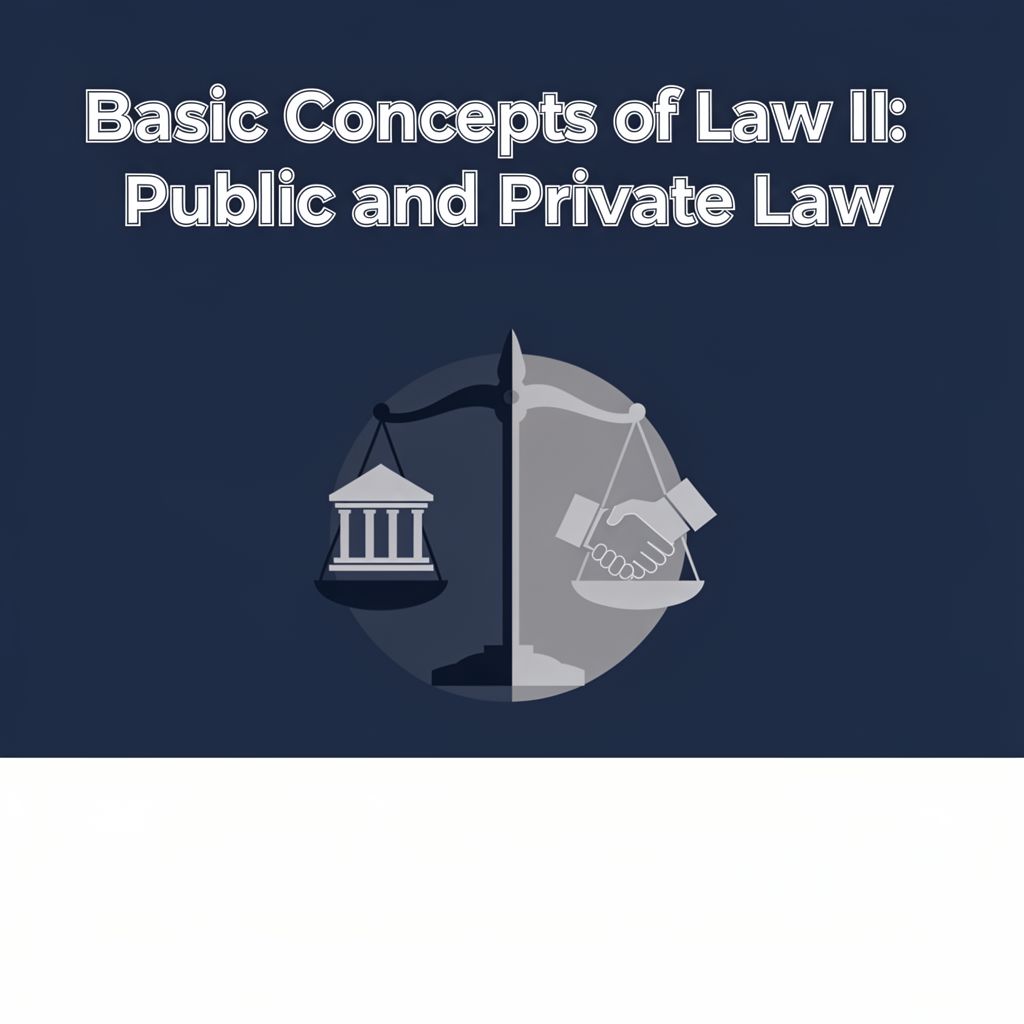
This study material is compiled from lecture slides (copy-pasted text) and an audio transcript of the lecture.
📚 Basic Concepts of Law II: Introduction to Legal Frameworks
🎯 Course Overview
This study material provides an introduction to the fundamental concepts of law, specifically focusing on the distinction between Private Law and Public Law, and the various branches of Public Law. Taught by Dr. Bihter Kaytaz Eker, this course is structured to cover Private Law in the Fall Term and Public Law in the Spring Term.
📝 Course Logistics & Assessment
- Term Focus:
- Fall Term: Private Law
- Spring Term: Public Law
- Recommended Reading List: 📚
- "Turkish Public Law" - Prof. Dr. M. Refik Korkusuz
- "An Introduction to Law" - Rona Aybay
- "Introduction to Law in a Nutshell" - Engin Saygin
- "Introduction to Turkish Law" - Tugrul Ansay and Don Wallace JR
- Assessment: 📊
- Mid-term Exam: 40%
- Final Exam: 60%
- Exam Style: The exams will feature a mixture of question types. Understanding these formats is crucial for preparation.
- Multiple-Choice Questions (MCQ):
- Structure: Typically consists of a "stem" (the question or incomplete statement) and several "options" or "choices," usually four or five, only one of which is the correct answer. The incorrect options are called "distractors."
- Strategy:
- Read the Stem Carefully: Understand exactly what is being asked. Look for keywords like "always," "never," "except," "not."
- Eliminate Obvious Distractors: Rule out options that are clearly incorrect.
- Identify the Best Answer: Sometimes more than one option might seem plausible; choose the one that is most accurate or comprehensive.
- Avoid Overthinking: Your first instinct is often correct unless you have a clear reason to change it.
- Example: Which of the following is NOT a key feature of "Law" as discussed in the lecture? a) Normative b) Institutionalized c) Coercive d) Subjective e) Protective
- True/False Questions:
- Structure: A statement is presented, and you must determine if it is entirely true or entirely false.
- Strategy:
- Look for Absolutes: Words like "always," "never," "all," "none" often make a statement false, as there are usually exceptions in law.
- Identify Qualifiers: Words like "sometimes," "often," "may," "generally" tend to make statements true, as they allow for exceptions.
- Focus on Each Part: If any part of the statement is false, the entire statement is false.
- Example: True or False: According to the Roman jurists' "interest-theory," public law primarily focused on the interests of individuals.
- Fill-in-the-Blanks Questions:
- Structure: A sentence or paragraph with one or more words missing, which you need to supply.
- Strategy:
- Read the Entire Sentence/Paragraph: Understand the context and meaning.
- Consider Keywords and Concepts: Think about the specific terminology used in the course.
- Ensure Grammatical Fit: The word(s) you choose must fit grammatically into the sentence.
- Be Precise: Use the exact term or concept discussed in the lecture.
- Example: The "subject theory" differentiates public and private law based on the ___________ of the parties involved.
- Multiple-Choice Questions (MCQ):
- Course Resources: Students should regularly check AYBUZEM for the detailed Course Syllabus, lecture Slides, and Vocabulary Lists.
1️⃣ The Term "Law"
The concept of "Law" is multifaceted and can be understood through various definitions and characteristics.
📚 Definitions of Law
According to the Collins Cobuild English Dictionary, "law" can be defined as:
- A rule or set of rules, enforceable by the courts, regulating the government of a state, the relationship between governmental organs and state subjects, and the conduct of subjects towards each other.
- A rule or body of rules made by the legislature.
- The condition and control enforced by such rules.
- One of a set of rules governing a particular field of activity.
- A binding force or statement.
- A general principle, formula, or rule describing a phenomenon in mathematics, science, philosophy, etc.
✅ Notable Features of Law
Law possesses several key characteristics that define its nature and function:
- Normative: Law is full of rules that serve as a guide for governing human behavior in society. It sets standards for what is permissible and impermissible.
- Institutionalized: The creation, modification, and application of law are all regulated by established legal institutions. These institutions ensure the systematic functioning of the legal system.
- Coercive: Sovereign power ensures obedience to law and its application through the use of force, primarily via sanctions. This means there are consequences for non-compliance.
- Protective: Law secures the freedom and rights of individuals, providing a framework for justice and order.
💡 Concise Definition: In essence, "law" can be defined as the rules regulating people in their relationships with each other and in their relationships with the state.
2️⃣ Difference Between Private Law and Public Law
The distinction between Private Law and Public Law is a foundational concept in legal studies, with roots tracing back to Roman jurisprudence.
🏛️ Historical Perspective: Roman Jurists' "Interest-Theory"
- Roman jurists initially divided legal rules based on "the nature of the interests protected by the law."
- Public Law: Focused on the interests of the community.
- Private Law: Focused on the interests of individuals.
- This "interest-theory" posited that public interests were dealt with by public law, while private interests fell under private law.
🔄 Modern Perspective: Evolution and "Subject Theory"
- While the division persists in Continental European countries, the underlying theory has evolved.
- Challenge to Interest-Theory: Today, distinguishing public from private interests is complex. For example, peaceful resolution of disputes between private individuals is not only in their interest but also serves the State's interest in maintaining order.
- Dominant Theory: "Subject Theory" ✅
- This theory differentiates public law and private law based on the character of the parties involved in a legal relationship.
- Public Law Handles:
- Relationships and conflicts between individuals and the State.
- Governmental regulation of individual and corporate activities.
- Organization and limitations of State power.
- Private Law Deals With:
- Relationships and disputes exclusively between private individuals (both legal persons like companies and natural persons).
⚖️ Key Distinguishing Factor: State's Sovereign Capacity
- ⚠️ Crucial Point: If one of the parties is the State acting in its sovereign capacity, the relationship is public in nature and governed by public law.
- Example (Public Law): The relationship between the government and taxpayers regarding taxation is a public law relationship because the State acts with sovereign authority to collect taxes.
- If the State is not acting in its sovereign capacity, the relationship is considered a private law matter.
- Example (Private Law): If the State rents a building from a private individual for an administrative office, this transaction is a private-law relationship. The State, in this instance, acts as a tenant, similar to any private entity, not exercising sovereign power.
🤝 Power Dynamics
- In Public Law, the State typically holds a superior position over the individual.
- In Private Law, there is an assumption of equality among subjects, irrespective of gender, nationality, economic, or educational circumstances.
3️⃣ Branches of Public Law
The main branches of Public Law are critical areas of study that govern the organization and functioning of the state and its relationship with individuals.
- Constitutional Law: Deals with the fundamental principles by which the government exercises its authority. It defines the structure of the state, the powers of its branches, and the rights of its citizens.
- Administrative Law: Governs the activities of administrative agencies of government. It concerns the powers and duties of public officials and the procedures by which they make decisions.
- **Criminal Law (Penal Law): Defines criminal offenses and their punishments. It aims to protect society by deterring crime and punishing offenders.
- Public International Law: Governs the relationships between states and international organizations. It includes treaties, customs, and general principles of law recognized by civilized nations.
🗓️ Course Progression for Public Law Branches
The course will systematically explore these branches:
- Week 2: Society and Order / Social Order, Application of Legal Orders
- Week 3: Sources of Law / Legal Systems of the World
- Week 4: Sources of Turkish Law
- Week 5: Constitutional Law
- Week 6: Administrative Law
- Week 7: Revision Week
- Weeks 8 & 9: Mid-term Exam
- Week 10: Turkish Administrative Jurisdiction, Criminal Law I
- Week 11: Criminal (Penal) Law II
- Week 12: Law of Penal Procedure
- Week 13: International Law
- Week 14: International Human Rights Law and Human Rights Law in Turkey
- Week 15: Revision
📖 Vocabulary List
- Public Law: The body of law dealing with the relationship between the state and individuals, and the organization of government.
- Private Law: The body of law dealing with relationships between private individuals.
- Jurist: A person who is an expert in law; a legal scholar.
- Legal rules: Principles or regulations established by a government or other authority and applicable to a people, whether by legislation or by custom and policies recognized and enforced by judicial decision.
- Branch: A division or subdivision of a larger system, such as a branch of law.
- Interest of the community: The collective well-being or benefit of the public or society as a whole.
- Interest of individuals: The personal well-being, rights, or benefits of a single person.
- Administrative Law: The body of law that governs the activities of administrative agencies of government.
- Government: The governing body of a nation, state, or community.
- Governmental regulation: Rules or laws imposed by a government to control or influence behavior.
- Individual and corporate activities: Actions undertaken by single persons (natural persons) and by organizations or companies (legal persons).
- Relationship: The way in which two or more people or things are connected.
- Legal person: An entity, such as a corporation, that is recognized by law as having rights and obligations.
- Natural person: A human being, as distinguished from a legal person.
- Sovereign: Possessing supreme or ultimate power.
- Criminal (Penal) Law: The body of law that relates to crime. It regulates social conduct and proscribes whatever is threatening, harming, or otherwise endangering to the property, health, safety, and moral welfare of people.