 Podit
Podit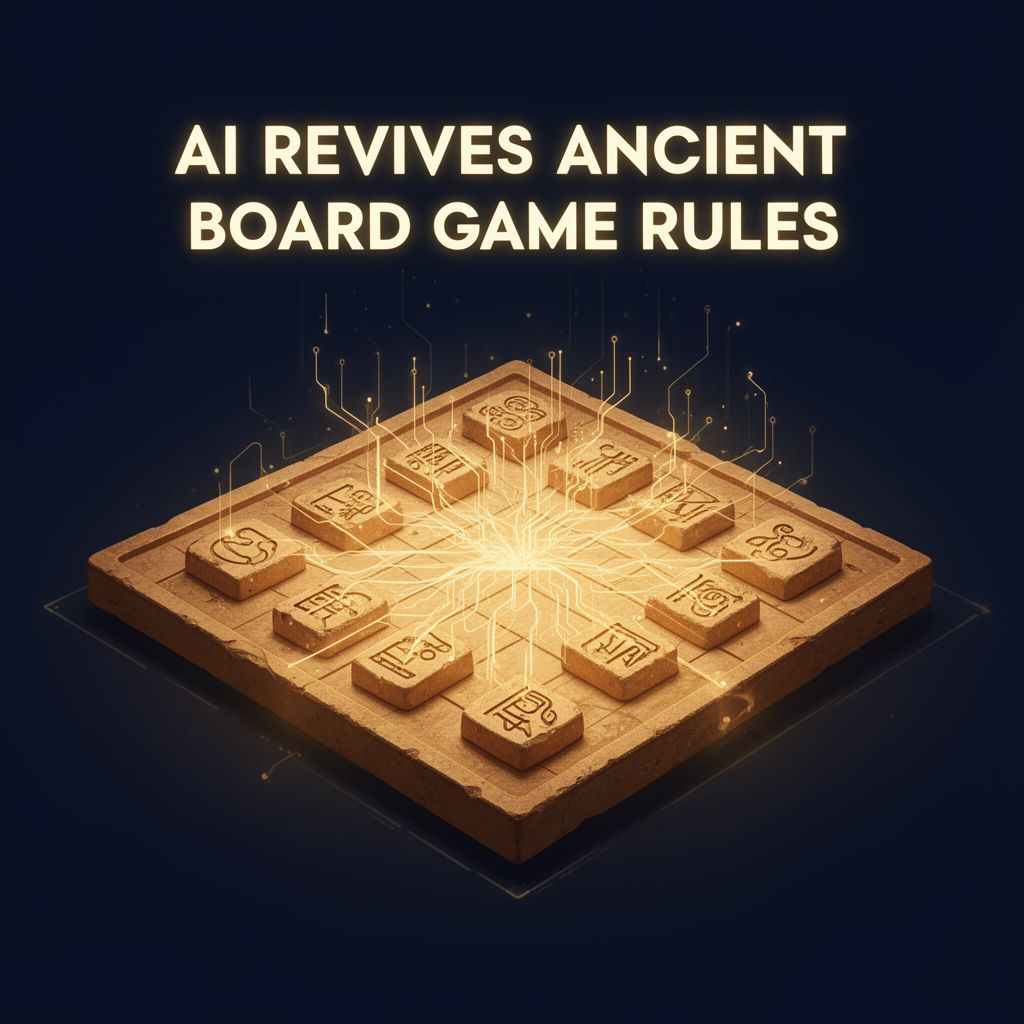
Sesli Özet
10 dakikaKonuyu otobüste, koşarken, yolda dinleyerek öğren.
Sesli Özet
AI Revives Ancient Board Game Rules
Flash Kartlar
25 kartKarta tıklayarak çevir. ← → ile gez, ⎵ ile çevir.
Tüm kartları metin olarak gör
1. What significant artifact was discovered in Shahras hairan in the 1970s?
The oldest complete board game ever found, approximately 4500 years old, known as the Shahr-i Sokhta game.
2. What were the components of the Shahr-i Sokhta game?
It consisted of a board with 20 circular fields formed by a carved snake, four dice, and 27 geometric pieces.
3. Name two other ancient board games mentioned in the text besides Shahr-i Sokhta.
Examples include the Roman game Ludus Latrunculorum and the Egyptian game Senet, found in Tutankhamun's tomb.
4. Which ancient game's rules were deciphered from a cuneiform tablet in 2007?
The rules for the Royal Game of Ur were deciphered from a cuneiform tablet found in the British Museum.
5. What modern technology is helping to revive ancient board games?
Artificial intelligence (AI) is being used by researchers to find possible rules and make these forgotten games playable again.
6. According to Eric Piette, what do ancient games offer us?
They serve as a window into the past, providing clues about the social and cultural dynamics of the people who played them.
7. Who is credited with deciphering the rules of the Royal Game of Ur?
Irving Finkel from the British Museum is the person who deciphered the rules of the Royal Game of Ur.
8. What was a major challenge in reconstructing ancient game rules?
Challenges included limited historical records, the absence of universal rule sets, and games being taught orally.
9. Why did ancient games likely have multiple rule variants?
Because games were taught orally and spread across different geographical regions over hundreds or thousands of years.
10. Who began deriving rule sets for Ludus Latrunculorum?
Ulrich Schädler from the University of Fribourg in Switzerland began deriving rule sets for Ludus Latrunculorum.
11. What types of evidence were used to derive rules for Ludus Latrunculorum?
Strategies from modern games, archaeological findings, and historical evidence like a Latin poem praising Calpurnius Piso's skills.
12. Describe the typical playing setup for Ludus Latrunculorum.
It was played on a stone or ceramic board divided into squares, likely by two players using glass disc pieces.
13. Name two online platforms where digital versions of ancient games can be played.
Locus Ludi and Ludii Portal are online sites that allow playing digital versions of ancient games with proposed rule variants.
14. Who developed a digitally playable version of the Shahr-i Sokhta game?
Software developer Sam Jelveh and archaeologist Hossein Morad created a digital version of the Shahr-i Sokhta game.
15. What is one future goal for AI in game archaeology regarding newly discovered games?
For AI to be able to suggest methods on how a newly unearthed game was actually played.
16. Explain AI-driven rule generation in the context of ancient games.
It's a method where algorithms simulate various possible rule sets based on the game's structure to find plausible rules.
17. How does AI help test the fun factor of possible game rules?
AI tests countless permutations of possible rules by breaking the game into 'ludemes' and feeding them to the AI to determine fun vs. boring outcomes.
18. Which ancient game was an early case study for using AI in rule reconstruction due to its historical descriptions?
Ludus Latrunculorum was an early case study because historical writings provided the most information about it.
19. What did historical accounts suggest about Ludus Latrunculorum's nature?
Historical accounts indicated that Ludus Latrunculorum was a strategic war game.
20. What was the purpose of the Digital Ludere Project?
This five-year project used AI-simulated gameplay to investigate which board sizes were most logical for the proposed rules of Ludus Latrunculorum.
21. Name three modern games identified as having strong similarities to Ludus Latrunculorum.
Kharebga, Seega, and Tablut are three modern games that show strong resemblances to Ludus Latrunculorum.
22. What did AI simulations reveal about playing Ludus Latrunculorum on larger boards?
Simulations showed that game sessions became incredibly long on larger boards, suggesting smaller boards were more consistent with ancient Roman descriptions.
23. What is the GameTable network?
It's a new European network of over 200 experts collaborating to develop sophisticated AI-supported digital tools for studying historical games.
24. What is one key goal of the GameTable network regarding documentation?
To create a unified database that documents ancient and traditional games, their rules, and historical contexts, highlighting cultural connections.
25. According to Irving Finkel, what often happens to a good board game over time?
A good board game is unlikely to die but rather transforms into something more vital, like the Royal Game of Ur evolving into backgammon.
Bilgini Test Et
15 soruÇoktan seçmeli sorularla öğrendiklerini ölç. Cevap + açıklama.
What is the primary focus of the podcast episode mentioned in the introduction?