 Podit
Podit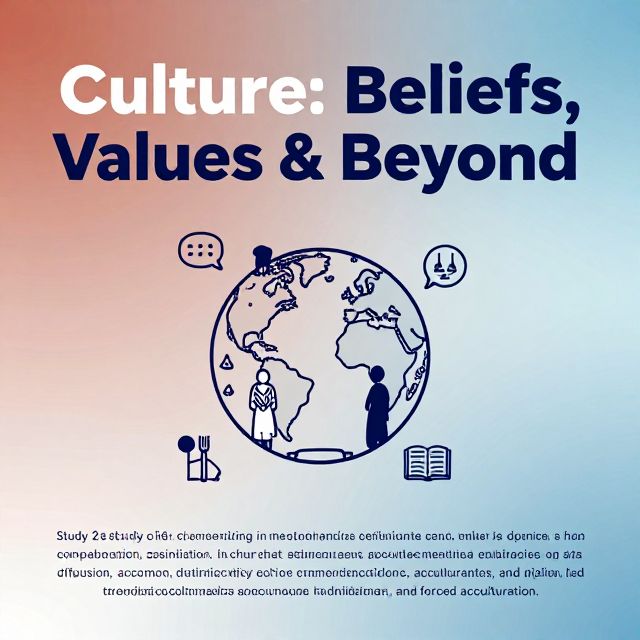
Comprehensive Study Guide: Understanding Culture and Its Dynamics
Source Information: This study material has been compiled from a lecture audio transcript and copy-pasted text provided by the user.
Introduction to Culture 📚
Culture is the intricate tapestry of beliefs, values, behaviors, customs, arts, knowledge, and habits that uniquely define a particular group of people, community, or society. It encompasses both the tangible (material) and intangible (non-material) aspects of a society, fundamentally shaping how individuals perceive the world, interact with one another, and construct their identities.
✅ Key Characteristics of Culture:
- Learned and Shared: Culture is not innate; it is acquired and transmitted across generations.
- Dynamic: It constantly evolves and adapts due to influences like technology, globalization, and inter-cultural interactions.
- Provides Identity: Culture offers groups and societies a sense of continuity, identity, and belonging.
- Allows Diversity: It permits individual expression within group norms.
Historically, the concept of 'high culture' was often confined to elite institutions. However, with widespread education, culture has been redefined to include the everyday interactions and shared experiences of all people within a given context.
Key Components of Culture 🧩
Understanding culture requires examining its constituent parts:
- Beliefs and Values: These are the core principles and moral frameworks guiding societal behavior. They include ideas about right and wrong, life and death, and priorities like individualism versus collectivism.
- Customs and Traditions: Regular practices and rituals marking significant events, seasons, or life transitions (e.g., festivals, holidays, weddings, funerals).
- Language: A fundamental cultural element, language facilitates communication, knowledge sharing, and belief transmission. It profoundly shapes and reflects cultural identity.
- Art and Literature: Creative expressions through music, dance, paintings, sculpture, stories, and written works. These forms often reflect a society's values and historical narrative.
- Social Norms and Etiquette: Unwritten rules and expectations for behavior in specific social contexts, including manners, dress codes, and interpersonal interactions.
- Food and Cuisine: A defining cultural aspect, reflecting geographic, environmental, and historical influences, often carrying symbolic meanings.
- Religion and Spirituality: Influences daily rituals, major life events, and moral codes in many cultures.
- Technology and Tools: The material culture, encompassing tools, technological innovations, and infrastructure, from traditional handicrafts to modern digital technologies.
- Social Institutions: Systems like family, education, government, and economic structures that organize society and influence daily life.
Cultural Dynamics and Interactions 📈
Cultures are not static; they interact, change, and influence each other through various processes.
Assimilation vs. Acculturation 💡
These two concepts describe how cultures change when they come into contact.
-
Assimilation:
- 📚 Definition: The process where one culture comes under the significant influence of another, leading it to adopt the dominant culture's traits and potentially dissolve within it.
- Mechanism: A dominant culture often imposes itself, presenting an image of being "higher" or "more developed," causing the minority culture to distance itself from its heritage.
- Types: Cultural, Religious, Linguistic, Psychological.
- Example: An immigrant changing their dress and behavior to align with the new country's norms.
- Historical Purpose: Some policies, like the "Assimilation Policy," aimed to integrate native people into white society by removing children from families, intending to destroy native culture.
-
Acculturation:
- 📚 Definition: The transfer of values and customs from one group to another, resulting in changes in the original cultural patterns of one or both groups.
- Factors: Occurs when groups from different cultures have constant, first-hand contact.
- Example: Japanese people adopting Western clothing styles while retaining other aspects of their culture.
- Process: Can happen at any point in life, involving relearning rules, values, and behavior patterns (re-socialization).
📊 Key Differences between Assimilation and Acculturation:
| Feature | Acculturation | Assimilation | | :---------------------- | :---------------------------------------------- | :------------------------------------------------- | | Affected Group | Individual or minority group | Minority group or culture | | Original Culture | May or may not preserve original culture | Generally leads to loss of original culture's distinct features | | Power Structure | Strong power structure influences | No strong power structure influences (as per source) | | Nature of Change | Voluntary or forced, bidirectional | Gradual and natural, unidirectional | | Outgroup Acceptance | Does not necessarily imply outgroup acceptance | Means outgroup acceptance |
Enculturation 👶
- 📚 Definition: The process by which individuals acquire and transmit their culture as they grow up within it.
- Mechanism: Parents and other authority figures guide children toward socially acceptable activities and ideals, shaping their worldview.
Culture Shock ⚠️
- 📚 Definition: Feelings of uncertainty, confusion, or anxiety experienced when moving to a new country or encountering an unfamiliar culture. It's a normal adjustment to an unfamiliar environment.
- Phases:
- Honeymoon: Initial excitement and fascination.
- Frustration: Challenges and difficulties arise, leading to irritation.
- Adjustment: Beginning to understand and adapt to the new culture.
- Acceptance: Feeling comfortable and integrated, appreciating the new culture.
- Symptoms: Homesickness, helplessness, isolation, disorientation, lack of concentration, irritability, sadness, sleep/eating disturbances, paranoia.
Cultural Diffusion 🌍
- 📚 Definition: The spread and adoption of material and non-material cultural elements from a cultural center to surrounding areas.
- Example: The global spread and acceptance of Western clothing styles in various regions, such as Turkey.
Cultural Lag ⏳
- 📚 Definition: The discrepancy in the speed at which institutions and non-material culture respond to rapid changes in material culture, particularly technological innovations.
- Explanation: Material culture (technology) often advances quickly, while non-material culture (norms, values, laws) lags behind, creating mismatches.
- Examples:
- Cell Phone Etiquette: Widespread use of cell phones (material culture) but a lag in adopting norms like silencing phones during meetings (non-material culture).
- Social Media and Privacy: Rapid adoption of social media for sharing personal information, but slow development of societal norms and laws regarding privacy, leading to concerns about data misuse and cyberbullying.
- Remote Work vs. Office Culture: Technology enables remote work, but many companies resist fully embracing this cultural shift, preferring traditional office setups.
- Digital Payments: Availability of digital payment systems, but reluctance among certain demographics to transition from cash, indicating a lag in cultural adoption.
Forced Acculturation (Trans-Culturation) 🚫
- 📚 Definition: A coercive process where a dominant culture compels other cultures to resemble itself, often pushing them toward extinction.
- Mechanism: Historical and spiritual traces of the transformed culture are damaged, with no willingness from those belonging to it. Enforcement occurs through social agents like educational and military institutions.
- Modern Context: Generally not accepted in modern societies due to potential international backlash; instead, processes of assimilation and integration are encouraged.