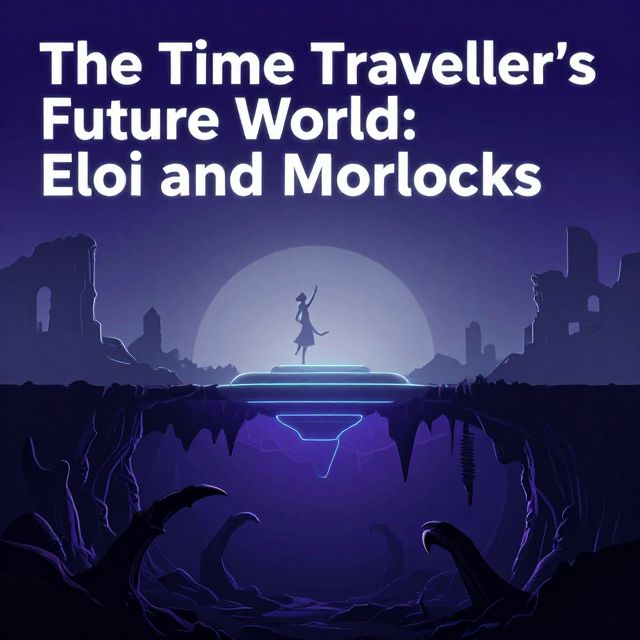
The Time Traveller's Future World: Eloi and Morlocks - kapak
Edebiyat#h.g. wells#the time machine#science fiction#dystopian literature

The Time Traveller's Future World: Eloi and Morlocks

An academic summary of the Time Traveller's initial encounters, evolving theories on future humanity, and preparations for retrieving his Time Machine in H.G. Wells' 'The Time Machine'.

carpedi3mApril 28, 2026 ~22 dk toplam
01

Sesli Özet

6 dakika

Konuyu otobüste, koşarken, yolda dinleyerek öğren.

Sesli Özet

The Time Traveller's Future World: Eloi and Morlocks

0:006:14
02

Flash Kartlar

25 kart

Karta tıklayarak çevir. ← → ile gez, ⎵ ile çevir.

1 / 25
Tüm kartları metin olarak gör
  1. 1. In what year AD does the Time Traveller first arrive in the future?

    The Time Traveller first arrives in the year 802,701 AD. This distant future setting immediately establishes a vastly changed world, allowing him to observe the long-term consequences of human evolution and societal development. His arrival marks the beginning of his journey into understanding this new reality.

  2. 2. Describe the initial characteristics of the Eloi as observed by the Time Traveller.

    The Eloi are described as small, delicate humanoids with a lack of fear, gentle demeanor, and childlike characteristics. They possess a frail physical appearance and limited intellectual capacity, often interpreting gestures simplistically. These traits lead the Time Traveller to initially hypothesize about a 'social paradise'.

  3. 3. What did the Time Traveller discover about the Eloi's intellectual capacity?

    The Time Traveller found that the Eloi had a limited intellectual capacity. His attempts at communication revealed that they interpreted his gestures simplistically, indicating a decline in complex thought and communication skills. This observation contributed to his initial theory of humanity's degeneration due to a lack of struggle.

  4. 4. What critical event occurred shortly after the Time Traveller's arrival regarding his Time Machine?

    A critical event was the disappearance of his Time Machine. After removing the control levers for security, he later discovered the entire machine had vanished from its resting place near a white marble sphinx, prompting a frantic search and a significant mystery.

  5. 5. Where did the Time Traveller deduce his Time Machine had been moved?

    The Time Traveller deduced that his Time Machine had been moved into the hollow pedestal of the white marble sphinx. This realization came after a frantic search and careful observation of the surroundings, leading him to suspect a hidden mechanism or entity was responsible.

  6. 6. Describe the first creature the Time Traveller encountered that he later identified as a Morlock.

    The first creature he later identified as a Morlock was an ape-like being with dull white skin, large, greyish-red eyes, and flaxen hair. It was extremely sensitive to light, indicating an adaptation to a subterranean existence. This encounter was a pivotal moment in his understanding of the future world.

  7. 7. What observations did the Time Traveller make about the Morlocks' habitat and behavior?

    The Time Traveller observed the Morlocks utilizing ladder-like structures within deep wells, indicating a subterranean existence. He later confirmed their aversion to sunlight and their presence in underground caverns, suggesting they had adapted to living and working beneath the surface.

  8. 8. What profound fear did the Eloi exhibit, which the Time Traveller initially overlooked?

    The Eloi exhibited a profound fear of darkness and the deep wells. The Time Traveller initially dismissed this, but later recognized its significance as it pointed towards the presence and threat of the subterranean Morlocks. This fear was a key clue to the true nature of their society.

  9. 9. Who was Weena, and how did the Time Traveller form a bond with her?

    Weena was an Eloi whom the Time Traveller rescued from drowning. Despite his initial low expectations of her kind, she showed affection towards him, forming a unique bond. This relationship provided him with a personal connection in the otherwise alien future world.

  10. 10. What was the Time Traveller's initial hypothesis about the future of humanity?

    His initial hypothesis was that mankind had achieved a 'social paradise' where all forms of struggle had ceased. He believed this led to widespread indolence and physical feebleness among the Eloi, as evolutionary pressures for strength and intelligence were eliminated.

  11. 11. According to the Time Traveller's initial theory, why had the Eloi become physically feeble and indolent?

    In his initial theory, the Eloi became physically feeble and indolent because humanity had achieved a 'social paradise.' The complete subjugation of nature, eradication of disease, and absence of hardship eliminated the evolutionary pressures that once fostered strength, intelligence, and traditional social structures, leading to a species that had 'waned'.

  12. 12. What discovery necessitated a revision of the Time Traveller's initial hypothesis about future humanity?

    The discovery of the subterranean Morlocks and the Eloi's pervasive fear of the dark necessitated a revision of his initial hypothesis. The existence of a second, distinct species living underground, coupled with the Eloi's fear, challenged his idea of a simple utopian degeneration.

  13. 13. Describe the Time Traveller's revised theory regarding the divergence of humanity.

    His revised theory posited that humanity had diverged into two distinct species due to extreme social stratification. The affluent 'Haves' evolved into the delicate, pleasure-seeking Eloi on the surface, while the working-class 'Have-nots' transformed into the nocturnal, subterranean Morlocks.

  14. 14. How did the Eloi evolve according to the Time Traveller's revised theory?

    According to his revised theory, the Eloi evolved from the affluent 'Haves' who remained on the surface. They became delicate, pleasure-seeking beings, characterized by their indolence and physical feebleness, having lost the need for struggle or intellectual development.

  15. 15. How did the Morlocks evolve according to the Time Traveller's revised theory?

    In his revised theory, the Morlocks evolved from the working-class 'Have-nots' who were compelled to labor underground. They transformed into nocturnal, bleached, and carnivorous beings, adapted to their subterranean environment, and eventually reversed the power dynamic with the surface dwellers.

  16. 16. What chilling realization did the Time Traveller have about the Morlocks' role in sustaining the Eloi?

    The chilling realization was that the Morlocks now sustained the Eloi, potentially as a food source. This emerged upon recalling the sight of meat in the Morlock's underground dwelling, suggesting a reversal of the historical power dynamic where the surface dwellers became prey.

  17. 17. What evidence supported the Time Traveller's theory about the Morlocks' carnivorous diet?

    The evidence supporting the Morlocks' carnivorous diet included the sight of meat in their underground dwelling and, later, detecting the 'faint halitus of freshly shed blood' in their subterranean cavern. These observations strongly suggested they consumed flesh.

  18. 18. What physical adaptations did the Morlocks exhibit that corroborated the Time Traveller's theory of their subterranean existence?

    The Morlocks exhibited physical adaptations such as large, light-sensitive eyes and an aversion to sunlight. These traits corroborated his theory of their long-term adaptation to a subterranean environment, where light is scarce and keen night vision would be advantageous.

  19. 19. What was the name of the vast, ruined edifice the Time Traveller explored?

    The vast, ruined edifice the Time Traveller explored was called the Palace of Green Porcelain. This structure served as a significant location for him to gather resources and further understand the remnants of past human civilization.

  20. 20. What did the Time Traveller ascertain about the function of the Palace of Green Porcelain?

    He ascertained that the Palace of Green Porcelain functioned as a museum. It housed remnants of past human civilization, including paleontological exhibits, natural history displays, and a gallery of corroded machinery, providing insights into the world before the Eloi and Morlocks.

  21. 21. What two crucial items did the Time Traveller find in the Palace of Green Porcelain that he recognized as potential weapons against the Morlocks?

    The Time Traveller found a box of matches and a sealed jar of camphor. He recognized their potential as effective weapons against the light-averse Morlocks, planning to use them to create fire and light, which the Morlocks detested.

  22. 22. How did the Eloi react when the Time Traveller tried to elicit information about the Time Machine's location?

    The Eloi reacted with fear and revulsion to his gestures towards the Sphinx pedestal when he tried to elicit information about the Time Machine's location. This reinforced his conviction that the Morlocks were responsible for its removal and that the Eloi were terrified of them.

  23. 23. What perilous undertaking did the Time Traveller perform to confirm the Morlocks' existence and habitat?

    The Time Traveller descended into one of the deep wells, a perilous undertaking exacerbated by cramped conditions and the palpable presence of the Morlocks. This direct exploration allowed him to observe their subterranean world firsthand and confirm their existence.

  24. 24. What significant observation did the Time Traveller make in the subterranean cavern regarding the Morlocks?

    In the subterranean cavern, he observed the Morlocks' machinery and detected the 'faint halitus of freshly shed blood.' This observation was significant as it confirmed their carnivorous diet and their industrial capabilities, further solidifying his revised theory.

  25. 25. How did the Time Traveller repel the Morlocks during his direct confrontation in the subterranean cavern?

    During his direct confrontation, the Time Traveller repelled the Morlocks by employing his matches. The light and fire generated by the matches were effective against the light-averse creatures, allowing him to narrowly escape their grasp.

03

Bilgini Test Et

15 soru

Çoktan seçmeli sorularla öğrendiklerini ölç. Cevap + açıklama.

Soru 1 / 15Skor: 0

In what year does the Time Traveller initially arrive in the future?

04

Detaylı Özet

6 dk okuma

Tüm konuyu derinlemesine, başlık başlık.

This study material is compiled from excerpts of H.G. Wells' The Time Machine (Chapters 4-8) and a lecture audio transcript.


📚 The Time Machine: Chapters 4-8 Study Guide

💡 Introduction to the Future World

This guide explores the Time Traveller's initial experiences and his evolving understanding of the future world in H.G. Wells' The Time Machine. It covers his encounters with the inhabitants, the disappearance of his machine, and his developing theories about humanity's future.

1. Initial Encounters and the Disappearance of the Time Machine (Chapter 4)

Upon his arrival in the year 802,701 A.D., the Time Traveller immediately encounters a new species of humanity.

1.1. Meeting the Eloi

  • Appearance: Small, delicate, graceful creatures with curly hair, small mouths, pointed chins, and large, mild eyes. They wear soft, brightly colored robes.
  • Behavior: Childlike ease, gentle, and seemingly fearless. They approach the Time Traveller with curiosity and laughter.
  • Communication: They speak a "strange and very sweet and liquid tongue." The Time Traveller finds his own voice too harsh for them. Attempts at communication are met with simplistic interpretations and laughter, indicating a limited intellectual capacity.
  • Physicality: They appear frail and inspire confidence rather than alarm, leading the Time Traveller to initially underestimate them.

1.2. The Vanishing Time Machine

  • Initial Security: Noticing the Eloi's curiosity about his Time Machine, the Time Traveller removes the control levers and places them in his pocket for security.
  • Discovery: Later, he finds his Time Machine has vanished from its resting place near a white marble sphinx.
  • Frantic Search: Overwhelmed by fear and the possibility of being stranded, he frantically searches the area.
  • Deduction: He deduces that the machine has been moved into the hollow pedestal of the sphinx, which he discovers is not a solid block but a decorated, hollow structure.

2. Deepening Mysteries and the Morlocks' Revelation (Chapter 5)

The Time Traveller's initial observations lead to a revised understanding of the future world.

2.1. First Encounter with the Morlocks

  • Appearance: While exploring ruins, he encounters a distinct, ape-like creature with dull white skin, large, greyish-red eyes, and flaxen hair. It is extremely sensitive to light.
  • Subterranean Existence: He observes these creatures using ladder-like structures within deep wells, indicating a subterranean habitat.
  • Eloi's Fear: The Eloi exhibit a profound fear of darkness and these wells, a detail the Time Traveller initially overlooks but later recognizes as crucial.

2.2. The Bond with Weena

  • Rescue: The Time Traveller rescues an Eloi named Weena from drowning, as the other Eloi make no attempt to help.
  • Affection: Weena develops a strong, childlike affection for him, following him everywhere and providing companionship.
  • Weena's Fear: She shares the Eloi's intense dread of darkness and "black things," which further highlights the mystery of the night.

2.3. Developing Theories on Future Humanity

  • Initial Hypothesis (Social Paradise): The Time Traveller initially theorizes that humanity has achieved a "social paradise" where all struggle has ceased. This led to widespread indolence and physical feebleness among the Eloi, as evolutionary pressures for strength and intelligence disappeared.
  • Revised Hypothesis (Social Stratification): The discovery of the Morlocks forces a revision. He theorizes that humanity diverged into two species due to extreme social stratification:
    • Eloi (The Haves): Descendants of the affluent, living on the surface, pursuing pleasure and comfort, leading to physical and intellectual degeneration.
    • Morlocks (The Have-Nots): Descendants of the working class, compelled to labor underground, evolving into nocturnal, bleached, and carnivorous beings.
  • Reversal of Power: He chillingly realizes that the Morlocks now sustain the Eloi, potentially as a food source, reversing the historical power dynamic. The sight of meat in the Morlock's underground dwelling solidifies this grim understanding.

3. Exploration and Preparation for Confrontation (Chapter 6)

Driven by the need to recover his Time Machine and understand the Morlocks, the Time Traveller begins to prepare for confrontation.

3.1. The Palace of Green Porcelain

  • Discovery: He explores a vast, ruined edifice, the Palace of Green Porcelain, which he identifies as a museum.
  • Contents: It houses remnants of past human civilization, including paleontological exhibits (e.g., Megatherium, Brontosaurus skeletons), natural history displays, and a gallery of corroded machinery.
  • Resource Gathering: He finds a box of matches and a sealed jar of camphor, recognizing their potential as effective weapons against the light-averse Morlocks. He also fashions a mace from a lever found in the machinery gallery.

3.2. Confrontation in the Underworld

  • Descent: Despite Weena's distress, he descends into one of the deep wells, a perilous journey due to the cramped conditions and the palpable presence of the Morlocks.
  • Morlock Habitat: In the subterranean cavern, he observes Morlock machinery and detects the "faint halitus of freshly shed blood," confirming their carnivorous diet.
  • Escape: He confronts several Morlocks, using his matches to repel them, and narrowly escapes their grasp during his ascent. This direct encounter solidifies his resolve to arm himself and secure a reliable source of fire.

4. The Nature of the Future World and Renewed Resolve (Chapters 7 & 8)

The Time Traveller's understanding of the future deepens, and he solidifies his plans.

4.1. The Great Fear and Evolutionary Decay

  • Eloi's Vulnerability: The Eloi's terror of the dark and the Morlocks' nocturnal activities highlight their extreme vulnerability.
  • Humanity's Fate: The Time Traveller concludes that humanity has indeed "waned." The Eloi represent the decay of the once-dominant surface dwellers, while the Morlocks are a monstrous adaptation to perpetual labor.
  • Cannibalism: The horrifying realization that the Morlocks likely prey on the Eloi becomes undeniable.

4.2. Strategic Planning and Continued Exploration

  • Weapons and Refuge: He plans to use his mace, matches, and camphor as a torch to confront the Morlocks and retrieve his machine. He seeks a safe refuge for himself and Weena.
  • Return to the Palace: He returns to the Palace of Green Porcelain with Weena, seeking shelter and further resources.
  • Further Discoveries: He finds more remnants of the past, including rusted weapons and decaying books, which he interprets as a "wilderness of rotting paper." He also discovers dynamite cartridges, which turn out to be inert dummies.
  • The Sphinx Pedestal: His conviction grows that the Time Machine is hidden within the Sphinx pedestal, and he resolves to force open its bronze doors.

✅ Conclusion: A Revised Understanding and Future Plans

The Time Traveller's journey reveals a profoundly altered human landscape, characterized by the divergence into two distinct species: the gentle, indolent Eloi and the subterranean, predatory Morlocks. His initial optimistic vision of a utopian future is replaced by a grim understanding of social evolution, where extreme comfort led to degeneration for one group, and perpetual labor to a monstrous adaptation for the other.

Armed with a clearer, albeit disturbing, comprehension of this future world and its inherent dangers, the Time Traveller is resolute in his determination to recover his Time Machine. His immediate objectives include:

  1. Securing a safe refuge 🛡️
  2. Gathering resources for fire 🔥
  3. Forcibly retrieving his invention from the Sphinx pedestal, which he now believes to be the Morlocks' hiding place.

This quest is motivated by a complex interplay of scientific curiosity, self-preservation, and a burgeoning sense of responsibility towards Weena.
Kendi çalışma materyalini oluştur

PDF, YouTube videosu veya herhangi bir konuyu dakikalar içinde podcast, özet, flash kart ve quiz'e dönüştür. 1.000.000+ kullanıcı tercih ediyor.

Sıradaki Konular

Tümünü keşfet
The Time Machine: Final Journeys and Disappearance

The Time Machine: Final Journeys and Disappearance

An academic summary of the Time Traveller's harrowing encounters with Morlocks, his journey into Earth's distant future, and his enigmatic final disappearance, as depicted in H.G. Wells' classic novel.

6 dk Özet 25 15
The Time Machine: Initial Journey and Future Society

The Time Machine: Initial Journey and Future Society

This summary explores the Time Traveller's initial exposition of the Fourth Dimension, his maiden voyage into the distant future, and his early observations and theories regarding the bifurcated human society of the Eloi and Morlocks.

6 dk Özet 25 15
Development of Contemporary African American Fiction

Development of Contemporary African American Fiction

An academic overview of the development of contemporary African American fiction, exploring its narrative techniques, linguistic features, and key socio-historical and theoretical concepts.

7 dk Özet 25 15
Milton's Paradise Lost: Books III and IV Summary

Milton's Paradise Lost: Books III and IV Summary

An academic summary of John Milton's Paradise Lost, focusing on Book III's divine council and the Son's sacrifice, and Book IV's depiction of Satan's journey to Eden and his first encounter with humanity.

6 dk Özet 25 15
Imagist Poetry: Characteristics and Key Figures

Imagist Poetry: Characteristics and Key Figures

This audio summary explores Imagist Poetry, detailing its historical context, core principles, and the contributions of prominent figures such as Amy Lowell, H.D., and William Carlos Williams.

6 dk Özet 25 15
Key Figures and Themes in 18th-Century and Romantic Literature

Key Figures and Themes in 18th-Century and Romantic Literature

This audio summary explores pivotal works and literary movements from the 18th century and the Romantic era, analyzing narrative techniques, poetic themes, and the philosophical contributions of key English authors.

6 dk Özet 25 15
Oliver Twist: Plot, Characters, and Social Commentary

Oliver Twist: Plot, Characters, and Social Commentary

An academic summary of Charles Dickens's 'Oliver Twist,' detailing its intricate plot, key characters, and profound social commentary on Victorian England's poverty and injustice.

6 dk Özet 25 15
Oliver Twist: Early Life and Apprenticeship

Oliver Twist: Early Life and Apprenticeship

An academic summary detailing Oliver Twist's harsh upbringing in the workhouse system, his forced apprenticeship to an undertaker, and the pivotal events that shaped his early experiences.

7 dk Özet 25 15