 Podit
Podit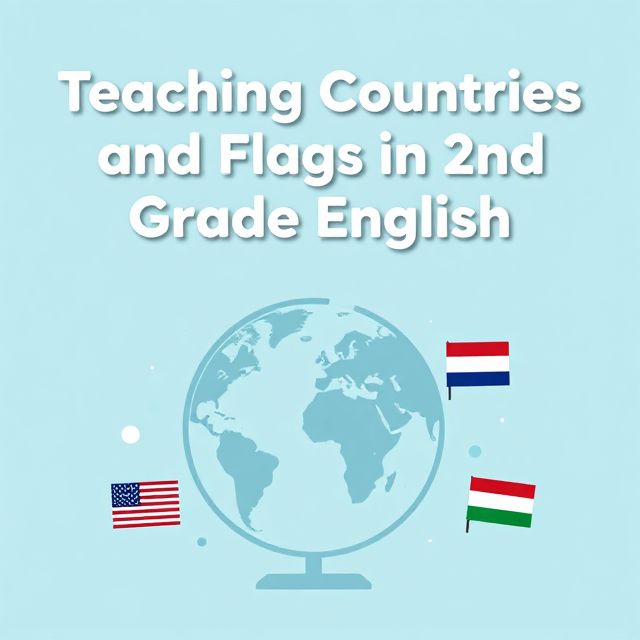
Sesli Özet
7 dakikaKonuyu otobüste, koşarken, yolda dinleyerek öğren.
Sesli Özet
Teaching Countries and Flags in 2nd Grade English
Flash Kartlar
25 kartKarta tıklayarak çevir. ← → ile gez, ⎵ ile çevir.
Tüm kartları metin olarak gör
1. What is the primary target age group for the "Countries and Flags" educational module described?
The educational module is meticulously designed for young learners, typically aged seven to eight years. This age group corresponds to second-grade students, for whom the content is tailored to align with their specific cognitive development stage, ensuring the material is both engaging and comprehensible.
2. What is the overarching goal of introducing countries and flags to young learners in this curriculum?
The overarching goal is twofold: to foster early linguistic acquisition and to cultivate a nascent sense of global awareness. This aims to provide children with foundational vocabulary related to nations and their symbols, alongside an initial understanding of the diverse world around them, promoting a broader perspective.
3. Describe the main pedagogical approach emphasized in this educational module.
The pedagogical approach places significant emphasis on visual learning, systematic repetitive practice, and interactive engagement. These methods are carefully tailored to align with the specific cognitive development stage of children aged seven to eight years, ensuring effective learning and retention of geographical and cultural concepts.
4. What is the primary objective regarding vocabulary and communicative structures in this module?
The primary objective is to establish a robust foundational vocabulary related to various nations and their distinctive symbolic representations. Concurrently, it aims for the mastery of basic communicative structures essential for expressing nationality and geographical origin, building confidence in early English communication.
5. Why is early exposure to geographical and cultural concepts considered critical in this curriculum?
Early exposure is critical because it builds a comprehensive understanding of the diverse world. This foundational knowledge is essential for future learning, helping students develop a broader perspective, appreciate global interconnectedness, and prepare for more advanced studies in geography and social sciences.
6. What type of learning experiences are central to the pedagogical approaches for teaching countries and flags?
Multisensory learning experiences are central to the pedagogical approaches. These involve engaging multiple senses through various tools and activities, such as visual aids, songs, and interactive games, to enhance learning and retention, making the educational process more dynamic and effective for young learners.
7. Name three specific tools or resources mentioned for multisensory learning in this module.
Three specific tools mentioned for multisensory learning are flashcards depicting national flags and country names, large-scale visual aids such as world maps and globes, and interactive digital resources. These tools provide diverse ways for students to engage with the material, catering to different learning styles.
8. How is repetition strategically integrated into the learning process for vocabulary retention?
Repetition is strategically integrated through various engaging formats to aid vocabulary retention. These include educational songs that incorporate country names and flag colors, rhythmic chants, and simple, age-appropriate games like 'flag bingo' or 'match the country to the flag,' reinforcing learning through play and friendly competition.
9. How is a 'country' defined within the context of this educational module for young learners?
Within this educational module, a 'country' is defined as a distinct geographical and political entity. It possesses its own government, borders, and a unique cultural identity, distinguishing it from other nations and providing a clear understanding for young students.
10. What is the definition of a 'flag' as introduced to second-grade students?
A 'flag' is introduced as a country's unique national symbol. It embodies the nation's history, values, and aspirations, serving as a visual representation of its identity and providing a tangible link to its cultural heritage for young learners.
11. Provide examples of foundational linguistic structures introduced for asking about a country.
Foundational linguistic structures introduced include interrogative forms such as 'What country is this?' and declarative responses like 'This is [Country Name].' These phrases help students identify and name countries, building their basic conversational skills in English related to geography.
12. How is the concept of nationality introduced to young learners in this curriculum?
The concept of nationality is carefully introduced through practical phrases. Examples include 'I am from [Country Name]' and 'I am [Nationality],' allowing students to express their own origin and identity in English. This fosters self-identification and understanding of others' backgrounds.
13. What is the significance of this foundational understanding for early intercultural competence?
This foundational understanding is instrumental in supporting the development of early intercultural competence. It provides a crucial context for future geographical studies and fosters an appreciation for global diversity and interconnectedness, laying groundwork for respectful interactions with different cultures.
14. What are the main criteria for selecting countries to be taught in a 2nd-grade English lesson?
Countries are chosen based on several criteria: their global cultural significance, the distinctiveness and simplicity of their flag designs, and their phonetic accessibility for young learners. This ensures the content is relevant, visually engaging, and manageable for the target age group, facilitating effective learning.
15. Name at least five common countries frequently included in this type of curriculum.
Common examples frequently include the United States of America, the United Kingdom, Canada, Australia, France, Germany, Japan, and China. Other possibilities are Italy, Brazil, or India, depending on curriculum specifics and the diverse backgrounds of the students in the class.
16. Beyond simple identification, what does the language focus extend to in this module?
Beyond simple identification, the language focus extends to descriptive language and basic conversational exchanges. Students learn to describe flags using simple adjectives for colors and patterns, and practice asking and answering questions about origin and nationality, enhancing their communicative abilities.
17. Give an example of a descriptive sentence students learn to formulate about a flag.
Students learn to formulate sentences such as 'The flag of the United States is red, white, and blue with stars and stripes.' This teaches them to use simple adjectives for colors and patterns, allowing them to articulate visual details in English and describe national symbols.
18. What grammatical structures are reinforced through practicing questions about origin and nationality?
Practicing questions like 'Where are you from?' and 'What is your nationality?' reinforces the correct usage of prepositions, personal pronouns, and basic adjective forms in a communicative context. This helps solidify fundamental English grammar in a practical and meaningful way.
19. How are cultural facts or greetings used to enrich the learning experience?
Simple greetings, iconic landmarks, or very basic cultural facts associated with these countries may be introduced to enrich the learning experience. For example, learning 'Bonjour' for France or identifying the Eiffel Tower promotes cultural appreciation and provides a broader context for linguistic elements.
20. What is the pedagogical objective at this stage regarding memorization and geopolitical details?
The pedagogical objective at this stage is not exhaustive memorization of all world flags or complex geopolitical details. Instead, it focuses on developing fundamental recognition skills and the ability to confidently use basic English phrases in a relevant and meaningful cultural context, building practical communication skills.
21. How does this module contribute to building confidence in linguistic abilities?
By enabling students to confidently use basic English phrases in a relevant and meaningful cultural context, the module helps build confidence in their linguistic abilities. This practical application of language skills in a relatable setting reinforces their learning and encourages further communication.
22. What is the overall significance of teaching countries and flags in a 2nd-grade English curriculum?
It represents a vital and foundational component in early language education and the cultivation of global literacy. This module systematically introduces essential geographical vocabulary, universally recognized national symbols, and fundamental communicative structures pertinent to expressing origin and identity, setting a strong base for future learning.
23. How do educators facilitate the acquisition of new linguistic concepts in this module?
Educators effectively facilitate the acquisition of new linguistic concepts by employing visually rich, interactive, and age-appropriate pedagogical methods. This approach makes learning engaging and accessible for young learners, ensuring that complex ideas are broken down into manageable and understandable components.
24. What invaluable appreciation does this approach foster from an early age?
This approach fosters an invaluable appreciation for global diversity and intercultural understanding from an early age. By exposing children to different nations and cultures, it helps them recognize and value the differences and similarities between people, promoting a more inclusive worldview.
25. What crucial and robust groundwork does the ability to identify countries and express nationality lay?
It lays a crucial and robust groundwork for more advanced academic studies in geography, social sciences, and the development of sophisticated intercultural communication skills. This foundation is indispensable for future learning, enabling students to build upon their initial knowledge and understanding of the world.
Bilgini Test Et
15 soruÇoktan seçmeli sorularla öğrendiklerini ölç. Cevap + açıklama.
What is the primary age group for which this educational module on countries and flags is designed?