 Podit
Podit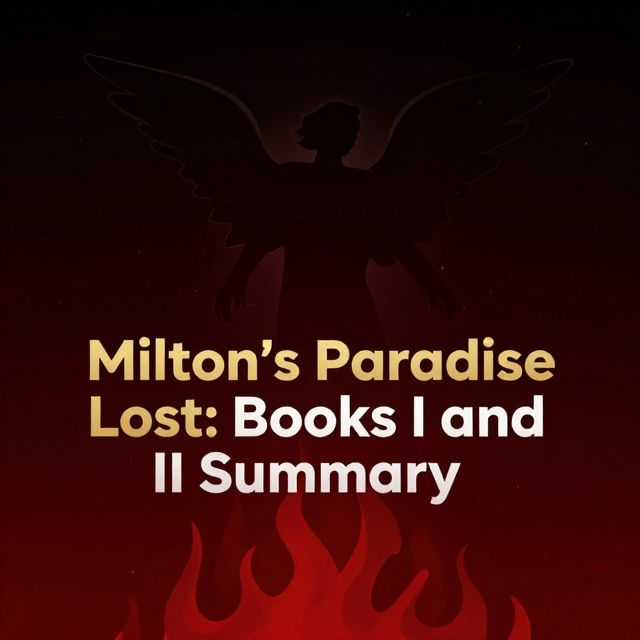
📚 Study Material: John Milton's Paradise Lost - Books I & II
Source Information:
- Copy-Pasted Text: Excerpts from John Milton's Paradise Lost, Books I and II (1667 edition).
- Lecture Audio Transcript: "Introduction to Paradise Lost: Books I and II."
Overview: Milton's Epic Purpose 🌍
John Milton's Paradise Lost is an epic poem that recounts the biblical story of the Fall of Man. The poem's central purpose, as stated in Book I, is twofold: ✅ To narrate "Man's First Disobedience" and its consequences. ✅ To "justify the ways of God to men," exploring divine justice and human free will.
Books I and II establish the narrative's core conflict, introducing the fallen angels, their descent into Hell, and their initial strategies following their defeat in Heaven.
Book I: The Fall and the Assembly in Hell 🔥
Book I plunges the reader directly into the aftermath of the celestial war, focusing on Satan and his legions.
1. Invocation of the Muse 💡
Milton begins by invoking the "Heav'nly Muse," seeking divine inspiration to tell a story "unattempted yet in Prose or Rhime." This classical epic convention immediately signals the grand scale and ambition of the poem.
2. Satan's Defiance and the Horrors of Hell 😈
The poem introduces Satan, not as a defeated foe, but as a figure of immense, albeit corrupted, pride.
- The Fall: Satan and his rebellious angels are depicted vanquished in a "fiery Gulfe" after their "impious War in Heav'n." They are hurled "headlong flaming from th' Ethereal Skie" into "bottomless perdition."
- Description of Hell: It is a place of "Adamantine Chains and penal Fire," where "darkness visible" reigns. It is a "Dungeon horrible," a "Region of sorrow" where "peace and rest can never dwell, hope never comes."
- Satan's Unbroken Spirit: Despite his suffering, Satan's pride and "unconquerable Will" remain. He famously declares to Beelzebub: "Better to reign in Hell, then serve in Heav'n." This line encapsulates his defiant spirit and refusal to submit.
3. Rallying the Fallen Legions 📢
Satan rallies his innumerable fallen angels, who lie "vanquisht, rowling in the fiery Gulfe."
- Immense Stature: These beings are described as having "mighty Stature," comparable to mythical giants like the Titans or the Leviathan.
- Pagan Deities: Milton lists many of these demons by names later known as pagan gods, suggesting that these fallen angels corrupted humanity through idolatry after their expulsion from Heaven. Examples include:
- Moloch: Associated with human sacrifice.
- Chemos: The "obscene dread of Moabs Sons."
- Astoreth (Astarte): "Queen of Heav'n" worshipped by Phoenicians.
- Thammuz: Whose annual wound in Lebanon was lamented.
- Dagon: The "Sea Monster, upward Man And downward Fish."
- Rimmon: Worshipped in Damascus.
- Osiris, Isis, Orus: Egyptian deities.
- Belial: The "lewd" spirit who loves "Vice for it self."
4. Construction of Pandemonium 🏰
Under Satan's command, the fallen angels swiftly construct Pandemonium, the capital of Hell.
- Architect: Mulciber, who had previously built "high Towrs" in Heaven, is identified as the architect.
- Magnificence: The palace rises "like an Exhalation" with "Dulcet Symphonies," adorned with "Golden Architrave" and "fretted Gold."
- Shrinking Angels: To fit into the vast hall for their council, the "incorporeal Spirits" reduce their "immense" forms to smaller sizes, like "smallest Dwarfs" or "Faerie Elves."
- The Great Consult: The book concludes with the infernal council convening to deliberate their next move.
Book II: The Infernal Council and Satan's Journey 🌌
Book II details the strategic debate among the fallen angels and Satan's perilous journey.
1. The Infernal Debate: Strategies for Revenge 📊
Satan, enthroned in Pandemonium, initiates a debate on how to proceed against God.
- Moloch's Proposal (Open War): ⚔️
- Advocates for immediate, "open Warr" against Heaven.
- Believes "utter annihilation" is preferable to eternal suffering.
- Proposes using Hell's fires as weapons.
- Belial's Proposal (Passive Endurance): 🕰️
- Argues against direct confrontation, citing God's overwhelming power and the risk of "worse" punishment.
- Suggests enduring their current state, hoping that time might "mitigate" their pain or that God's wrath might subside.
- Characterized by "eloquent but deceitful rhetoric."
- Mammon's Proposal (Self-Sufficiency): 💰
- Proposes building a "self-sufficient empire" within Hell, exploiting its "Gemms and Gold."
- Aims to create their own "Heaven" and reject subservience to God.
- Beelzebub's Proposal (Subtle Corruption): 🐍
- Presents a plan, secretly devised by Satan, to corrupt a "new Race call'd MAN" in a "new World."
- The goal is to strike at God indirectly by turning His beloved creation into His enemies, thereby causing "Treble confusion, wrath and vengeance" upon Him.
2. Satan's Volunteer Mission 🚀
Satan, with "Monarchal pride" but feigned humility, volunteers for the perilous journey to find this new world.
- Perilous Task: The journey involves traversing the "dark unbottom'd infinite Abyss" of Chaos.
- Motivation: He aims to find "Deliverance for us all" and execute the plan to corrupt humanity.
3. Encounter at the Gates of Hell 🚪
Satan reaches the "thrice threefold" Gates of Hell, made of "Brass, Iron, [and] Adamantine Rock."
- Sin: He encounters a monstrous figure, "Woman to the waste" but ending in a "scaly fould" with a "mortal sting," surrounded by "Hell Hounds." She reveals herself as Sin, Satan's daughter, sprung from his head during his rebellion.
- Death: Sin's son, Death, is a "shadowy, terrifying figure" born from their incestuous union. He is "Grim DEATH my Son and foe."
- Opening the Gates: Sin, holding the "fatal Key," opens the gates, revealing the vast realm beyond.
4. Journey Through Chaos 🌪️
Satan ventures into the "illimitable Ocean without bound" of Chaos.
- Description of Chaos: It is a realm of "Eternal ANARCHIE," where "hot, cold, moist, and dry, four Champions fierce Strive here for Maistrie." It is the "Womb of nature and perhaps her Grave."
- Perilous Passage: Satan navigates this turbulent abyss, facing immense dangers and elemental strife. He "swims or sinks, or wades, or creeps, or flyes."
- Sighting Earth: After a arduous journey, Satan finally reaches the edge of the newly formed universe, where he beholds "this pendant world," Earth, "hanging in a golden Chain" like a star.
Conclusion: Foundations of Rebellion and Corruption ✅
Books I and II lay the groundwork for the entire epic.
- Satan's Character: They establish Satan as a complex figure of immense pride, defiance, and strategic cunning, despite his fallen state.
- Shift in Strategy: The infernal council marks a crucial shift from direct military confrontation to a more insidious plan of corrupting humanity.
- Thematic Setup: These books introduce key themes of rebellion, free will, divine justice, and the origins of evil, setting the stage for the profound theological and philosophical drama that unfolds in the subsequent books of Paradise Lost.