 Podit
Podit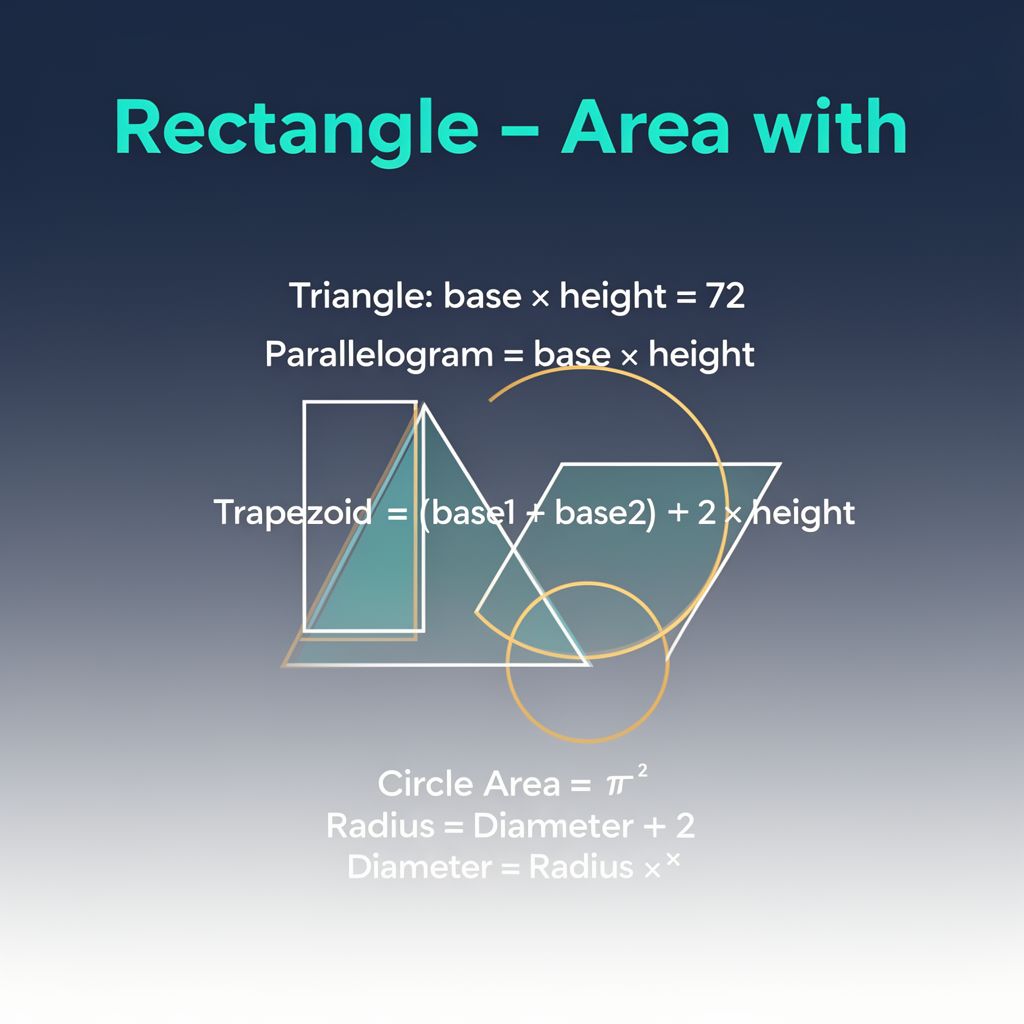
Flash Kartlar
25 kartKarta tıklayarak çevir. ← → ile gez, ⎵ ile çevir.
Tüm kartları metin olarak gör
1. What is the primary focus of this content regarding geometric formulas?
The content primarily focuses on fundamental geometric formulas used to calculate areas of various shapes and properties of circles. These foundational concepts are crucial for understanding geometry and its applications, providing the building blocks for more complex mathematical and real-world problems.
2. Why are these foundational geometric concepts considered important?
These foundational geometric concepts are crucial because they provide the building blocks for understanding geometry and its applications. Mastering them is a vital step in any mathematical journey, laying the groundwork for advanced studies and practical applications in fields ranging from engineering to design.
3. How is the area of a rectangle calculated?
The area of a rectangle is calculated by multiplying its base by its height. This simple yet powerful formula, often expressed as 'Area equals base multiplied by height', helps us determine the two-dimensional space enclosed by the rectangle. The base refers to the length of one of its sides, and the height refers to the length of the perpendicular side.
4. Define 'base' and 'height' in the context of a rectangle's area formula.
In the context of a rectangle's area formula, the 'base' refers to the length of one of its sides. The 'height' refers to the length of the side perpendicular to the base. Together, these dimensions are multiplied to find the two-dimensional space enclosed by the rectangle.
5. What is the formula for calculating the area of a triangle?
The formula for calculating the area of a triangle is found by taking half of the product of its base and its height. So, the formula is 'Area equals base multiplied by height, divided by two'. The height here refers to the perpendicular distance from the base to the opposite vertex.
6. Explain what 'height' represents in the area formula for a triangle.
In the area formula for a triangle, 'height' represents the perpendicular distance from the base to the opposite vertex. It is crucial that this distance is measured perpendicularly to the chosen base. This ensures the correct calculation of the two-dimensional space enclosed by the triangle.
7. How is the area of a parallelogram determined?
The area of a parallelogram is determined by multiplying its base by its height. This is represented as 'Area equals base multiplied by height'. The height is the perpendicular distance between the base and the opposite side, making its calculation similar to that of a rectangle.
8. What is the definition of 'height' for a parallelogram's area calculation?
For a parallelogram's area calculation, 'height' is defined as the perpendicular distance between the base and the opposite side. This perpendicular measurement is essential for accurately determining the two-dimensional space enclosed by the parallelogram, similar to how it's used for a rectangle.
9. Describe the characteristics of a trapezoid.
A trapezoid is defined as a quadrilateral with at least one pair of parallel sides. This specific characteristic distinguishes it from other quadrilaterals. Its area calculation involves these parallel sides, making it a unique geometric figure with a slightly more complex formula.
10. What is the formula for calculating the area of a trapezoid?
The formula for calculating the area of a trapezoid involves the sum of its two parallel bases, divided by two, and then multiplied by its height. The formula is 'Area equals the sum of base one and base two, divided by two, all multiplied by height'. Here, 'base one' and 'base two' are the lengths of the parallel sides.
11. What do 'base one' and 'base two' represent in the trapezoid area formula?
In the trapezoid area formula, 'base one' and 'base two' represent the lengths of the two parallel sides of the trapezoid. These are the sides that never intersect, and their lengths are crucial for calculating the average width of the trapezoid before multiplying by its height.
12. How is the area of a circle calculated?
The area of a circle is calculated using the constant Pi, often denoted by the Greek letter π, and its radius. The formula is 'Area equals Pi multiplied by the radius squared'. This formula quantifies the two-dimensional space enclosed within the circle's boundary.
13. What is Pi (π) and what is its common approximation?
Pi (π) is a fundamental mathematical constant representing the ratio of a circle's circumference to its diameter. It is often approximated as 3.14 for practical calculations. This constant is crucial in all formulas related to circles, linking their linear and area properties.
14. Define 'radius' in the context of a circle.
The 'radius' of a circle is defined as the distance from the center of the circle to any point on its circumference. It is a fundamental measurement used in calculating both the area and circumference of a circle, and it is half the length of the diameter.
15. What is the relationship between the radius and the diameter of a circle?
The relationship between the radius and diameter of a circle is fundamental. The radius is half the length of the diameter, expressed as 'Radius equals Diameter divided by two'. Conversely, the diameter is twice the length of the radius, expressed as 'Diameter equals Radius multiplied by two'.
16. Define 'diameter' in the context of a circle.
The 'diameter' of a circle is a straight line segment that passes through the center of the circle and has its endpoints on the circumference. It is the longest chord of a circle and is twice the length of the radius, making it a key dimension for circular properties.
17. How is the circumference of a circle calculated?
The circumference of a circle, which is the distance around its edge, is calculated by multiplying two times Pi by the radius. The formula is 'Circumference equals two multiplied by Pi multiplied by radius'. This formula allows us to measure the total length of the boundary of a circular shape.
18. What does 'circumference' refer to in a circle?
'Circumference' refers to the distance around the edge of a circle. It is the total length of the boundary of a circular shape. This property is calculated using the radius and the constant Pi, providing a measure of the circle's perimeter.
19. Which geometric shapes' areas are covered in this content?
This content covers the essential formulas for calculating the areas of rectangles, triangles, parallelograms, and trapezoids. These are fundamental polygons whose two-dimensional spaces can be quantified using specific formulas, providing a strong foundation in geometry.
20. What properties of circles are discussed in this content?
This content discusses several key properties of circles, including their area, radius, diameter, and circumference. Understanding these properties and their interrelationships is crucial for working with circular shapes in geometry and for solving related mathematical problems.
21. How does the area calculation for a parallelogram relate to that of a rectangle?
The area calculation for a parallelogram is similar to that of a rectangle. Both are determined by multiplying the base by the height. This similarity arises because a parallelogram can be transformed into a rectangle by cutting off a triangular section from one end and attaching it to the other.
22. What is the significance of the constant Pi (π) in circle formulas?
The constant Pi (π) is of fundamental significance in circle formulas because it represents the ratio of a circle's circumference to its diameter. It is an indispensable component in calculating both the area and circumference of any circle, linking its linear and two-dimensional properties universally.
23. If a circle has a diameter of 10 units, what is its radius?
If a circle has a diameter of 10 units, its radius would be 5 units. This is because the radius is half the length of the diameter. The formula 'Radius equals Diameter divided by two' is applied directly here, illustrating the inverse relationship between the two.
24. If a circle has a radius of 7 units, what is its diameter?
If a circle has a radius of 7 units, its diameter would be 14 units. This is because the diameter is twice the length of the radius. The formula 'Diameter equals Radius multiplied by two' is applied directly here, demonstrating the direct relationship between the two.
25. What is the general purpose of understanding geometric formulas?
The general purpose of understanding geometric formulas is to quantify and understand the dimensions of various shapes. These formulas are fundamental tools in geometry, providing the means to solve both theoretical mathematical problems and practical applications in fields like engineering and design, laying crucial groundwork.
Bilgini Test Et
15 soruÇoktan seçmeli sorularla öğrendiklerini ölç. Cevap + açıklama.
According to the content, what is the primary purpose of understanding fundamental geometric formulas?