Foundational Principles of Economics and Business Analysis - kapak
Ekonomi#economics#microeconomics#macroeconomics#scarcity

Foundational Principles of Economics and Business Analysis

This summary explores core microeconomic and macroeconomic concepts, including scarcity, supply and demand, GDP, inflation, and unemployment, alongside key business analysis frameworks.

rose111May 5, 2026 ~27 dk toplam
01

Sesli Özet

8 dakika

Konuyu otobüste, koşarken, yolda dinleyerek öğren.

Sesli Özet

Foundational Principles of Economics and Business Analysis

0:008:07
02

Görsel Özet

İnfografik

Konunun tüm parçalarını tek bakışta gör.

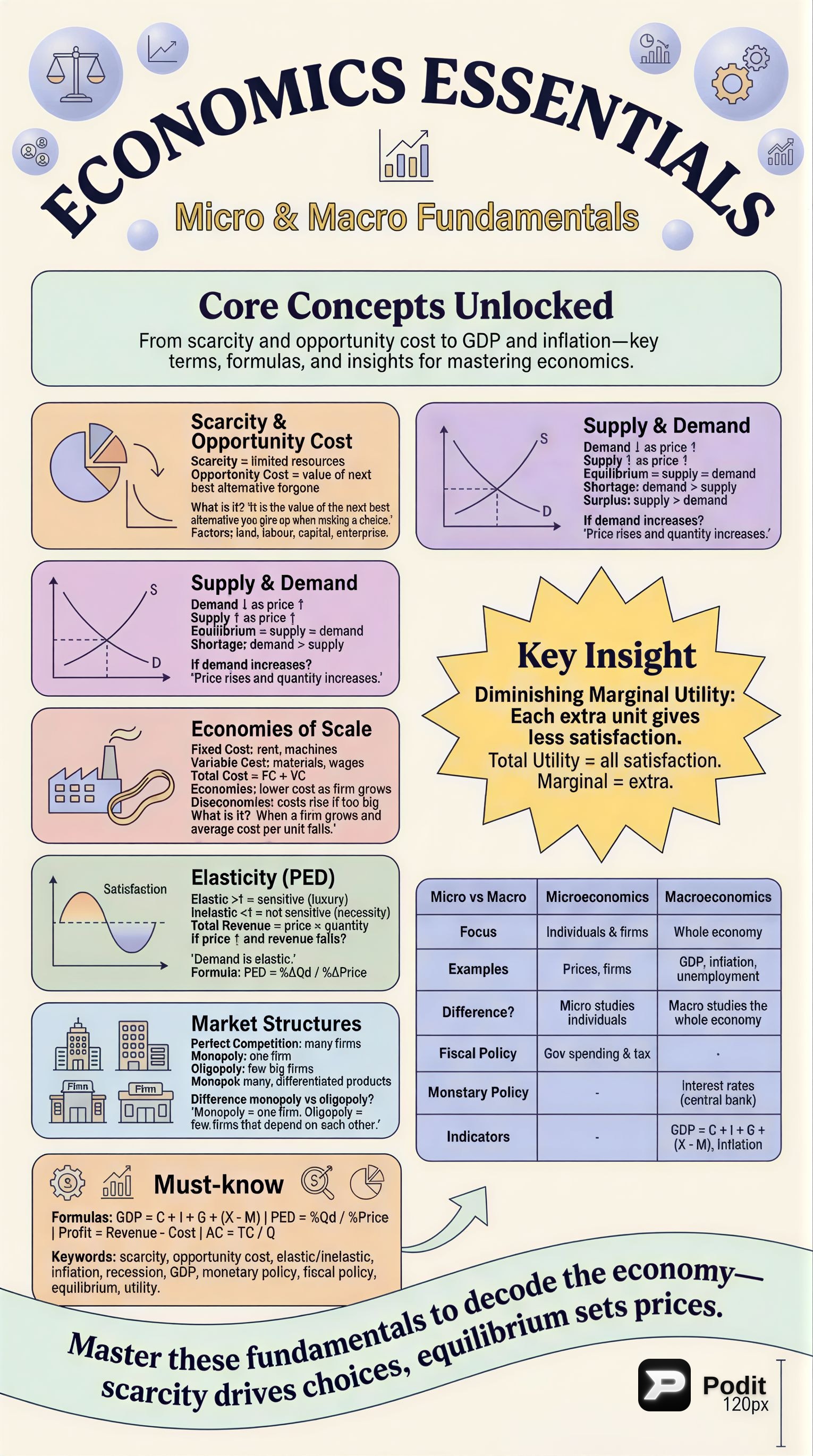
Foundational Principles of Economics and Business Analysis - görsel özet infografik
Tam boyutta görüntüle →
03

Flash Kartlar

25 kart

Karta tıklayarak çevir. ← → ile gez, ⎵ ile çevir.

1 / 25
Tüm kartları metin olarak gör
  1. 1. What is the primary distinction between microeconomics and macroeconomics?

    Microeconomics focuses on the decisions and behaviors of individual economic agents, such as households and firms, and how they interact in specific markets. Macroeconomics, on the other hand, examines the economy as a whole, analyzing aggregate phenomena like national output, inflation, and unemployment. Understanding both is crucial for a comprehensive view of economic activity, from individual resource allocation to national economic performance.

  2. 2. Explain the fundamental economic concept of scarcity.

    Scarcity refers to the basic economic problem that human wants and needs for goods, services, and resources exceed what is available. Resources like land, labor, and capital are limited, while desires are virtually infinite. This fundamental concept necessitates choices about how to allocate these limited resources efficiently, forming the basis of all economic decision-making.

  3. 3. Define opportunity cost and provide a simple example.

    Opportunity cost is the value of the next best alternative that must be forgone when a decision is made. It represents the benefits an individual, investor, or business misses out on when choosing one alternative over another. For example, if a student chooses to spend an evening studying for an exam, the opportunity cost might be the enjoyment of attending a social event they otherwise would have gone to.

  4. 4. Differentiate between fixed costs and variable costs for a firm.

    Fixed costs are expenses that do not change regardless of the level of production, such as rent for a factory or the cost of machinery. Variable costs, conversely, are expenses that fluctuate directly with the level of output, like the cost of raw materials or wages for production workers. Total cost is the sum of these fixed and variable costs, and understanding this distinction is vital for a firm's financial planning and pricing strategies.

  5. 5. What are economies of scale and how do they impact a firm's costs?

    Economies of scale occur when a firm's average cost per unit of production decreases as its output increases. This often happens due to factors like bulk purchasing discounts, specialized labor, or more efficient use of machinery. As a firm grows and produces more, it can spread its fixed costs over a larger number of units, leading to lower average costs and potentially higher profitability.

  6. 6. What are diseconomies of scale and when do they typically arise?

    Diseconomies of scale occur when a firm's average cost per unit of production increases as its output expands beyond an optimal point. This can happen due to challenges associated with managing a very large organization, such as communication breakdowns, bureaucratic inefficiencies, or difficulties in coordinating complex operations. Excessive size can lead to a loss of flexibility and responsiveness, ultimately driving up per-unit costs.

  7. 7. How is market equilibrium achieved in the context of supply and demand?

    Market equilibrium is the state where the quantity of a good or service demanded by consumers equals the quantity supplied by producers. At this point, there is no pressure for the price to change, as the market has cleared. It represents a balance where buyers are willing to purchase exactly what sellers are willing to offer at a specific price, ensuring efficient resource allocation.

  8. 8. Explain the difference between a market shortage and a market surplus.

    A market shortage occurs when the quantity demanded for a good or service exceeds the quantity supplied at a given price, typically leading to upward pressure on prices. Conversely, a market surplus happens when the quantity supplied exceeds the quantity demanded, usually resulting in downward pressure on prices. Both situations indicate a disequilibrium in the market, which will naturally adjust towards equilibrium over time.

  9. 9. Define Price Elasticity of Demand (PED) and explain its significance.

    Price Elasticity of Demand (PED) measures the responsiveness of the quantity demanded of a good or service to a change in its price. It is calculated as the percentage change in quantity demanded divided by the percentage change in price. PED is significant because it helps businesses understand how price changes will affect their total revenue and allows policymakers to predict consumer reactions to taxes or subsidies.

  10. 10. Describe the characteristics of elastic demand and provide an example.

    Demand is considered elastic when the Price Elasticity of Demand (PED) is greater than one, meaning that a small change in price leads to a proportionally larger change in the quantity demanded. Consumers are highly sensitive to price changes for these goods. Luxury items, such as designer clothing or high-end electronics, often exhibit elastic demand because consumers can easily postpone their purchase or choose alternatives if prices rise.

  11. 11. Describe the characteristics of inelastic demand and provide an example.

    Demand is considered inelastic when the Price Elasticity of Demand (PED) is less than one, indicating that a change in price leads to a proportionally smaller change in the quantity demanded. Consumers are relatively insensitive to price changes for these goods. Necessities like basic food items, essential medicines, or gasoline often have inelastic demand because people need them regardless of price fluctuations.

  12. 12. Explain the principle of diminishing marginal utility.

    The principle of diminishing marginal utility states that as an individual consumes more and more units of a specific good or service, the additional satisfaction (marginal utility) derived from each successive unit tends to decrease. While total utility may continue to increase, the rate at which it increases slows down. For example, the first slice of pizza might bring immense satisfaction, but the tenth slice will likely provide very little additional enjoyment.

  13. 13. What are the key characteristics of a perfectly competitive market structure?

    A perfectly competitive market is characterized by a large number of buyers and sellers, homogeneous products, perfect information, and no barriers to entry or exit. Individual firms are price takers, meaning they have no power to influence market prices. This theoretical market structure serves as a benchmark for efficiency, though it is rarely observed in its purest form in the real world.

  14. 14. Describe a monopoly market structure and how it differs from an oligopoly.

    A monopoly is a market structure where a single firm dominates the entire market for a particular good or service, facing no significant competition and having substantial control over pricing. This is often due to high barriers to entry. In contrast, an oligopoly consists of a few large, interdependent firms that dominate the market, where the actions of one firm significantly impact the others. The key difference is the number of dominant firms: one in a monopoly versus a few in an oligopoly.

  15. 15. What defines an oligopoly market structure, particularly regarding firm behavior?

    An oligopoly is a market structure characterized by a small number of large firms that dominate the market. A key feature is the mutual interdependence among these firms, meaning that the strategic decisions of one firm regarding price, output, or advertising significantly affect the others. This often leads to strategic interactions, such as price wars or tacit collusion, as firms anticipate and react to their rivals' moves.

  16. 16. What are the defining characteristics of monopolistic competition?

    Monopolistic competition is a market structure characterized by a large number of firms offering differentiated products that are close substitutes for one another. Firms have some degree of market power due to product differentiation (e.g., branding, quality, features), allowing them to set prices slightly above marginal cost. There are relatively low barriers to entry and exit, and firms compete through non-price methods like advertising and product innovation.

  17. 17. Define fiscal policy and identify its main tools.

    Fiscal policy refers to the government's use of spending and taxation to influence the economy. Its main tools are government spending, which includes expenditures on infrastructure, defense, and social programs, and taxation, which affects disposable income and investment incentives. Governments use fiscal policy to manage aggregate demand, stabilize the economy, and achieve macroeconomic goals like full employment and price stability.

  18. 18. Define monetary policy and explain how a central bank uses interest rates as a tool.

    Monetary policy refers to actions undertaken by a central bank to influence the availability and cost of money and credit in an economy. A primary tool is the manipulation of interest rates. Higher interest rates make borrowing more expensive, discouraging investment and consumption, which can help curb inflation. Conversely, lower interest rates encourage borrowing and spending, stimulating economic growth.

  19. 19. What is Gross Domestic Product (GDP) and what does it measure?

    Gross Domestic Product (GDP) is the total monetary or market value of all the finished goods and services produced within a country's borders in a specific time period. It serves as a comprehensive measure of a nation's economic output and activity. GDP is a key indicator used to gauge the health and growth of an economy, reflecting the total value added by all sectors.

  20. 20. Explain the difference between nominal GDP and real GDP.

    Nominal GDP measures the total value of goods and services produced at current market prices, without adjusting for inflation. Real GDP, on the other hand, adjusts nominal GDP for inflation, providing a more accurate measure of economic output by expressing the value of goods and services in constant prices from a base year. Real GDP is preferred for comparing economic output over time, as it reflects actual changes in production rather than just price changes.

  21. 21. How is a recession conventionally defined in economic terms?

    A recession is conventionally defined as a significant decline in economic activity spread across the economy, lasting more than a few months, normally visible in real GDP, real income, employment, industrial production, and wholesale-retail sales. More specifically, it is often characterized by two consecutive quarters of negative growth in real Gross Domestic Product (GDP). Recessions are a normal part of the business cycle, marking a period of economic contraction.

  22. 22. What are some key limitations of using GDP as a sole measure of a nation's well-being?

    While GDP is a crucial economic indicator, it has several limitations as a measure of overall well-being. It does not account for income inequality, environmental degradation, or the value of non-market activities like household production or volunteer work. Furthermore, GDP doesn't capture the quality of life, health, or education levels within a country, meaning a high GDP doesn't necessarily equate to a high standard of living for all citizens.

  23. 23. Differentiate between demand-pull inflation and cost-push inflation.

    Demand-pull inflation occurs when aggregate demand in an economy outpaces aggregate supply, leading to upward pressure on prices as too much money chases too few goods. Cost-push inflation, conversely, arises from an increase in the costs of production, such as higher wages or raw material prices, which forces businesses to raise their prices to maintain profit margins. Both types result in a general rise in the price level, but their underlying causes differ.

  24. 24. What is the Consumer Price Index (CPI) and what is its typical target?

    The Consumer Price Index (CPI) is a measure that examines the weighted average of prices of a basket of consumer goods and services, such as transportation, food, and medical care. It is a widely used indicator to measure inflation and the purchasing power of a country's currency. Central banks typically target an inflation rate around two percent, as measured by the CPI, to maintain price stability and support sustainable economic growth.

  25. 25. Briefly describe two different types of unemployment mentioned in the text.

    The text mentions several types of unemployment, including cyclical and structural. Cyclical unemployment is directly linked to the business cycle, increasing during economic recessions when there's a general downturn in demand for labor. Structural unemployment, on the other hand, arises from a mismatch between the skills workers possess and the skills demanded by available jobs, often due to technological advancements or shifts in industry structure.

04

Bilgini Test Et

15 soru

Çoktan seçmeli sorularla öğrendiklerini ölç. Cevap + açıklama.

Soru 1 / 15Skor: 0

Which of the following best describes the primary distinction between microeconomics and macroeconomics?

05

Detaylı Özet

9 dk okuma

Tüm konuyu derinlemesine, başlık başlık.

Economics and Business Analysis: Foundational Principles Study Guide

This study material has been compiled and organized from a lecture audio transcript and a copy-pasted text containing key definitions and questions.


📚 Introduction to Economic Principles

Economics is a fundamental field that examines how societies allocate scarce resources to satisfy unlimited wants and needs. It is broadly divided into two main branches: Microeconomics and Macroeconomics. Understanding these principles is crucial for comprehending individual and firm decisions, market functions, and the performance of entire national economies. This guide covers core concepts from both microeconomic and macroeconomic theory, alongside essential frameworks for business analysis.


🔬 Microeconomic Concepts: Individuals, Firms, and Markets

Microeconomics focuses on the behavior of individual economic agents, such as households and firms, and how they interact in specific markets.

1. Scarcity, Choice, and Opportunity Cost

The foundation of economics lies in scarcity 🌍, meaning resources are limited while human wants are unlimited. This necessitates making choices ✅.

  • Scarcity: The fundamental economic problem of having seemingly unlimited human wants and needs in a world of limited resources.
  • Choice: The act of selecting among alternatives due to scarcity.
  • Opportunity Cost: The value of the next best alternative that must be given up when a choice is made. It's what you forgo to get something else.
    • Example: If you choose to study for an exam, the opportunity cost might be the income you could have earned working during that time.
  • Allocation: How limited resources (land, labor, capital, enterprise) are distributed and utilized among competing uses.
    • Factors of Production:
      • Land: Natural resources.
      • Labor: Human effort.
      • Capital: Man-made resources used in production (e.g., machinery).
      • Enterprise: The ability to organize and manage the other factors of production.

2. Costs and Economies of Scale

Firms face various costs in production:

  • Fixed Cost (FC): Costs that do not change with the level of output (e.g., rent, machinery depreciation).
  • Variable Cost (VC): Costs that change with the level of output (e.g., raw materials, wages for production workers).
  • Total Cost (TC): The sum of fixed and variable costs (TC = FC + VC).
  • Economies of Scale: Occur when a firm's average cost per unit falls as its output (size) increases. This is often due to specialization, bulk purchasing, or more efficient use of machinery.
  • Diseconomies of Scale: Occur when a firm becomes too large, leading to increased average costs per unit. This can be due to coordination problems, bureaucracy, or communication breakdowns.

3. Supply and Demand

These are the fundamental forces that determine market prices and quantities.

  • Demand: The quantity of a good or service that consumers are willing and able to purchase at various prices during a specific period.
    • Law of Demand: As price increases, quantity demanded decreases (and vice versa).
  • Supply: The quantity of a good or service that producers are willing and able to offer for sale at various prices during a specific period.
    • Law of Supply: As price increases, quantity supplied increases (and vice versa).
  • Equilibrium: The point where the quantity demanded equals the quantity supplied. At this point, there is no tendency for price or quantity to change.
    • Shortage: Occurs when quantity demanded exceeds quantity supplied (demand > supply), leading to upward pressure on prices.
    • Surplus: Occurs when quantity supplied exceeds quantity demanded (supply > demand), leading to downward pressure on prices.
  • 💡 Insight: If demand increases, both the equilibrium price and quantity will generally rise.

4. Elasticity (Price Elasticity of Demand - PED)

Elasticity measures the responsiveness of quantity demanded or supplied to a change in price or other factors.

  • Price Elasticity of Demand (PED): Measures how much the quantity demanded of a good responds to a change in its price.
    • Elastic Demand (PED > 1): Quantity demanded is highly sensitive to price changes. Often associated with luxury goods or goods with many substitutes.
    • Inelastic Demand (PED < 1): Quantity demanded is not very sensitive to price changes. Often associated with necessities or goods with few substitutes.
  • Total Revenue (TR): The total income a firm receives from selling its goods (TR = Price × Quantity).
    • Example: If price increases and total revenue falls, demand is elastic. Consumers are cutting back significantly on purchases due to the price hike.

5. Utility

Utility refers to the satisfaction or benefit derived from consuming a good or service.

  • Total Utility: The overall satisfaction gained from consuming a certain amount of a good.
  • Marginal Utility: The additional satisfaction gained from consuming one more unit of a good.
  • Diminishing Marginal Utility: The principle that as a consumer consumes more units of a good, the additional satisfaction (marginal utility) gained from each successive unit tends to decrease.
    • Example: The first slice of pizza brings immense satisfaction, but the tenth slice might bring very little, or even negative, satisfaction.

6. Market Structures

Market structures describe the competitive environment in which firms operate.

  • Perfect Competition: Many small firms, identical products, free entry and exit, price takers.
  • Monopolistic Competition: Many firms, differentiated products, relatively easy entry and exit.
  • Oligopoly: A few large firms dominate the market, interdependent decision-making, significant barriers to entry.
    • Key Difference: A monopoly has only one firm, while an oligopoly has a few large, interdependent firms.
  • Monopoly: A single firm dominates the entire market, unique product, significant barriers to entry, price maker.
  • Barriers to Entry: Obstacles that make it difficult for new firms to enter a market (e.g., high start-up costs, patents, government regulations).

📈 Macroeconomic Concepts: National Performance and Policy

Macroeconomics examines the economy as a whole, focusing on aggregate phenomena and national economic performance.

1. Micro vs. Macro: The Big Picture

  • Microeconomics: Studies individual economic units (households, firms) and specific markets (e.g., the price of cars, a firm's production decisions).
  • Macroeconomics: Studies the economy as a whole, focusing on aggregate variables like national output (GDP), inflation, and unemployment.

2. Fiscal and Monetary Policy

Governments and central banks use policies to influence the economy.

  • Fiscal Policy: Government's use of spending and taxation to influence the economy.
    • Expansionary Fiscal Policy: Increased government spending or reduced taxes to stimulate economic growth.
  • Monetary Policy: Central bank's control over interest rates and the money supply to influence economic activity.
    • Higher Interest Rates: Reduce borrowing and spending, which can help curb inflation by lowering aggregate demand.
    • Lower Interest Rates: Encourage borrowing and spending, stimulating economic growth.

3. Economic Indicators

These are statistics that provide insights into the health and performance of an economy.

  • Gross Domestic Product (GDP): Measures the total value of all goods and services produced within a country's borders in a specific period.
  • Inflation: The general increase in the price level of goods and services over time.
  • Unemployment: The percentage of the labor force that is willing and able to work but cannot find a job.
  • Balance of Payments: A record of all economic transactions between residents of a country and the rest of the world.

4. Gross Domestic Product (GDP)

GDP is a key measure of economic output.

  • GDP Formula: C + I + G + (X - M)
    • C: Consumption (household spending)
    • I: Investment (business spending)
    • G: Government Spending
    • X - M: Net Exports (Exports minus Imports)
  • Real GDP: GDP adjusted for inflation, providing a more accurate measure of output changes.
  • GDP per Capita: GDP divided by the population, indicating average output per person.
  • Recession: Defined as two consecutive quarters of negative GDP growth.
  • ⚠️ Limitation: GDP does not measure income inequality, environmental quality, or overall societal well-being.

5. Inflation

Inflation erodes purchasing power.

  • Demand-Pull Inflation: Occurs when aggregate demand in an economy outpaces aggregate supply, pulling prices up.
  • Cost-Push Inflation: Occurs when the costs of production (e.g., wages, raw materials) increase, leading firms to raise prices.
  • Consumer Price Index (CPI): A common measure of inflation, tracking the average change over time in the prices paid by urban consumers for a market basket of consumer goods and services.
  • 📊 Target: Many central banks aim for an inflation target of around 2%.

6. Unemployment

Different types of unemployment exist:

  • Cyclical Unemployment: Caused by downturns in the business cycle (recessions).
  • Structural Unemployment: Arises from a mismatch between the skills workers possess and the skills demanded by available jobs, often due to technological changes or shifts in industry structure.
  • Frictional Unemployment: Short-term unemployment that occurs as workers move between jobs or search for new ones.
  • Seasonal Unemployment: Occurs due to seasonal variations in demand for labor (e.g., agricultural workers, holiday retail staff).

7. Business Cycle

The economy experiences natural fluctuations over time.

  • Boom: A period of rapid economic growth, high employment, and rising prices.
  • Recession: A significant decline in economic activity spread across the economy, lasting more than a few months, normally visible in real GDP, real income, employment, industrial production, and wholesale-retail sales. (Often defined as two consecutive quarters of negative GDP growth).
  • Trough: The lowest point of a recession, after which recovery begins.
  • Recovery: A period of increasing economic activity, rising employment, and moderate growth.

8. Aggregate Demand (AD) and Aggregate Supply (AS)

These concepts describe the total demand and supply in an economy.

  • Aggregate Demand (AD): The total demand for all goods and services in an economy at a given price level and time period (AD = C + I + G + (X - M)).
  • Aggregate Supply (AS): The total supply of all goods and services produced in an economy at a given price level and time period.
  • 💡 Impact: An increase in AD typically leads to both higher output and increased prices. An increase in AS, often due to improved productivity, can lead to economic growth with stable or falling prices.

📊 Business Analysis Frameworks

Beyond core economic theories, these frameworks help analyze the external and internal factors affecting businesses.

1. PESTLE Analysis

A strategic tool used to analyze the external macro-environmental factors that can impact an organization.

  • Political: Government policies, political stability, trade regulations.
  • Economic: Economic growth, inflation, interest rates, exchange rates.
    • Example: High inflation reduces consumer spending power, impacting businesses.
  • Social: Demographics, cultural trends, lifestyle changes.
  • Technological: Innovation, automation, R&D activity.
  • Legal: Laws, regulations, consumer protection.
  • Environmental: Climate change, sustainability, resource availability.

2. Porter's Five Forces

A framework for analyzing the attractiveness and profitability of an industry.

  • Threat of New Entrants: How easy or difficult it is for new competitors to enter the market.
  • Bargaining Power of Buyers: The ability of customers to force prices down or demand higher quality.
  • Bargaining Power of Suppliers: The ability of suppliers to raise prices or reduce the quality of goods and services.
  • Threat of Substitute Products or Services: The likelihood of customers switching to alternative products or services.
  • Rivalry Among Existing Competitors: The intensity of competition among firms already in the industry.

✅ Essential Formulas and Key Terms

Must-Know Formulas:

  • GDP = C + I + G + (X - M) (Aggregate Demand/Output)
  • PED = (% Change in Quantity Demanded) / (% Change in Price) (Price Elasticity of Demand)
  • Profit = Total Revenue - Total Cost
  • Average Cost (AC) = Total Cost (TC) / Quantity (Q)

Must-Know Keywords:

  • Scarcity
  • Opportunity Cost
  • Elastic / Inelastic (Demand)
  • Inflation
  • Recession
  • GDP (Gross Domestic Product)
  • Monetary Policy
  • Fiscal Policy
  • Equilibrium
  • Utility

💡 Conclusion: Interconnectedness of Economic Principles

The concepts outlined in this guide – from the microeconomic decisions driven by scarcity and opportunity cost to the macroeconomic performance measured by GDP and inflation – are deeply interconnected. Understanding the interplay between supply and demand, the impact of government policies, and the strategic insights offered by business frameworks like PESTLE and Porter's Five Forces provides a comprehensive lens for interpreting economic phenomena at various scales. Mastery of these principles is essential for informed decision-making in both academic and professional contexts.

Kendi çalışma materyalini oluştur

PDF, YouTube videosu veya herhangi bir konuyu dakikalar içinde podcast, özet, flash kart ve quiz'e dönüştür. 1.000.000+ kullanıcı tercih ediyor.

Sıradaki Konular

Tümünü keşfet
Economics and Economic Reasoning: Core Concepts

Economics and Economic Reasoning: Core Concepts

Explore the fundamental principles of economics, including scarcity, microeconomics, macroeconomics, marginal analysis, opportunity cost, and the interplay of economic, social, and political forces.

Özet 25 15
Understanding Inflation and Unemployment

Understanding Inflation and Unemployment

Explore the core concepts of inflation and unemployment, including their definitions, causes, measurement, and economic impacts, within a macroeconomic framework.

Özet 25 15
Inflation: Causes, Types, Consequences, and Management

Inflation: Causes, Types, Consequences, and Management

This summary explores inflation, its causes, classifications, socio-economic impacts, and the monetary and non-monetary policy instruments used for its management and control.

6 dk 25 15
Economic Growth and Macroeconomic Indicators

Economic Growth and Macroeconomic Indicators

This summary explores economic growth, its extensive and intensive paths, and key macroeconomic indicators like GDP and GNP, examining their calculation and impact on quality of life.

6 dk 25 15
Microeconomics Essentials: Costs, Markets, and Profit Maximization

Microeconomics Essentials: Costs, Markets, and Profit Maximization

Explore fundamental microeconomic concepts including explicit and implicit costs, market structures like perfect competition and monopoly, and strategies for profit maximization.

7 dk Özet 25 15
Cognitive Biases and Heuristics in Behavioral Economics

Cognitive Biases and Heuristics in Behavioral Economics

An academic summary exploring key cognitive biases and heuristics, their impact on human decision-making, and their role in behavioral economics, contrasting with traditional economic theory.

5 dk Özet 25 15
Air Cargo Operations: Fees, Methods, and Market Dynamics

Air Cargo Operations: Fees, Methods, and Market Dynamics

An academic overview of air cargo operations, covering overflight and airport fees, chargeable weight, transportation methods, ground handling, and global market trends.

7 dk Özet 25 15
Game Theory in Action: Matching Problems and Stability

Game Theory in Action: Matching Problems and Stability

This summary explores matching problems, stable matching theory, and algorithms like Gale-Shapley. It covers applications, properties of stable matchings, strategic considerations, and extensions of the core model.

6 dk Özet 25 15